Introduction
A software update can fix one problem and unintentionally create another. A change to a banking application’s transaction engine, for example, might work as expected but disrupt account balances or transaction histories. Similarly, a new checkout feature could affect existing payment methods in an e-commerce application.
These problems are known as regressions. They occur when changes to software negatively affect functionality that previously worked correctly.
The challenge is growing as enterprises release software more frequently and manage increasingly interconnected applications. Automation can accelerate testing, but maintaining reliable test data, selecting the right test cases, and managing complex dependencies remain significant challenges.
In its November 2025 report, Maturity Model for Software Quality and Testing, Gartner found that only 60% of software engineering teams met or exceeded expectations for software quality. This highlights the need for more effective approaches to testing throughout the software development lifecycle.
What Is Regression Testing?
Regression testing is a software testing technique used to verify that code changes, bug fixes, upgrades, or new features have not negatively affected existing functionality.
It involves retesting relevant workflows after a change to confirm that previously working features continue to behave as expected.
Consider an insurance application that introduces a new premium calculation rule. While the new rule may work correctly, it could unintentionally affect policy renewals, billing, or existing customer records. Regression testing validates these related workflows to identify potential problems.

How Mature Is Your QA Practice?
Find out where your testing processes stand, identify gaps in your QA practices, and discover opportunities to improve testing efficiency and quality.
Take the free QAScan assessment to evaluate your QA maturity and identify where to focus next.
Start My QAScanUnlike testing that focuses only on newly developed functionality, regression testing examines the impact of changes on the existing application.
Why Is Regression Testing Important in Software Testing?
Regression testing helps organizations maintain software stability while continuing to introduce changes. Its value extends beyond defect detection to release reliability, operational continuity, and customer experience.
- Prevents production defects: Identifies unintended effects of changes before deployment.
- Protects critical workflows: Helps preserve essential processes such as payments, order management, billing, and authentication.
- Supports faster releases: Reusable and automated tests provide repeatable feedback across development cycles.
- Reduces rework: Detecting issues earlier can reduce the effort required for investigation, emergency fixes, and production recovery.
- Supports modernization: Provides a way to validate existing functionality during application upgrades, cloud migrations, and technology transformations.
For example, a financial institution upgrading a trading platform must ensure that existing transaction processing and settlement workflows remain reliable after the upgrade.
As you can see in this case study, an automated QA framework helped a financial institution reduce its Calypso regression testing cycle from 60 days to 45 days, a 25% reduction. The engagement also involved expanding test coverage and integrating testing into the upgrade process.
The example demonstrates how a structured regression testing strategy can help organizations manage complex upgrades while maintaining application stability.

“Regression testing should do more than confirm that existing functionality still works. It should give teams the confidence to release changes faster without compromising software quality. By combining risk-based testing, intelligent automation, and AI-driven insights, organizations can identify potential issues earlier, reduce repetitive effort, and make quality an integral part of every release.”
Bighneswar Parida
Director – Quality Engineering, Everforth Quinnox
How Does Regression Testing Work?
Regression testing follows a repeatable process. The exact steps depend on the application and the size of the change, but most teams follow this sequence.
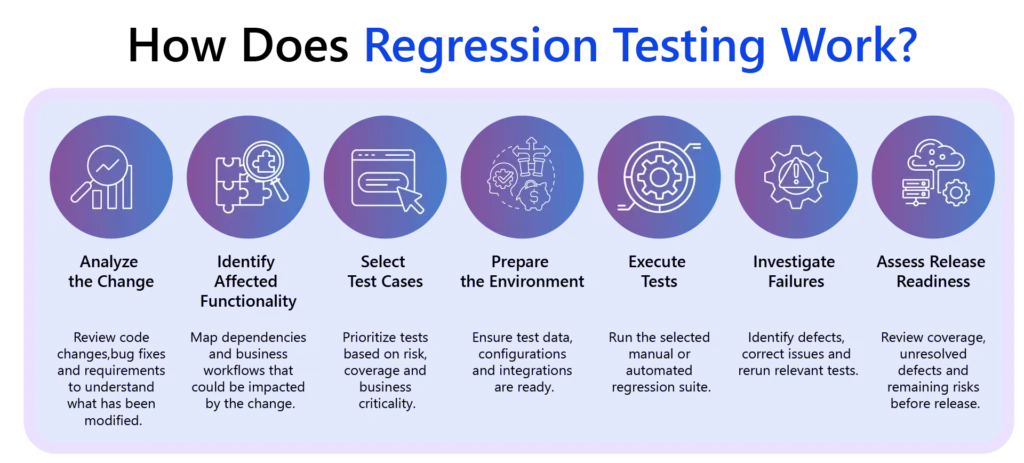
1. Analyze the change – review code changes, bug fixes, and requirements.
2. Identify affected functionality – map dependencies and business workflows that could be impacted.
3. Select test cases – prioritize tests based on risk, coverage, and business criticality.
4. Prepare the environment – ensure test data, configurations, and integrations are ready.
5. Execute tests – run the selected manual or automated regression suite.
6. Investigate failures – identify defects, correct issues, and rerun relevant tests.
7. Assess release readiness – review coverage, unresolved defects, and remaining risks.
The key is to select tests based on the change’s potential impact. A narrowly scoped test suite can provide fast feedback, while broader testing may be necessary for major releases or changes affecting shared components.
Types of Regression Testing
The approach to regression testing depends on the nature and scope of a software change.
| Type | How it works |
|---|---|
| Corrective regression testing | Text |
| Reuses existing test cases when requirements and functionality remain largely unchanged. | Progressive regression testing |
| Updates or adds test cases when requirements or functionality change. | Selective regression testing |
| Executes a relevant subset of tests based on the areas affected by a change. | Partial regression testing |
| Tests modified components alongside related functionality and dependencies. | Complete regression testing |
| Executes the full regression suite within the defined scope. | Retest-all |
Selective regression testing is useful for frequent, targeted updates because it can reduce execution time. Complete regression testing is more appropriate when changes are extensive or affect critical application components.
These categories can overlap in practice, and you may use slightly different definitions according to your organizational tech landscape. The important consideration is choosing an approach that provides adequate coverage for the level of risk involved.
These testing approaches serve different purposes but work together to improve software quality.
Regression Testing vs. Functional Testing vs. Unit Testing
| Criteria | Regression testing | Functional testing | Unit testing |
|---|---|---|---|
| Purpose | Detect unintended effects of changes | Verify features against requirements | Validate individual code units |
| Scope | Existing functionality and related workflows | Specific features or business processes | Individual functions or components |
| Typical timing | After changes and throughout delivery | During feature development and validation | During coding and development |
| Automation | Manual or automated | Manual or automated | Usually automated |
For example, when a banking application introduces a fund transfer feature:
- Unit testing checks individual functions, such as transaction validation.
- Functional testing verifies that the transfer follows the specified business rules.
- Regression testing checks that existing functionality, such as balance updates and transaction histories, still works correctly.
Functional tests can become part of a regression suite when they are reused to validate existing functionality after subsequent changes. Unit tests can also be rerun to identify code-level regressions.
Manual vs. Automated Regression Testing
Manual regression testing requires testers to execute test cases and verify results themselves. Automated regression testing uses scripts and tools to perform these checks.
| Criteria | Manual testing | Automated testing |
|---|---|---|
| Execution speed | Slower for repeated tests | Faster for repeatable scenarios |
| Initial effort | Usually lower | Requires framework and script setup |
| Consistency | Depends on execution | Consistent when scripts and environments are reliable |
| Maintenance | Test procedures need updating | Scripts and test data need maintenance |
| Best suited for | Exploratory and judgment-intensive scenarios | Repetitive, stable, high-volume tests |
Forrester’s April 2026 analysis of autonomous testing platforms reported that 37 enterprise customers using these platforms had automated an average of 51–60% of their tests. The finding suggests that advanced automation can expand coverage, but it does not eliminate the need for manual testing, oversight, or maintenance.
How to Automate Regression Testing
Effective regression testing automation requires a maintainable framework, appropriate test selection, and integration with development workflows.
Automation should be evaluated by the quality of feedback it provides, not simply by the number of scripts created. A smaller, reliable suite that catches meaningful defects early may provide more value than a large, unstable one.
Regression Testing in Agile and CI/CD
In traditional development models, regression testing often took place near the end of a release cycle. Agile and CI/CD environments require a more continuous approach.
A practical approach uses testing at multiple stages:
- During development: Run unit tests and fast checks after code changes.
- During integration: Validate affected components, APIs, and business workflows.
- Before release: Execute broader regression suites based on business risk and change scope.
Best Practices for Effective Regression Testing
Effective regression testing balances coverage, execution speed, and reliability. These best practices help teams achieve that balance.
1. Prioritize by business risk. Give greater attention to critical workflows, frequently used features, complex dependencies, and areas with a history of defects.
2. Keep the test suite relevant. Remove redundant tests, update obsolete scenarios, and add coverage when new functionality or dependencies are introduced.
3. Automate repetitive tests. Prioritize stable scenarios that run frequently and offer clear benefits from automation.
4. Maintain reliable test data. Use controlled datasets and consistent environments to avoid misleading results.
5. Test early and continuously. Run relevant checks during development and integration instead of waiting until release validation.
6. Reduce flaky tests. Investigate failures caused by timing, unstable environments, unreliable selectors, or shared test data. Unreliable tests weaken confidence in the entire suite.
7. Use realistic environments. Validate relevant configurations, integrations, and dependencies. Simulate unavailable external services where appropriate.
8. Measure meaningful outcomes. Track execution time, critical workflow coverage, escaped defects, test reliability, and maintenance effort.
Regression Testing Tools and Frameworks
The right tool depends on the application’s architecture, the testing team’s expertise, and the need to integrate testing into existing delivery workflows.
| Tool | Common use |
|---|---|
| Selenium | Browser automation for web applications |
| Playwright | Modern web testing across browsers |
| Qyrus | AI-driven test automation for web, mobile, API, SAP, and data testing |
| Cypress | Web application and end-to-end testing |
| Appium | Mobile application automation |
| JUnit | Unit and integration testing in Java |
| TestNG | Java test organization and execution |
| Katalon | Web, mobile, API, and desktop testing |
| QFAST (Everforth Quinnox) | Codeless UI, API, and data testing built on Selenium, Playwright, and Cypress, with reusable components, CI/CD integration, and zero licensing fees for clients. |
While some tools focus on specific testing environments, frameworks such as QFAST bring together multiple automation capabilities to help enterprises standardize regression testing across applications.
When evaluating tools, consider:
- Compatibility with the application and technology stack
- Integration with CI/CD pipelines
- Support for parallel execution and reporting
- Ease of script maintenance
- Team skills and learning requirements
- Licensing, infrastructure, and total cost of ownership
Enterprises with complex application portfolios should also consider reusability and consistency across teams.
Our software testing services include testing automation and quality engineering capabilities for enterprise environments. Refer our QA transformation case study involving 35+ enterprise applications and more than 650 automated test scripts, where testing execution accelerated by over 80% in that specific engagement.
How Can Regression Testing Be Improved with AI and Automation?
Traditional automation improves test execution, but teams still face challenges in selecting relevant tests, maintaining scripts, and investigating failures. AI can help address some of these problems such as intelligent test selection, automated test generation, self-healing automation, Failure analysis and defect prediction.
What does this mean for enterprises?
AI adoption in quality engineering is growing, but scaling it remains a challenge.
For enterprises, this suggests that successful adoption requires more than choosing an AI tool. Teams need reliable test data, clear governance, integration with existing workflows, and ways to validate AI-generated outputs.
The practical goal is to combine intelligent automation with human oversight to improve coverage, reduce repetitive effort, and provide faster, more dependable feedback.

Head – Digital Marketing, Everforth Quinnox
FAQs
Regression testing verifies that code changes, bug fixes, or new features have not negatively affected existing functionality.
After adding a new payment method to an online store, testers check that existing payment methods, checkout totals, order confirmations, and refunds continue to work.
Common types include corrective, progressive, selective, partial, complete, and retest-all regression testing.
Retesting verifies that a specific defect has been fixed. Regression testing checks whether a change has affected other existing functionality.
Yes. Tools such as Selenium, Qyrus, Playwright, Cypress, and Appium can automate repeatable regression tests across web and mobile applications.
It should be performed whenever changes could affect existing functionality, including feature updates, bug fixes, integrations, configuration changes, and application upgrades.
Prioritize tests by risk, maintain a relevant test suite, automate stable scenarios, manage test data, integrate testing into CI/CD, address flaky tests, and measure outcomes.
AI can assist with test selection, test generation, script maintenance, defect prediction, and failure analysis. Human validation remains important to ensure accuracy and coverage.