Accelerate IT operations with AI-driven Automation
Automation in IT operations enable agility, resilience, and operational excellence, paving the way for organizations to adapt swiftly to changing environments, deliver superior services, and achieve sustainable success in today's dynamic digital landscape.
Driving Innovation with Next-gen Application Management
Next-generation application management fueled by AIOps is revolutionizing how organizations monitor performance, modernize applications, and manage the entire application lifecycle.
AI-powered Analytics: Transforming Data into Actionable Insights
AIOps and analytics foster a culture of continuous improvement by providing organizations with actionable intelligence to optimize workflows, enhance service quality, and align IT operations with business goals.
At many organizations, regression testing has traditionally been a manual safety net: QA teams re-run large sets of test cases by hand, comparing results to expected behavior. But as software complexity grows – with microservices, APIs, multi-platform clients, and API-driven ecosystems – manual approaches begin to buckle under pressure, leading to inefficiency, risk, and rising costs.
This is where automated regression testing becomes a strategic imperative.
Automating regression tests transforms repetitive checks into reliable, repeatable safety gates that run with every build, every pipeline, and every deployment. Rather than waiting for human intervention, teams get feedback early and often – shortening release cycles while protecting stability and user experience.
In this blog, we’ll take a deep dive into what automated regression testing really means in today’s delivery landscape, why it’s indispensable for modern quality engineering, how it delivers measurable business value, where it fits in real development workflows, and the best practices that separate high-performing teams from the rest.
What is Automated Regression Testing?
Automated regression testing is the process of running a suite of automated tests to verify that recent code changes haven’t adversely affected existing functionality. Unlike manual regression testing – where testers execute test cases manually – automation uses scripts, tools, and frameworks to run tests automatically, ensuring faster execution, improved consistency, and more reliable results.
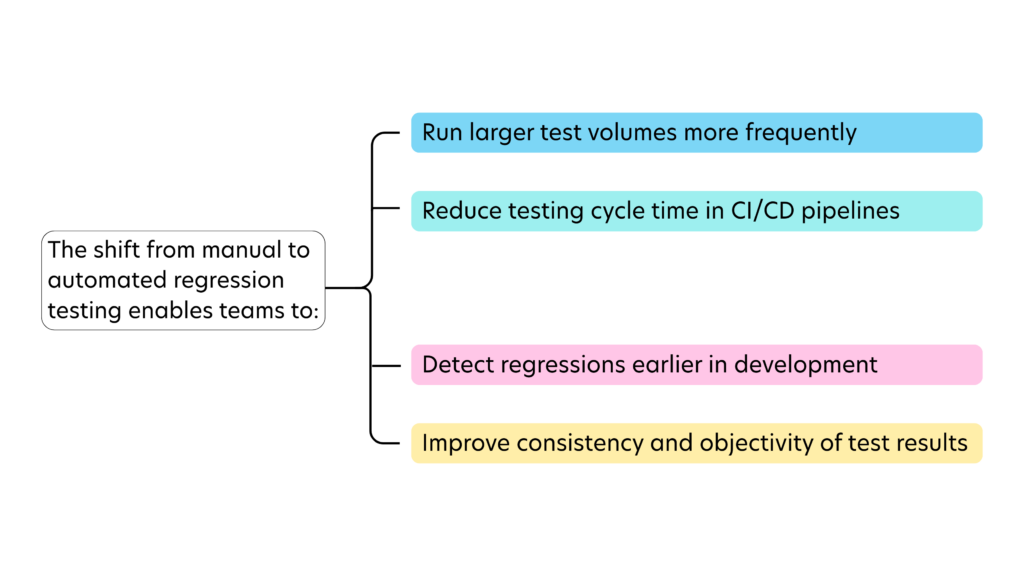
Automating regression testing reduces repetitive effort and helps teams focus on strategic testing activities, ultimately lowering cost and improving quality.
Why Regression Testing Matters Today
Modern software is not monolithic – it is a composite of interconnected services, APIs, user interfaces, data stores, and third-party dependencies. In this environment:
- Any single change can have cascading impacts. A UI adjustment might affect API behavior; a database schema change might break analytics pipelines.
- Release cycles are shorter than ever. According to industry surveys, many organizations now deploy software weekly or even daily.
- Customer expectations for reliability are unforgiving. A bug in a checkout flow or login page can erode trust instantly.
Manual regression testing can be time-intensive, error-prone, and difficult to maintain- especially as systems grow. Hence, automating this practice becomes a strategic necessity.
The Rise of Automated Regression Testing and its Benefits
With the shift toward agile methodologies and rapid release cycles, teams can no longer afford slow feedback loops. This is where automation accelerates testing, reduces repetitive effort, and allows teams to focus on exploratory and high-value tasks.
As software systems grow more complex and release cycles become increasingly compressed, traditional testing approaches are struggling to keep pace. Automated regression testing has emerged as a practical solution, enabling teams to verify existing functionality quickly and consistently as new changes are introduced. By reducing manual effort and catching defects earlier, this approach not only improves product stability but also empowers development teams to innovate with greater confidence and speed.
Specialised solutions like Qyrus , an Agentic AI-driven test automation platform powered by Quinnox – and other services offered by companies specializing in quality engineering further empower teams to scale automation.
Automated regression delivers tangible value across engineering, delivery, and business outcomes:
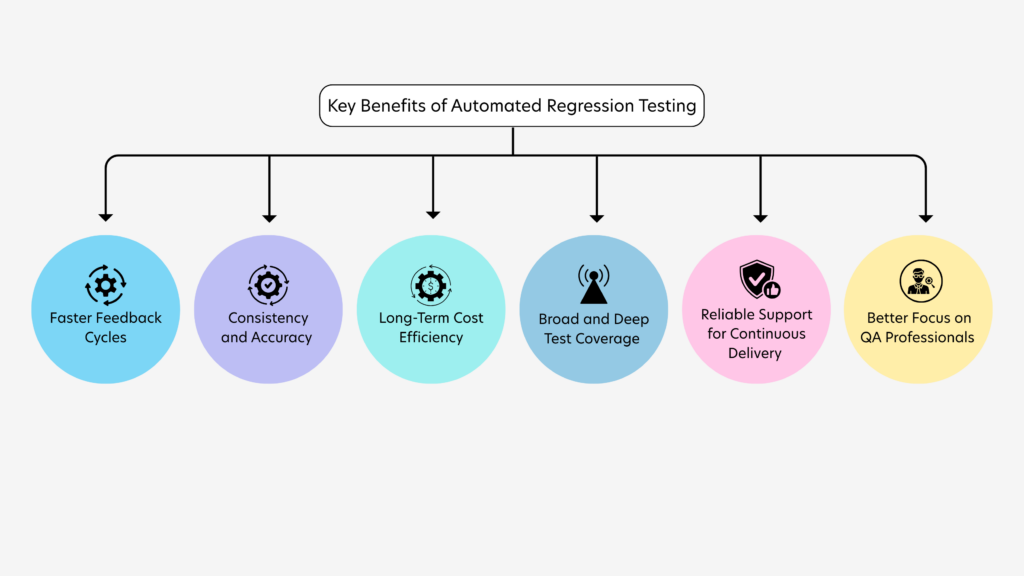
1. Faster Feedback Loop
Automated regression tests can be incorporated into CI/CD pipelines. This means that as soon as developers commit code, the regression suite can run instantly, providing rapid feedback and enabling teams to fix defects early.
Short feedback loops not only speed delivery but also reduce the cost of defect resolution. IBM research shows that defects caught early in the lifecycle are up to 15 times cheaper to fix than those found in production.
2. Improved Accuracy and Consistency
Human testers are incredible but even the best testers can experience fatigue or oversight when executing repetitive test cases manually. Automated regression tests run with precision every time, ensuring consistent validation and eliminating human error from repetitive checks.
3. Cost Efficiency in the Long Run
Automation requires investment in tools, frameworks, and skills upfront – but over time it reduces the need for large manual regression teams and accelerates delivery cycles. According to industry research, automation can significantly reduce overall regression testing costs while improving test coverage and quality.
4. Enhanced Test Coverage
Automated regression testing can run hundreds or even thousands of checks across different application modules, data sets, environments, and configurations – something that would be nearly impossible with manual testing alone.
5. Supports Continuous Delivery
Reliable regression suites are an essential element of modern DevOps pipelines. They allow teams to validate builds automatically, enabling frequent, high-quality releases with minimal risk.
6. Better Resource Allocation
When automation takes care of repetitive regression tests, QA teams can dedicate their time to more exploratory testing, usability checks, performance testing, and other high-value QA activities.
Most Insightful Guide: The Next-Gen Testing Blueprint: Shift SMART with Intelligent Quality (IQ)
Automated Regression Testing Use Cases
Let’s look at practical scenarios where automated regression testing adds significant value.
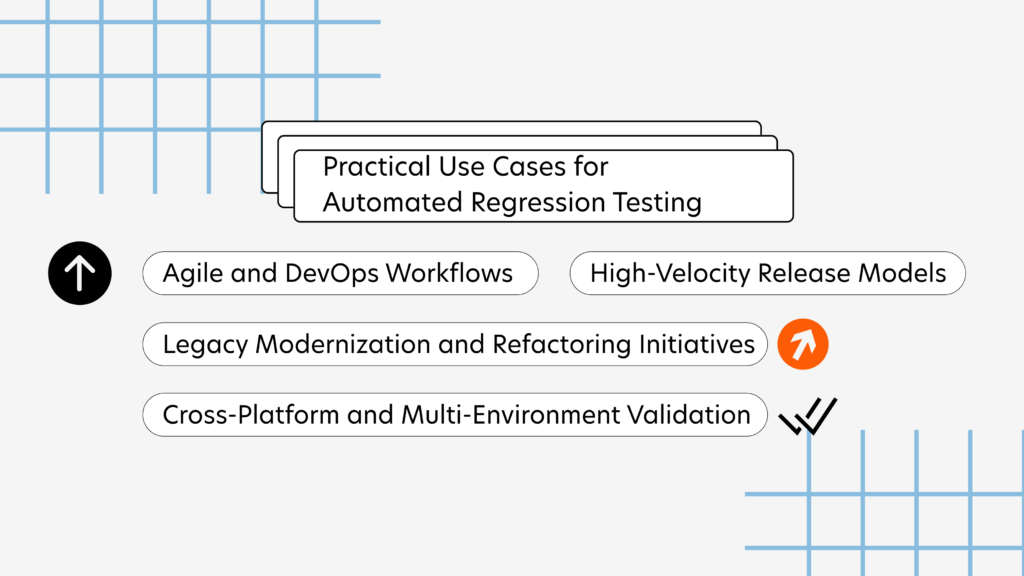
1. Agile & DevOps Environments
In agile development, new features are delivered in short cycles called sprints. Each sprint may introduce multiple code changes. Automated regression testing ensures that new features don’t break core functionality.
Manual retesting in such cycles is both inefficient and error-prone. By integrating automated regression tests into CI/CD pipelines, teams can unlock a “shift-left” approach – catching and fixing defects earlier in the lifecycle.
Stat to Know: A global automation testing market report found that 59% of enterprises have integrated automated testing into CI/CD workflows to support continuous delivery and improve quality.
2. Continuous Integration / Continuous Delivery (CI/CD) Pipelines
In CI/CD workflows, every code commit triggers builds and automated testing. According to industry stats, over 80% of enterprises use CI/CD to shorten release cycles and reduce human error.
A robust automation regression suite ensures stability at each stage, preventing faulty code from reaching production. This is particularly critical for businesses that deploy multiple times a day.
Considering a scenario where an enterprise SaaS provider sees regression failures as part of its pre-deployment pipeline. Automated regression suites fire on every developer commit, triggering hundreds of end-to-end and integration tests. Only builds that pass these automated checks are staged for user acceptance testing, ensuring a stable baseline before users ever interact with new features.
3. Frequent Release Cycles
High-velocity apps like e-commerce platforms, mobile applications, and SaaS products rely on fast and frequent updates. In such environments, regression automation becomes a business necessity rather than a technical convenience. Automated regression tests ensure that critical customer journeys – such as login, checkout, payments, and search – remain functional after every deployment.
According to Marketing Scoop research, 73% of QA teams automate functional and regression testing, reflecting that repetitive tests are ideal automation candidates, especially when delivering rapid releases
4. Complex Legacy Systems
Many enterprises are modernizing legacy systems – migrating to cloud, decoupling monoliths into microservices, or refactoring codebases for maintainability and performance. These architectural changes introduce risk because core business logic is often tightly coupled and poorly documented. Automated regression testing helps ensure that modernization, migration, or refactoring doesn’t unintentionally disrupt core features. Automation in these contexts boosts reliability and accelerates validation.
5. Cross-Platform Testing
Modern applications run on multiple platforms – web browsers, mobile devices, APIs, operating systems, and third-party integrations. Automated regression tests can be run across environments simultaneously, ensuring consistent behaviour everywhere. This approach saves significant manual effort and improves test coverage. Continuous integration of automated test suites with CI/CD tools is now the norm, with 80% of testing teams linked to CI/CD pipelines
Best Practices for Automated Regression Testing
Automated regression testing is valuable –but only if executed well. Here are industry recommended practices for building effective regression suites:
1. Choose the Right Tests to Automate
Not all test cases should be automated. Prioritise:
- High-risk functionality
- Frequently used features
- Stable areas of the application (not rapidly changing)
- Critical business workflows
Automation works best when used on areas where repetitive checks provide maximum value.
2. Use Robust Automation Tools and Frameworks
Select tools that align with your application type, programming stack, and team skill set. A tool like Qyrus can be especially helpful in enhancing automation with intelligent test orchestration, maintenance analytics, and actionable insights.
For broader automation strategy and services, explore Testing and test automation services to discover effective approaches tailored to your context.
3. Maintain Test Suites Regularly
As the application evolves, automated tests may become outdated or brittle. Regularly revisit and update regression test suites to remove deprecated tests, add new coverage, and optimise scripts.
4. Integrate With CI/CD
Automated regression tests deliver maximum value when integrated into CI/CD pipelines. When every code commit triggers a regression suite, teams get rapid insights into failures and can act immediately.
5. Prioritise Test Data Management
Reliable regression testing requires clean and representative test data. Invest in strategies to generate, mask, and manage test data to ensure consistent outcomes.
6. Monitor and Analyse Results
Use dashboards and analytics to review test outcomes, track trends, and identify patterns. This helps teams improve test quality and make informed decisions.
Tools and Technology for Automated Regression Testing
The market is rich with tools that help teams build and execute reliable automated regression tests. These tools vary in their capabilities – from scriptless automation and cross-platform support to intelligent maintenance and test analytics.
A few widely used automation categories include:
- Open-source frameworks
- Commercial automation platforms (with integrated dashboards and support)
- Cloud-based test labs (for scaling cross-browser/device execution)
- AI-assisted testing tools (for self-healing test scripts and predictive maintenance)
Choosing the right automated regression testing software depends on your application landscape, team expertise, budget, and long-term testing goals.For organisations looking for expert guidance and advanced automation frameworks, partnering with a specialised provider can make all the difference.
To learn more about selecting the right automation platform for your business, read this guide: How to Select the Best Testing Automation Tool
Challenges in Automated Regression Testing
While the advantages are significant, automated regression testing isn’t without hurdles. Understanding the challenges ahead helps teams prepare and mitigate risks effectively.
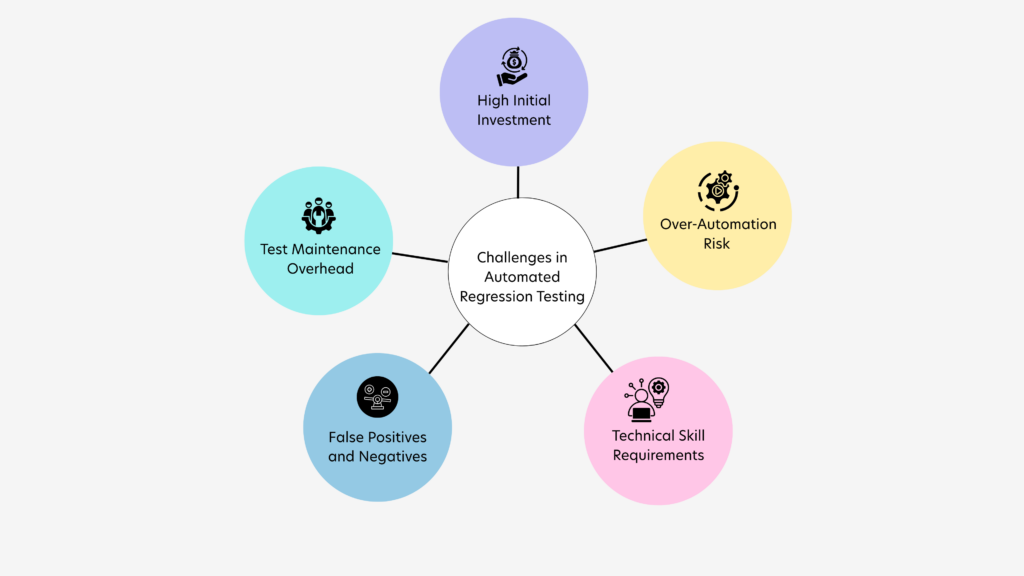
1. High Initial Investment
Building an automated regression suite requires time, tools, and skilled resources. There’s an upfront cost but long-term benefits often outweigh these initial investments.
2. Test Maintenance Overhead
As the application evolves, automated tests must be updated to reflect UI changes, new workflows, and updated logic. Without proper maintenance, automation suites can become unstable and unreliable.
3. False Positives and Negatives
Poorly written tests can generate false alarms (false positives) or miss actual issues (false negatives). Maintaining test quality and stability requires careful design and continuous review.
4. Technical Skill Requirements
Effective automated regression testing demands scripting abilities, framework knowledge, and tool proficiency. Teams may need training or specialised resources to build and manage automation effectively.
5. Over-Automation Risk
Not everything should be automated. Over-automation can lead to brittle test suites with low ROI. Prioritising the right cases helps teams preserve time and effort.
Mitigation to these challenges
Facing these challenges head-on enables teams to build successful, scalable regression automation:
- Establish clear criteria for what should be automated
- Invest in team skills and ongoing learning
- Design tests with modular, reusable components
- Use analytics to monitor and stabilise the suite
- Integrate test maintenance into the development rhythm
- Leverage tools with self-healing and intelligent insights
Why Integrating Regression Automation with Everforth Quinnox Matters
Across all these use cases, regression automation becomes far more effective when guided by intelligence, automation, and integration with delivery pipelines. With Quinnox’s Shift SMART framework, powered by Intelligent Quality (IQ), – fueled by AI models, predictive analytics, and self-healing automation turns regression from a repetitive task into a strategic quality control mechanism embedded in the software lifecycle achieving:
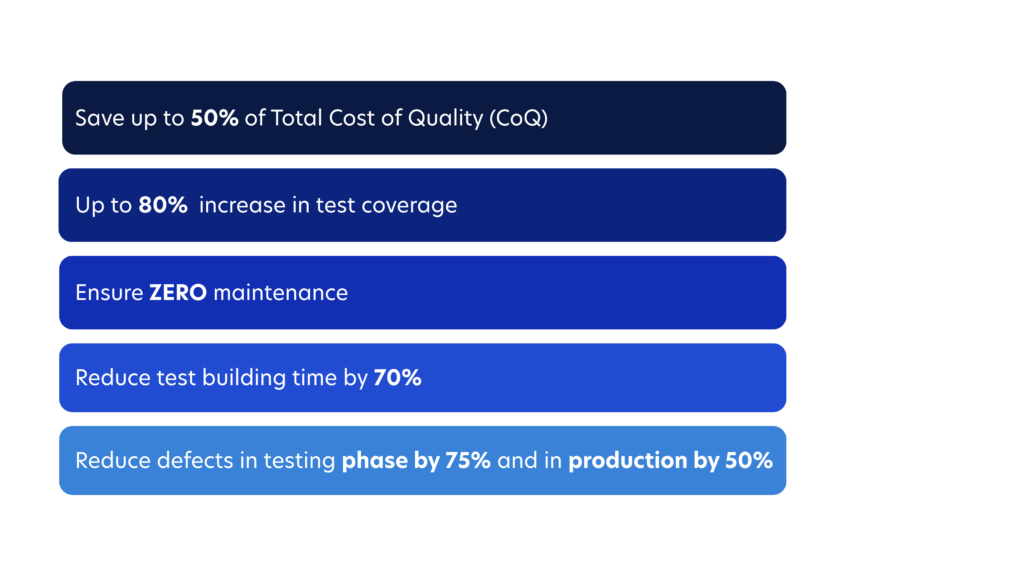
These results highlight how combining automated regression with intelligent distributed testing and predictive quality insights benefits delivery performance and product reliability.
Want to see what this would look like in your own delivery environment? Get a free 1:1 Consultation here .
To further explore practical strategies and success stories, visit Testing Test Automation and Test Automation Best Practices.

Megha Jhala is a Deputy Marketing Manager at Everforth Quinnox and a certified Digital Marketing professional with 14+ years of extensive experience across Marketing Automation & Operations, B2B SaaS Marketing, E-commerce consulting, Digital Marketing, lead generation and Vendor management. Outside of work, she enjoys travelling and reading, and she actively keeps up with emerging trends and innovations in the digital marketing space to continuously refine her approach and stay ahead in an ever-evolving industry.”
FAQs: Common Questions About Automated Regression Testing
Automated regression tests should ideally run every time a meaningful code change is introduced — especially in CI/CD pipelines. This means:
– On every commit submitted to the main or integration branch
– Before major releases
– After bug fixes, feature updates, or configuration changes
The goal is to catch defects as early and as often as possible to prevent issues from progressing downstream.
Both are essential test types but they serve different purposes:
Smoke Testing: A quick, shallow set of tests to verify core application functionality after a new build. It ensures the system is stable enough for further testing.
Regression Testing: A deeper suite of tests designed to verify that recent changes haven’t broken existing functionality. It’s broader and more comprehensive than smoke testing.
Think of smoke testing as a preliminary check and regression testing as a detailed verification.
In agile environments, yes — especially if the sprint introduces new features, changes, or bug fixes. Regression testing helps maintain quality as the product evolves. Automated regression tests are particularly helpful here because they can be executed quickly and reliably during sprint cycles.
Absolutely! AI and machine learning are transforming automated regression testing:
Self-healing test scripts that adapt to minor UI changes
Predictive analysis to identify high-risk areas for regression
Smart test prioritisation based on usage patterns and history
Automated test generation to expand coverage
Platforms that integrate AI capabilities including those like Qyrus help teams achieve more resilient, efficient, and intelligent regression suites.