Accelerate IT operations with AI-driven Automation
Automation in IT operations enable agility, resilience, and operational excellence, paving the way for organizations to adapt swiftly to changing environments, deliver superior services, and achieve sustainable success in today's dynamic digital landscape.
Driving Innovation with Next-gen Application Management
Next-generation application management fueled by AIOps is revolutionizing how organizations monitor performance, modernize applications, and manage the entire application lifecycle.
AI-powered Analytics: Transforming Data into Actionable Insights
AIOps and analytics foster a culture of continuous improvement by providing organizations with actionable intelligence to optimize workflows, enhance service quality, and align IT operations with business goals.
Most QA teams are not testing software. They are testing their assumptions about software.
They assume the checkout flow still works the way it did last quarter. They assume that regression suites cover the new payment integration. They assume someone updated those test cases after the last refactor. They assume that because nothing broke in staging, nothing will break in production.
Assumptions are not a QA strategy. And the gap between what a team thinks is covered, and what is actually covered is exactly where production defects are born – quietly, invisibly, until a real user finds them.
According to Forbes Research, 40% of organizations report that poor software quality costs them over $1 million annually. That is not a technology problem. That is a process problem. Specifically, it is what happens when testing runs on habit and hope rather than structure and evidence.
Test case management is what closes that gap. Not by adding bureaucracy, but by replacing assumption with accountability – giving every team a clear, shared, documented answer to the question that matters most before any release: do we actually know this works, or do we just think it does?
Why Traditional QA Breaks Down in Modern Delivery Environments
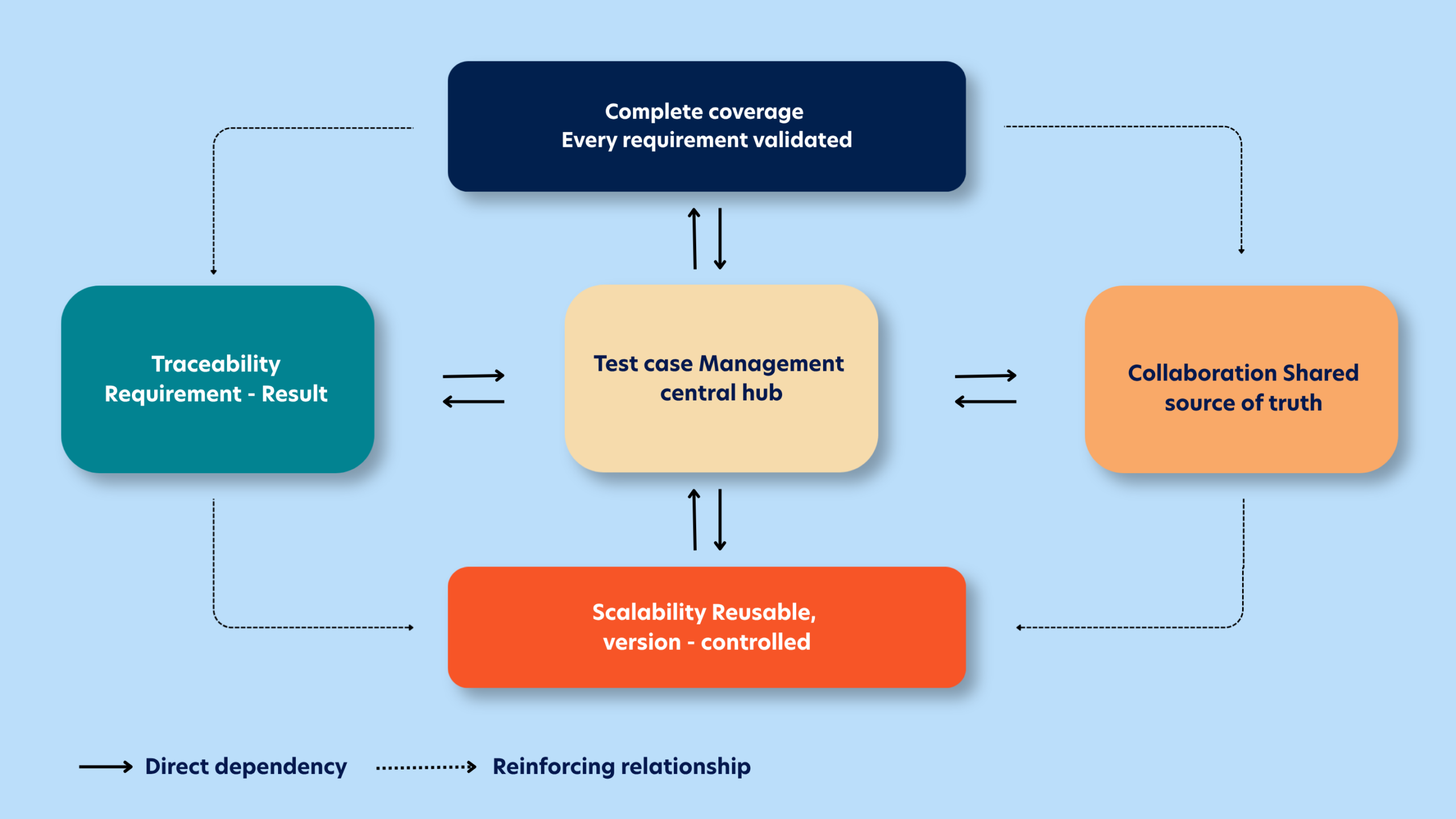
This guide breaks down exactly how leading QA teams build that accountability – from the core components and lifecycle to the real-world practices that keep testing precise, scalable, and genuinely trustworthy.
Why Test Case Management is Critical for QA Success
The consequences of poor test case management are not theoretical — they show up as production outages, failed audits, and frustrated customers.
Without structured test case management, QA efforts quickly devolve into ad-hoc testing marathons exhausting, inconsistent, and ultimately ineffective. Teams end up retesting the same things repeatedly while missing critical scenarios entirely. Release dates slip because no one knows what ‘done’ actually means. And when a production defect finally surfaces, there is no documentation trail to understand what was tested, how, or why it was missed.
Key Benefits of Test Case Management:
Improved Testing Accuracy and Consistency:
Structured test cases ensure that each test is executed in a consistent manner, reducing variability and human error during testing cycles.
Faster Release Cycles with Better Planning:
Organized test cases allow teams to plan and execute testing more efficiently, enabling quicker feedback loops and faster product releases.
Better Risk Identification and Mitigation:
By prioritizing test cases based on risk, teams can focus on critical areas first, ensuring that high-impact defects are caught early.
Stronger Compliance and Audit Readiness:
Detailed documentation helps organizations meet regulatory requirements and maintain audit trails for testing activities.

The future of test case management lies in intelligent optimization where AI helps teams prioritize, maintain, and evolve test suites based on real business risk and application change patterns.
Bighneswar Parida
Director – Quality Engineering, Everforth Quinnox
Key Components of Test Case Management
A strong test case management system consists of several interconnected components that work together to ensure efficiency.
1. Test Cases
Test cases are detailed instructions that describe what to test, how to test it, and what the expected outcome should be.
- They include inputs, execution steps, and expected results
- They help standardize testing across teams
- They serve as a reference for future testing cycles
2. Test Suites
Test suites are collections of related test cases grouped together based on functionality or modules.
- They help organize large volumes of test cases
- They enable batch execution of tests
- They improve test management efficiency
3. Test Data
Test data refers to the input values used during testing.
- It ensures realistic testing scenarios
- It helps validate edge cases and boundary conditions
- It supports both positive and negative testing
4. Test Environment
The test environment is the setup where testing is performed.
- It includes hardware, software, and network configurations
- It ensures that testing conditions mimic real-world scenarios
- It reduces discrepancies between testing and production environments
5. Traceability Matrix
A traceability matrix maps requirements to test cases.
- It ensures complete coverage of all requirements
- It helps identify missing or redundant test cases
- It improves accountability and transparency
Test Case Lifecycle Explained
The test case lifecycle defines how test cases evolve from creation to retirement providing a structured framework that ensures every test case serves a clear, time-bound purpose. Managing this lifecycle actively is what separates teams that maintain lean, effective test suites from those buried under outdated, conflicting, or redundant test cases.
When lifecycle stages are clearly defined, QA teams can allocate effort more precisely: investing in thorough creation upfront, enforcing quality gates during review, capturing accurate results during execution, and systematically retiring what no longer adds value. This discipline is what makes test coverage both comprehensive and maintainable over time.
Stages in Detail
Creation Phase:
Test cases are authored from business requirements, user stories, or technical specifications. This phase demands close collaboration between QA engineers and business analysts to ensure every functional and non-functional requirement maps to at least one test case. The quality of creation directly determines downstream testing accuracy — vague or incomplete test cases at this stage cascade into missed defects later.
Review Phase:
Before test cases enter execution, they go through structured peer or stakeholder review to validate correctness, completeness, and clarity. Reviewers check for ambiguous steps, missing expected results, and gaps in requirement coverage. In regulated industries like banking or healthcare, this phase also ensures audit readiness and compliance alignment.
Execution Phase:
Test cases are run against the application under test, with actual results recorded against expected outcomes. This phase generates primary data that informs release decisions. Execution may be manual, automated, or hybrid, but in all cases, the results must be documented with enough detail to support defect reproduction and root cause analysis.
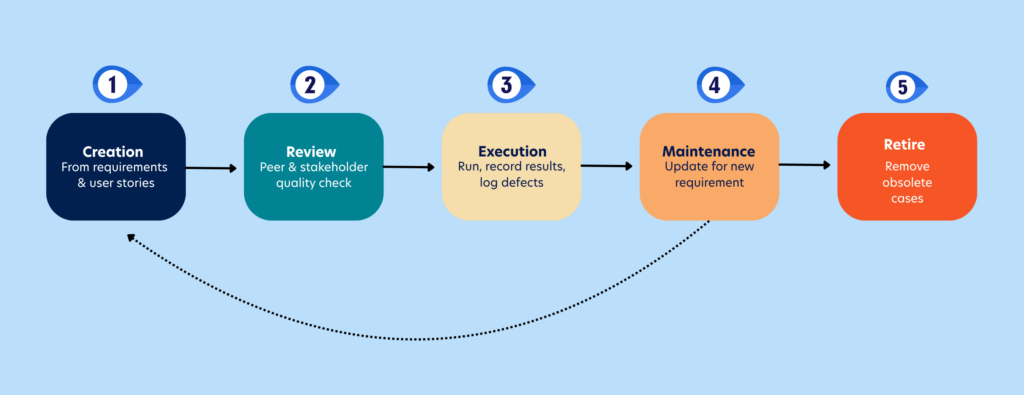
Maintenance Phase:
As applications evolve, test cases must evolve with them. The maintenance phase involves reviewing and updating test cases in response to requirement changes, refactored code, new integrations, or discovered edge cases. Teams that skip this phase accumulate test debt — test suites that appear comprehensive but fail to reflect actual system behavior.
Retirement Phase:
Not all test cases age well. Test cases that cover deprecated features, duplicate existing coverage, or no longer align with current system behavior should be formally retired. Regular retirement keeps the test suite lean, reduces execution time, and prevents teams from maintaining artifacts that provide no testing value.
Test Case Management Process (Step-by-Step Framework)
A structured process ensures consistency and efficiency in managing test cases.
Step 1: Requirement Analysis
Understanding business requirements is the foundation of effective testing.
- Identify functional and non-functional requirements
- Clarify ambiguities with stakeholders
- Define testing scope and objectives
Step 2: Test Case Design
Designing effective test cases is crucial for success.
- Use proven application testing as software test case design techniques
- Focus on edge cases and boundary conditions
- Ensure clarity and reusability
Check this blog to learn more on Test Case Design Techniques
Step 3: Test Case Development
This involves writing detailed and structured test cases.
- Include clear steps and expected outcomes
- Use consistent formatting
- Ensure readability for all team members
Step 4: Test Execution
Executing test cases helps validate functionality.
- Record actual results
- Compare with expected outcomes
- Identify and log defects
Step 5: Defect Tracking
Defects identified during testing must be tracked systematically.
- Assign severity and priority levels
- Monitor defect resolution
- Retest after fixes
Step 6: Reporting and Optimization
Continuous improvement is key.
- Analyze test results and trends
- Identify bottlenecks
- Optimize testing strategies
Types of Test Cases
Different testing scenarios require different types of test cases.
Functional Test Cases
These validate whether the system behaves according to requirements.
- Focus on user actions and system responses
- Ensure business logic is correctly implemented
Non-Functional Test Cases
These evaluate system performance and usability.
- Test system performance under load
- Assess security and reliability
Regression Test Cases
These ensure that new changes do not break existing functionality.
- Re-run previously executed test cases
- Validate system stability
Integration Test Cases
These verify interactions between modules.
- Ensure data flows correctly between components
- Identify integration issues early
Performance Test Cases
These measure system performance under different conditions.
- Test response times and scalability
- Identify performance bottlenecks
Best Practices for Effective Test Case Management
A brilliant test suite is only as good as the system holding it together. Without a deliberate strategy for organizing, executing, and updating your scenarios, even the most thorough testing efforts can devolve into a chaotic bottleneck. Effective test case management isn’t just about archiving scripts; it’s about transforming your QA process into a lean, visible, and high-velocity engine that drives software quality forward rather than just catching bugs at the eleventh hour.
Here are the best practices to follow for an effective test case management:
Write Clear and Detailed Test Cases:
Avoid ambiguity by using plain language, precise action verbs, and explicit expected results. A well-written test case should be executable by any team member without requiring additional context which is especially critical when testing is distributed across geographies or when original authors are unavailable during critical release cycles.
Avoid Redundancy in Test Cases:
Duplicate test cases inflate execution time without adding coverage value. Conduct quarterly audits to identify overlapping test logic and consolidate where possible. This is particularly important in regression suites, where redundant cases can significantly slow down release feedback loops without improving defect detection rates.
Maintain Version Control:
Test cases should be version-controlled alongside the application code they validate. When a feature changes, the corresponding test case should be updated in the same sprint not retroactively. Version history also enables teams to trace which test cases were active at the time of a production incident, supporting post-mortem analysis.
Prioritize Based on Risk:
Not all features carry equal risk. Apply a risk-based testing model that prioritizes test execution for high-impact, high-probability failure points — such as payment flows, authentication, and data migration paths. This ensures that critical defects are caught first, even when testing time is constrained by tight release schedules.
Regularly Update Test Cases:
Outdated test cases are worse than no test cases – they give false confidence. Establish a formal review of cadence tied to sprint cycles or release milestones to ensure test cases reflect current system behavior, updated requirements, and any changes in business logic or third-party integrations.
CTA: Join the ATaS Webinar to learn advanced QA strategies, automation frameworks, and real-world testing insights that can transform your testing approach.
Manual vs Automated Test Case Management
Choosing how to govern your test cases isn’t a one-size-fits-all decision; it’s a high-stakes trade-off between human contextual awareness and machine-driven speed. Relying strictly on manual curation guarantees precision but sacrifices scalability, while over-automating can lead to a mountain of brittle maintenance debt. To build a resilient QA strategy, you must map out exactly where human evaluation ends, and programmatic execution begins.
Below, let’s have a look at the detailed differences:
Manual Testing
- Manual testing places a human tester at the center of execution — interpreting instructions, interacting with the application, and making judgment calls that automation cannot replicate. Its core strength lies in flexibility: manual testers can adapt in real time to unexpected behavior, explore UI nuances, and evaluate subjective qualities like usability, accessibility, and visual consistency.
It is the method of choice for exploratory testing, where the goal is to discover unknown unknowns rather than validate documented requirements. It also plays a critical role in user acceptance testing (UAT), where business stakeholders validate that the system behaves as expected in real-world scenarios. The trade-off is throughput — manual execution is time-intensive and difficult to scale across large regression suites or high-frequency release pipelines.
Automated Testing
- Automated testing uses scripts, frameworks, and tools to execute predefined test cases without human intervention. Once written, automated test cases can run thousands of times across builds, environments, and devices — delivering rapid, consistent feedback that is simply not achievable at scale with manual effort.
It is most valuable in regression testing, where the same test cases must be re-executed repeatedly to confirm that new code has not broken existing functionality. Automation also integrates directly into CI/CD pipelines, enabling teams to validate every code commit in real time and shift defect detection as early as possible in the development cycle.
The investment in automation pays compounding returns: test suites written today continue to protect quality across every future release. The practical consideration is maintenance — automated tests require updates whenever the application changes, and poorly maintained automation can become a drag on velocity rather than an enabler of it.
Common Challenges in Test Case Management & Solutions
A testing repository can either be a team’s ultimate safety net or its biggest operational bottleneck. As applications scale and release cycles compress, the sheer volume of testing data can easily overwhelm a development team. When test case management is treated as an afterthought, subtle inefficiencies quickly compound into systemic blockers that stall deployments and compromise software reliability. To build a highly resilient QA pipeline, organizations must actively identify the friction points dragging down their velocity.
By addressing these foundational flaws head-on with deliberate, structured solutions, engineering teams can shift from reactive firefighting to predictable, high-quality delivery.
Poor Documentation
- The Blueprint of Confusion: When test cases lack structural clarity and are written with vague instructions, they invite guesswork into the QA process. A step that seems obvious to the author can be entirely incomprehensible to a colleague, leading to highly subjective and inconsistent testing. This absence of precise execution steps means critical bugs slip through the cracks simply because the tester had to guess what the expected behavior actually was.
- The Tactical Fix: Eliminate ambiguity by enforcing rigid, standardized templates and clear documentation guidelines across the board. Every test case should rigidly define preconditions, explicit inputs, click-by-click actions, and unambiguous, measurable success criteria. Standardizing this layout ensures that any team member can step in and execute any test with absolute precision, removing human interpretation from the quality equation.
Redundant Test Cases
- The Bloat Tax: Over time, test suites naturally collect clutter. When multiple engineers write localized scripts for overlapping features, the repository quickly balloons with duplicate testing scenarios. This bloat creates massive inefficiencies, forcing automated test suites to run for hours on identical code paths and draining the manual QA team’s energy as they repeatedly validate the same underlying logic under different names.
- The Tactical Fix: Treat your test repository as a high-value asset that requires routine pruning. Establishing a cadence for regular, comprehensive audits allows teams to cross-reference test cases against core product requirements. By systematically consolidating overlapping scenarios and discarding duplicate scripts, you drastically reduce maintenance overhead and maximize your pipeline’s execution speed.
Lack of Collaboration
- The Silo Bottleneck: Software quality suffers when engineering, product management, and QA operate in isolation. When critical feedback and test results are trapped inside fragmented spreadsheets or siloed messaging threads, team misalignment is inevitable. Developers end up building features based on one interpretation, while testers validate them using entirely different, outdated assumptions—leading to wasted development cycles and friction right before a launch.
- The Tactical Fix: Bridge the communication gap by adopting centralized test case management tools and unified platforms. Integrating your test repository directly into your project management ecosystems creates a shared window into software health. When developers, product owners, and QA professionals can view, comment on, and trace test coverage in one shared space, collaboration becomes a natural byproduct of the workflow.
Outdated Test Cases
- The Erosion of Trust: Software is highly dynamic, but test suites are often stubbornly static. When code changes but the corresponding validation scripts are ignored, the entire testing suite rapidly loses its utility. Outdated test cases undermine the integrity of your QA process by triggering false alarms for expected changes, forcing teams to burn valuable hours debugging “failures” that were actually just obsolete requirements.
- The Tactical Fix: Make test suite maintenance a non-negotiable part of your “Definition of Done.” Whenever a feature is modified, optimized, or retired, the corresponding test cases must be updated in tandem. Cultivating a continuous update habit ensures that your testing library evolves at the exact same pace as your codebase, keeping your quality metrics accurate, relevant, and trustworthy.
Real-World Examples of Test Case Management
The best QA strategies aren’t born in a vacuum; they are forged through operational friction, tight deadlines, and scaling pains. Seeing how other development teams navigated massive codebases, fragmented testing silos, and mounting regression debt offers a masterclass in practical engineering.
Let’s look at how distinct engineering cultures transitioned from spreadsheet chaos to high-velocity pipelines, proving that structured management is a necessity.
Retail & E-commerce Transformation
In large-scale retail environments, managing thousands of product flows, payment integrations, and user journeys requires highly structured testing.
A typical enterprise retail client implemented centralized test case management to:
- Standardize test case design across multiple modules such as checkout, inventory, and order management
- Improve coordination between distributed QA teams working across geographies
- Enable faster regression cycles during frequent feature releases
Impact:
- More consistent test coverage across customer journeys
- Reduced production defects during peak traffic events
- Improved release confidence during seasonal spikes
Banking & Financial Services Modernization
In banking systems, where compliance and accuracy are critical, test case management plays a vital role in ensuring system reliability.
A financial services organization adopted a traceability-driven test case management approach to:
- Map regulatory requirements directly to test cases
- Ensure complete validation of transaction workflows
- Maintain audit-ready documentation for compliance reviews
Impact:
- Stronger alignment between business requirements and testing
- Improved audit readiness and compliance validation
- Reduced risk of critical defects in production systems
Enterprise SaaS Platform Optimization
For SaaS platforms with continuous deployments, managing evolving test cases is a major challenge.
An enterprise SaaS provider enhanced its QA process by implementing structured and partially automated test case management:
- Organized test cases into reusable suites for faster execution
- Integrated test case management with CI/CD pipelines
- Enabled better tracking of test execution results and defects
Impact:
- Faster release cycles with improved testing efficiency
- Better visibility into test coverage and gaps
- Enhanced collaboration between development and QA teams
Conclusion
Test case management is a strategic pillar that directly impacts the quality, reliability, and speed of software delivery. Investing in strong test case management practices is essential for any organization aiming to deliver high-quality software consistently. It is not just about managing tests—it is about enabling smarter testing, faster innovation, and long-term success in an increasingly competitive digital landscape.
To truly transform your QA strategy, your team needs to move beyond legacy processes, explore advanced approaches to QA in software testing, and leverage Everforth Quinnox’s next generation AI powered software testing solutions backed by Services as software (SaS) framework designed to seamlessly bridge the gap between development speed and product reliability.
Connect with our expert today to elevate your test case management and unlock the precision automation your pipeline needs to succeed.

Deputy Manager, Marketing, Everforth Quinnox
FAQs Related to Test Case Management in Software Testing
Test case management is the process of organizing, designing, executing, and maintaining test cases to ensure software quality. It helps QA teams systematically validate application functionality against requirements.
Effective test case management involves creating clear and detailed test cases, organizing them into logical test suites, and maintaining traceability with requirements. Teams should also regularly review and update test cases to reflect changes in the application.
A test scenario is a high-level description of what needs to be tested, focusing on user actions or system functionality. In contrast, a test case provides a detailed, step-by-step procedure with inputs, execution steps, and expected results. While scenarios help in identifying test coverage areas, test cases ensure precise validation.
Test case management is important because it brings structure and consistency to the testing process. It ensures that all requirements are covered, reduces duplication, and improves defect detection.
Test case design techniques are systematic approaches used to create effective and efficient test cases. These include methods like boundary value analysis, equivalence partitioning, and decision table testing.
Test cases should be updated whenever there are changes in requirements, features, or system behavior. Regular reviews should also be conducted to remove outdated or redundant test cases.
Yes, test case management can be partially automated by integrating it with automation frameworks and CI/CD pipelines. While the creation of test cases may still require human input, execution and reporting can be automated for efficiency.