Accelerate IT operations with AI-driven Automation
Automation in IT operations enable agility, resilience, and operational excellence, paving the way for organizations to adapt swiftly to changing environments, deliver superior services, and achieve sustainable success in today's dynamic digital landscape.
Driving Innovation with Next-gen Application Management
Next-generation application management fueled by AIOps is revolutionizing how organizations monitor performance, modernize applications, and manage the entire application lifecycle.
AI-powered Analytics: Transforming Data into Actionable Insights
AIOps and analytics foster a culture of continuous improvement by providing organizations with actionable intelligence to optimize workflows, enhance service quality, and align IT operations with business goals.
Every digital interaction whether it’s a customer placing an order, an employee updating records, or a partner integrating through an API depends on systems that work exactly as intended. Yet, as software ecosystems grow more complex, so do the risks. New features released under tight timelines, dependencies between legacy systems and cloud-native modules, and constant shifts in user expectations create fragile intersections where things can go wrong. A single overlooked defect in functionality can translate into transaction failures, customer churn, reputational damage, or even compliance violations.
This is precisely where functional testing steps in as a business necessity. Functional testing helps teams uncover gaps that might otherwise hide beneath successful deployments: misaligned requirements, logic errors, broken integrations, and usability flaws that emerge only when users engage in real scenarios. In a market where customers have zero tolerance for digital friction, verifying that your software functions as promised isn’t just a quality measure; it’s a competitive differentiator.
For forward-thinking organizations, investing in functional testing is a commitment to trust, stability, and agility. It empowers them to release software faster without compromising reliability, adapt to changing business rules, and confidently scale innovation.
In this blog, we’ll explore what functional testing really means, examine various types of functional testing, discuss its business value, and look at practical functionality testing examples that illustrate its impact in real-world scenarios.
What Is Functional Testing
Functional testing is the disciplined process of validating that each feature of a software application behaves exactly according to the defined business requirements, user expectations, and design specifications. Unlike non-functional tests, functional testing asks, “Does this functionality do what it is supposed to do?”
At the heart of functional testing are functional testing test cases, which are nothing, but structured scenarios that derive from requirements or user stories. These tests simulate real-world behaviours: login flows, form submissions, data uploads, transactions, content retrieval, business rule enforcement, and so on.
Types of Functional Testing
Functional testing is not monolithic. It spans a collection of complementary approaches – each addressing a different layer of the software stack, a different testing objective, or a different stage of the development lifecycle. Below is a breakdown of the most widely recognized types of functional testing, along with why each matters.


Unit Testing
This is the smallest granularity level of functional testing: individual functions, methods, classes or in other words, units of code. Developers typically perform unit tests early, with automated frameworks verifying that each piece of logic works as intended in isolation. While unit testing is often considered part of developer discipline, it remains a cornerstone of functional correctness.
Further, with the integration of emerging technologies, traditional unit testing has evolved into AI unit testing that automates and enhances the creation, execution, and analysis of unit tests.
Integration Testing
Once units have been verified individually, the next step is to validate how they work together. Integration testing checks the interactions between modules, APIs, data flows, and dependencies. It uncovers issues like interface mismatches, incorrect data transformation, missing error handling, and more.
System Testing
Here, the application under test is treated as a whole: a complete system built from integrated subsystems. System testing validates that the end-to-end solution meets the specified functional requirements. It simulates real user-facing workflows and business rules.
Regression Testing
Every time new features are added or changes are made, there’s a risk of breaking existing functionality. Regression testing targets previously working features to ensure they continue to operate correctly after changes. It’s essential for maintaining confidence as the software evolves.
Smoke Testing (Build Verification)
Often called “build verification testing,” smoke tests are lightweight checks executed when a new build is deployed. They verify that the most critical functions work (e.g., the application launches, key menus open, core workflows start) before more in-depth testing is conducted.
Sanity Testing
Sanity testing is a focused subset of regression testing employed after minor changes, bug fixes or specific updates to ensure that the functionality impacted is still working and that the application is stable enough to proceed with deeper testing.
User Acceptance Testing (UAT)
Often conducted by business stakeholders or end-users (rather than QA engineers alone), UAT validates whether the software meets the real-world business needs and whether the user experience aligns with expectations. This is the final functional checkpoint before release.
Other Specialized Types
- Interface Testing: Ensuring that the user interface behaves correctly (buttons, menus, input fields) and that back-end operations reflect changes appropriately.
- Database Testing: Verifying that database operations (CRUD: create, read, update, delete) adhere to functional requirements, business rules, and data integrity constraints.
- API Functional Testing: Validating that API endpoints perform according to their specifications (correct input/output, error handling, data transformations).
- End-to-End Testing: This form of testing validates the entire user journey from start to finish – beginning with login and extending through interactions across multiple modules, transaction execution, status updates, and data logging. It ensures that every component of the system right from the user interface to the back-end services works together seamlessly to deliver the intended business outcome.
Each of these types of functional testing plays a distinct role. Combining them smartly creates a robust testing strategy. While a unit test might flag a single logic error, an end-to-end flow test spots issues in how modules integrate, and UAT ensures the solution aligns with business goals. Together, they form layers of assurance.
Benefits of Functional Testing
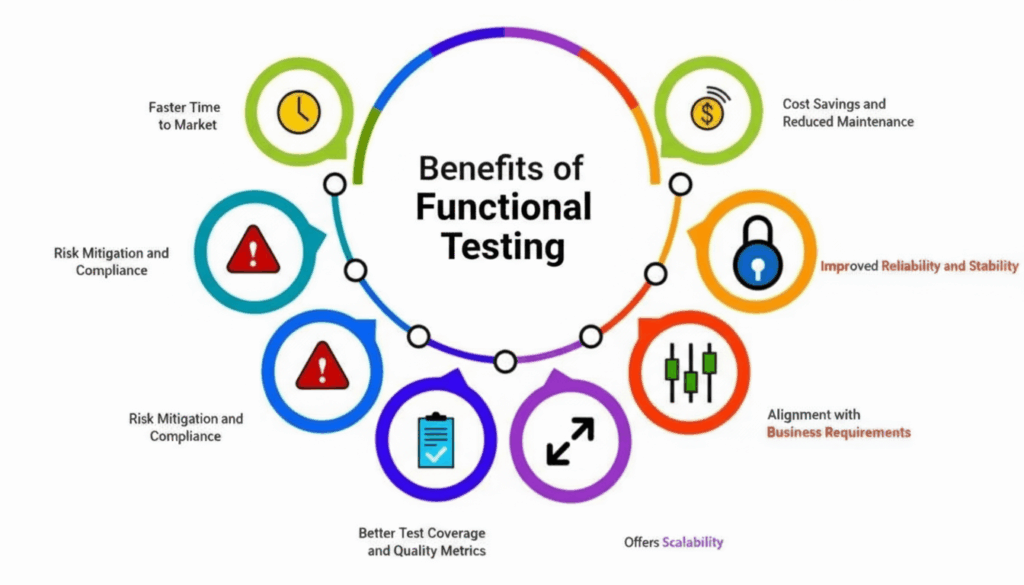
When executed properly, functional testing delivers more than defect detection. It drives outcomes across business, operational, technical, and user-experience dimensions. Below are key benefits to consider:
Enhanced User Experience
If the functionality is reliable and intuitive, users trust the application. Functional testing focuses on user-facing behaviours: login, purchases, workflows, data retrieval. When these flows work seamlessly, users are less likely to be frustrated, more likely to convert, and more likely to remain loyal.
Improved Software Reliability and Stability
Faulty functionality is often the root cause of production defects, service disruptions, and customer complaints. Regular functional testing helps identify and resolve issues before they reach production, increasing overall reliability and reducing downtime.
Alignment with Business Requirements
Functional testing ensures that what was built aligns with what was specified and what the business demands. This requirement traceability means fewer mistakes, less scope creep, and higher confidence that the product supports business objectives.
Faster Time to Market
Paradoxically, investing in functional testing early and comprehensively can accelerate release cycles. With a proper coverage of functional testing test cases, teams spend less time firefighting defects later. Moreover, catching issues earlier lowers the cost of fixing them and reduces rework.
Cost Savings and Reduced Maintenance
Defects discovered in production carry high costs from fixing the code, patching systems, supporting users, damage to brand reputation. Functional testing reduces the risk of such defects. Over time, fewer regressions, fewer emergency patches, less manual intervention, contribute to lower total cost of ownership.
Risk Mitigation and Compliance
Many industries such as finance, healthcare, retail often face regulatory and business-process requirements. This is where functional testing ensures that workflows such as payments processing, patient data management, reporting operate correctly and adhere to compliance norms reduce business risk.
Better Test Coverage and Quality Metrics
When you design comprehensive test cases across unit, integration, system, regression you improve test coverage, traceability, and metrics. These in turn support metrics-driven QA practices and give visibility into risk areas, helping teams be proactive rather than reactive.
In short, functional testing is not just “another phase” of the lifecycle. It is the foundation of software quality. A robust functional-testing discipline affects every stakeholder: developers, testers, product owners, business leaders, and ultimately end users.
Functional Testing Examples
Sometimes the theory becomes real when you examine how functional testing works in concrete settings. Below are several functionality examples across domains illustrating how functional testing plays out in practice:
Retail Checkout Flow
Consider an online retail platform: the user journey begins with product selection, transitions into a shopping cart, applies a discount voucher, supplies billing/shipping information, proceeds with payment, receives confirmation, and triggers post-order workflows (inventory update, invoice generation, shipping notification). A functional testing example here would include:
- Verifying product selection adds correct quantity and price.
- Testing voucher application logic (valid vs expired vs non-applicable codes).
- Checking payment gateway invocation and success/failure flows.
- Confirming inventory decrement, invoice creation, and shipping event trigger.
- Validating error scenarios (insufficient inventory, invalid payment).
This scenario demands end-to-end coverage, multiple modules interacting (front end, payment service, inventory DB, notification system), and regression safeguards for each build.
Banking Application Login & Transaction
In a financial services use-case, a software functional testing example might involve a user logging into the banking portal, viewing account balances, initiating a fund transfer, receiving a confirmation SMS, and checking updated account activity. Functional test cases could include:
- Valid login with correct credentials; invalid login attempts.
- Multi-factor authentication workflows.
- Fund transfer between own accounts, third-party accounts, and verifying limit rules.
- Error handling for insufficient funds, network failure, duplicate transactions.
- Confirming ledger updates and notification triggers.
In this case, reliability and correctness are vital, as any functional flaw can impact trust and regulatory compliance.
Healthcare Management System
For a patient-records system, functional testing might examine workflows such as: patient registration, appointment scheduling, medical record updates, physician notes, billing, insurance claims. Example test cases include:
- Registering a new patient and verifying required fields and validation rules.
- Scheduling an appointment, ensuring availability rules, conflict detection.
- Updating record with medical notes, checking that tracking/audit fields work.
- Generating a bill, processing insurance claims, verifying the system logs all events.
In this domain, functional correctness is imperative for both patient safety and compliance.
SaaS Application Workflow
For a business-application SaaS product (e.g., project-management tool), a functional example can involve user roles, permissions, project creation, task assignment, notifications, analytics dashboard. A typical scenario:
- Admin invites a user; user receives email, logs in, joins a project.
- Project owner creates tasks, assigns them; assignee marks tasks complete.
- System updates dashboard metrics, sends notifications.
- Role changes (user to admin) propagate correctly.
Functional testing ensures that each feature (invite, assignment, role change, dashboard update) functions as intended and that changes don’t break existing flows.
By examining these functional testing examples, one can appreciate how broad the scope is: various industries, multiple workflows, front-end/back-end interactions, edge cases, negative flows, and business rule complexity. Functional testing is as much about the business story as about the code.
Manufacturing Workflow
In a manufacturing setup, enterprise systems such as ERP or MES (Manufacturing Execution Systems) manage complex production operations – from raw material procurement to finished goods dispatch. A functional testing example here would be validating the production order workflow.
When a production planner creates a new manufacturing order, the system should automatically check material availability, allocate resources, trigger machine scheduling, and update inventory in real time. Functional test cases would include:
- Creating and approving a production order.
- Verifying that material reservations are updated correctly in the inventory module.
- Ensuring machine downtime or capacity limits are respected.
- Checking that quality control checkpoints trigger at the right stages.
- Confirming finished goods are moved to the warehouse upon completion.
This kind of functionality testing scenario ensures seamless communication between ERP, MES, and inventory systems, preventing costly production halts and inventory inaccuracies.
Logistics Workflow
In logistics, timing and visibility are critical. Functional testing often focuses on shipment tracking and order fulfillment workflows.
A software functional testing example could involve validating the shipment creation and tracking process:
- The system generates a shipment order once a warehouse confirms packaging.
- A unique tracking ID is assigned, and the carrier integration updates shipment status (in transit, delayed, delivered).
- Notifications are triggered to customers at key milestones.
- Billing and proof-of-delivery data sync with the finance module.
Functional testing verifies that data flows correctly between the TMS (Transportation Management System), carrier APIs, warehouse systems, and customer portals. It ensures that no shipment is lost due to broken integrations, and that customers always see accurate, real-time information.
Supply Chain Management Workflow
In supply chain systems, end-to-end visibility and coordination between suppliers, manufacturers, distributors, and retailers are essential. A typical functional testing example focuses on demand planning and replenishment automation.
Here, test cases validate whether the system accurately interprets sales forecasts, triggers purchase orders, and synchronizes stock levels across locations. For instance:
- Simulating forecast updates to confirm automated reorder point adjustments.
- Testing supplier portal integrations for order acknowledgment.
- Verifying that inventory data across warehouses syncs correctly.
- Checking escalation workflows when stock-out conditions occur.
Best Practices for Functional Testing
To harness the full power of functional testing and embed it as a strategic part of your software lifecycle, the following best practices help guide implementation, ensure efficiency, and drive impact.
1. Shift-Left and Shift-Right Testing
Begin functional testing as early as possible (shift-left) so defects are caught in requirements, design, or unit phases rather than after major development. Also plan shift-right (post-release functional regression or production-validation) to monitor real-world behaviour. Early and continuous testing reduces risk and cost.
2. Clarify and Trace Requirements
Every functional testing test case should map directly to a business requirement, user story, or specified behaviour. Maintain traceability matrixes that allow you to show that each requirement has corresponding test coverage. This aligns testing with business goals and helps reduce gaps.
3. Prioritise Test Cases Based on Risk and Business Impact
Not all functions are equal. Prioritise testing work on high-value or high-risk workflows (for example: payment, login, data privacy). Designing types of functional testing with risk-based prioritisation ensures efficient use of resources.
4. Develop Realistic Functionality Testing Scenarios
Go beyond happy-path flows. Include realistic user journeys, negative flows (invalid inputs, network failures), edge cases, error conditions, and data-variance. This gives broader coverage and reduces operational surprises in production.
5. Choose Appropriate Functional Testing Tools
Select and integrate the right functional testing tools (automation frameworks, test-case management, CI/CD hooks, API testing tools) to support your strategy. Automation is critical for regression, integration, and system testing at scale.
6. Automate Where It Makes Sense
Manual testing remains indispensable, especially for exploratory testing. But automating repetitive functional flows (e.g., regression suite, smoke tests) frees resources to focus on new features, creative testing, and deeper quality coverage.
7. Maintain Tests Actively
Test code and test data must evolve alongside the application. Periodically review test suites, retire obsolete tests, update test scripts when requirements change. Otherwise, you risk bloated or irrelevant testing overhead.
8. Integrate Testing into CI/CD Pipelines
Embed functional tests into your continuous integration/deployment pipelines so that every build triggers a functional test cycle. This enables early feedback, faster release confidence, and continuous quality assurance.
9. Measure Coverage and Outcomes
Track metrics: test-case coverage, defect density, time to fix, automation pass rate, number of escaped defects into production. Having measurement drives continuous improvement, transparency, and alignment with business goals.
10. Collaborate Across Teams
Functional testing isn’t just QA’s responsibility. Developers, business analysts, product owners, operations teams all should contribute to functional testing strategy, test-case review, scenario design, and sign-off. This cross-discipline collaboration ensures holistic quality.
By following these practices, functional testing becomes not just a tactical effort but a strategic discipline – a quality function that supports agility, innovation, and business continuity.
How Everforth Quinnox IQ Helps in Functional Testing?
In the context of large-scale enterprise software and across complex digital environments, implementing functional testing at scale and at speed poses significant challenges. That’s where Quinnox offers a framework called Intelligent Quality (IQ) – a paradigm shift that integrates AI, automation, analytics, and cloud-native architectures to transform testing from a tactical task into a strategic differentiator. Central to this transformation is Shift SMART —an intelligent, strategic framework that offers:

- Shift Start: Quality-first mindset, starting early in the SDLC.
- Zero Maintenance: Modular, self-healing test automation that evolves with your app.
- AI & Automation: Intelligent tools that reduce manual effort and speed up cycles.
- Reliability: Early defect detection to avoid costly production issues.
- Total CoQ: Dramatic reduction in overall quality costs through proactive testing.
In the latest report “The Next-Gen Testing Blueprint: Shift SMART with Intelligent Quality (IQ),” Quinnox experts share insights on how embedding IQ across the SDLC helps businesses:
- Reduce test build time by 70%
- Cut total Cost of Quality by 50%
- Eliminate costly maintenance issues right from the start
Here is how Quinnox’s approach helps with functional testing:
AI-Powered Test Design and Prioritisation
Using proprietary AI-powered end-to-end testing platform Qyrus, Quinnox assists in automatically generating and prioritising test cases based on risk, business impact, and historical defect data. The platform analyses functional modules and suggests which types of functional testing require focus.
End-to-End Automation for Functional Scenarios
Functional workflows often span multiple systems (web, mobile, API, backend). Qyrus supports end-to-end, cross-channel automation for functional scenarios, ensuring each step of the functionality is validated. This is where Quinnox’ claims coverage increase and test-cycle acceleration through advanced AI-powered automation.
Self-Healing and Low-Code/No-Code Capabilities
One of the barriers to large-scale functional testing automation is the maintenance overhead—locator changes, UI updates, environment shifts. This is where Quinnox’s IQ-powered software testing solutions offer low-code/no-code capabilities and self-healing test scripts so that functional test suites stay relevant, reducing manual maintenance.
Continuous Integration and Risk-Driven Regression
Quinnox’s approach integrates functional testing into CI/CD pipelines, enabling functional test execution every build, frequent regression coverage, and early detection of defects. Regression testing is heavily supported via automated functional flows.
Domain and Industry-Specific Expertise
Beyond tool capabilities, Quinnox brings decades of testing expertise and domain accelerators including pre-built functional test libraries and scenario libraries tailored to industries like banking, retail, manufacturing, utilities. This enables organisations to adopt functional testing with richer context, faster.
Conclusion
Whether you’re developing an enterprise application with dozens of modules, or a nimble SaaS product with frequent releases, the consistent thread remains: when functionality works, users are satisfied; when it fails, business suffers. The investment you make today in functional testing is foundational to the experience, reliability, and evolution of your software tomorrow.
As you plan your next release or test cycle, ask yourself: Are our functional flows validated end-to-end? Do our test-cases reflect real user journeys and failure modes? Are we automating efficiently? Are we leveraging analytics and intelligence to prioritise the right tests?
If the answer is yes, you are aligned for success. If not, this is your moment to elevate functional testing from an operational task to a strategic capability.
Key Challenges in AI Inference
Deploying AI models for inference in real-world environments is more than just running trained models – it comes with a unique set of challenges spanning data, models, infrastructure, and organizational readiness.
1. Data Quality and Preparation
- Poor-quality or misformatted data leads to inaccurate predictions – “garbage in, garbage out” remains true.
- Ensuring that datasets are clean, relevant, and representative of real-world scenarios is critical to reliable inference outcomes.
FAQs about Functional Testing
Functional testing is a quality assurance process that verifies whether every feature of a software application works according to the defined requirements and user expectations. It focuses on what the system should do validating business logic, data processing, integrations, and user interactions rather than how it performs them.
In practice, functional testing involves executing well-defined test cases that simulate real user actions like logging in, submitting forms, processing payments, or generating reports. The purpose is to ensure the application’s functions behave consistently, accurately, and reliably under expected conditions.
There are several types of functional testing, each addressing a specific layer or objective of validation:
- Unit Testing: Verifies individual components or methods in isolation.
- Integration Testing: Ensures different modules or services work together correctly.
- System Testing: Tests the complete, integrated system against overall requirements.
- Regression Testing: Checks that recent code changes haven’t broken existing functionality.
- Smoke Testing: Performs a quick health check to confirm that critical features work after a new build.
- Sanity Testing: Validates that specific defects have been fixed and that related areas remain stable.
- User Acceptance Testing (UAT): Confirms that the software meets user and business expectations before release.
- End-to-End Testing: Validates complete workflows across multiple systems, from start to finish.
Each type complements the others — together, they provide comprehensive assurance that the application functions as intended.
A classic software functional testing example can be seen in an online retail platform’s checkout process. A tester verifies that when a customer adds items to the cart, applies a discount, enters payment details, and confirms the order, each step behaves correctly. The test ensures that totals are accurate, payments are processed securely, and order confirmations are generated.
If any of these functions fail say, discount codes don’t apply or payment confirmation isn’t recorded – it indicates a defect in functionality. This example highlights how functional testing connects directly to business operations and user trust.
Common functional testing examples appear across nearly every domain:
- Banking: Validating fund transfers, account creation, and transaction history updates.
- E-commerce: Testing product search, order placement, payment, and invoice generation.
- Healthcare: Checking patient registration, appointment scheduling, and medical record updates.
- Logistics & Supply Chain: Verifying shipment tracking, inventory synchronization, and supplier order flows.
- Manufacturing: Ensuring production order creation, resource allocation, and quality checks function seamlessly.
The key distinction lies in what they test. Functional testing evaluates whether a system’s features perform their intended operations – it validates correctness and adherence to requirements. Non-functional testing, on the other hand, examines how well the system performs under various conditions assessing aspects like speed, scalability, security, usability, and reliability.
Related Insights
https://www.quinnox.com/blogs/what-is-application-testing/
https://www.quinnox.com/blogs/ai-in-quality-assurance/
https://www.quinnox.com/blogs/enterprise-application-testing/