If your SAP ECC system is still running on premises, you’ve probably had this conversation more than once this year: should you move to RISE with SAP, and is it actually worth it?
You’re not alone. According to Gartner, only about 37% of SAP ECC customers worldwide had bought or subscribed to S/4HANA licenses as of Q2 2024. Most enterprises are still deciding, and RISE with SAP is usually the first option that comes up.
This isn’t a vendor pitch. It’s a straight answer to what RISE with SAP actually is, what it costs, whether you need a partner to pull it off, and if it fits your situation.
Not sure what your migration will actually cost?
Use the SAP Implementation Cost Calculator to model your S/4HANA and RISE with SAP costs based on your FUEs, data volume, and migration path.
What Is RISE with SAP?
RISE with SAP is SAP’s subscription bundle for moving to S/4HANA Cloud. SAP now officially calls it SAP Cloud ERP Private, so if you see that name instead, it’s the same offering. Most of the market still says, “RISE with SAP,” so that’s what we’ll use here.
SAP categorizes it as a Business Transformation as a Service (BTaaS) offering, not a single piece of software. That distinction matters, because instead of buying licenses, infrastructure, and tools separately, you get one contract.
What Are the Components of RISE with SAP?
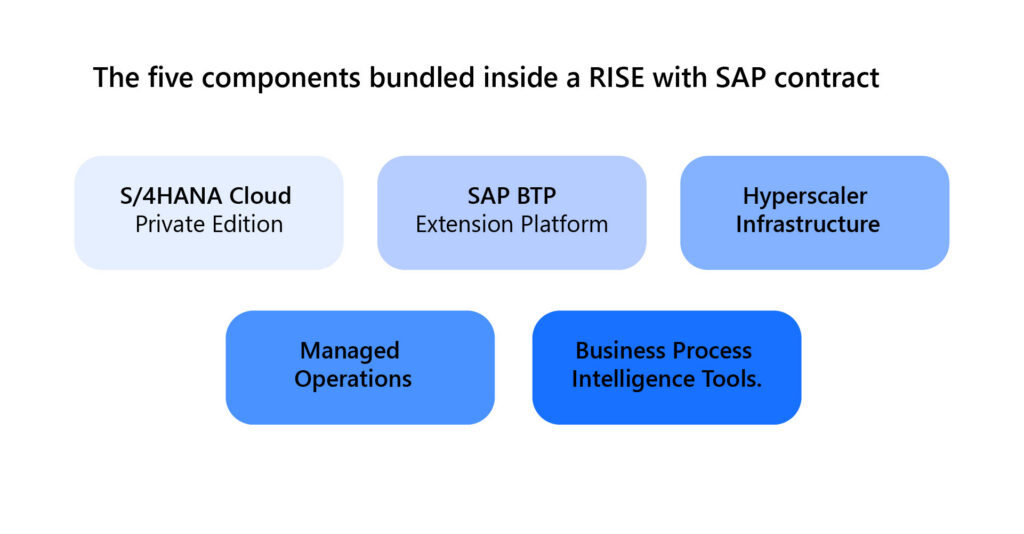
That single contract covers:
- SAP S/4HANA Cloud, Private Edition
- SAP Business Technology Platform (BTP)
- Hyperscaler infrastructure (AWS, Azure, or Google Cloud)
- Managed operations for the underlying system, so SAP handles patching, monitoring, and infrastructure upkeep
- Business process intelligence tools that benchmark your processes against industry standards
The idea behind it is what SAP calls a “clean core.” You keep customizations out of the core system and push them into extensions on BTP instead. That matters if you’re coming from a heavily customized ECC environment, because clean core is what makes future upgrades faster and cheaper.
What's Actually Inside SAP BTP
BTP isn’t one tool. It’s a platform made up of several layers, and knowing what’s in each one helps you understand where your customizations and integrations actually live once you move to a clean core model.
| Layer | Platform | Products covered |
|---|---|---|
| Data + Analytics | SAP BDC (Business Data Cloud) | SAP Cloud Analytics (SAC), SAP Datasphere, SAP Master Data Management/Governance |
| Integration + App Development | SAP BTP | SAP Integration Suite (CPI, API Management, Event Mesh, Open Connectors, Integration Advisor); SAP Build (Build Apps, Workflow/Process Automation, Business Application Studio) |
| AI | AI Stack | SAP AI Core, SAP AI Launchpad, Joule and AI agents (emerging layer) |
For most enterprises coming off a customized ECC system, the Integration + App Development layer is where the bulk of the migration work lands, since that’s where your existing custom code and third-party connections get rebuilt as extensions instead of core modifications.
RISE with SAP and S/4HANA: How They Fit Together
Here’s where people get confused. RISE with SAP isn’t a product. It’s the delivery model that gets you to S/4HANA Cloud.
Think of S/4HANA Cloud as the destination and RISE with SAP as the contract structure that gets you there. If you’re planning your SAP S/4HANA migration, our S/4HANA migration guide breaks down the three paths (Greenfield, Brownfield, and Bluefield) you’ll choose between, and RISE typically applies to the Brownfield or Hybrid route since it’s built for existing customers, not net-new implementations.
The Migration and Modernization Pillar
RISE with SAP’s migration and modernization component includes a readiness assessment, custom code analysis, and cutover support tools from SAP. Useful, but not the whole job.
What it doesn’t cover: data cleansing, legacy interface remediation, and the testing rigor most enterprises actually need during cutover. That’s typically where an implementation partner’s work starts, right where SAP’s own tooling stops.

In every migration engagement I have been part of, data cleansing takes longer than the project plan allows. The teams that treat it as a phase, and not a task, are the ones that go live without a war room.
Vidhyashankar Ganapathy
Executive Vice President & Head Global Marketing, Everforth Quinnox
The RISE with SAP Methodology
Beyond the commercial bundle, RISE with SAP comes with its own implementation methodology, and this is a separate thing from the contract itself.
It’s built on SAP Activate, SAP’s standard project framework, but with a more prescriptive, AI-assisted layer on top. Instead of a generic six-phase rollout, you get:
- Pre-configured, industry-specific “best practice” content baked into the starting system
- Guided readiness checks that flag customization conflicts before they hit your budget
- AI-assisted cutover tooling that automates parts of the testing and validation cycle
Here’s the part worth knowing before you commit: the methodology is designed to move fast on a standard implementation. It’s not designed to absorb heavy customization or complex legacy interfaces without extra planning.
If your landscape has years of custom code, the standardized RISE with SAP methodology gives you a strong starting template, but you’ll still need a delivery partner who can adapt it to your actual environment rather than force-fitting your system into the template.
What Does RISE with SAP Cost?
RISE with SAP shifts your spending from CapEx (Capital Expenditure) to OpEx (Operating Expenditure). Instead of buying servers and licenses upfront, you pay a subscription based on FUEs (Full User Equivalents), your data volume, and which hyperscaler you run on.
A few things drive the number up or down:
- How customized your current ECC system is. More custom code means more remediation work before cutover.
- Which migration path you choose. Brownfield is usually cheaper than Greenfield, but it depends on how much technical debt you’re carrying.
- Your data volume and complexity. Multi-system landscapes cost more to consolidate than single-instance environments.
Don’t take a vendor’s number at face value. Build your own model first. Our SAP Implementation Cost Calculator lets you model your own S/4HANA and RISE with SAP costs based on your FUEs, data volume, and migration path, and our free whitepaper on why the 2027 deadline changes your S/4HANA cost equation walks through the rest.
| Dimension | What It Tests |
|---|---|
| Accuracy | Does the value reflect the real-world entity it represents? |
| Completeness | Are all required fields populated? |
| Conformance | Does the data match the format S/4HANA expects? |
| Consistency | Do related records agree across source systems? |
| Timeliness | Is the record current enough to be operationally relevant? |
| Uniqueness | Does this entity exist exactly once in the source? |
| Validity | Does the value fall within the expected domain or range? |
RISE with SAP Benefits
The case for RISE with SAP is strongest when you’re already staring down the 2027 ECC support deadline. Here’s what it actually delivers:
- Predictable budgeting. One contract, one bill, no separate infrastructure procurement.
- A built-in modernization runway. BTP and clean core give you a path to extend the system without breaking future upgrades.
- Less operational overhead. Since SAP manages the underlying infrastructure and system operations, your internal team isn’t carrying patching and monitoring on top of everything else.
- Faster time to value on process benchmarking. The business process intelligence tools flag where your processes lag industry standards before migration even starts.
To be fair, there’s a trade-off. Gartner has reported that RISE’s share of S/4HANA sales fell from 71% in Q3 2023 to 41% in Q2 2024, as more customers moved toward GROW with SAP or negotiated separate infrastructure deals for more control.
Bundling isn’t free. You’re trading some infrastructure flexibility for simplicity, and whether that trade is worth it, depends on your organization’s appetite for a managed model versus direct control.
RISE with SAP vs. GROW with SAP: Which One Applies to You?
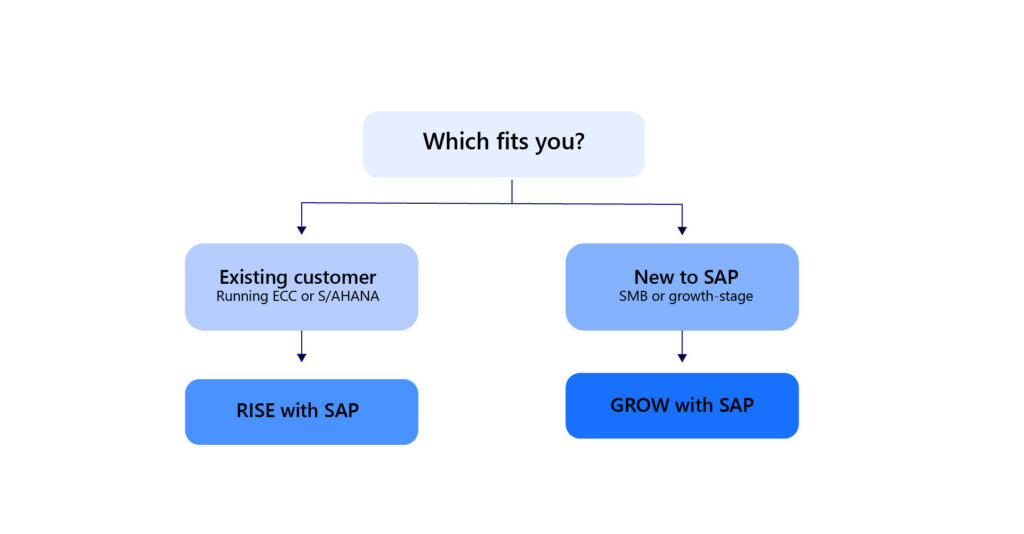
This is a five-second decision once you know the rule:
- RISE with SAP is for existing SAP customers migrating off ECC or on-premises S/4HANA.
- GROW with SAP is for companies new to SAP, or smaller and growth-stage businesses implementing S/4HANA Cloud Public Edition for the first time.
If you’re running ECC today, RISE is your path. If you’ve never run SAP before, GROW is built for you. There’s not much real ambiguity here despite how often the two get lumped together in marketing content.
Do You Need a RISE with SAP Implementation Partner?
Short answer: almost always, yes.
RISE with SAP gives you the contract, the infrastructure, and a methodology template. It doesn’t give you a team that knows your specific landscape.
SAP recognizes a network of implementation partners for exactly this reason: enterprises consistently need outside delivery expertise to actually execute a RISE with SAP migration, not just sign up for it.
Everforth Quinnox is an SAP partner that brings three things SAP’s own bundle doesn’t:
- Landscape-specific readiness work. Assessing your actual customizations, interfaces, and data quality, not a generic template.
- Testing rigor through cutover. RISE with SAP’s tooling automates parts of validation, but enterprise cutover windows still need dedicated regression and integration testing.
- Post-go-live ownership. SAP manages the infrastructure. Someone still needs to own your business processes, user adoption, and continuous improvement after go-live.
This is the role Everforth Quinnox plays for enterprises moving to RISE with SAP: not a hyperscaler, not an infrastructure vendor, but the delivery partner that handles the parts of the migration the RISE with SAP bundle was never designed to cover.
Is RISE with SAP Right for Your Enterprise?
Run through these questions honestly before you commit:
1. How customized is your current ECC system? Heavy customization means more remediation work no matter which path you choose.
2. How much time do you have before 2027? If your runway is already tight, RISE’s bundled timeline can help you move faster than assembling infrastructure and licensing separately.
3. How complex is your data landscape? Multi-system, multi-region data adds real risk to cutover if it’s not planned for early, which is exactly what our SAP data migration best practices blog walks through.
4. Do you have testing coverage for cutover? This is the step most RISE with SAP timelines underestimate, and it’s why we built dedicated software testing solutions for SAP cutover windows, so go-live doesn’t become a fire drill.
5. Who’s running the system after go-live? RISE with SAP covers the infrastructure, but day-to-day support and continuous improvement still need a plan, which is where application maintenance and support comes in.
If most of your answers point to “we need help operationalizing this,” that’s normal. Most enterprises do.

RISE with SAP gives you the contract and the infrastructure, but it doesn’t run your cutover for you. The enterprises that get this right treat the SAP bundle as the starting point, not the finish line, and bring in dedicated data and testing rigor well before go-live, not after something breaks.
Golla Srinivasa Rao
Director, SAP Practice & Delivery, Everforth Quinnox
Getting Started with RISE with SAP
Start with a readiness assessment: understand your customization footprint, your data complexity, and your realistic timeline against 2027 before you sign anything.
From there, Everforth Quinnox’s full range of SAP consulting services covers everything from initial assessment through migration, testing, and post-go-live support. And if you want to see how BTP extensions fit into a clean core strategy, our SAP BTP use cases breakdown is worth reading next.
Want the full picture on why the clock’s ticking on this decision? Download the free whitepaper.

Assistant Manager, Marketing, Everforth Quinnox
FAQs related to RISE with SAP
It’s SAP’s subscription bundle for moving to S/4HANA Cloud, combining licenses, BTP, and hyperscaler infrastructure under one contract.
Yes. SAP now officially refers to it as SAP Cloud ERP Private, though most of the market, including SAP’s own marketing, still uses “RISE with SAP” interchangeably.
RISE with SAP is the delivery model. S/4HANA Cloud Private Edition is the product it gets you to. They’re not the same thing, but they’re always paired together.
Predictable OpEx-based budgeting, a built-in modernization path through clean core and BTP, reduced operational overhead since SAP manages infrastructure, and process benchmarking tools that flag gaps before migration starts.
S/4HANA Cloud Private Edition, SAP BTP, hyperscaler infrastructure, managed operations, and business process intelligence tools, all under a single subscription.
The same five: the ERP software itself, BTP for extensions, cloud infrastructure, managed operations, and process benchmarking tools.
An implementation framework built on SAP Activate, with AI-assisted readiness checks and cutover tooling layered on top. It’s designed for a standardized rollout and works best when paired with a delivery partner who can adapt it to a customized landscape.
In almost every case, yes. RISE with SAP provides the contract, infrastructure, and a methodology template, but landscape-specific readiness work, cutover testing, and post-go-live support typically require a dedicated implementation partner.
RISE is built for existing SAP customers migrating off ECC. GROW is built for companies implementing SAP for the first time.
Traditional implementations mean buying licenses and infrastructure separately and managing vendors independently. RISE bundles all of it into one contract with a single point of accountability.
SAP launched RISE with SAP in January 2021.
No. It’s SAP’s recommended path, but Greenfield and Brownfield migrations outside of RISE are still valid options. What’s mandatory is moving off ECC before mainstream support ends in 2027.
Timelines typically run 6 to 18 months, depending on customization complexity and data volume. Simpler, less customized environments move faster.