Introduction
For many organizations, the SAP S/4HANA migration marks the completion of a technology transformation. In reality, it is the beginning of an operational one.
While businesses invest significant time and resources in implementing SAP S/4HANA, long-term value is determined not by how successfully the system goes live, but by how effectively it is operated, optimized, and evolved over time. Today’s ERP environments are expected to support continuous innovation, frequent business changes, evolving compliance requirements, and increasingly complex hybrid cloud architectures. In fact, Gartner predicts that by 2027, more than 70% of recently implemented ERP initiatives will fail to fully achieve their original business objectives, often because organizations struggle to align technology with evolving business needs after go-live.
This is where SAP managed services have become a strategic business capability rather than simply an operational necessity. Whether organizations have adopted SAP S/4HANA Cloud Public Edition, Private Edition through RISE with SAP, or an on-premises deployment, success increasingly depends on operational excellence after go-live. Organizations need governance models that balance business continuity with innovation, allowing them to consume quarterly SAP releases, integrate emerging technologies such as AI and automation, strengthen cybersecurity, and continuously improve business processes without disrupting operations.
AMS runs 15–20% of implementation cost annually. Have you modelled the full five-year picture?
Our calculator includes post-go-live support in your total cost of ownership, so the board sees the real number. Build your business case →
This is why leading enterprises are investing in next-generation SAP application management services that combine technical expertise, business process knowledge, cloud operations, automation, and proactive advisory capabilities into a single operating model.
What SAP Managed Services Mean in an S/4HANA World
Historically, managed services focused on maintaining system uptime, applying patches, monitoring infrastructure, and resolving incidents as they occurred. Service providers were measured primarily by infrastructure availability, ticket closure rates, and adherence to service-level agreements (SLAs).
The S/4HANA era demands a much broader mandate.
Modern SAP environments are increasingly cloud-based, interconnected with dozens or even hundreds of enterprise applications, enriched by analytics, AI, robotic process automation, and industry-specific solutions. Business teams expect ERP systems to evolve continuously rather than remain static between major upgrade cycles.
As a result, managed services must shift from maintaining systems to enabling business outcomes.
Today’s SAP AMS model extends beyond technical administration to include:
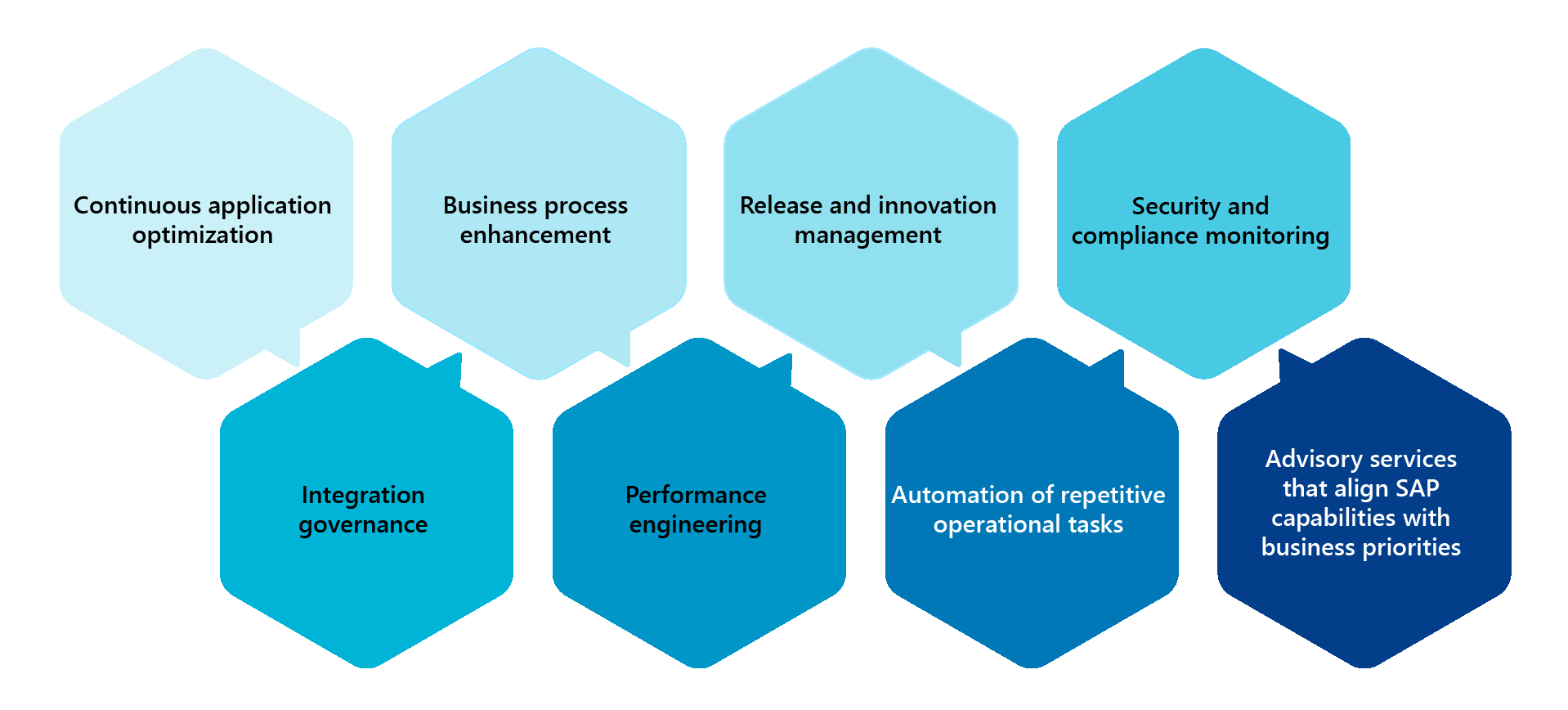
This represents a significant departure from the traditional “break-fix” approach. Here is how:
1. From Reactive Support to Continuous Value Creation
A common misconception is that managed services become less important after an SAP implementation. In practice, the opposite is true.
Research consistently shows that organizations often realize only a fraction of their ERP platform’s potential immediately after deployment. The greatest return on investment (ROI) is achieved through ongoing optimization—refining processes, adopting new capabilities, improving user adoption, and leveraging innovations introduced in regular SAP release cycles.
Without structured governance, many businesses postpone updates, delay enhancements, accumulate technical debt, and miss opportunities to improve operational efficiency.
Modern SAP support services address this challenge by embedding continuous improvement into day-to-day operations. Instead of responding only when issues arise, service teams actively monitor system health, identify optimization opportunities, recommend architectural improvements, and help organizations adopt new SAP innovations with minimal business disruption.
2. Requiring a Different Support Model
SAP S/4HANA introduces architectural and operational characteristics that significantly influence how support should be delivered.
These include:
- An in-memory database architecture that requires specialized performance optimization
- Simplified yet continuously evolving business processes
- Frequent cloud releases introducing new functionality
- Increasing integration with SAP Business Technology Platform (BTP), analytics, AI services, and third-party applications
- Higher expectations around cybersecurity, governance, and regulatory compliance
- Hybrid landscapes combining on-premises and cloud environments
Supporting such environments requires multidisciplinary expertise spanning infrastructure, applications, databases, integrations, security, cloud operations, and business processes.
For example, SAP HANA managed services focus on ensuring optimal database performance, memory utilization, backup strategies, disaster recovery readiness, and high availability areas that directly influence business continuity and application responsiveness.
Similarly, SAP BASIS managed services have evolved beyond system administration to encompass cloud provisioning, transport management, automation, identity management, patch governance, monitoring, and lifecycle management across increasingly distributed SAP landscapes.
These capabilities collectively form the operational backbone that enables business applications to remain resilient, secure, and scalable.
3. Changing Business Expectations
Business leaders no longer evaluate IT solely on operational efficiency.
Increasingly, executive teams ask broader questions:
- Can new business capabilities be introduced faster?
- Can regulatory changes be implemented with minimal disruption?
- Can users adopt SAP innovations without extensive retraining?
- Can AI and automation improve operational efficiency?
- Can system performance support business growth?
- Can technology investments generate measurable business value?
Answering these questions requires managed service providers to possess not only technical knowledge but also deep functional expertise across finance, supply chain, procurement, manufacturing, human resources, and customer experience.
This is why the boundary between SAP application support and business consulting continues to blur. The most effective service providers now work alongside business stakeholders, identifying opportunities to optimize workflows, automate manual processes, improve reporting, and enhance the overall user experience.
4. The Rise of Outcome-Oriented Managed Services
Forward-looking organizations are redefining success metrics for SAP operations.
Instead of measuring only incident volumes or response times, they increasingly evaluate managed services based on outcomes such as:
- Faster adoption of SAP innovations
- Reduced operational risk
- Improved business process efficiency
- Higher system performance
- Increased user satisfaction
- Greater automation
- Lower total cost of ownership
- Accelerated time-to-value from SAP investments
This shift has transformed managed services from an operational expense into a strategic enabler of digital transformation.
As SAP ecosystems become more intelligent, interconnected, and cloud-driven, enterprises require service models that can simultaneously ensure operational resilience, support evolving business needs, and continuously unlock new value. This evolution sets the foundation for the next-generation operating model built around three interconnected capabilities: Run, Support, and Improve.
The Three-Layer Operating Model: Run, Support, Improve
The most successful SAP S/4HANA programs don’t distinguish between implementation and operations – they view operations as a continuous transformation journey.
This shift has given rise to a modern operating model built around three interconnected layers: Run, Support, and Improve. Rather than functioning as independent activities, these layers work together to ensure business continuity while enabling continuous innovation.
Organizations that embrace this model move beyond reactive IT operations and create an environment where SAP evolves in step with changing business priorities.
Layer 1: Run – Ensuring Stability, Availability, and Performance
The “Run” layer forms the operational foundation of the SAP landscape. Its objective is straightforward yet critical: keep business systems available, secure, performant, and resilient around the clock.
For global enterprises operating across multiple geographies and time zones, even a few minutes of ERP downtime can disrupt supply chains, delay financial transactions, interrupt manufacturing schedules, or impact customer service. Consequently, the Run layer must deliver operational excellence at scale.
Core capabilities include:
- 24×7 proactive system monitoring
- Infrastructure and application health checks
- Performance and capacity management
- High availability and disaster recovery planning
- Backup and recovery management
- Security patching and vulnerability management
- Job scheduling and monitoring
- Database optimization
- Cloud resource monitoring
For organizations running SAP on hyperscalers such as Microsoft Azure, AWS, or Google Cloud, the Run layer also includes cloud infrastructure optimization to ensure workloads remain cost-efficient and resilient.
A critical component of this layer is SAP BASIS managed services, which oversee system administration, transport management, kernel updates, user administration, technical monitoring, and lifecycle management. As SAP environments become increasingly hybrid and distributed, BASIS teams also play an important role in automating routine administration and ensuring governance across multiple landscapes.
Similarly, SAP HANA managed services ensure that the in-memory database powering S/4HANA delivers consistent performance through proactive memory management, indexing optimization, backup strategies, replication monitoring, and database health assessments.
Increasingly, organizations are applying AIOps capabilities to the Run layer. Instead of waiting for alerts after failures occur, machine learning models analyze telemetry data to identify abnormal behavior, predict infrastructure issues, and recommend preventive actions before users experience service degradation.
The result is a more resilient ERP environment with fewer unplanned outages and improved operational efficiency.
Layer 2: Support – Moving Beyond Incident Resolution
Traditional support models often revolved around a ticket queue. Users reported issues, IT teams investigated them, and service providers resolved them within agreed service-level agreements (SLAs).
While incident management remains essential, modern SAP support services extend far beyond reactive troubleshooting.
Today’s support organizations are expected to act as trusted advisors who understand business processes as deeply as they understand SAP technology. This means collaborating with finance teams during period-end close, assisting procurement teams during supplier onboarding, supporting manufacturing operations, and ensuring that critical business processes continue uninterrupted.
Modern support services typically include:
- Functional application support
- Incident and problem management
- Root cause analysis
- Change request management
- Release coordination
- Security and authorization support
- Integration issue resolution
- User training and knowledge management
- Compliance and audit assistance
Rather than measuring success solely by ticket closure rates, mature organizations evaluate support using business-centric metrics such as process availability, first-contact resolution, business impact, and user satisfaction.
This evolution has significantly expanded the scope of SAP application support. Support teams increasingly collaborate with business stakeholders to identify recurring issues, eliminate manual workarounds, and recommend process improvements instead of simply resolving technical incidents.
As organizations accelerate digital transformation, this consultative approach becomes a competitive differentiator.
Layer 3: Improve – Turning Operations into Continuous Innovation
The Improve layer is where modern managed services create the greatest long-term business value.
Unlike traditional support contracts that focused on maintaining existing functionality, today’s enterprises expect their SAP environments to evolve continuously. Every quarter introduces new SAP innovations, security enhancements, user experience improvements, and AI-enabled capabilities. Organizations that fail to adopt these advancements risk accumulating technical debt and falling behind competitors.
The Improve layer embeds continuous optimization into day-to-day operations through activities such as:
- Business process optimization
- Continuous performance tuning
- SAP innovation adoption
- Automation opportunities
- Technical debt reduction
- Release readiness assessments
- User experience improvements
- AI and analytics enablement
- KPI monitoring and optimization
- Cost optimization across cloud environments
This proactive approach aligns closely with Forrester’s view that modern application management is shifting from operational maintenance to continuous business transformation. Instead of acting only as support providers, managed service partners should become strategic advisors who help organizations maximize the business value of enterprise applications.
The Improve layer is particularly valuable for organizations that have recently completed S/4HANA migrations. Rather than treating go-live as the finish line, they establish governance processes that continuously evaluate new SAP capabilities against business objectives.
SAP Managed Services in the Cloud (RISE and Private/Public Edition)
The move toward cloud ERP has fundamentally changed how organizations consume and manage SAP.
Whether businesses adopt SAP S/4HANA Cloud Public Edition, Private Edition through RISE with SAP, or a hybrid deployment model, operational responsibilities are now shared across SAP, hyperscale cloud providers, internal IT teams, and managed service partners.
Understanding these responsibilities is essential for successful cloud operations.
1. Managed Services in SAP S/4HANA Cloud Public Edition
In the Public Edition model, SAP manages much of the underlying technical infrastructure, including upgrades, platform maintenance, and core system operations. However, this does not eliminate the need for managed services.
Organizations still require expertise in areas such as:
- Business process configuration
- Integration management
- User administration
- Security governance
- Change management
- Quarterly release adoption
- Testing coordination
- Business process optimization
- Application monitoring
Hence, consultation and support from SAP partners can help organizations rapidly adopt new capabilities introduced in SAP’s quarterly releases while minimizing disruption to ongoing operations.
2. Managed Services in SAP S/4HANA Cloud Private Edition and RISE with SAP
Private Edition offers greater flexibility and customization but also introduces additional operational complexity.
Although SAP manages significant portions of the infrastructure through RISE with SAP, customers remain responsible for many application-level activities, integrations, security policies, custom developments, testing, governance, and business process optimization.
This is where SAP cloud managed services become indispensable.
The following table provides an overview of the key SAP technology layers, the corresponding platform, and the products covered under each layer. It illustrates how SAP’s technology ecosystem is organized across data & analytics, integration & application development, and artificial intelligence:
| Layer | Platform | Products Covered |
|---|---|---|
| Data + Analytics | SAP BDC (Business Data Cloud) | SAC (SAP Cloud Analytics) SAP Datasphere SAP Master Data Management/Governance SAP Integration Suite: CPI (Cloud Process Integration), API Management, Event Mesh, Open Connectors, Integration Advisor |
| Integration + App Development | SAP BTP | SAP Build (Low Code & Automation Consolidation): SAP Build Apps, SAP Workflow/Process Automation, SAP BAS (Business Application Studio) |
| AI | AI Stack | SAP AI Core: SAP AI Launch Pad, Joule/AI Agents (Emerging Layer) |
A partner offering SAP consulting services acts as the operational bridge between SAP, hyperscale cloud providers, internal business teams, and third-party vendors – ensuring that responsibilities are clearly defined, issues are resolved efficiently, and innovations are implemented without disrupting business operations.
Typical services include:
- Cloud operations management
- Integration monitoring
- Release planning
- Custom code lifecycle management
- Security governance
- Business continuity planning
- Environment management
- Performance optimization
- Automation initiatives
As cloud environments become increasingly interconnected, these services help organizations maintain visibility and control across complex digital ecosystems.
Why Cloud Requires a Different Operating Mindset
Migrating to the cloud does not reduce operational responsibility – it changes its nature.
Instead of managing physical infrastructure, organizations must focus on:
- Governance
- Automation
- Consumption optimization
- Security
- Business process resilience
- Innovation adoption
To achieve this balance, organizations need a service model that can simultaneously protect operational stability and accelerate continuous transformation. This is where experienced managed service providers play a critical role. By combining deep SAP expertise with modern cloud operating capabilities, they help enterprises navigate complex S/4HANA environments, optimize performance, adopt new innovations faster, and maximize the long-term value of their cloud investments while maintaining the resilience, security, and operational excellence their businesses depend on.
How Intelligent Application Management (iAM) is Redefining SAP Managed Services
As enterprise applications become more interconnected and business expectations continue to evolve, traditional support models are reaching their limits. Managing tickets, resolving incidents, and maintaining system availability remain important, but they are no longer sufficient to maximize the value of an SAP S/4HANA investment.
This is where Intelligent Application Management (iAM) represents the next evolution of SAP managed services.
Rather than focusing solely on operational maintenance, iAM combines automation, artificial intelligence (AI), predictive analytics, business process intelligence, and human expertise to create a proactive, data-driven operating model. The objective is simple: prevent issues before they occur, optimize applications continuously, and align IT operations with measurable business outcomes.
Instead of asking, “How quickly can we resolve an incident?”, iAM asks, “How can we prevent the incident altogether?”
The Core Principles of Intelligent Application Management
An Intelligent Application Management (iAM) framework is built on five key pillars that help organizations move from reactive SAP support to proactive, continuous improvement.
1. Predictive Operations
Predictive operations use intelligent monitoring tools to continuously track the health and performance of SAP applications, databases, integrations, and infrastructure.
Instead of waiting for a system failure or performance issue, AI-powered analytics identify unusual patterns, detect potential risks, and alert teams before problems impact business operations.
This allows support teams to take preventive action, reduce downtime, and ensure a more reliable SAP environment.
2. Automation at Scale
Many SAP operations involve repetitive tasks such as system health checks, job monitoring, user access management, backup verification, and compliance reporting. With intelligent automation, these activities can be performed faster and more consistently with minimal manual effort.
Automation reduces errors, improves operational efficiency, and allows technical teams to focus on more strategic activities such as innovation and business improvement.
3. Business Process Intelligence
Traditional SAP monitoring focuses mainly on technical performance, such as system speed, database health, or infrastructure availability. iAM goes further by understanding how technology impacts critical business processes across areas such as finance, procurement, supply chain, manufacturing, and customer operations.
For example, instead of simply reporting that an integration has failed, iAM can identify that the issue is delaying purchase orders, affecting invoice processing, or disrupting production planning.
This business-focused approach helps teams prioritize problems based on their impact on the organization not just their technical severity.
4. Continuous Innovation Management
SAP continuously introduces new features, security updates, AI capabilities, and industry-specific innovations. However, many organizations struggle to adopt these improvements while managing day-to-day operations.
An iAM approach helps organizations evaluate new SAP capabilities, understand their business value, test them effectively, and implement them smoothly.
This ensures businesses continue to get maximum value from their SAP investments without disrupting critical operations.
5. Data-Driven Decision Making
iAM provides real-time dashboards and insights into key areas such as system performance, application availability, automation levels, user adoption, and service quality.
These insights help IT leaders and business stakeholders make better decisions, identify improvement opportunities, and measure the actual business value generated from their SAP environment.
By using data instead of assumptions, organizations can continuously optimize their SAP operations and align technology investments with business goals.
The Business Impact of iAM
Organizations adopting Intelligent Application Management experience benefits that extend well beyond traditional IT operations. By combining automation, AI-driven insights, and business-focused monitoring, iAM helps enterprises build SAP environments that are more resilient, efficient, and aligned with business objectives.
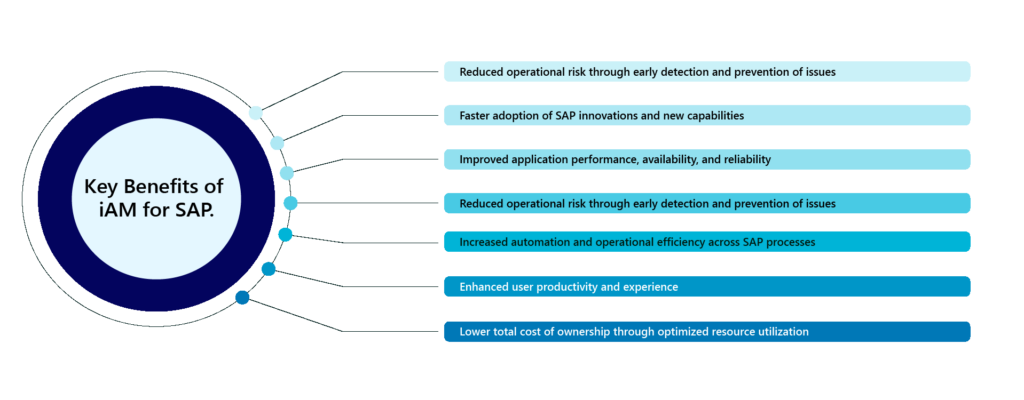
As iAM continues to mature, the next wave of transformation is being driven by agentic AI, taking SAP operations from intelligent monitoring to intelligent decision-making. By combining real-time insights with autonomous AI agents, organizations can move beyond simply identifying issues to predicting risks, recommending improvements, and executing corrective actions with minimal human intervention.
This evolution is paving the way for self-healing and self-optimizing SAP environments – systems that continuously learn, adapt, and improve to support changing business needs while delivering greater agility, efficiency, and business value.
Also Read: How AI Agents are Revolutionizing Application Management: Moving Beyond the AI Hype
Choosing an SAP Managed Services Partner for S/4HANA
Selecting a managed services partner is no longer a procurement decision focused solely on cost or service-level agreements. It is a strategic investment that influences how effectively an organization can operate, optimize, and evolve its SAP landscape over the long term.

The role of SAP managed services has evolved from simply maintaining systems to enabling continuous transformation. Enterprises today need partners who can proactively manage complexity, leverage automation, and help them unlock the full potential of their S/4HANA investments. We at Everforth Quinnox is championing this evolution by combining deep SAP expertise, AI-led automation, and intelligent delivery models to help organizations build resilient, future-ready SAP landscapes that continuously adapt and deliver business value.
Golla Srinivasa Rao
Director – SAP Practice & Delivery, Everforth Quinnox
The right partner should not only keep systems running but also contribute to innovation, operational resilience, and measurable business value.
1. Evaluate Business and Technical Expertise
SAP S/4HANA is deeply integrated with critical business processes. As a result, managed service providers must possess expertise across both technology and functional domains.
Look for partners with experience in areas such as:
- Finance and controlling
- Supply chain management
- Manufacturing
- Procurement
- Human capital management
- Customer experience
- Analytics and reporting
- SAP Business Technology Platform (BTP)
A provider that understands business outcomes is better equipped to recommend process improvements and support digital transformation initiatives.
2. Assess Cloud Capabilities
As organizations increasingly adopt hybrid and cloud-first strategies, partners should demonstrate proven expertise in managing SAP workloads across cloud environments.
A capable partner should have expertise in areas such as:
- Cloud architecture design: Creating the right cloud setup to ensure SAP systems are secure, scalable, and designed for future growth.
- Multi-cloud operations: Managing SAP environments that run across different cloud platforms while maintaining consistent performance and control.
- RISE with SAP support: Helping organizations manage their responsibilities in RISE with SAP, including application operations, integrations, security, and continuous improvements.
- Integration management: Ensuring SAP connects smoothly with other business applications, platforms, and digital services.
- Cloud security: Protecting SAP systems and sensitive business data through strong security practices, monitoring, and compliance controls.
- Disaster recovery planning: Preparing strategies to quickly restore SAP operations during unexpected disruptions.
- Cost optimization: Monitoring cloud usage and improving resource utilization to control costs without affecting performance.
- Automation and orchestration: Using automation tools to simplify routine tasks, improve efficiency, and reduce manual effort.
3. Look Beyond Traditional SAP AMS
Many providers continue to position SAP AMS as an incident management service.
Leading organizations, however, expect much more.
A modern provider should offer:
- Continuous improvement programs
- Innovation roadmaps
- Automation initiatives
- AI-enabled monitoring
- Release and change management
- Business process optimization
- KPI reporting
- Executive governance
The objective should be to create an ongoing partnership focused on delivering business value rather than simply resolving support tickets.
4. Evaluate Automation and AI Maturity
Automation has become a key differentiator for modern managed service providers. The right partner should not only resolve issues but also use automation to make SAP operations faster, smarter, and more efficient.
When evaluating a managed services partner, ask how they use automation for activities such as:
- Monitoring SAP system health and identifying potential issues early
- Managing routine tasks such as backups, updates, and system checks
- Automating testing and deployment processes
- Streamlining compliance reporting and documentation
- Reducing manual effort in repetitive administrative activities
- Improving response times and operational efficiency
A partner with strong automation capabilities can help organizations reduce operational complexity, minimize errors, and allow IT teams to focus more on innovation and business improvement rather than routine maintenance.
5. Prioritize Governance and Transparency
Successful managed services depend on clear communication, accountability, and a strong governance approach. A good partner should have a structured way of managing the relationship, tracking performance, and continuously improving services.
This includes:
- Defined service ownership
- Executive steering committees
- Regular operational reviews
- Business value reporting
- Risk assessments
- Innovation planning sessions
- Clearly defined KPIs aligned with business objectives
6. Think Long Term
SAP S/4HANA is designed as a digital core that supports enterprise growth over many years. Accordingly, the relationship with a managed services provider should evolve alongside the business.
The most successful partnerships are characterized by collaboration, continuous learning, shared accountability, and a commitment to innovation.
Rather than acting as an external vendor, the ideal partner becomes an extension of the organization’s IT and business teams.
How Everforth Quinnox’s SAP Managed Services Enable Smarter S/4HANA Operations and Continuous Improvement
As organizations navigate the complexities of SAP S/4HANA transformation and ongoing operations, they need more than traditional managed services. They need a partner that can combine SAP expertise, intelligent automation, and business-focused innovation to help them operate efficiently today while preparing for future growth.
Everforth Quinnox’s SAP managed services approach is built around this principle – helping enterprises run, support, and continuously improve their SAP environments through a combination of deep domain expertise, automation-led delivery, and intelligent operations.
A key differentiator is Everforth Quinnox’s Services-as-Software (SaS) framework recognized by HFS Research, which brings a software-driven approach to SAP transformation and managed services. The AI-led delivery platform automates repetitive and time-consuming activities such as SAP landscape assessment, custom code analysis, test case generation, and data validation. This allows SAP experts to focus their efforts on complex business decisions, solution design, and optimization opportunities where human expertise creates the greatest impact.
By combining intelligent automation with SAP expertise, the SaS model helps organizations reduce analysis and solution effort by 50%, enabling faster execution, lower project costs, improved predictability, and reduced transformation risks.
The approach is supported by purpose-built capabilities designed to address different stages of the SAP lifecycle:
- QTransition helps organizations assess their SAP landscape, identify migration complexities, and accelerate S/4HANA readiness.
- QMDG enables effective master data governance, helping enterprises improve data quality and establish a strong foundation for digital transformation.
- QArchive supports legacy data management by helping organizations streamline historical data retention while maintaining compliance and accessibility.
- UI5 Converter accelerates SAP Fiori modernization by helping enterprises with legacy ERP transition, transforming traditional user interfaces into modern, user-friendly experiences.
- SAP managed services capabilities provide ongoing application support, optimization, monitoring, and continuous improvement after go-live.
Beyond migration, Everforth Quinnox helps organizations establish a future-ready SAP operating model.
So, whether you are preparing for an SAP S/4HANA transformation, optimizing an existing landscape, or looking to build a more intelligent operating model, connecting with Everforth Quinnox SAP experts can make the difference between simply running SAP and continuously unlocking its value.

Deputy Manager, Marketing, Everforth Quinnox
FAQs Related to SAP Managed Services
SAP AMS (Application Management Services) primarily focuses on supporting SAP applications—resolving incidents, managing changes, and improving business processes. SAP managed services take a broader approach by covering application support along with infrastructure, cloud operations, security, monitoring, automation, and continuous optimization of the entire SAP landscape.
The cost of SAP managed services depends on factors such as the size and complexity of the SAP environment, number of users, support coverage, cloud model, customization levels, and required service capabilities. Most providers offer flexible models based on business needs, from basic application support to fully managed SAP operations.
Yes. SAP managed services can support S/4HANA Cloud environments, including RISE with SAP. While SAP manages certain infrastructure responsibilities, organizations still need support for application management, integrations, security, testing, governance, user support, and continuous improvement.
SAP Basis managed services cover the technical administration of SAP systems. This includes system monitoring, performance management, user administration, transport management, upgrades, patches, backups, and overall system health. These services help ensure SAP environments remain stable, secure, and available for business operations.