Your finance team spends nearly a third of its time reconciling data that should already agree, while your ECC custom code has grown untouched for years because nobody wants to be the one who breaks something. These are not edge cases, but the operational reality that makes SAP ECC to S/4HANA migration not just a technical initiative, but a business imperative.
With SAP mainstream support ending December 31, 2027, the window to migrate on your own terms is closing faster than most project plans acknowledge.
As of 2026, whether you call it an ECC to S/4HANA migration, an S/4HANA system conversion, or an s4hana upgrade, the destination and the deadline are the same. This guide maps the full path from ECC to S/4HANA.
This guide covers every decision your team needs to make right from strategy, deployment model, data governance, testing, and the ROI metrics that justify the investment to your board.
How much will your S/4HANA migration cost?
Get your projected NPV, IRR, and payback period in under two minutes, with numbers your CFO can defend in the room. Calculate your ROI →
The 2026 Strategic Mandate: This Is No Longer Optional
It’s 2:58 AM. Your CFO is on a bridge call because the month-end close has stalled. Your ECC system is reconciling data across three separate ledgers, and one of them quietly failed a batch job six hours ago. Your best ECC architect retired last year, and the two who remain are fielding calls from three other panicked teams just like yours.
Tens of thousands of organizations worldwide are navigating this exact inflection point, and the window to act on your own terms is narrowing with every passing quarter.
The companies moving decisively are gaining competitive separation. The ones waiting are accumulating technical, financial, and operational risk at an accelerating rate, compounding in ways most teams don’t fully price until they’re already behind.
What Is SAP S/4HANA Migration? Building the AI-Native Digital Core
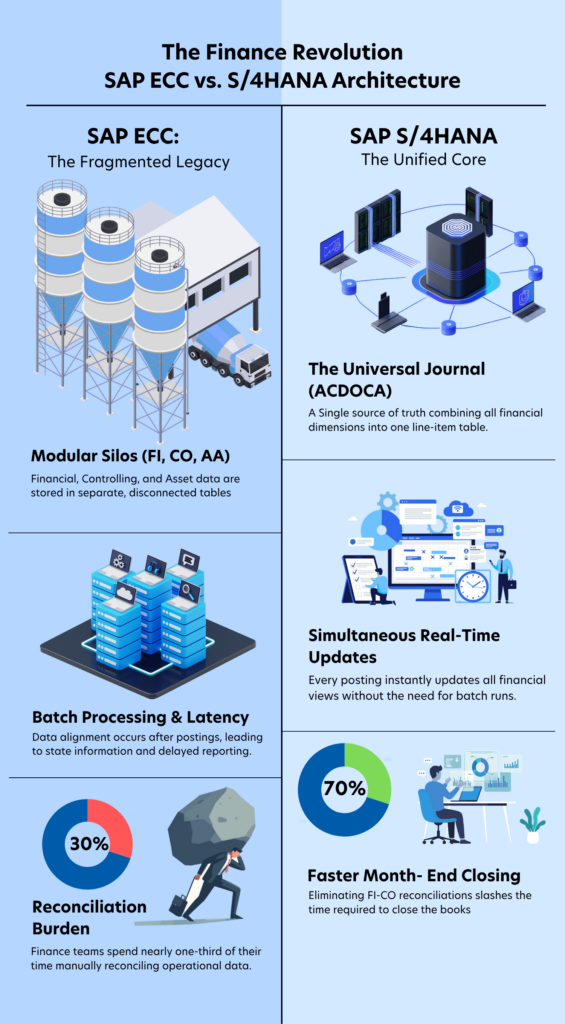
SAP S/4HANA migration, specifically the move from SAP ECC to S/4HANA, is not just a software update. It is a fundamental re-architecture of how your enterprise creates, stores, and acts on financial and operational data.
The most significant technical shift is the move from legacy batch processing to the Universal Journal (Table ACDOCA) – a single, real-time data store that eliminates the fragmented ledger landscape that has plagued ECC environments for decades.
The Journal of Enterprise Resource Planning reports that companies running traditional ERP systems spend approximately 30% of their finance team’s time simply gathering operational and financial data. That’s not an analysis. That’s manual error-correction at enterprise scale, and the Universal Journal eliminates that inefficiency by design.
Beyond the architecture, S/4HANA unlocks Business AI, specifically SAP Joule – a generative AI assistant – that operates directly on your transactional data, supporting finance teams on closing tasks and supply chain teams on exception management in real time.
SAP ECC vs S/4HANA: Key Differences at a Glance
Before choosing a path, teams need a clear picture of what actually changes between the two systems. The move from SAP ECC to S/4HANA is an architectural shift, not a version upgrade, and the differences below drive every downstream decision on strategy, cost, and effort.
| Dimension | SAP ECC | SAP S/4HANA |
|---|---|---|
| Database | Disk-based, runs on any supported database | In-memory SAP HANA only |
| Data model | Redundant aggregate and index tables | Simplified; aggregates removed |
| Finance core | Separate FI, CO, and AA ledgers | Universal Journal (ACDOCA), single source of truth |
| Processing | Batch, with latency between postings | Real-time, simultaneous updates |
| Analytics | Separate BW or reporting layer | Embedded, real-time analytics |
| User experience | SAP GUI and transaction codes | Fiori role-based Launchpad |
| Intelligence | Reactive and manual | AI-native with SAP Joule |
These differences explain why a like-for-like lift of ECC configuration rarely works. S/4HANA rewards simplification, and the migration is the moment to claim it.
Key Takeaway: SAP ECC to S/4HANA migration replaces a disk-based, batch-driven, GUI-led ERP with an in-memory, real-time, Fiori-based, AI-native core. The differences are structural, which is why strategy and Clean Core decisions matter more than raw technical conversion.
Real Risks, Challenges & Mitigation: What Could Go Wrong (and Often Does)
The challenges that derail SAP ECC to S/4HANA migrations are predictable, which means they are manageable when named early:
- The 2027 maintenance deadline and shrinking runway (below)
- The retiring ECC talent pool and rising consulting costs (below)
- Custom code sprawl and Clean Core readiness (see The Clean Core Imperative)
- Data quality, the leading cause of migration failure (see Data Migration)
- Integration continuity across dozens of interfaces (see Keeping Your Integrations Intact)
- Authorization and GRC redesign for Fiori (see Redesigning Security and Authorizations)
- Testing coverage gaps that surface at go-live (see Testing Strategy)
The 2027 Deadline Is Closer Than It Looks
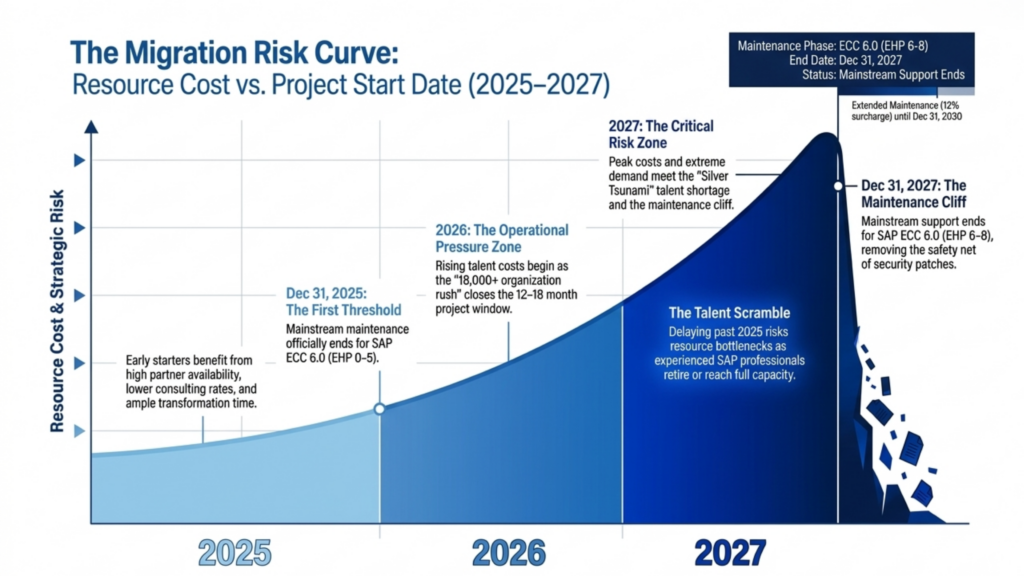
Despite the looming maintenance cliff, a significant portion of global companies have not yet started their S/4HANA migration, and the ones who haven’t are running out of runway faster than their project plans reflect.
For many, the urgency hasn’t fully landed until they look at the hard dates:
- SAP ECC 6.0 (EHP 6-8): Mainstream support ends December 31, 2027
- SAP ECC (EHP 0-5): Mainstream support ended December 31, 2025
If your organization is on an older EHP version, you may already be operating on borrowed time.
The Talent Shortage Nobody Budgets For
Veteran ECC specialists are retiring in large numbers. By 2027, you won’t just face tighter timelines, but also resource bottlenecks and significant price spikes as every company in your industry competes for the same shrinking pool of qualified consultants.
More custom code also accumulates with every passing quarter, making the eventual assessment more complex, the migration longer, and a slip past the 2027 deadline more likely.

Most organizations are treating the 2027 deadline as a project start date. That’s the wrong frame. By the time you factor in landscape assessment, clean core preparation, and data governance, 2027 is already your go-live window, not your planning window. The teams we see struggle are the ones who thought they had more runway than they did.
Golla Srinivasa Rao
Director – SAP Practice & Delivery, Everforth Quinnox
How Everforth Quinnox's QTransition Breaks the Loop
Everforth Quinnox’s QTransition platform automates the discovery process, providing a reverse-engineered understanding of your entire SAP landscape before a single line of migration code is written. It replaces assessment uncertainty with a structured, data-driven picture of what needs to move, what needs to be rebuilt, and what should simply be retired.
If you’re mapping out your migration engagement and want to understand what end-to-end looks like, from landscape assessment through post-migration AMS, Everforth Quinnox’s SAP S/4HANA migration and implementation practice is the right starting point.
Building that foundation of certainty early is what separates migrations that land on schedule from the ones that make headlines for the wrong reasons.
Key Takeaway: The 2027 maintenance cliff, the shrinking talent pool, and compounding technical debt create a trifecta of risk. AI-powered tools like QTransition remove uncertainty by automating discovery, cutting the most common cause of scope creep before the project starts.
Choosing Your Migration Strategy: Greenfield, Brownfield, or Selective Transformation
There is no single right path. The correct strategy depends on your business complexity, data volume, customization debt, and transformation appetite.
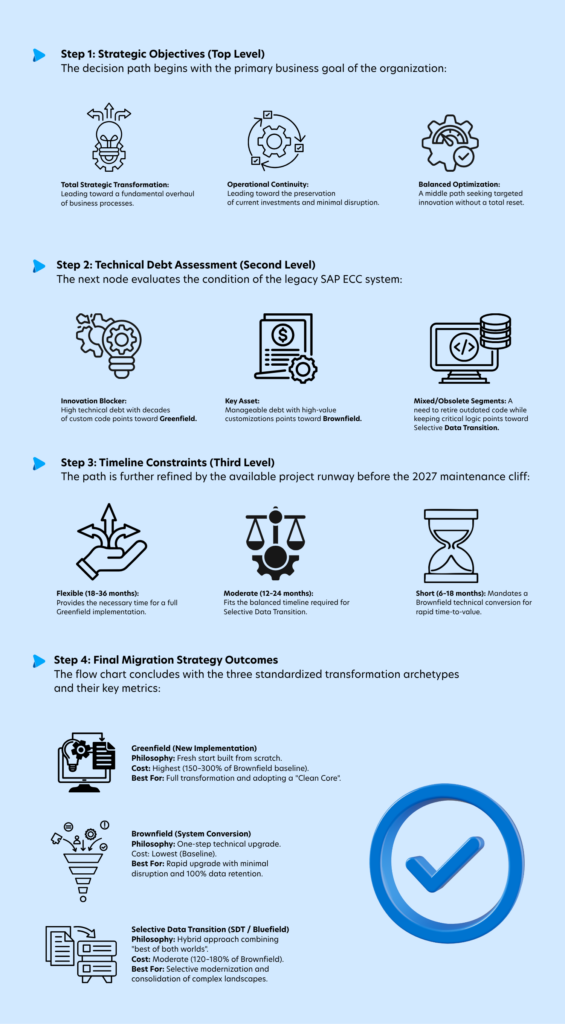
Greenfield: Start Clean
Greenfield (New Implementation) is the right choice when your ECC environment is a museum of accumulated workarounds, and you want to re-engineer business processes from the ground up.
You carry no legacy technical debt into the new environment, but the tradeoff is time, cost, and significant change of management. Best suited for organizations with M&A complexity or highly fragmented landscapes.
Brownfield: Move Fast, Stay Intact
Brownfield (System Conversion) is the fastest path, typically 6 to 12 months, retaining 100% of historical data and preserving existing configurations.
The risk: Brownfield converts what exists without cleaning it, which is why Clean Core work remains non-negotiable even here. Best suited for organizations with tight timelines and low appetite for process disruption.
Bluefield: The Best of Both
Selective Data Transition (Bluefield®) allows organizations to selectively migrate data, consolidate multiple SAP instances, and adopt new processes simultaneously.
Everforth Quinnox delivers this through SynerG, an accelerated methodology built for complex scenarios, including multi-company code migrations, legal entity restructuring, and hybrid landscape rationalization.
Key Takeaway: 86% of enterprises choose Brownfield or Hybrid migration, not Greenfield. Strategy selection should be driven by your customization volume, timeline pressure, and tolerance for business disruption.
Deployment Model Decision: RISE with SAP, Private Cloud, or On-Premises?
How you host S/4HANA matters as much as which migration path you choose.
| Metric | RISE with SAP (Public Edition) | Private Cloud (Private Edition) | On-Premises |
|---|---|---|---|
| TCO (Total Cost of Ownership) | Lowest: Operates as a fully managed SaaS solution, shifting costs from CapEx to OpEx and reducing the burden on internal IT. | Moderate: Shifts to an OpEx subscription model that bundles infrastructure and operations, balancing cloud cost-benefits with more complex needs. | Highest: Requires large upfront CapEx for hardware and licenses, plus ongoing costs for an internal SAP IT team to manage maintenance and upgrades. |
| Flexibility | Low to Moderate: Prioritizes speed and standardization through "Fit-to-Standard" processes; least suitable for unique, complex customizations. | High: Provides a dedicated environment that supports moderate customizations, extensions, and a phased approach to cloud adoption. | Highest: Offers ultimate customization, allowing the enterprise to adapt the system to unique needs and integrate deeply with existing IT infrastructure. |
| Control | Low: Fully managed by SAP; updates are automatic and standardized, meaning the enterprise has limited control over the underlying infrastructure. | Moderate: Offers a dedicated environment with more control over process design and custom code compared to the public edition. | High autonomy. Agents can decide how to execute workflows, adjust plans, and complete validations independently. |
RISE with SAP shifts infrastructure costs from CapEx to a predictable OpEx model through SAP’s “Transformation-as-a-Service” bundle, offering budget predictability and transferring infrastructure management to SAP.
Private Cloud provides greater control for complex compliance environments, while On-Premises retain full control at the highest infrastructure cost.
GJETA states that organizations moving to a central S/4HANA platform can achieve IT operational cost reductions of up to 30% through landscape consolidation.
Everforth Quinnox’s Cloud Enablement services align migration architecture with hyperscalers, AWS, Azure, and GCP, thus ensuring your S/4HANA investment compounds through cloud-native capabilities rather than simply replicating an on-premises footprint elsewhere.
Key Takeaway: Central S/4HANA platforms can reduce IT operational costs by 30%. Aligning with a hyperscaler during migration, rather than retrofitting later, maximizes long-term ROI.
The Clean Core Imperative: Why It Defines Your Migration Success
Here’s what kills S/4HANA value post-go-live: Migrating a clean system and then immediately re-polluting it with legacy custom logic that was never re-evaluated.
Clean Core means decoupling custom business logic from the ERP core by moving extensions to the SAP Business Technology Platform (BTP). The result is a standard, maintainable core that absorbs SAP quarterly upgrades without regression nightmares.
The GJETA study above also states that a clean core foundation typically delivers a 15-25% improvement in Total Cost of Ownership (TCO), and that improvement compounds with every future upgrade.
Most ECC landscapes carry years, sometimes decades, of custom code. Some are genuinely necessary while some are obsolete logic that nobody dares touch because nobody fully understands it anymore.
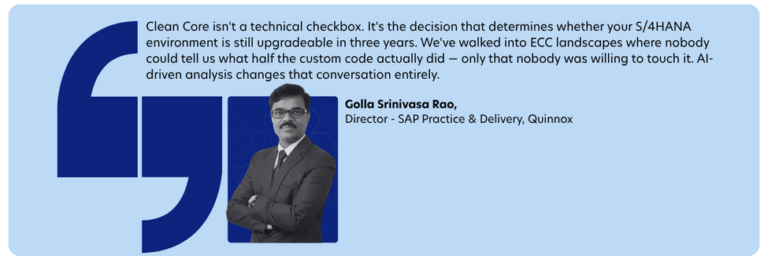
Clean Core isn’t a technical checkbox. It’s the decision that determines whether your S/4HANA environment is still upgradeable in three years. We’ve walked into ECC landscapes where nobody could tell us what half the custom code actually did — only that nobody was willing to touch it. AI-driven analysis changes that conversation entirely.
Golla Srinivasa Rao
Director – SAP Practice & Delivery, Everforth Quinnox
AI-driven code analysis identifies and retires the latter, consistently eliminating a substantial portion of custom code volume in Everforth Quinnox’s migration engagements — a direct reduction in the testing surface area that must be validated at go-live. at go-live.
Key Takeaway: Clean Core is the structural foundation of long-term S/4HANA ROI. AI-driven code analysis consistently eliminates a substantial portion of redundant custom code, directly lowering TCO and reducing the complexity of every future upgrade.
Data Migration: Solving the #1 Project Risk with QMDG & QArchive
Ask any SAP project manager what causes migration failures, and you’ll hear the same answer: data quality.
Poor data quality, not infrastructure failures or missing integrations, is the single leading cause of migration delays, and it is the risk that gets underestimated on almost every project plan. For a deeper look at the safeguards that prevent it, see our SAP data migration best practices guide.
Everforth Quinnox’s QMDG (Everforth Quinnox Master Data Governance) platform automates the validation, governance, and distribution of master data, ensuring high-quality data enters the new environment from day one, and not day ninety, when the cleansing exercise finally gets funded. It establishes the governance framework that prevents data quality from degrading again after go-live.
Every ECC environment also carries decades of historical data that nobody needs in the live system but must retain for compliance purposes. Migrating it directly into S/4HANA inflates HANA memory costs. QArchive solves this by retiring legacy cold data to cost-effective, compliant storage, reducing the database footprint and keeping the live environment lean.
Key Takeaway: Data quality is the leading cause of SAP migration failures. QMDG automates validation and governance from day one. QArchive reduces HANA memory costs by retiring historical data to cost-effective storage.
Keeping Your Integrations Intact During Migration
A typical ECC landscape does not run alone. It exchanges data with banking systems, EDI partners, warehouse and manufacturing systems, tax engines, CRM, and dozens of custom interfaces built over the years. Migration re-points, rebuilds, or retires every one of them, and an integration that silently breaks at cutover can stall order-to-cash on day one.
The shift is from point-to-point, IDoc and PI/PO-era connections toward API-first integration on SAP Integration Suite and the Business Technology Platform. Done well, this is where fragile custom middleware gets replaced with governed, monitored, reusable APIs.
The discipline is straightforward: inventory every interface during landscape assessment, map each one to keep, rebuild, or retire, and validate all of them under production-like load before users log in. Quinnox’s SAP integration services carry that inventory through to integration testing, so external connections hold when the system goes live.
Key Takeaway: Integrations are a top cause of go-live disruption. Inventory every interface during assessment, move point-to-point connections toward API-first integration on SAP BTP, and validate them under load before cutover.
Modernizing User Experience: From SAP GUI to Fiori & AI
Users won’t adopt a system that feels like it was designed in 2003. The shift from transaction codes (T-codes) to SAP Fiori’s role-based Launchpad is one of the highest-visibility changes in any S/4HANA migration. When it lands well, adoption accelerates. When it’s an afterthought, shadow IT fills the gap.
| UX Feature | SAP GUI (Legacy) | SAP Fiori (Modern) |
|---|---|---|
| Navigation | Transaction Codes (T-codes) and deep, complex menus. | Tile-based Launchpad with instant access to apps. |
| Design Basis | Form-based; requires manual data entry across multiple screens. | Role-based; shows only the specific tasks and data relevant to the user. |
| Device Support | Primarily restricted to Desktop/PC. | Responsive; accessible via Mobile, Tablet, or PC. |
| Intelligent Core | Reactive & Manual; users must seek out data and run reports. | Proactive & AI-Integrated; uses SAP Joule for autonomous insights. |
| Customization | Rigid and costly to adapt to user needs. | Flexible, extensible, and follows modern design standards |
Everforth Quinnox’s proprietary UI5 Converter automates the transformation of legacy SAP GUI screens into modern Fiori experiences, reducing time on typical conversion efforts by 60% and cutting turnaround timelines by as much as 80%, compressing what would otherwise be a months-long manual effort into weeks.
The UX modernization doesn’t stop at the interface layer. Integrating SAP Joule into finance workflows fundamentally changes the speed at which complex financial reports are generated, compressing what used to take hours into minutes.
Key Takeaway: User experience is a migration success factor, not a post-go-live refinement. SAP Joule integration fundamentally compresses the time finance teams spend generating complex reports, freeing analysts to focus on decisions rather than data assembly.
Redesigning Security and Authorizations for Fiori
Fiori does not just change how the system looks, it changes how access is granted. ECC authorizations are built around transaction codes and GUI menus. S/4HANA and Fiori move to a catalog and group model, where roles are composed from Fiori catalogs, spaces, and pages mapped to what each user actually does.
Lifting ECC roles across unchanged is the most common security mistake in a migration. Roles need to be re-derived against the new app inventory, segregation of duties (SoD) rules re-validated, and GRC controls re-baselined for the S/4HANA authorization objects. Getting this right protects the audit position and prevents the access gaps that generate help-desk load in the first weeks after go-live.
Key Takeaway: S/4HANA and Fiori replace transaction-based authorizations with a catalog and role model. Re-derive roles against the new app inventory and re-validate SoD and GRC controls rather than lifting ECC roles across unchanged.
Testing Strategy: The Discipline That Saves Go-Lives
The most common go-live failure in SAP migrations is a testing gap: a scenario not covered, a regression not caught, a custom workflow that behaved differently than expected. Manual UAT cannot scale to enterprise S/4HANA complexity.
Everforth Quinnox’s proprietary automated testing platform changes the equation entirely. Clients have achieved a 95% improvement in resolution time for automated use cases during the migration cycle, compressing five-hour triage marathons into focused, rapid response workflows.
The testing lifecycle doesn’t end at go-live. The regression suite built during migration continues delivering value in production, which is what prevents the post-go-live incidents that erode user confidence.
For organizations building a testing strategy across the full migration lifecycle, Everforth Quinnox’s SAP testing services detail the automation-first methodology behind that 95% improvement. The same coverage model extends to SAP integration testing, ensuring all external connections hold under production load before users log in.
Key Takeaway: Manual UAT cannot cover enterprise S/4HANA migration complexity. Everforth Quinnox’s automated testing platforms reduce resolution time by 95% and provide continuous coverage from implementation through production support.
Industry-Specific ROI Metrics
The ROI case for SAP S/4HANA migration is not theoretical. Across finance, operations, and compliance, enterprises consistently report gains that compound over time rather than plateau after go-live.
The Universal Journal restructures how financial data flows through the entire organization. That single architectural change creates downstream benefits touching every business function, from how fast the books close to how easily the business responds to regulatory demands.
The industry-specific outcomes below reflect where those gains are most immediate and measurable.
Financial Close: The impact on financial close is among the most immediate outcomes enterprises report after migration. When reconciliation is eliminated by architecture, the close cycle shrinks in ways that manual process improvements simply cannot replicate.
US Market, ESG Compliance: California SB 253 requires large companies to disclose greenhouse gas emissions. S/4HANA’s Universal Journal records emissions at the transaction level, turning regulatory reporting into a byproduct of normal operations.
Automotive: Embedded analytics and real-time supply chain visibility improve production planning outcomes, particularly relevant given ongoing supply chain volatility.
Life Sciences: GxP-compliant process migration requires careful validation rigor, including validated system documentation and audit trail management within the S/4HANA framework.
Key Takeaway: Month-end close time drops measurably post-migration, a direct consequence of reconciliation being eliminated by architecture rather than managed by people. US enterprises gain compounding ROI from ESG compliance integration, with emissions recorded at the transaction level transforming regulatory reporting from a burden into a standard output
Migration Timeline: Your SAP S/4HANA Migration Roadmap
Every well-run SAP S/4HANA migration roadmap follows the SAP Activate methodology: Discover, Prepare, Explore, Realize, Deploy, Run. The specific duration depends on your migration strategy, landscape complexity, and organizational readiness.
AI-powered assessment platforms meaningfully compress overall migration timelines — acceleration that comes from replacing weeks of manual landscape documentation with automated discovery before the Explore phase even begins.
SAP S/4HANA Migration Checklist: Pre-Migration Non-Negotiables
No SAP S/4HANA migration checklist is complete without validating these items before technical migration begins:
- Unicode Compliance: All custom code and data must be Unicode-compliant
- Business Partner (BP) Conversion: ECC customers and vendors must be converted to the S/4HANA Business Partner model
- New Asset Accounting (FI-AA) Pre-Checks: The new depreciation framework requires configuration validation before migration
- Custom Code Impact Analysis: ABAP custom code must be scanned for S/4HANA compatibility
- Data Quality Baseline: Master data governance framework must be in place before the Realize phase begins
Key Takeaway: AI-powered assessment meaningfully compresses migration timelines by eliminating manual discovery work before the project formally begins. Your SAP S/4HANA migration roadmap should follow SAP Activate methodology, while your SAP S/4HANA migration checklist, covering BP conversion, Unicode compliance, and FI-AA validation, must be completed before technical migration begins.
The Everforth Quinnox SaS Advantage: Your SAP S/4HANA Migration Partner
Not all SAP migration partners are the same. What separates SAP migration partners isn’t the headcount, but the methodology and tooling behind the delivery team.
Capability Matrix: Traditional SAP Services vs. Everforth Quinnox SaS
| Capability / Metric | Traditional SAP Services Model | Everforth Quinnox Services as Software (SaS) |
|---|---|---|
| Delivery Philosophy | Relies on manual spreadsheets, weeks of workshops, and hand-compiled documentation. | Rewires service delivery as an AI-led, software-driven engine. |
| Analysis & Solution Effort | Labor-intensive; requires significant manual effort from consultants to map legacy systems. | Delivers a 50% reduction in analysis and solution effort through automated platforms. |
| Resolution Speed | Dependent on human availability; often results in longer cycles for resolving use cases. | Achieves a 95% improvement in resolution time for automated use cases. |
| Support Efficiency | Focuses on reactive operational support, leading to potential bottlenecks. | Drives a 30% improvement in support efficiency while acting as an intelligent growth engine. |
| Testing & Quality Assurance | Uses hand-compiled test catalogs and disconnected tools, increasing risk. | Utilizes Quinnoix’s proprietary test automation platform for complex end-to-end automated testing. |
| Resource Collaboration | Primarily human-driven; knowledge is often siloed in individual consultants. | Built on a hybrid human-digital workforce that combines human expertise with AI. |
| Strategic IT Impact | Viewed as a technical cost center focused on system maintenance. | Transforms IT into a scalable, intelligent engine for business agility. |
Everforth Quinnox’s Services as Software (SaS) model uses an AI-led delivery platform to automate the repeatable components, including assessment, code analysis, test case generation, and data validation, while applying human intelligence to the decisions that require it.
The result is a 50% reduction in analysis and solution effort, which translates directly into faster timelines, lower project costs, and more predictable outcomes.
HFS Research has recognized Everforth Quinnox as a Market Challenger for this software-led delivery model. Core capabilities span QTransition for landscape assessment, QMDG for master data governance, QArchive for legacy data management, the UI5 Converter for Fiori modernization, and SAP AMS for post-go-live optimization.
The 2027 deadline is nearing. The talent shortage is accelerating, and the cost of waiting is compounding.
Organizations that start their SAP S/4HANA migration in 2025 or 2026 will go live with experienced resources, competitive pricing, and a clean core ready to absorb SAP’s next wave of AI capabilities.
Key Takeaway: The Everforth Quinnox SaS model reduces analysis and solution effort by 50% by combining AI-led automation with human expertise, delivering faster, more predictable SAP S/4HANA migrations at lower total cost.
Start Your SAP S/4HANA Migration Today
The lowest-risk next step is a structured landscape assessment. Before committing to a migration strategy, deployment model, or timeline, you need an AI-generated picture of your current SAP landscape: custom code volume, data quality baseline, integration dependencies, and S/4HANA readiness gaps. That is what QTransition delivers, in weeks, not months.
If your organization is ready to move from evaluation to execution, explore Everforth Quinnox’s SAP S/4HANA migration and implementation services and take the first step toward a migration that lands on time, on budget, and built to last.

Assistant Manager, Marketing, Everforth Quinnox
Frequently Asked Questions
SAP S/4HANA migration typically takes 6 to 18 months. Brownfield conversions can complete in 6 to 12 months, while Greenfield or Bluefield transitions run longer. AI-powered assessment platforms like QTransition meaningfully compress those timelines by eliminating the weeks of manual landscape discovery that traditionally precede the project’s first formal phase.
RISE with SAP is SAP’s “Transformation-as-a-Service” bundle, packaging S/4HANA Cloud, infrastructure, and support into a single subscription. It shifts costs from CapEx to a predictable OpEx model and transfers infrastructure management to SAP – best suited for organizations prioritizing budget predictability and a managed cloud path.
Costs vary based on organization size, migration strategy, and custom code volume. Brownfield is generally the most cost-efficient while Greenfield carries higher redesign costs. The most accurate way to size the investment is through an AI-driven landscape assessment that quantifies complexity before any budget is committed.
RISE with SAP suits organizations prioritizing cloud agility and OpEx predictability. On-premises offers maximum control, preferred in highly regulated industries. Either way, centralizing on S/4HANA can reduce IT operational costs by up to 30% — the key is aligning your deployment model with your cloud strategy before migration, not after.
The process covers six workstreams: landscape assessment, deployment model selection, custom code remediation, data migration and governance, Fiori UX modernization, and end-to-end testing. It follows SAP Activate methodology across Discover, Prepare, Explore, Realize, Deploy, and Run phases, with Unicode compliance, Business Partner conversion, and FI-AA validation completed before technical migration begins.
Everforth Quinnox’s in-house automation framework was built specifically for SAP S/4HANA migration scenarios, delivering a 95% improvement in resolution time for automated use cases. Unlike third-party tools, it creates a reusable regression suite during migration that continues providing coverage across rollout and production support, not just at go-live.
Quinnox is an HFS Market Challenger recognized for its Services as Software (SaS) delivery model. The Quinnox SAP practice covers S/4HANA migration and implementation, SAP testing, SAP integration, and post-migration application management services.
SAP ECC is a disk-based ERP that stores financial data in separate FI, CO, and AA ledgers and processes updates in batches. SAP S/4HANA runs on the in-memory SAP HANA database, unifies finance in the Universal Journal (ACDOCA), updates in real time, replaces the SAP GUI with the Fiori Launchpad, and adds AI through SAP Joule. The move is an architectural shift, not a version upgrade.
Yes. S/4HANA is the successor to ECC. SAP mainstream support for ECC 6.0 (EHP 6 to 8) ends December 31, 2027, and support for older EHP levels (0 to 5) ended December 31, 2025. ECC is not switched off, but running it past mainstream support means no new features and, eventually, no standard security patches.
Clean Core means keeping the S/4HANA core standard by moving custom business logic out to the SAP Business Technology Platform (BTP) instead of modifying the core. It matters because a clean core absorbs SAP’s quarterly upgrades without regression, which keeps the system upgradeable and lowers total cost of ownership over time.
Custom ABAP code is scanned for S/4HANA compatibility, then triaged into what must be kept, what should be rebuilt as a side-by-side extension on BTP, and what can be retired. AI-driven code analysis consistently removes a substantial share of obsolete custom code, which shrinks the testing surface at go-live.
Every interface is inventoried during landscape assessment and mapped to keep, rebuild, or retire. Point-to-point and IDoc-era connections move toward API-first integration on SAP Integration Suite and BTP, and all connections are validated under production-like load before cutover so order-to-cash and other flows hold on day one.
Choose Greenfield to re-engineer processes from scratch when the ECC landscape carries heavy technical debt or M&A complexity. Choose Brownfield for the fastest, lowest-disruption path when configurations are worth preserving. Choose Bluefield (Selective Data Transition) when you want to consolidate instances or restructure entities while migrating only the data and processes that still matter.
As of 2026 the migration window is mid-cycle. Mainstream support for older ECC EHP levels already ended in December 2025, and the ECC 6.0 (EHP 6 to 8) deadline is December 31, 2027. With landscape assessment, Clean Core preparation, and data governance factored in, 2026 is effectively the last comfortable year to start and still go live on your own terms.
Data-intensive, process-heavy sectors see the fastest gains: manufacturing and automotive through real-time supply chain visibility, financial services and large enterprises through faster close and embedded analytics, and life sciences through GxP-compliant, audit-ready process migration.