
SAP Implementation Cost Calculator for S/4HANA Migration
December 31, 2027. That is when SAP ends ECC support, and a full migration takes up to 30 months. The cost of waiting is already running. Here is what the data shows:


Calculator Snapshot

What Does SAP S/4HANA Implementation Actually Cost?
Before your board approves a single dollar, they will ask one question: what does this cost, and what do we get back?
SAP S/4HANA implementation cost varies widely depending on organization size and complexity. Focused mid-market deployments typically start below $1 million, while global enterprise rollouts commonly reach $5 million and beyond. But the headline number is rarely the number that matters. What matters is the full five-year financial picture: what you spend, when you spend it, what you recover, and what the residual business value looks like at the end.
That is exactly what this calculator models.
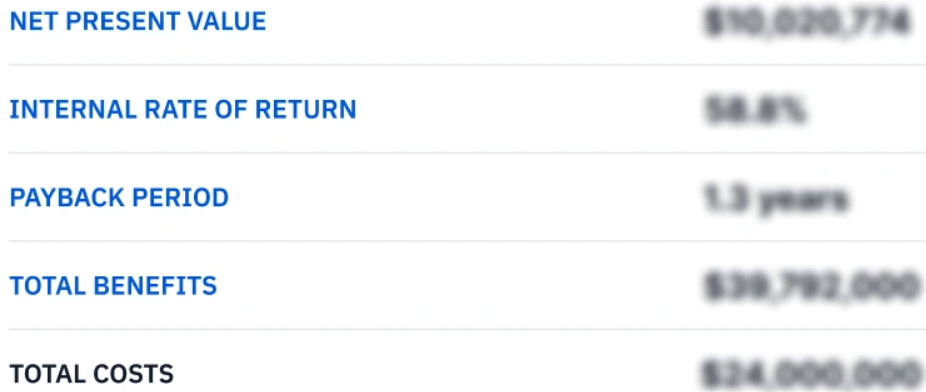
Based on your organization's inputs - implementation cost, IT run cost savings, working capital release, inventory reduction, and finance productivity gains - it produces a board-ready output: net present value (NPV), internal rate of return (IRR), and payback period. The same financial framework your CFO will use to make the call.
How to Read Your ROI Output
The calculator produces three financial metrics. Here is what each one means for your SAP business case.
 NPV
NPV
Net Present Value
NPV discounts your future cash flows back to today's value. A positive NPV means the migration is expected to create value in excess of its cost, adjusted for the time value of money. A negative NPV does not always mean reject - it may mean your benefit assumptions need refinement, or your discount rate needs review.
 IRR
IRR
Internal Rate of Return
IRR is the annualized return your migration investment is expected to generate. If your organization's hurdle rate (the minimum acceptable return on capital) is 12%, and the calculator returns an IRR of 22%, you have a compelling case. IRR is particularly useful for comparing migration scenarios - for example, assessing whether a phased rollout or a big-bang approach generates better returns.
 Payback
Payback Period
The point in months at which cumulative benefits exceed cumulative costs. IDC research (cited in Everforth Quinnox's SAP S/4HANA Migration Whitepaper) puts the average S/4HANA migration payback at just 10.6 months . If your payback extends beyond four years, it is worth revisiting your implementation scope, benefit assumptions, or deployment model.
What Drives ROI in an S/4HANA Migration?
Each benefit the calculator captures maps to a real, measurable outcome from S/4HANA adoption.

IT Run Cost Reduction
Maintaining ECC in the post-2027 support window is expensive. Extended maintenance contracts carry significant price premiums. Moving to S/4HANA on RISE eliminates legacy infrastructure costs, reduces the number of systems in the landscape (S/4HANA consolidates many standalone SAP modules), and moves infrastructure management to SAP's hyperscaler backbone. Customers routinely report IT run cost reductions of 15–30% in the three years post-migration. Everforth Quinnox's SAP S/4HANA migration guide notes that centralizing on S/4HANA can reduce IT operational costs by up to 30%.
These SAP cost savings compound over the five-year model horizon - meaning the later years of the calculator output carry proportionally more value than year one, which is why IRR is a more useful measure than simple payback for this investment class.
A clean core strategy - decoupling custom logic to SAP BTP rather than embedding it in the ERP core - typically delivers a 15–25% improvement in Total Cost of Ownership, compounding with every future upgrade. (Source: GJETA study, cited in Everforth Quinnox's SAP S/4HANA migration guide)

Working Capital Release
S/4HANA's real-time processing and Universal Journal enable finance teams to close faster and see cash positions more accurately. Tighter days sales outstanding (DSO) and days payable outstanding (DPO) management, enabled by S/4HANA's cash management module, can release meaningful working capital for mid-to-large organizations. Even a one-day improvement in DSO across $500 million in annual revenue translates to over $1.3 million in freed cash.

Inventory Reduction
S/4HANA's embedded analytics and Materials Requirements Planning (MRP Live) give supply chain teams real-time inventory visibility that ECC batch-processing cannot match. Organizations moving to S/4HANA commonly report inventory reductions in the range of 10–15% as forecast accuracy improves - a figure consistent with SAP's published industry value benchmarks, which cite 2–15% reduction in days in inventory for S/4HANA deployments. For a manufacturer carrying $50 million in inventory, even a 10% reduction translates to $5 million in capital released.

Finance Productivity Gains
Financial close is among the most resource-intensive and critical processes in any organization. SAP S/4HANA, particularly when paired with SAP BTP capabilities, enables continuous accounting, automated reconciliations, and faster consolidation cycles. Everforth Quinnox's SAP BTP use cases blog highlights how organizations using SAP Advanced Financial Closing and SAP Datasphere in tandem have materially reduced close cycle times - with every day of acceleration giving leadership faster access to accurate numbers for decisions.

Custom Code Reduction
This is the benefit most ROI models miss entirely - and it is one of the most significant. ECC landscapes typically carry years, sometimes decades, of custom code. AI-driven code analysis during the migration assessment phase identifies and retires obsolete custom logic, consistently eliminating a substantial portion of custom code volume. Less custom code means a smaller testing surface, lower AMS costs, and faster upgrade cycles going forward.
How Everforth Quinnox Approaches SAP Implementation Cost Management
Everforth Quinnox's SAP practice works with enterprises across manufacturing, retail, financial services, and healthcare. Two principles govern every engagement that directly affect the cost model you are building.

Clean Core as a Cost Discipline
- Every customization in ECC carries a hidden lifecycle cost: additional testing effort, upgrade friction, AMS complexity.
- Everforth Quinnox's migration engagements start with an AI-driven custom code analysis that identifies which customizations are essential and which can be retired or moved to BTP extensions.
- This discipline reduces implementation scope, lowers the testing surface at go-live, and structurally improves the five-year TCO - compounding savings that appear in the IRR and payback outputs of the calculator above.

Testing as Risk Management, Not an Afterthought
- One of the most significant sources of SAP implementation cost overrun is inadequate testing.
- Defects found post-go-live cost 5–10x more to fix than those caught in the testing phase.
- Everforth Quinnox's SAP testing services address the top challenges that impact customer experience - and independent analysis shows that scaling automation across the application lifecycle with SAP testing solutions can deliver a 334% ROI and organizational benefits of $7.8 million over three years.
Source: Forrester study, cited in Everforth Quinnox's SAP testing blog.
The 2027 Deadline: Why the Cost of Waiting Is Rising
SAP ends mainstream maintenance for ECC on 31 December 2027. Learn more about SAP ECC end of life and the risks of delaying your S/4HANA migration.. After that date, continued support requires an extended maintenance contract - at a significant premium - or organizations run their ERP unsupported. Every quarter spent on ECC is a quarter of:
- Rising infrastructure costs relative to cloud alternatives
- Growing custom-code debt that will be more expensive to untangle later
- Lost competitive advantage from capabilities S/4HANA users already deploy: embedded AI, real-time analytics, automated process orchestration
The organizations moving now are not just meeting a deadline. They are compressing their payback period by starting the benefit clock earlier. Modelling the cost of delay - the extended maintenance premium plus the foregone benefits - is one of the most powerful additions you can make to your board presentation.