Introduction
According to the latest data from the Bank for International Settlements (BIS), the notional value of outstanding over-the-counter (OTC) derivatives reached $846 trillion by mid-2025—a 16% year-over-year increase and the fastest market growth since before the 2008 financial crisis. And as trading volumes and product complexity increase, so do the operational demands placed on financial institutions.
Every trade now passes through a highly interconnected ecosystem of pricing, risk management, collateral, settlement, accounting, and regulatory reporting – often spanning multiple business units, geographies, and technology platforms. In this environment, even a small disconnect between systems can trigger reconciliation breaks, reporting delays, liquidity risks, or costly regulatory penalties.
The challenge is that many legacy trading platforms were built for a different era. Siloed applications, fragmented data, and disconnected workflows make it increasingly difficult to manage today’s high-volume, real-time trading operations while meeting growing regulatory and risk management expectations.
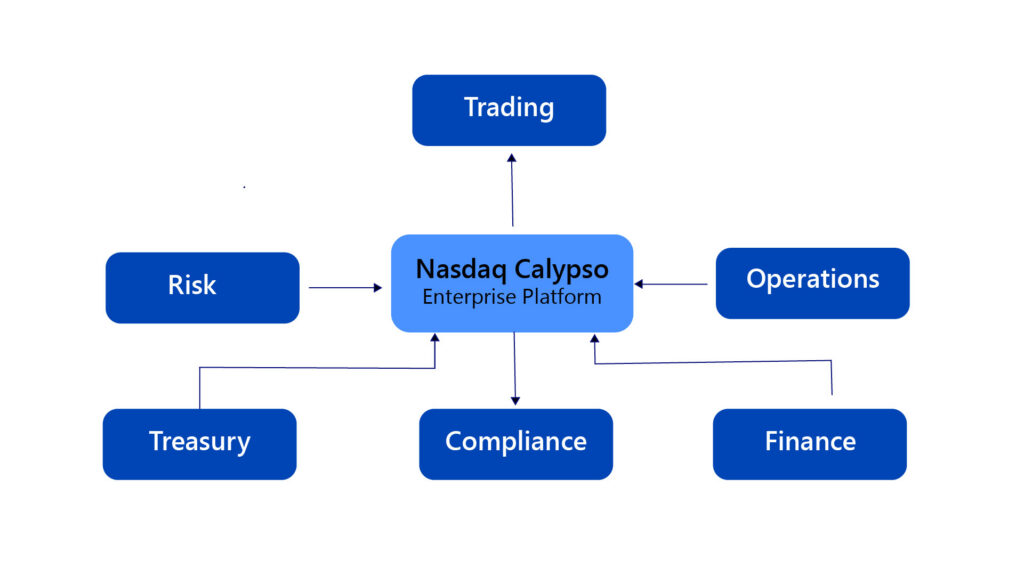
This is where Nasdaq Calypso stands apart. Designed as a unified capital markets platform, Calypso brings front-office, middle-office, back-office, risk, treasury, and operations onto a single architecture with a shared data model. By eliminating operational silos and creating a single source of truth across the trade lifecycle, it helps financial institutions improve operational efficiency, strengthen risk management, streamline regulatory compliance, and reduce operational risk.
Whether you’re evaluating a next-generation capital markets platform, planning a Calypso implementation, modernizing legacy trading systems, or preparing for a major platform upgrade, understanding how Calypso addresses today’s market challenges is essential.
This guide explores the platform’s capabilities, architecture, and the role it plays in helping financial institutions build more resilient, scalable, and future-ready trading operations.
Related read: Upgrade Legacy Trading System with Calypso Platform
Why Nasdaq Calypso Continues to Lead the Capital Markets Industry
Capital markets technology decisions are rarely driven by feature lists alone. Financial institutions evaluate platforms based on long-term operational resilience, scalability, regulatory readiness, and their ability to support business growth. Calypso has maintained its leadership position because it addresses each of these priorities within a single platform.
Credit derivatives also recorded the strongest year-over-year growth among all major asset classes. Operating at this scale requires technology capable of supporting continuous processing, real-time visibility, and consistent data across the organization.
Calypso’s long-standing market position can largely be attributed to five structural advantages.
| Why Financial Institutions Choose Calypso | Business Impact |
|---|---|
| Unified trade lifecycle | Eliminates reconciliation between business functions |
| Cross-asset platform | Supports multiple asset classes within one architecture |
| Integrated risk management | Improves visibility into market and counterparty exposure |
| Embedded regulatory capabilities | Simplifies compliance with global regulations |
| Proven scalability | Supports large trading volumes across global institutions |
Rather than functioning as a collection of integrated applications, Calypso provides a unified operational foundation where trading, operations, finance, treasury, and compliance teams work from the same underlying dataset.
This architectural consistency becomes increasingly valuable as institutions expand into new markets, introduce additional asset classes, or modernize legacy technology landscapes.
Core Features of Nasdaq Calypso That Power Modern Capital Markets Operations
A platform responsible for supporting hundreds of trillions of dollars in financial exposure must deliver much more than trade execution. Calypso combines multiple business-critical capabilities into a single operational environment, enabling financial institutions to reduce technology complexity while improving operational efficiency.
The following capabilities form the foundation of the platform.
1. Trade Capture and Pricing
Trading begins with accurate trade capture. Calypso supports both OTC and exchange-traded products across multiple asset classes while ensuring pricing consistency throughout the organization. Shared market data, pricing curves, and valuation models allow front-office traders, risk managers, and operations teams to reference the same valuation framework, eliminating discrepancies that often arise in fragmented environments.
Business value
- Faster trade processing
- Consistent pricing across teams
- Reduced operational errors
- Improved valuation accuracy
2. Enterprise Risk Management
Risk management has evolved from periodic reporting to continuous monitoring. Calypso provides real-time visibility into market risk, counterparty credit exposure, liquidity positions, and trading limits, allowing institutions to identify emerging risks before they affect the broader portfolio.
Instead of relying solely on overnight batch processing, organizations gain continuous insight into changing market conditions and portfolio exposures.
Check out this related article: Eliminating Risk in Calypso Migrations with ACT Framework + Free Checklist Inside!
3. Collateral and Margin Management
Collateral has become one of the most strategically important aspects of derivatives operations. Calypso automates margin calculations, collateral allocation, optimization strategies, and regulatory methodologies such as ISDA SIMM. As industry-wide initial margin requirements continue to grow, institutions increasingly rely on automation to optimize liquidity while maintaining regulatory compliance.
4. Post-Trade Processing and Settlement
Operational efficiency depends on minimizing manual intervention after trades are executed. Calypso supports straight-through processing across confirmation, clearing, settlement, accounting, corporate actions, and lifecycle event management. Exception-based workflows allow operations teams to focus only on transactions requiring attention, significantly reducing manual effort while improving settlement accuracy.
5. Regulatory Reporting
Regulatory reporting is no longer a standalone operational activity. Because Calypso maintains a unified trade record, compliance reporting becomes an integrated outcome of the trading process rather than a separate reconciliation exercise. The platform supports major regulatory frameworks including Dodd-Frank, EMIR, MiFID II, FRTB, and SA-CCR, helping financial institutions meet evolving compliance obligations with greater confidence.
6. Treasury and Liquidity Management
Beyond derivatives trading, Calypso also supports treasury operations through real-time visibility into cash positions, securities holdings, funding requirements, and liquidity management. This enables treasury teams to make more informed funding decisions while improving balance sheet optimization across the organization.
How Nasdaq Calypso Supports the Complete Trade Lifecycle
Many capital markets platforms perform well within individual functions – trading, risk management, or settlement. The real challenge begins when information needs to move across these functions without introducing inconsistencies, delays, or manual intervention.
This is where Nasdaq Calypso stands apart. Instead of treating every business function as an independent process, Calypso manages the entire lifecycle of a trade through a unified architecture. Every stage – from execution to regulatory reporting – operates on the same underlying trade record, eliminating duplicate data entry and reducing reconciliation efforts.
For financial institutions managing millions of transactions across multiple asset classes, this continuity significantly improves operational efficiency while reducing enterprise-wide risk.
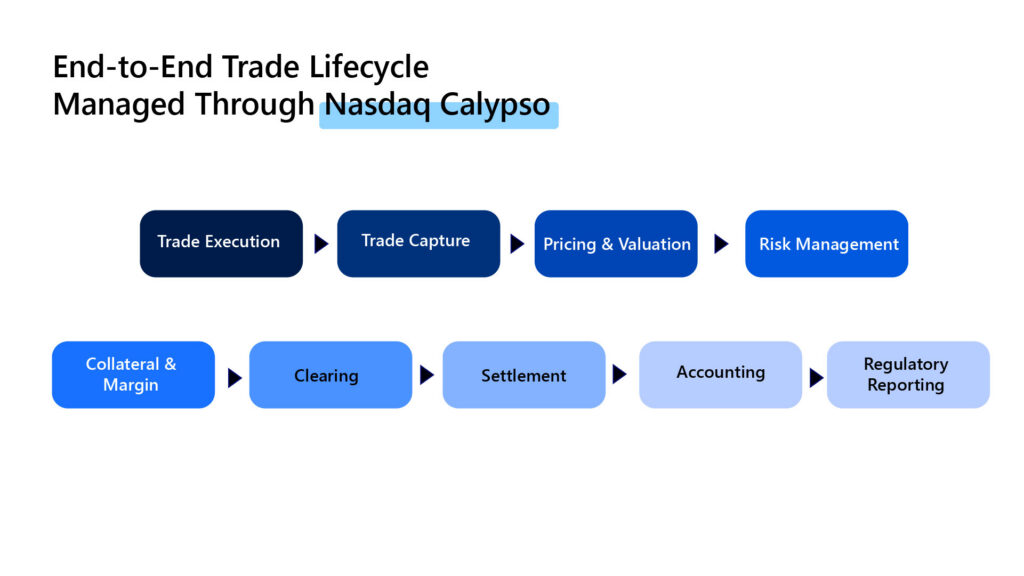
Stage 1: Trade Execution and Capture
Every trade begins with execution. Once a transaction is captured in Calypso, it is immediately assigned a persistent identity that remains intact throughout its lifecycle. Unlike legacy environments where the same trade is recreated in separate systems, Calypso maintains a single trade record that is shared across the enterprise. This eliminates duplicate data entry while providing every downstream function with consistent trade information.
Business outcome
- Faster trade processing
- Improved data consistency
- Reduced operational errors
Stage 2: Valuation and Pricing
As market conditions evolve, every trading decision depends on accurate pricing. Calypso applies centralized market data, yield curves, pricing models, and valuation methodologies to ensure that traders, risk managers, and operations teams reference the same values. This removes one of the most common operational issues in fragmented trading environments – multiple teams working with different valuations for the same position.
Business outcome
- Accurate portfolio valuation
- Consistent pricing across business units
- Faster decision-making
Stage 3: Continuous Risk Monitoring
Risk cannot wait until the end of the trading day. Calypso continuously evaluates:
- Market risk
- Counterparty exposure
- Credit limits
- Liquidity positions
- Portfolio concentrations
Instead of relying solely on overnight batch processing, institutions gain near real-time visibility into changing exposures, allowing risk teams to identify issues before they become material business events. For organizations operating across multiple geographies and trading desks, this continuous visibility strengthens enterprise-wide risk governance.
Stage 4: Collateral and Margin Management
Collateral management has evolved from an operational activity into a strategic balance sheet function. Modern derivatives markets require institutions to calculate initial margin, variation margin, and collateral obligations with increasing accuracy while optimizing available liquidity.
Calypso automates these processes through built-in collateral optimization capabilities and support for industry-standard methodologies such as ISDA SIMM. With clearinghouse initial margin requirements continuing to increase globally, efficient collateral management directly contributes to stronger capital utilization and improved liquidity planning.
Stage 5: Clearing and Settlement
Once trades are executed, operational efficiency depends on how quickly they move through clearing and settlement.
Calypso supports straight-through processing (STP), allowing transactions to progress through confirmation, netting, settlement instructions, accounting, and lifecycle events with minimal manual intervention. Exception-based workflows ensure operations teams spend their time resolving genuine issues instead of processing routine transactions.
The result is:
- Faster settlements
- Lower operational costs
- Improved settlement accuracy
- Reduced manual workload
Stage 6: Accounting and Regulatory Reporting
Regulatory reporting becomes significantly more manageable when every function relies on the same underlying data.
Instead of reconstructing information from multiple systems, Calypso generates reporting directly from the trade lifecycle, helping institutions meet requirements across major regulatory frameworks such as Dodd-Frank, EMIR, MiFID II, FRTB, and SA-CCR. This integrated approach reduces reporting complexity while strengthening audit readiness.
Key Asset Classes Supported by Nasdaq Calypso
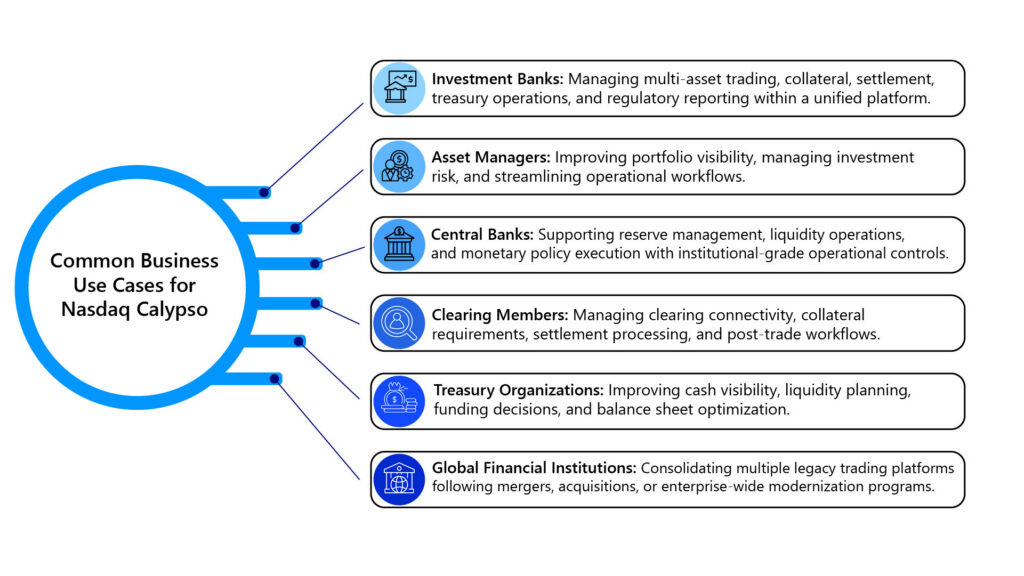
One of Calypso’s defining strengths is its ability to support multiple asset classes within a single platform. Rather than maintaining separate systems for different trading products, institutions can consolidate operations onto one integrated architecture.
This simplifies technology management while providing consistent workflows across trading, risk, treasury, and operations.
| Asset Class | Examples |
|---|---|
| Interest Rate Derivatives | Swaps, Swaptions, Caps, Floors |
| Foreign Exchange | Spot, Forwards, Swaps, Options |
| Credit Derivatives | CDS, Index CDS |
| Equity Derivatives | Options, Swaps, Structured Products |
| Fixed Income | Government Bonds, Corporate Bonds |
| Repo & Securities Financing | Repurchase Agreements |
| Commodities | Energy, Metals, Agricultural Products |
| Treasury Instruments | Cash Management, Liquidity Products |
Why Financial Institutions Continue to Invest in Nasdaq Calypso
Technology investments within capital markets are increasingly measured by operational outcomes rather than software features alone. Institutions evaluating modern trading platforms typically prioritize five business objectives: reduce operational risk, improve regulatory compliance, increase processing efficiency, simplify technology architecture, and prepare for future growth. Calypso directly supports each of these priorities.
1. Reduced Operational Risk
Disconnected systems increase the likelihood of inconsistent trade data, reconciliation breaks, and settlement failures. By maintaining a unified trade record across the entire lifecycle, Calypso reduces these operational risks while improving transparency across business functions.
2. Faster Regulatory Compliance
Global regulatory requirements continue to evolve. Having compliance integrated into the trading lifecycle enables institutions to produce accurate regulatory reports more efficiently while reducing manual reporting efforts.
3. Better Collateral Utilization
Collateral represents one of the largest liquidity commitments for derivatives trading. Calypso’s optimization capabilities help institutions allocate collateral more effectively, improving liquidity utilization while meeting regulatory obligations.
4. Lower Technology Complexity
Instead of maintaining multiple point solutions across trading, risk, collateral, settlement, and reporting, organizations can consolidate these capabilities onto one platform. Benefits include:
- Fewer integrations
- Lower maintenance costs
- Reduced infrastructure complexity
- Simplified upgrades
5. Cloud and Hybrid Deployment Flexibility
Modern versions of Nasdaq Calypso support cloud, hybrid, and on-premises deployments, allowing organizations to modernize infrastructure at their own pace without requiring disruptive, large-scale migrations.
Challenges in Calypso Implementation and How to Overcome Them
It’s worth being direct about this: migrating core trading, risk, and collateral workflows onto a new engine touch nearly every desk and control function in an institution simultaneously. The difficulty is rarely the platform’s functionality itself – it’s everything around it.
Data migration and validation:
Moving years, sometimes decades, of trade history and reference data without introducing silent errors is the single riskiest part of any implementation. A bad migration doesn’t always fail loudly – it can quietly misstate a position that only surfaces months later during an audit or a margin dispute. The fix is treating data migration and validation as a dedicated, resourced workstream from day one, not a weekend cutover activity squeezed in at the end of a project.
Download this valuable resource: Data Migration Checklist 2026 | Your Essential Guide to a Seamless Transition
Legacy system decommissioning:
Institutions almost never replace one system at a time. Overlapping legacy platforms – often several generations of them – need to be retired in a carefully sequenced order without disrupting business-as-usual trading, which means running parallel environments longer than anyone initially budgets for.
Customization versus upgradeability:
Heavy customization solves today’s specific requirement elegantly, but it can make every future version upgrade dramatically more expensive and time-consuming. Institutions that plan for extensibility deliberately – rather than customizing reactively, feature request by feature request – protect their ability to move to newer platform releases without re-litigating every customization from scratch.
Testing at the scale derivatives platforms actually operate at:
Validating a system processing this much notional value, across both GUI and API layers, demands automated, reusable test coverage rather than manual regression testing that can’t realistically keep pace with release cycles.
Regulatory alignment during transition:
Reporting obligations don’t pause for a migration. Parallel-run periods, careful cutover sequencing, and rigorous reconciliation between old and new systems during the transition window are necessary to avoid any gap in regulatory reporting continuity.
Change management:
Trading, risk, and operations professionals who have run a given workflow for a decade need structured training, hands-on support, and genuine buy-in — not just a new login screen and a memo announcing go-live.
Calypso vs. Murex: Which Capital Markets Platform Is Right for Your Organization?
When financial institutions evaluate capital markets platforms, two names consistently appear on the shortlist: Nasdaq Calypso and Murex MX.3.
Both platforms are trusted by global banks and investment firms. However, they address different priorities depending on an institution’s business model, technology landscape, and transformation goals.
Rather than asking “Which platform is better?”, decision-makers should ask:
- Which platform best supports our operating model?
- Which aligns with our long-term modernization strategy?
- Which integrates more effectively with our existing ecosystem?
- Which delivers the lowest operational complexity over time?
The answer varies from one organization to another
| Capability | Nasdaq Calypso | Murex MX.3 |
|---|---|---|
| Primary Strength | Unified front-to-back operations | Advanced trading and risk analytics |
| Trade Lifecycle | End-to-end lifecycle management | Strong front-office capabilities |
| Asset Class Coverage | Broad multi-asset support | Broad multi-asset support |
| Risk Management | Integrated enterprise risk | Advanced market risk modelling |
| Collateral Management | Native collateral optimization | Comprehensive collateral capabilities |
| Treasury Management | Strong treasury functionality | Available through integrated modules |
| Settlement & Post-Trade | One of the platform's strongest differentiators | Comprehensive, but often front-office focused |
| Regulatory Reporting | Built-in reporting for global regulations | Extensive regulatory support |
| Cloud Readiness | Hybrid, cloud, and on-premises deployment | Hybrid and cloud deployment options |
| Best Fit | Organizations seeking operational consolidation | Institutions prioritizing complex trading analytics |
Both platforms continue to evolve rapidly, particularly in cloud deployment, AI-assisted workflows, and regulatory automation. Platform selection should ultimately reflect business priorities, existing architecture, operational maturity, and long-term strategic objectives – not feature checklists alone.
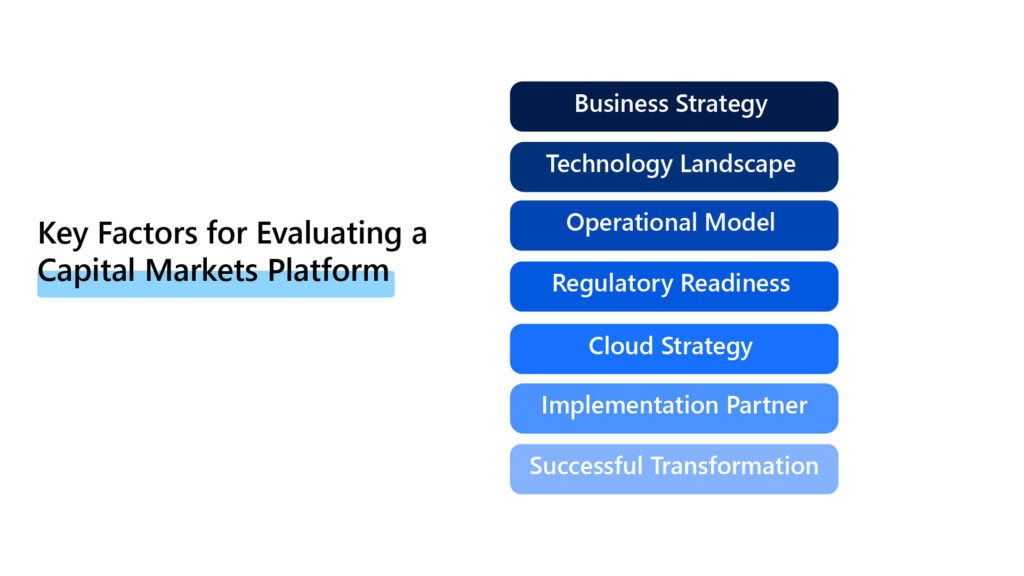
Choosing the Right Platform: Key Evaluation Criteria
Before selecting a capital markets platform, organizations should evaluate:
| Evaluation Area | Questions to Consider |
|---|---|
| Business Strategy | Are you modernizing legacy platforms or expanding into new asset classes? |
| Operational Model | Do you require a unified front-to-back platform or deeper front-office analytics? |
| Technology Landscape | How many existing systems must be integrated or replaced? |
| Regulatory Requirements | Which global regulations must your platform support? |
| Cloud Strategy | Is cloud adoption part of your modernization roadmap? |
| Future Growth | Can the platform scale with changing business needs? |
Why Financial Institutions Partner with Everforth Quinnox for Calypso Services
Nearly every challenge described above – data migration risk, testing at genuine production scale, upgrade complexity, change management across trading and operations teams – is fundamentally a services and delivery problem as much as it is a software one. That is the gap Everforth Quinnox has spent close to two decades closing specifically for capital markets clients running Calypso.
A validated, top-tier partnership: Everforth Quinnox is one of only two firms named a Global Partner in Adenza’s – now Nasdaq’s – Certified Implementation Partners program, the highest tier available in that ecosystem. That status was awarded directly by Adenza’s leadership in recognition of nearly two decades of collaboration, and it reflects a level of platform depth that few systems integrators outside the vendor itself can match.
Full lifecycle coverage from a dedicated Center of Excellence: Everforth Quinnox operates a dedicated Calypso Center of Excellence and delivers the complete lifecycle of Calypso services: consulting and roadmap design, implementation, version upgrades, custom development, data migration and validation, application management and support, and testing – covering everything from pre-trade to post-trade, accounting, and reporting.
Testing depth built specifically for this scale: This is arguably Everforth Quinnox’s sharpest differentiator. Its automated testing framework, Q-Frame, integrates directly with Calypso’s own CATT testing tools and draws on a library of more than 8,000 reusable automated test assets. That framework provides GUI and API test coverage capable of validating over a billion data points within a single test cycle – a level of coverage that manual or ad hoc testing simply cannot approach at the volume a production derivatives platform generates.
Success story in action: Check out on how a financial institution reduced their regression cycle from 60 days to 45 days.
Measurable operational impact: For institutions running batch-heavy Calypso environments, Everforth Quinnox’s application management and support engagements have delivered up to 30% improvement in batch processing optimization – a concrete efficiency gain that compounds daily across a live trading and risk environment.
Proven under deadline pressure: Everforth Quinnox’s published client work includes engagements where a full Calypso front-to-back installation covering interest rate derivatives, credit derivatives, and FX was completed within roughly 100 working days – evidence that deep platform specialization, not just headcount, is what actually compresses implementation timelines without cutting corners on quality.
That combination – a certified partnership status validated directly by Nasdaq, engineering talent specialized specifically in Calypso rather than generalist capital markets technology, and a testing practice purpose-built for the scale derivatives platforms operate at – is why banks, asset managers, and other capital markets firms consistently bring Everforth Quinnox in not just to stand up Calypso initially, but to keep it running reliably through every subsequent version upgrade, every new regulatory requirement, and the next inevitable wave of platform modernization.
Conclusion
Derivatives markets aren’t shrinking – they grew 16% in a single year through mid-2025, the fastest pace since the run-up to the last financial crisis, pushing total notional exposure past $846 trillion. Every additional trillion in notional value is another trillion that has to be priced accurately, margined correctly, cleared efficiently, and reported to regulators on time, in real time, across jurisdictions that don’t always agree with each other on the rules.
Platforms like Calypso exist because the alternative – reconciling risk across a dozen disconnected systems and hoping nothing slips through the cracks – simply doesn’t scale to numbers this size, let alone the double-digit growth rates the market has posted over the past year.
The institutions best positioned for what comes next are the ones that already have a single, trusted, real-time view of what they actually own – built on a platform architected for that purpose, and supported by an implementation partner capable of keeping that view accurate as the platform, the regulations, and the market itself keep moving underneath them.

Lead, Marketing, Everforth Quinnox
Frequently Asked Questions Related to Calypso in Derivatives
Calypso is used to trade, value, risk-manage, collateralize, clear, and settle derivatives and other capital markets instruments on a single front-to-back platform, replacing the fragmented, multi-system setups that historically made it difficult for institutions to see their true, aggregate exposure.
Calypso’s user base spans more than 60,000 users worldwide across banks, asset managers, central banks, and clearinghouses, including institutions using it for central bank reserve management and monetary policy operations.
Calypso is generally favored for front-to-back operational consistency across trading, collateral, clearing, and settlement, while Murex’s MX.3 is often favored in trading- and risk-intensive environments prioritizing advanced pricing and analytics capability. Platform choice usually comes down to an institution’s business model and existing architecture rather than a universal ranking.
Timelines vary significantly by scope, but full front-to-back installations covering multiple asset classes have been completed in roughly 100 working days in some documented engagements, while larger, multi-entity, multi-asset transformation programs typically run several quarters to multiple years.
The platform itself is only part of the challenge. Data migration, legacy system decommissioning, testing at production scale, and change management across trading, risk, and operations teams typically require specialized expertise beyond what most internal IT teams carry day to day — which is why certified partners like Everforth Quinnox are commonly engaged across the full implementation lifecycle, not just the initial go-live.