AI is not a feature you add to your delivery model. It is a new operating model altogether. The organizations that understand this early will not merely become more productive — they will become structurally different. The ones that do not will face a reckoning that no amount of tooling can reverse.
A New Kind of Shift
I want to be direct about what I see from where I sit. We work with delivery organizations across industries — software engineering teams, digital operations, data and analytics practices, infrastructure groups, and security teams. In the past eighteen months, something has changed that I have not seen since cloud fundamentally broke the economics of on-premise IT.
Generative AI has crossed a threshold. It is no longer experimental. It is becoming load-bearing infrastructure for how work gets done. And agentic AI — AI that does not just answer questions but orchestrates tasks, reasons across systems, and drives outcomes — is arriving faster than most delivery leaders are prepared for.
The question is no longer whether AI will change your delivery organization. The question is whether your change management will keep pace with the change the technology is driving.
These layers are not a checklist. They form a dependency chain. Leaders who understand that chain – and sequence their investment accordingly are the ones whose programs deliver lasting competitive advantage rather than isolated wins that stall.
The bottleneck is never the model. The bottleneck is the organization’s ability to absorb what the model makes possible.
When cloud arrived, organizations had to rethink infrastructure ownership, procurement models, and security perimeters. That was hard enough. But the engineers still wrote the same kind of code, in the same kind of languages, using the same kind of software development lifecycle. The tooling changed. The underlying craft did not.
AI does something different. It changes the craft itself.
A software engineer today is not the same role as a software engineer was in 2022 — not because the job title changed, but because the cognitive labor has shifted. Documentation, test generation, code review, boilerplate scaffolding: these are being automated at a rate that is genuinely new. What remains human is judgment, architecture, context, and taste. The same is true in data engineering, in operations, in cybersecurity.
This is not a productivity story. It is a role redefinition story. And role redefinition, at scale, is a change management challenge of the highest order.
The Five Domains Where Delivery Must Evolve
In working through how AI is reshaping delivery organizations, I keep returning to five distinct domains. Each carries its own adoption journey, its own governance challenges, and its own change management requirements. Treat them as separate conversations and you miss the systemic nature of the transformation. Treat them as one monolithic program and you lose the nuance that makes adoption real.
1. The Digital Workplace: Every Employee Is Now an AI User
Everyday AI assistants — Microsoft 365 Copilot, Gemini in Google Workspace, Claude by Anthropic, and a growing generation of purpose-built agents — are being deployed at a pace that outstrips governance readiness. The technology is not the obstacle. The real challenges are value quantification, data governance, and change management. Organizations winning here are not just deploying licenses; they are building community-driven adoption programs, investing in prompt literacy, and rethinking how knowledge is shared and acted upon. The shift is from AI as a tool to AI as a collaborative layer embedded in every workflow.
2. Software Engineering: The Developer Role Is Being Reconstructed
AI code assistants are now standard issue on well-run engineering teams. The productivity gains are real. But the more significant shift is what comes next: design-to-code workflows, AI-generated synthetic test data, AI-augmented security practices, and the discipline of building AI-powered applications — not just using AI to build traditional ones. Engineers need new skills: LLM architectures, RAG patterns, agentic frameworks, and the MCP ecosystem rapidly becoming the lingua franca of AI-to-tool integration. The change management imperative is skills architecture — what do your engineers need to know, and how fast?
3. Data and Analytics: AI Readiness Is the New Data Maturity
Every GenAI initiative surfaces the same hard truth: the quality and governance of your data determines the quality of your AI outcomes. Data naming conventions matter — not just for humans, but for models that must reason about what datasets represent. MLOps maturity becomes the operational backbone of any AI engineering capability. The analytics engineer — sitting at the intersection of data engineering and AI system design — is becoming a critical hire. Organizations must mature their data foundations and build evaluation frameworks to assess whether GenAI outputs are actually trustworthy. This cannot be deferred.
4. Infrastructure and Operations: Intelligence Needs a Home
AI workloads require GPU access, high-bandwidth memory, low-latency inference pathways, and edge infrastructure for real-time applications. The public cloud remains the right starting point for speed and flexibility. But the future belongs to hybrid architectures that incorporate on-premise AI infrastructure and edge compute, especially as inference costs become the dominant operational consideration. The skills gap in AI infrastructure engineering is acute. The operations teams that endure will be those who learn to use AI itself to monitor, respond to, and optimize the systems they run.
5. Cybersecurity: Defend With AI, or Be Defeated by It
AI expands the attack surface and the defensive capability simultaneously. Agentic AI systems introduce identity and access management challenges that traditional IAM models were never designed to handle. At the same time, AI-powered threat hunting, AI SOC agents, and GenAI-augmented security architecture are giving security teams leverage they have never had before. Organizations that get this right treat AI security as a first-class design constraint from day one — not a retrofit. Those that harness AI to defend gain compounding advantages over those who treat security as a compliance checkbox.
What Change Management Gets Wrong About AI
Most change management frameworks were built for a world where the change is discrete — a new ERP system, a new process, a new organizational structure. You communicate the change, train the people, manage the resistance, and declare success. The change has a beginning and an end.
AI adoption is not like that. It is a continuous, compounding transformation. Every six months the models improve in ways that shift the boundary of what is automatable. Every year the tooling ecosystem reinvents itself. The target is not static. The organization must learn to move with it.
THE CONTINUOUS ADOPTION IMPERATIVE
Traditional change management asks: “How do we get our people to adopt this change?” AI transformation asks a different question: “How do we build an organization that is structurally capable of continuously absorbing new AI capabilities as they emerge?” The first is a project. The second is an operating model redesign.
A Blueprint for Delivery Leaders
I want to be practical. Here is how I think about what delivery leaders must do now.
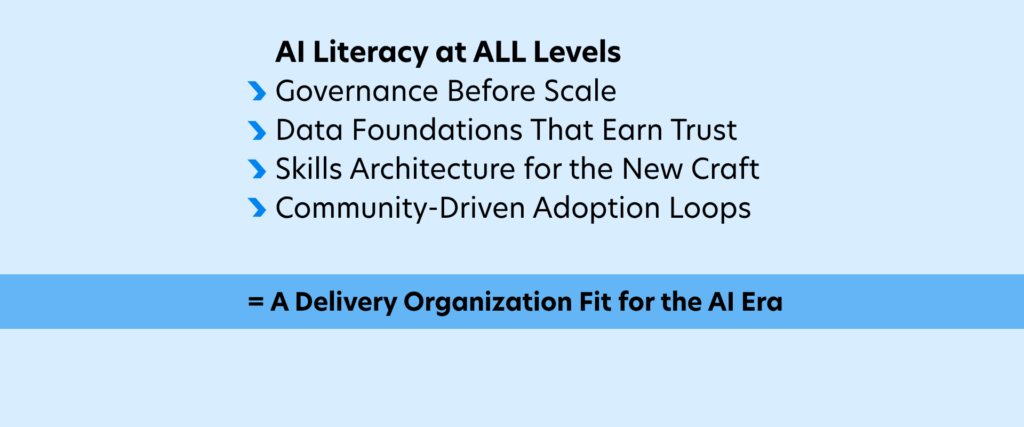
Start with literacy, not tooling. The first investment is not licenses — it is understanding. At every level of the delivery organization, from engineering leads to operations managers, people who grasp what AI can and cannot do make smarter decisions about where to apply it. Literacy precedes leverage.
Govern before you scale. Every enterprise AI deployment eventually collides with the same hard questions: Who owns the data the AI is acting on? How do we prevent sensitive information from leaking through model outputs? How do we manage identity for AI agents acting on behalf of humans? Answer these at pilot scale. Do not discover them at production scale.
Treat data readiness as a prerequisite, not a parallel workstream. GenAI systems are only as good as the data they reason over. Invest in data governance, semantic clarity, and AI readiness assessments before your initiatives hit production — not after the quality problems become visible to the business.
Redesign your skills architecture, not just your training catalog. The question is not what courses to offer. It is what your engineers, data practitioners, operations teams, and security professionals need to know to remain effective in a delivery model increasingly mediated by AI. That is a structural question requiring structural answers — new roles, new career paths, new evaluation criteria.
Build community as a change multiplier. The fastest-adopting organizations we work with share one trait: internal communities of practice around AI that function as both learning networks and knowledge repositories. Practitioners share what is working, surface what is not, and collectively evolve norms faster than any top-down program can.
The Direction Is Clear
We are early in this. The models will improve. The agentic capabilities will deepen. The infrastructure will become more accessible and more affordable. The ecosystem around AI — tools, frameworks, governance standards, regulatory clarity — will mature.
AI is not a wave you wait for. It is a current that is already moving. The question is whether your delivery organization is oriented to move with it.
The choices you make in the next twelve months — about governance, about skills, about how you build and operate AI-powered systems, about how you lead your teams through continuous change — will shape what your delivery organization is capable of for the rest of this decade.
The direction is clear. The time to move is now.

COO & President, Everforth Quinnox