Enterprise applications are no longer isolated systems operating behind the firewall. They connect employees, customers, partners, APIs, cloud platforms, third-party services, mobile experiences, and increasingly, AI-powered capabilities.
Every connection creates value. But every connection can also introduce another potential attack surface. The threat landscape is becoming harder to ignore. Verizon’s 2026 Data Breach Investigations Report found that 31% of breaches began with vulnerability exploitation, making it the leading breach entry point for the first time in the report’s 19-year history. The report also highlights how AI is accelerating the exploitation of known vulnerabilities, shrinking the window organizations have to identify and remediate weaknesses.
For enterprises, the challenge is therefore no longer simply finding security vulnerabilities. It is identifying, prioritizing, and addressing them early enough and consistently enough to prevent them from becoming business risks.
This points to a fundamental shift in how application security needs to be approached. Security can no longer remain a final checkpoint before production. It needs to become an integral part of the quality assurance and software development lifecycle, with vulnerabilities continuously tested, prioritized, and remediated before they can make their way into production environments.
This is where Enterprise Application Security Testing as a Service (STaaS) becomes particularly relevant—bringing security expertise, testing capabilities, automation, and continuous assessment into the application lifecycle to help enterprises identify risks earlier and strengthen application resilience at scale.
What Is Enterprise Application Security Testing as a Service?
Enterprise Application Security Testing as a Service is a managed approach to continuously identifying, assessing, validating, and helping remediate security vulnerabilities across an organization’s application landscape
Instead of conducting security testing as a periodic or standalone activity, organizations work with a specialized security testing partner that integrates security validation into their existing Software Development Lifecycle (SDLC), Quality Assurance (QA), and DevSecOps processes.
The service can span the entire application lifecycle – from requirements and architecture through development, testing, deployment, and production.
The defining characteristic is not simply the number of security tools involved. It is the integration of security testing into the broader QA lifecycle. Instead of asking security teams to test an application immediately before release, organizations can build security checks into multiple stages of development.
A typical lifecycle could look like:
Requirement → Threat Model → Development → SAST/SCA → Functional Testing → API Security Testing → DAST → Penetration Testing → Security Regression → Production Monitoring
This creates a continuous feedback loop in which security becomes part of application quality rather than a separate activity performed at the end.
Want to strengthen your test management approach? Explore how robust test case management can improve test coverage, traceability, execution, and release confidence.
Why Security Testing Belongs Inside Your QA Lifecycle, Not Beside It
For most of the last two decades, security testing operated as a separate track from quality assurance – a specialist function invited in near the end of a release cycle to run scans, file a report, and sign off (or not) before go-live. That model made sense when releases happened quarterly. It breaks down completely when releases happen daily.
The data confirms that teams already sense this. Nearly three-quarters of security professionals now describe their organization’s security efforts as “good” or “strong,” largely because scanning has become more continuous rather than event-driven. But the same research shows a harder truth underneath that optimism: According to Business Wire study, 73% of respondents say manual security and compliance processes slow down code releases. Under that pressure, teams often make an uncomfortable trade-off – speed now, risk later.
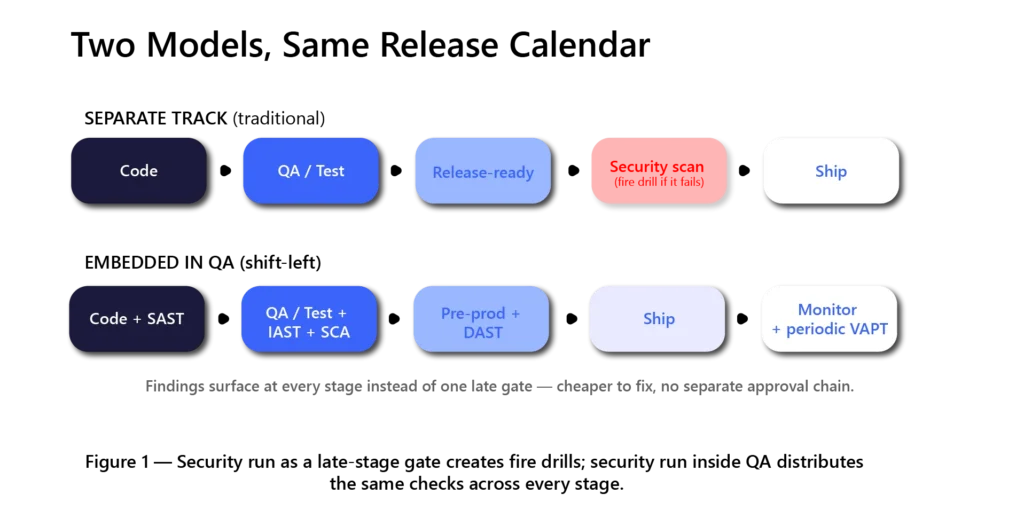
Separating security from QA doesn’t just slow things down; it actively degrades outcomes. When a penetration test or vulnerability scan runs after code is functionally “done,” every finding becomes a fire drill: a fix that reopens regression testing, delays a release date, and pulls developers back into code they’ve mentally moved past. When security checks run alongside functional test cycles – in the same sprint, against the same build, owned by the same delivery team – vulnerabilities get triaged and fixed the same way a failed functional test case would be: quickly, cheaply, and without a separate approval chain.
This is the essence of shift-left security, and enterprises are moving toward it because the alternative is now demonstrably more expensive.

Application security cannot be treated as a downstream activity when enterprises are releasing software at the speed they are today. The real opportunity is to bring security into the same quality engineering framework used to validate functionality, performance, and reliability. When security testing becomes continuous, risk-based, and integrated into QA, organizations can identify issues earlier, accelerate remediation, and make release decisions with greater confidence.
Bighneswar Parida
Director – Quality Engineering, Everforth Quinnox
Real-World Example — British Airways
The UK’s Information Commissioner’s Office fined British Airways £20 million after a 2018 breach exposed customer payment data. The ICO’s finding cited weak encryption and, notably, gaps in the airline’s testing regimen – the carrier hadn’t documented regular penetration tests. The failure regulators penalized wasn’t just a technical flaw; it was the absence of a continuous testing record. (Source: BBC News)
The practical implication for enterprise QA leaders: security testing shouldn’t have its own calendar, its own sign-off gate, or its own team operating in isolation from functional testing. It should be a category of test case – automated where possible, expert-led where it matters –running inside the same pipeline, tracked against the same release criteria, and owned with the same accountability as any other quality bar.
What Enterprise Application Security Testing Covers
“Security testing” is often used as a catch-all, which is part of why enterprises struggle to scope it, budget for it, or measure whether they’re actually doing enough of it. In practice, application security testing at enterprise scale spans several distinct but connected disciplines, each answering a different question about the same application.
| Discipline | Core Question | Primary Method |
|---|---|---|
| Code-level testing | Does our own source code introduce risk? | SAST, secure code review |
| Runtime & behavioral testing | How does the running app respond to abuse? | DAST, penetration testing |
| Dependency & supply chain | Is what we borrowed safe? | SCA, container scanning |
| Interface testing | Is the connective tissue exposed? | API & mobile security testing |
| Configuration & infrastructure | Is the environment safe? | Cloud posture & IAM review |
Comprehensive Application Security Testing as a Service brings all five of these disciplines under one operating model, tested against one release calendar, reported through one dashboard – rather than five vendors, five schedules, and five reports that never quite reconcile.
Key Components and Features of Application Security Testing as a Service
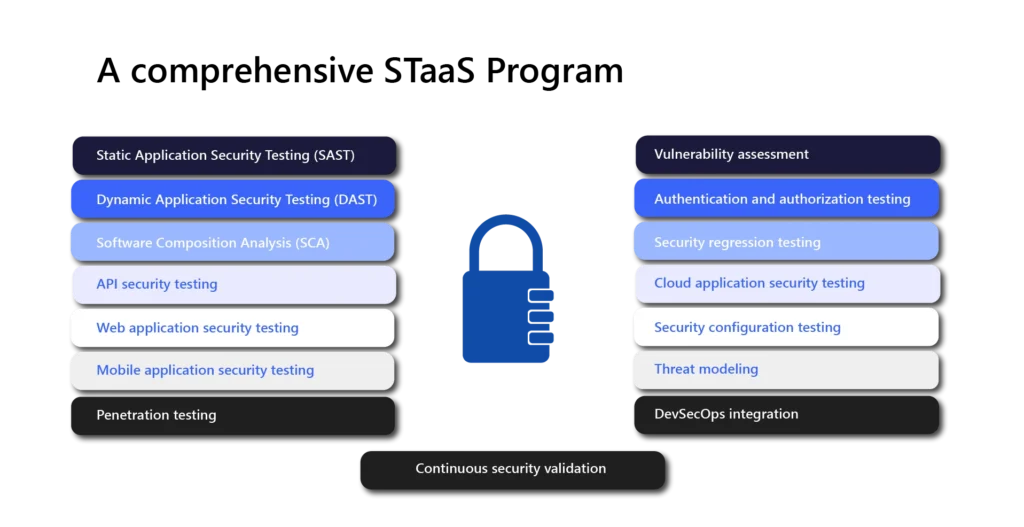
A strong STaaS model combines automated testing, expert-led security assessment, continuous validation, and governance.
1. Static Application Security Testing (SAST)
SAST examines source code, bytecode, or binaries to identify security vulnerabilities without executing the application. It is particularly useful during development because vulnerabilities can be detected before an application reaches later testing stages.
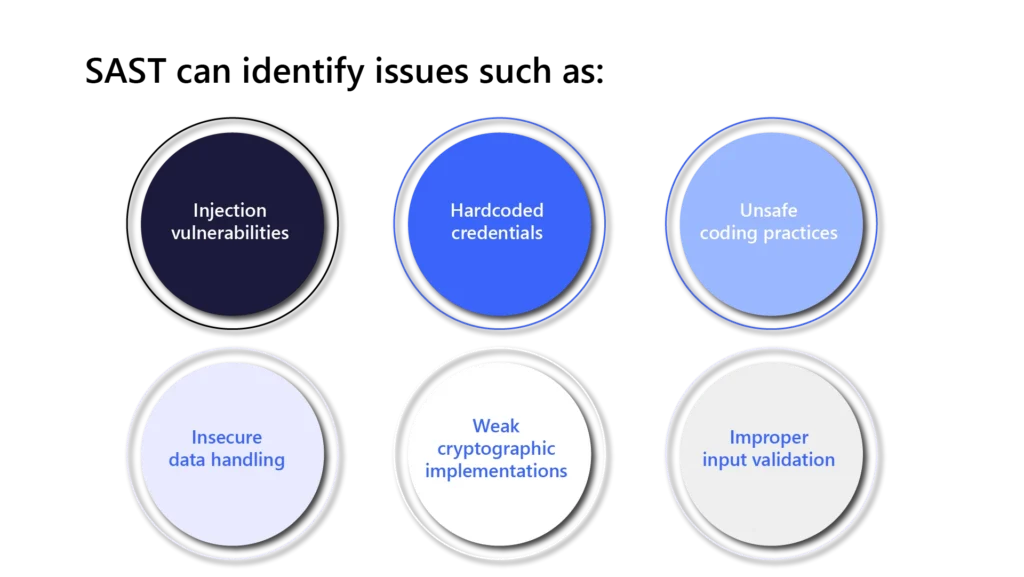
Integrating SAST into CI/CD pipelines allows security checks to happen automatically whenever developers commit code. This supports a shift from finding security defects after development to preventing them during development.
2. Dynamic Application Security Testing (DAST)
DAST evaluates an application while it is running. Unlike SAST, which examines the application’s underlying code, DAST interacts with the running application from an external perspective and evaluates how it behaves.
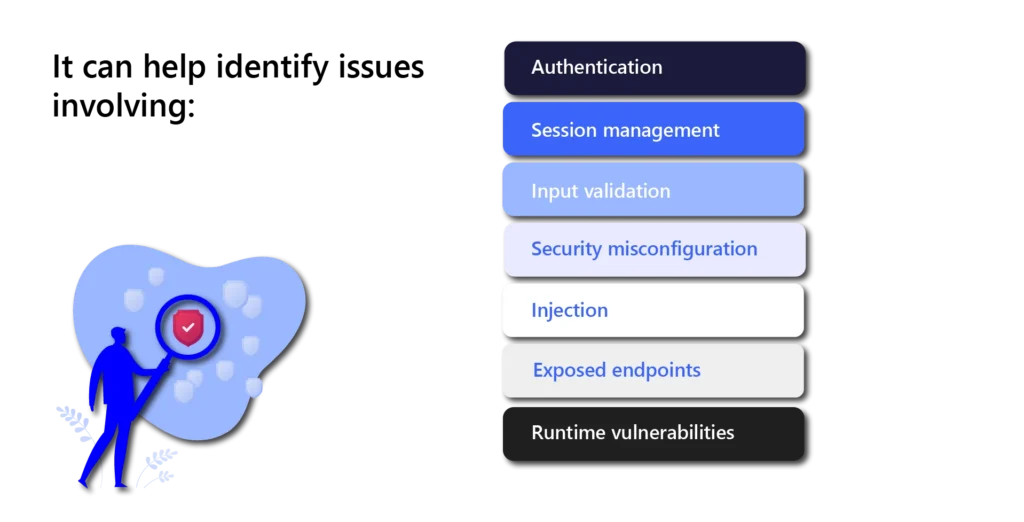
DAST is particularly valuable during integration, system, and pre-production testing because it evaluates the application in a realistic operating environment.
3. Software Composition Analysis
Enterprise applications increasingly depend on open-source libraries and third-party components. This creates a software supply chain challenge.
The OWASP Top 10 lists Software Supply Chain Failures as the third category of critical web application security risks. The updated category expands the focus beyond vulnerable dependencies to broader risks involving software components, development pipelines, and supply-chain integrity.
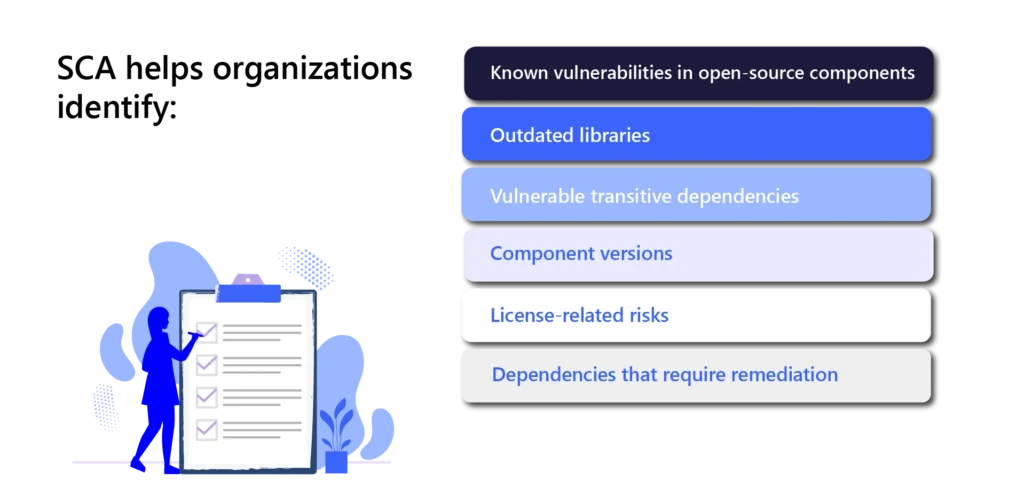
This becomes particularly important for enterprises managing hundreds of applications and thousands of dependencies.
4. API Security Testing
APIs have become one of the most important components of enterprise application architectures. They connect mobile applications, web applications, microservices, SaaS platforms, data platforms, partners, and AI applications.
However, APIs can also expose sensitive business functions and data.
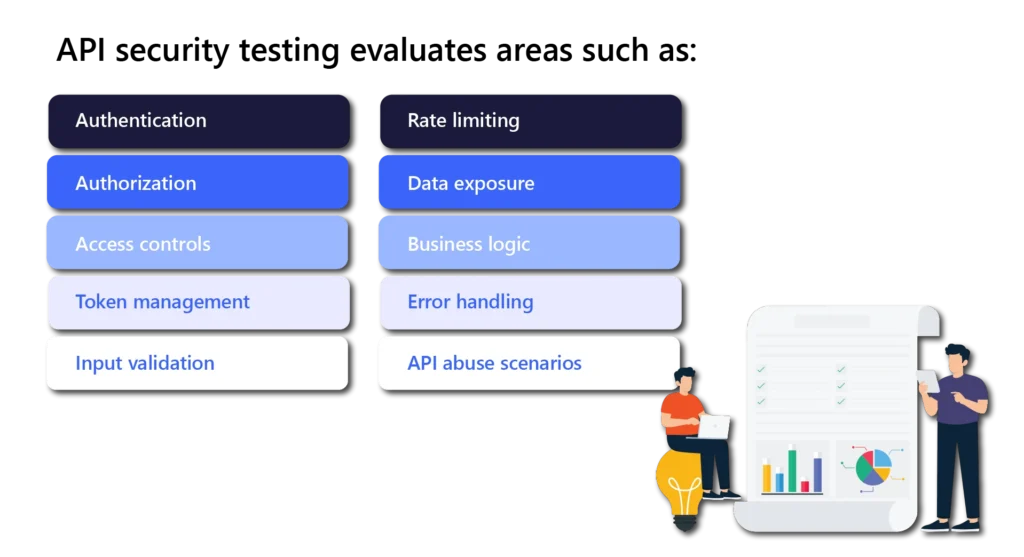
For example, an API may correctly authenticate a user but fail to verify whether that user is authorized to access a specific account. That is a security vulnerability that functional testing alone may not detect.
5. Penetration Testing
Automation provides scale, but it cannot replace human security expertise. Penetration testing involves security professionals attempting to exploit vulnerabilities in a controlled environment to determine their actual impact.
A penetration tester can identify attack chains that individual automated findings may not reveal.
For example, three medium-risk vulnerabilities might appear independently insignificant. But an experienced tester may discover that combining them enables privilege escalation or access to sensitive data. This is why a mature STaaS model combines: Automated discovery + expert validation + controlled exploitation + remediation guidance.
6. Security Regression Testing
Security fixes should themselves be tested. When a vulnerability is remediated, organizations need to confirm that:
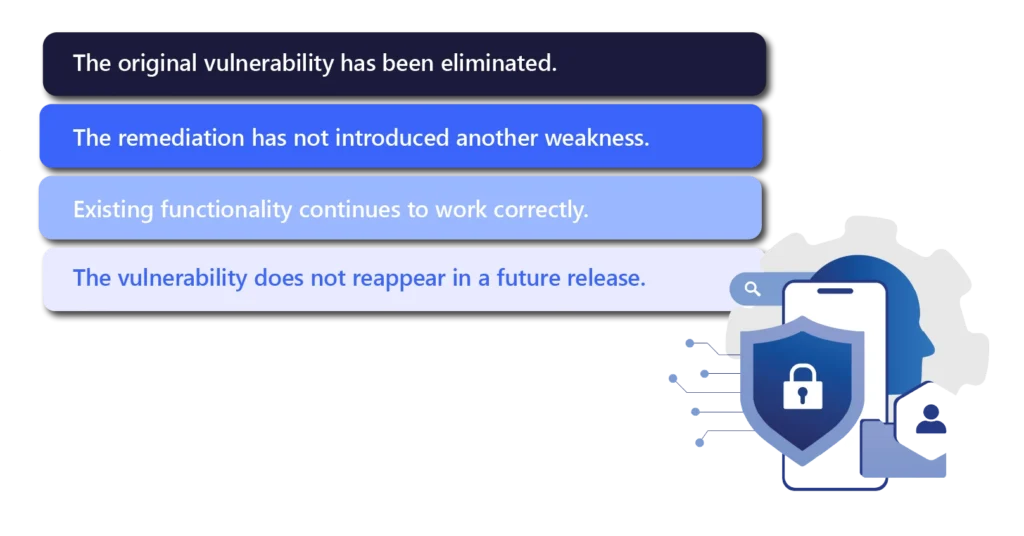
Security regression testing turns previously discovered vulnerabilities into reusable test scenarios. Over time, organizations can build a security regression suite that becomes part of their standard release validation.
7. Threat Modeling
Threat modeling brings security into the earlier stages of application development. Teams analyze the application’s architecture, data flows, trust boundaries, users, integrations, and potential attack vectors before implementation is complete.
For example, an enterprise customer portal handling financial information may require specific controls around:
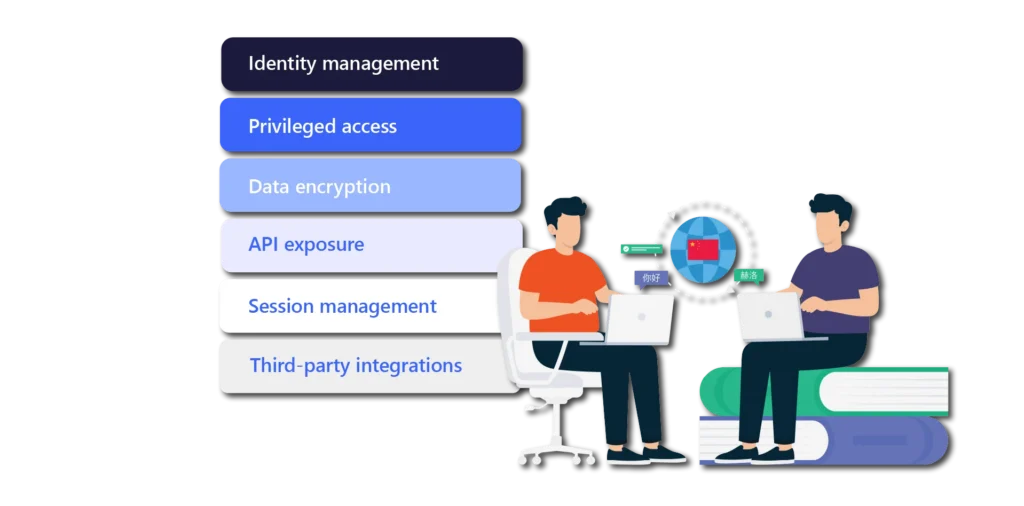
Addressing these risks during architecture and design is generally more efficient than discovering them after the application has been developed.
Traditional Security Testing vs. Security Testing as a Service
The real difference between traditional application security testing and STaaS lies not only in what is tested, but in how that testing is operationalized – whether it remains a periodic, project-based exercise or evolves into a continuous, scalable capability embedded throughout the application lifecycle. The table below explains how:
| Traditional Approach | Security Testing as a Service |
|---|---|
| Periodic security assessments | Continuous or recurring security validation |
| Often performed before release | Integrated throughout SDLC and QA |
| Heavy reliance on manual testing cycles | Combination of automation and expert testing |
| Security owned primarily by security teams | Collaboration across QA, development, security and operations |
| Findings often delivered as periodic reports | Continuous findings and remediation feedback |
| Limited coverage between assessments | Security coverage aligned with application changes |
| Primarily vulnerability-focused | Risk- and business-impact-focused |
| Retesting often handled separately | Security regression integrated into QA |
A traditional penetration test still has significant value. The issue arises when organizations expect an annual or quarterly test to represent the security posture of an application that changes every week.
STaaS does not necessarily replace penetration testing. Instead, it places penetration testing within a broader continuous security assurance model.
What Challenges Does Enterprise Security Testing Solve?
Implementing security testing at enterprise scale comes with several challenges.
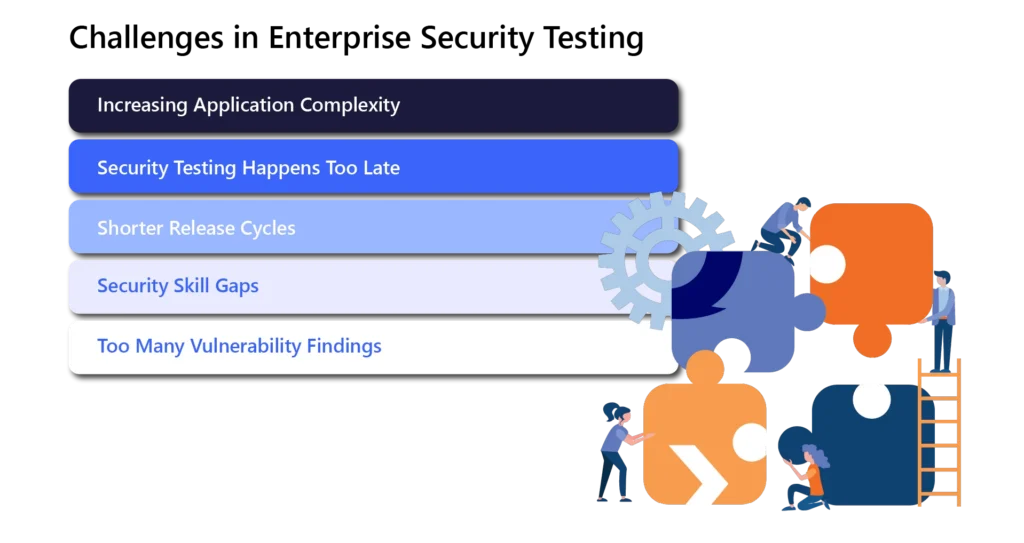
Challenge 1: Increasing Application Complexity
Large enterprises rarely operate a single application. They manage portfolios containing legacy applications, cloud-native systems, SaaS platforms, APIs, mobile applications, microservices, and third-party integrations. Testing all these components consistently is difficult without standardized processes and automation.
STaaS can provide a centralized testing framework while allowing individual applications to follow risk-appropriate testing strategies.
Challenge 2: Security Testing Happens Too Late
One of the most common problems is discovering vulnerabilities during the final stages of testing. At this point, fixing a security defect may require architectural changes, redevelopment, regression testing, and release delays.
Embedding security earlier in the lifecycle helps shorten the feedback loop.
Challenge 3: Shorter Release Cycles
Continuous delivery has changed the economics of security testing. If teams deploy frequently, manual security testing before every release becomes impractical.
Automated security tests can run alongside functional tests within CI/CD pipelines, while expert-led testing can focus on higher-risk applications, significant changes, and complex attack scenarios.
Challenge 4: Security Skill Gaps
Security testing requires specialized knowledge across application architectures, attack techniques, cloud environments, APIs, identity, cryptography, and compliance. Building deep expertise across all these areas internally can be expensive.
A managed STaaS model allows enterprises to supplement internal teams with specialized security testing expertise.
Challenge 5: Too Many Vulnerability Findings
Security tools can generate hundreds or thousands of findings. The challenge is determining which ones actually matter. Risk-based prioritization helps organizations assess vulnerabilities according to factors such as:
- Severity
- Exploitability
- Application exposure
- Asset criticality
- Data sensitivity
- Business impact
- Regulatory requirements
This helps security and engineering teams focus resources where they create the greatest reduction in risk.
Business Benefits of Security Testing as a Service
Security testing delivers value beyond identifying vulnerabilities. When it becomes a continuous, scalable capability rather than a periodic security exercise, it can help enterprises reduce exposure, strengthen application resilience, and respond faster as threats and application environments evolve.
The key benefits extend across security, technology, operations, and business outcomes.
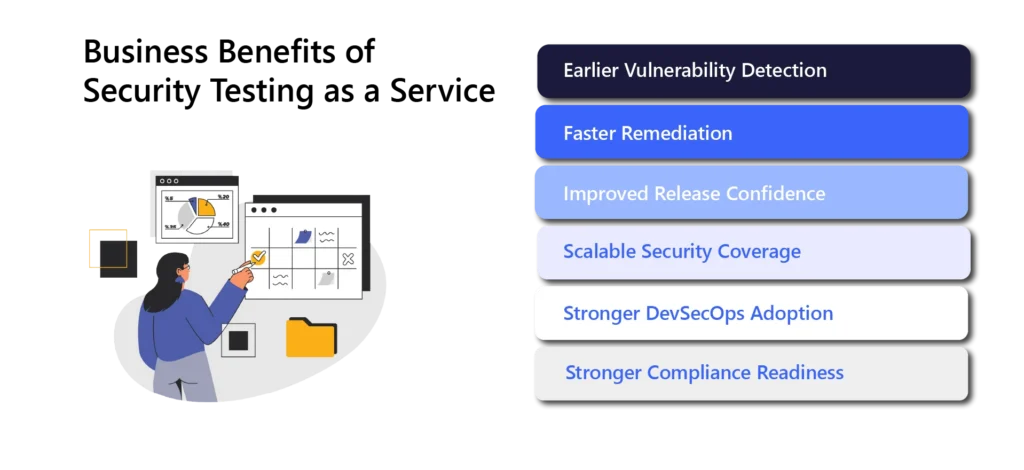
1. Earlier Vulnerability Detection
Integrating security testing into development and QA allows organizations to identify vulnerabilities earlier in the lifecycle. Instead of discovering a security issue immediately before deployment, teams can detect it when code is first introduced.
2. Faster Remediation
Security findings can be routed directly into existing development and QA workflows. Developers can address vulnerabilities while they still have context around the relevant code or feature.
This can reduce remediation time and avoid the complexity of reopening completed development cycles.
3. Improved Release Confidence
A release should not be considered ready simply because functional test cases have been passed. Security validation adds another layer of confidence during the release.
Teams can make release decisions using evidence from functional, performance, and security testing together.
4. Scalable Security Coverage
STaaS allows organizations to extend security testing across a larger application portfolio without proportionally increasing internal security resources.
This is particularly valuable for enterprises with hundreds of applications and distributed development teams.
5. Better DevSecOps Adoption
DevSecOps is fundamentally about integrating security into development and operations rather than treating it as a separate gate.
Security Testing as a Service can support this model by integrating security testing tools, processes, and expertise into existing DevOps workflows.
6. Stronger Compliance Readiness
Many industries operate under strict security and privacy requirements. Continuous testing provides documented evidence that security controls are being evaluated regularly rather than only during an annual assessment.
This can support audit preparation and broader governance objectives.
Real-World Enterprise Use Cases
Security testing becomes more meaningful when viewed through practical enterprise scenarios.
Use Case 1: Banking and Financial Services
A banking application may expose customer accounts through web and mobile interfaces supported by dozens of APIs. Security testing can validate:
- Authentication mechanisms
- Multi-factor authentication
- Role-based access
- Transaction authorization
- API security
- Session management
- Data encryption
- Business logic
A particularly important scenario is authorization testing. A customer may be correctly authenticated but should never be able to access another customer’s account by manipulating an account identifier in an API request. Security testing helps validate these access-control boundaries.
Use Case 2: Healthcare Applications
Healthcare applications process highly sensitive patient and clinical information. Testing can focus on:
- Patient data protection
- Role-based access
- API authorization
- Authentication
- Data encryption
- Audit logging
- Session security
- Third-party integrations
Security regression testing becomes particularly valuable because applications may undergo frequent changes while continuing to handle sensitive data.
Use Case 3: Insurance Platforms
Insurance ecosystems often connect customer portals, broker applications, policy administration systems, claims platforms, payment systems, and external services.
Security testing can evaluate whether sensitive policyholder information remains protected across these interconnected systems.
API security becomes particularly important because data frequently moves between multiple applications.
Use Case 4: Retail and E-Commerce
E-commerce platforms must protect customer accounts, payment-related information, order data, and promotional systems. Security testing can validate:
- Authentication
- Authorization
- Payment workflows
- Session management
- API security
- Input validation
- Account recovery
- Business logic
Testing business logic is especially important. For example, an attacker may attempt to manipulate discounts, prices, quantities, refund workflows, or order states without exploiting a conventional software vulnerability.
Use Case 5: Enterprise SaaS Platforms
SaaS applications typically serve multiple customers from shared infrastructure. This makes tenant isolation a critical security concern. Security testing can determine whether one tenant can:
- Access another tenant’s data
- Invoke another tenant’s APIs
- Manipulate tenant identifiers
- Access administrative functions
- Retrieve unauthorized files
These scenarios require security testing that understands both application functionality and business architecture.
Success Story in Action: The impact of an integrated testing model is best demonstrated through measurable outcomes. In one QA transformation, an enterprise achieved 13× faster testing using an Application Testing as a Service approach.
How to Build Security Into the QA Lifecycle
A practical enterprise approach can follow five stages.
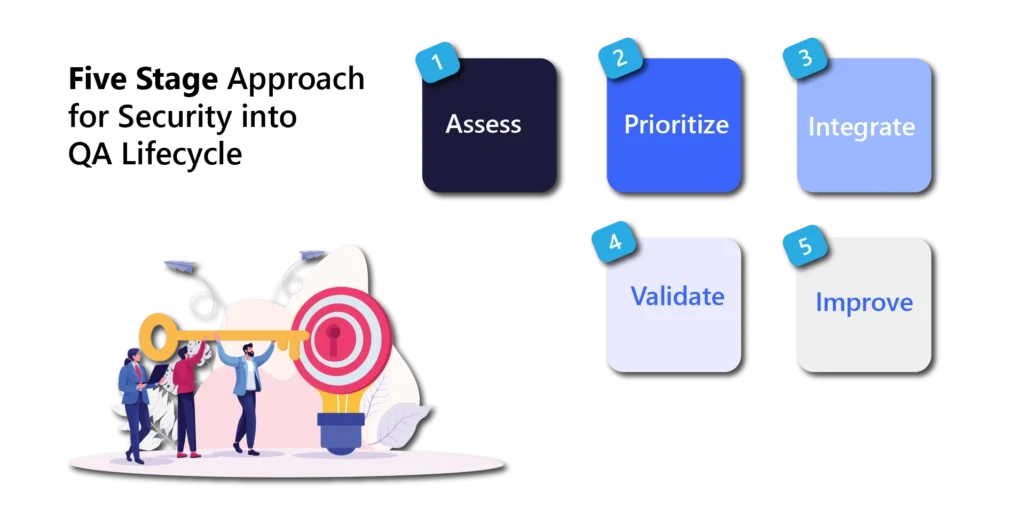
Stage 1: Assess
Start by understanding the application portfolio, technology landscape, data sensitivity, regulatory requirements, and existing security testing capabilities.
Stage 2: Prioritize
Not every application requires identical testing.
Classify applications based on business criticality, exposure, data sensitivity, architecture, and risk.
Stage 3: Integrate
Embed appropriate security testing capabilities into development, QA, CI/CD, API testing, and release processes.
Stage 4: Validate
Combine automated testing with expert-led penetration testing and security assessments for high-risk applications.
Stage 5: Improve
Use testing results, vulnerability trends, remediation metrics, and recurring findings to continuously improve the organization’s security posture.
The objective should be to create a repeatable security assurance process rather than another standalone testing project.
Related Read: How to Evaluate QA Software Testing Services →
Conclusion: Making Application Security a Continuous Practice
Enterprise application security can no longer be treated as a one-time validation performed before production. Applications are changing continuously, APIs are evolving, cloud environments are being reconfigured, dependencies are expanding, and development teams are releasing software at an unprecedented pace. Security testing therefore needs to evolve from periodic assessment to continuous assurance.
Enterprise Application Security Testing as a Service provides a practical way to make that shift. By combining automated security testing, expert-led assessments, continuous vulnerability validation, API and application testing, security regression, DevSecOps integration, and risk-based prioritization, organizations can embed security into the QA lifecycle rather than treating it as a separate checkpoint.
The objective is not simply to identify more vulnerabilities. It is to identify risks earlier, understand their potential business impact, remediate them faster, and prevent them from recurring. When security validation becomes part of everyday quality engineering, organizations can strengthen the connection between application quality, release confidence, regulatory compliance, and overall business resilience.
This is particularly important for enterprises navigating cloud transformation, legacy modernization, expanding API ecosystems, and accelerated digital product delivery. In these environments, security cannot remain a constraint introduced at the end of the development process. It needs to be engineered into the application lifecycle from the outset and continuously validated as applications evolve.
Everforth Quinnox can help enterprises make this approach part of their broader quality engineering and digital transformation strategy. Rather than treating security testing as an isolated assessment, organizations can embed security validation into their existing QA and SDLC ecosystems, establishing repeatable testing processes, automating security checks where appropriate, bringing specialized security expertise into complex testing scenarios, and providing stakeholders with greater visibility into application risk.
The result is a more integrated approach to application quality – one where security is continuously validated alongside functionality, performance, and reliability. Because in the modern enterprise, secure software is quality software, and security is most effective when it is engineered into every release rather than inspected in at the end.

Lead, Marketing, Everforth Quinnox
Frequently Asked Questions Related to Enterprise Application Security Testing
Enterprise Application Security Testing as a Service is a managed security testing model that helps organizations identify, assess, validate, and remediate application vulnerabilities across the software development lifecycle. It combines automated tools, expert-led assessments, continuous validation, and integration with QA, SDLC, CI/CD, and DevSecOps processes.
Traditional penetration testing is usually performed periodically, often before a major release or as part of an annual security assessment. STaaS provides a broader and more continuous security assurance model that can include SAST, DAST, SCA, API security testing, threat modeling, security regression testing, vulnerability assessment, and penetration testing.
STaaS does not replace penetration testing. Instead, it incorporates penetration testing into a wider security testing and quality engineering framework.
Integrating security testing into QA helps organizations identify vulnerabilities earlier, reduce remediation costs, improve test coverage, and make more informed release decisions. It also enables security teams, developers, and QA professionals to work from a shared testing process rather than operating through disconnected activities.
The appropriate frequency depends on the application’s risk profile, release frequency, architecture, exposure, data sensitivity, and regulatory requirements.
High-risk applications may require continuous automated testing, recurring penetration testing, security regression testing for every significant change, and additional assessments after major architectural or infrastructure changes.
Lower-risk applications may follow a less frequent but still structured testing schedule.
Yes. STaaS can complement internal security teams by providing additional testing capacity, specialized expertise, automation support, independent validation, and scalable coverage across application portfolios.
The model can be adapted to the organization’s existing responsibilities, tools, governance processes, and security operating model.
Risk-based security testing helps organizations prioritize testing and remediation according to business impact rather than treating every application or vulnerability identically.
Factors such as application criticality, external exposure, data sensitivity, exploitability, regulatory requirements, and potential business impact can be used to determine the appropriate testing depth and remediation priority.