Accelerate IT operations with AI-driven Automation
Automation in IT operations enable agility, resilience, and operational excellence, paving the way for organizations to adapt swiftly to changing environments, deliver superior services, and achieve sustainable success in today's dynamic digital landscape.
Driving Innovation with Next-gen Application Management
Next-generation application management fueled by AIOps is revolutionizing how organizations monitor performance, modernize applications, and manage the entire application lifecycle.
AI-powered Analytics: Transforming Data into Actionable Insights
AIOps and analytics foster a culture of continuous improvement by providing organizations with actionable intelligence to optimize workflows, enhance service quality, and align IT operations with business goals.
Modern software delivery isn’t slowing down – it’s accelerating in ways most organizations couldn’t have imagined just a few years ago. AI-assisted development, cloud-native platforms, continuous deployment, and increasingly complex digital ecosystems have fundamentally changed how software is built and delivered. Yet one function has often struggled to evolve at the same pace: Quality Assurance (QA).
For many organizations, the conversation around quality still revolves around test coverage, automation percentages, or the number of defects found before release. These metrics matter, but they rarely answer the question that business leaders care about most: Is our QA strategy enabling innovation or quietly becoming the bottleneck that limits it?
The answer often lies not in the tools being used, but in the capabilities behind them. Many organizations continue to rely on QA software testing services that were designed for slower release cycles, isolated development teams, and predictable application environments. As software delivery becomes increasingly continuous and AI-driven, these legacy testing models struggle to keep pace, creating hidden costs in the form of delayed releases, rising technical debt, inefficient automation, and inconsistent customer experiences.
This is why forward-looking organizations are taking a different approach. Rather than treating QA as a final checkpoint, they’re embedding quality across the entire software delivery lifecycle to accelerate releases, reduce business risk, and improve customer outcomes. The commercial impact of this shift is becoming increasingly difficult to ignore. Forrester found that organizations that modernised QA achieved a 213% return on investment over three years, while other industry studies have reported ROI ranging from 372% to 403%, alongside millions of dollars in net present value gains. These findings reinforce an important reality: modernising QA is no longer just a technology initiative – it is a strategic investment that delivers measurable business value.
In this blog, we’ll explore seven clear indicators that your current QA approach may be holding your organization back and the key capabilities to look for when evaluating QA software testing services that are built for today’s digital-first enterprises.
So, how do you know whether your QA function is ready for this shift? In this blog, we’ll explore seven clear indicators that your current QA approach may be holding your organization back and the key capabilities to look for when evaluating QA software testing services that are built for today’s digital-first enterprises.

Why Traditional QA Breaks Down in Modern Delivery Environments
Traditional QA was built for quarterly releases and siloed teams. In agile and DevOps environments, this model creates cascading bottlenecks that compound over time.
- Delayed feedback loops: Defects discovered late are up to 100x more expensive to fix than those caught in design – IBM’s 1-10-100 rule.
- High maintenance overhead: Script-based automation ages quickly. As applications evolve, test scripts break, creating a maintenance treadmill that consumes engineering capacity.
- Siloed operations: QA teams working independently from Dev and Ops create handoff friction at every stage, slowing deployment velocity.
- Limited scalability: Legacy QA frameworks weren’t built for microservices, cloud-native architectures, or AI-driven CI/CD pipelines.
The result is a QA function that spends more time managing itself than protecting the business and a leadership team that can’t confidently answer the question: are we ready to release?
Explore more on why QA in software testing is mission-critical to your digital success.
7 Signs Your QA Function Has Outgrown Traditional Quality Assurance
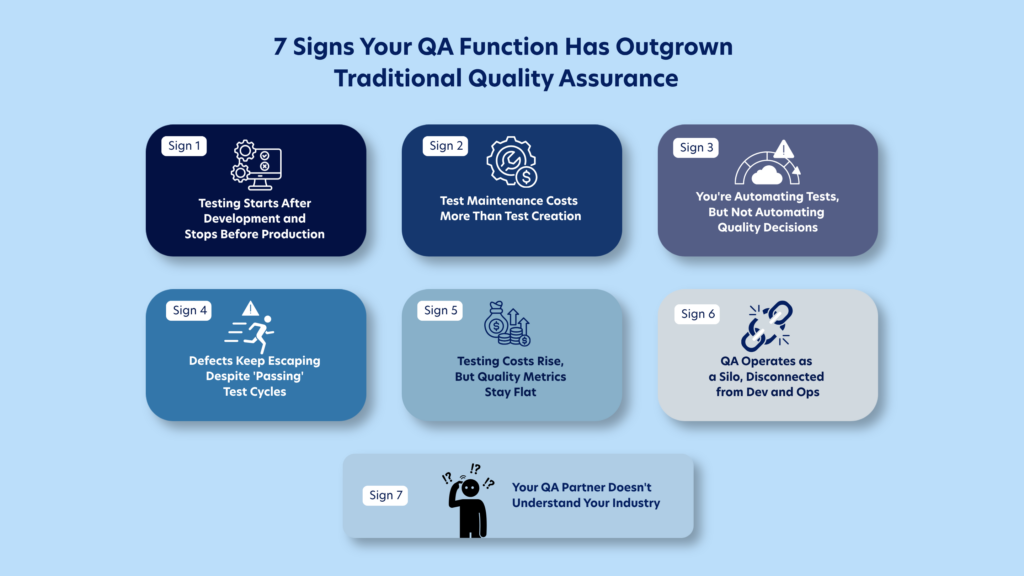
Sign 1 — Testing Starts After Development and Stops Before Production
If your QA team only engages after code is written – and disengages once a release ships -you’re running a reactive model that structurally guarantees defect leakage. Modern delivery environments require continuous validation: quality gates embedded from requirements and architecture decisions through to post-production monitoring.
The shift-left principle is widely cited but rarely fully practiced. Real shift-left testing means QA is part of sprint planning and design review, not just test execution.
Sign 2 — Test Maintenance Costs More Than Test Creation
This is one of the clearest signals of QA inefficiency. When your team spends more effort updating broken test scripts than building new coverage, your automation investment is working against you. The culprit is typically brittle, locator-based automation that breaks with every UI change.
For enterprises with complex, fast-evolving applications, this maintenance burden is unsustainable – and it quietly kills the ROI case for test automation entirely.
Sign 3 — You're Automating Tests, But Not Automating Quality Decisions
Automation without intelligence is just scripted repetition at scale. Many organizations have invested heavily in test automation but still rely on manual analysis to interpret results, triage failures, and decide whether to release. This creates a bottleneck at exactly the moment when speed matters most – and introduces human error at the highest-stakes decision point in the delivery process.
Sign 4 — Defects Keep Escaping Despite 'Passing' Test Cycles
If your test suite shows green but production incidents keep occurring, your QA model lacks predictive capability. Traditional test coverage measures volume – how many tests ran and passed. But high test volume without intelligent risk prioritization leaves critical business workflows exposed.
IBM’s 1-10-100 rule makes the cost clear: fixing a defect in production costs 100x more than catching it in design. For enterprises in regulated industries like banking or healthcare, that cost also includes compliance risk and reputational damage.
Sign 5 — Testing Costs Rise, But Quality Metrics Stay Flat
Escalating QA costs without corresponding improvements in defect rates, release confidence, or time-to-market is a structural problem – not a resourcing one. This pattern typically emerges when organizations continue adding headcount and tooling to a fundamentally broken process rather than re-architecting the model.
Sign 6 — QA Operates as a Silo, Disconnected from Dev and Ops
When QA, development, and operations function as separate units — separate tooling, separate metrics, separate priorities – the result is friction at every handoff. Defects get discovered late, root cause analysis takes longer, and release cycles stretch unnecessarily.
True DevOps quality engineering requires shared accountability: quality standards embedded into the pipeline, not bolted on at the end. Every team should understand the release risk picture before a deployment decision is made.
Sign 7 — Your QA Partner Doesn't Understand Your Industry
Generic QA services treat every application the same. But a retail e-commerce platform has fundamentally different quality requirements than a core banking system or a healthcare patient portal. Compliance frameworks, performance thresholds, data sensitivity requirements, and customer experience standards vary dramatically by sector.
A QA partner that doesn’t understand your industry’s regulatory landscape and risk profile cannot deliver intelligent quality engineering – only checkbox testing.
For broader automation strategy and services, explore Testing and test automation services to discover effective approaches tailored to your context.
Moving Beyond Traditional QA: Why Operating Models Matter More Than Tools
If the seven signs we’ve explored sound familiar, the answer isn’t necessarily another automation platform. Nor is it adding more testers.
The real opportunity lies in rethinking how quality is delivered. Modern quality engineering isn’t defined by individual tools. It’s defined by an operating model that embeds intelligence, automation, continuous validation, and business context into every stage of software delivery.
That’s precisely the thinking behind Everforth Quinnox’s Application Testing as Software (ATaS) approach. Rather than treating testing as a standalone activity performed at the end of development, ATaS reimagines quality as an autonomous, AI-powered capability that continuously protects business outcomes – from the earliest design discussions through production monitoring.
ATaS is part of Everforth Quinnox’s broader Services as Software (SaS) framework, which applies AI-driven, software-defined delivery across the full application lifecycle. Within that framework, ATaS specifically addresses the testing and quality engineering layer – transforming it from a manually operated, reactive function into an autonomous, outcome-driven capability.
ATaS powered by our Agentic AI-driven test automation platform brings together:
- No-code automation: Enabling rapid test creation across web, mobile, APIs, SAP, and enterprise applications — without deep scripting expertise.
- Self-healing test scripts: AI that automatically adapts test cases to application changes, eliminating the maintenance overhead that erodes automation ROI.
- Predictive defect analysis: Identifying risk patterns and focusing coverage on the workflows that matter most to the business.
- Agentic AI for autonomous testing: LLM-powered agents that sense, decide, and act — moving beyond scripted automation toward genuinely autonomous quality engineering.
- Seamless CI/CD integration: Quality gates embedded directly into DevOps pipelines for continuous, real-time validation.
- Industry-specific domain expertise: 20+ years of QA delivery across financial services, retail, healthcare, manufacturing, and more — ensuring testing aligns to sector-specific compliance and CX requirements.
Best Practices for Modernising QA
Modernising QA isn’t a single event – it’s a set of deliberate shifts in how quality is designed, measured, and owned across the organization. The following practices represent the most impactful changes enterprises can make, regardless of where they are on the maturity curve.
1. Shift Testing Left — and Mean It
Shift-left is one of the most cited principles in modern QA, and one of the least fully implemented. In most organizations, ‘shifting left’ means starting automation a sprint earlier. True shift-left means QA is part of the conversation from day one – present in requirements reviews, architecture discussions, and sprint planning to surface risk before a single line of code is written.
The practical implication: QA engineers need a seat at the table during design, not just during execution. When acceptance criteria are defined with testability in mind from the outset, the cost of quality drops significantly and the feedback loop between product, engineering, and QA shortens from weeks to hours.
Most Insightful Guide: The Next-Gen Testing Blueprint: Shift SMART with Intelligent Quality (IQ)
2. Build Continuous Validation Into the Pipeline
Quality gates should not be a phase in the delivery process – they should be a permanent feature of it. Integrating automated tests directly into CI/CD pipelines means every code commit is validated in real time, and release confidence is built incrementally rather than evaluated in a high-stakes window at the end of a sprint.
This requires more than plugging a test tool into Jenkins or GitHub Actions. It means defining clear pass/fail criteria for each pipeline stage, establishing ownership of gate failures, and ensuring test suites are fast enough not to become a bottleneck themselves. The goal is a pipeline where ‘are we ready to release?’ is answered by data, not by a manual QA sign-off.
3. Prioritise by Risk, Not by Coverage
A common trap in test automation is optimising for coverage breadth – the number of test cases executed – rather than coverage depth in the areas that matter most. A test suite with 90% coverage that misses the three most business-critical user journeys is not protecting the business. It’s creating a false sense of confidence.
Risk-based prioritisation means understanding which application areas carry the highest business impact if they fail core transaction flows, regulatory compliance pathways, high-traffic user journeys and ensuring those are covered with the greatest depth, frequency, and scrutiny. Lower-risk areas can be tested less frequently or with lighter coverage without meaningfully increasing release risk.
4. Redefine What 'Quality' Means in Your Metrics
Most traditional QA metrics – test cases executed, defects found, pass rate – measure activity, not outcomes. They tell you what the QA team did, not whether the software is ready to release or whether customers are experiencing the product as intended.
Outcome-driven metrics shift the frame entirely. Defect escape rate measures how many issues reach production that should have been caught earlier. Mean time to detection and mean time to resolution measure the efficiency of the quality feedback loop. Release frequency and deployment confidence scores connect QA performance directly to delivery velocity. Customer-facing metrics – error rates, transaction failure rates, support ticket volume – close the loop between internal quality data and real-world experience.
When QA metrics speak the language of business outcomes, conversations with leadership change. Quality engineering stops being a cost line and starts being a delivery enabler.
5. Invest in Self-Healing, Not Just Automation
Test automation is only as valuable as its ability to stay current. In rapidly evolving applications, brittle test scripts that break with every UI change create a maintenance overhead that can quickly consume more engineering time than the automation saves. This is one of the most common reasons QA automation programmes stall or regress.
Self-healing automation uses AI to detect when a UI element or application behaviour has changed and automatically updates the affected test case – without manual intervention. This keeps the test suite current at the pace of development, maintains coverage without a growing maintenance backlog, and preserves the ROI case for automation investment over time.
For enterprises managing large, complex application estates, self-healing capability is not a nice-to-have — it’s a prerequisite for sustainable automation at scale.
6. Align QA to Your Industry's Risk Profile
Quality requirements are not universal. A performance regression that causes a 200ms slowdown in a consumer app might be acceptable; in a high-frequency trading platform or a real-time payment system, it could be catastrophic. A data validation failure in an HR system is a nuisance; in a healthcare records platform, it’s a compliance breach.
Modern QA practice requires calibrating testing depth, coverage priorities, and validation criteria to the specific risk profile of the industry and the application. This means understanding relevant regulatory frameworks – PCI-DSS, GDPR, HIPAA, FCA guidelines – and building compliance validation into the standard test cycle rather than treating it as a periodic audit activity. It also means working with QA partners who bring genuine domain expertise, not just generic testing methodology applied to any vertical.
7. Make Quality a Shared Responsibility
Perhaps the most important cultural shift in modern QA: quality cannot be the responsibility of a single team. When QA operates as a separate function that accepts work from development and gates it before release, the incentive structures are misaligned – developers optimise for velocity, QA optimises for caution, and the tension between them slows delivery without necessarily improving outcomes.
High-performing engineering organizations treat quality as a shared accountability across Dev, QA, and Ops. This means developers write and own unit tests. Product teams define testable acceptance criteria. Operations teams feed production incident data back into test prioritisation. And QA engineers focus on the highest-value activities – risk analysis, test strategy, intelligent coverage decisions – rather than spending capacity on tests that other roles are better placed to own.
Use Cases Across Industries
While the principles of modern quality engineering remain consistent, the way they’re applied varies significantly across industries. Every sector faces unique regulatory requirements, operational risks, and customer expectations that demand tailored testing strategies.
Financial Services & Banking
Banks operate in an environment where every release must balance innovation with regulatory compliance, security, and customer trust.
Modern quality engineering helps financial institutions validate digital banking journeys, payment systems, lending platforms, and customer onboarding processes while supporting compliance with frameworks such as PCI DSS, GDPR, and FCA guidelines.
Continuous validation reduces operational risk, accelerates release cycles, and provides greater confidence in every deployment.
Related Case Story: Everforth Quinnox Enables Monument Bank’s Digital First Goals
Healthcare
In healthcare, software quality directly influences patient outcomes, regulatory compliance, and data privacy.
Modern QA validates interoperability across digital health platforms while protecting sensitive patient information and supporting compliance with evolving healthcare regulations.
Reducing defect leakage isn’t simply an engineering objective—it’s fundamental to delivering safe and reliable patient experiences.
Manufacturing
Manufacturers increasingly rely on interconnected ERP platforms, IoT ecosystems, and complex supply chain applications.
Quality engineering ensures these mission-critical systems continue operating reliably through upgrades, integrations, and ongoing digital transformation initiatives.
Automated regression testing across SAP and enterprise applications helps minimise operational disruption while accelerating innovation.
Retail & E-Commerce
Customer expectations have never been higher.
Retailers must deliver seamless experiences across web, mobile, point-of-sale systems, and digital marketplaces – particularly during seasonal peaks and promotional events.
Intelligent quality engineering helps validate omnichannel experiences, performance under heavy load, and business-critical customer journeys, ensuring revenue isn’t lost because of preventable software failures.
Stop Evaluating QA Tools & Start Evaluating QA Outcomes.
The seven signs explored in this blog aren’t edge cases. They’re patterns that most enterprises relying on traditional QA will recognise. The question isn’t whether your QA model has limitations — it’s whether those limitations are costing you releases, customers, and competitive position.
Evaluating QA software testing services requires moving beyond a toolset checklist. Does your QA model embed validation across the full delivery lifecycle? Does it predict and prevent defects rather than just detect them? Does it deliver measurable business outcomes rather than test execution metrics?
The organizations that answer yes to those questions and capture the triple-digit ROI that analyst research consistently attributes to QA modernisation – are the ones that treat quality not as a testing function, but as a strategic business capability.
If you’re ready to evaluate where your organization stands, Everforth Quinnox’s IQ Blueprint Assessment provides a structured maturity benchmark and a clear roadmap for the path forward.

Assistant Manager – Marketing (Analyst Relations), Everforth Quinnox
FAQ’s Related to QA Software Testing Services
Evaluating QA providers requires looking beyond automation capabilities or pricing models. Organizations should assess whether a provider offers industry expertise, AI-enabled automation, seamless CI/CD integration, predictive quality engineering, and measurable business outcomes that improve release confidence and operational resilience.
Common warning signs include testing that begins only after development, excessive automation maintenance, recurring production defects despite successful test cycles, rising QA costs with limited business impact, siloed delivery teams, and testing partners that lack industry-specific expertise.
It may be time to reassess your QA partner if they struggle to support Agile or DevOps delivery, rely heavily on manual processes, lack AI-driven automation capabilities, cannot align testing with your industry’s regulatory requirements, or continue measuring success through effort rather than business outcomes.
Intelligent Quality (IQ) is an AI-driven approach to quality engineering that combines autonomous testing, predictive defect analysis, self-healing automation, continuous validation, and outcome-based measurement to improve software quality while accelerating delivery.
Reducing the cost of quality starts with preventing defects rather than fixing them. Best practices include adopting Shift Left engineering, embedding continuous validation into CI/CD pipelines, using AI-powered self-healing automation, prioritising testing based on business risk, and measuring quality through operational and customer outcomes rather than testing activity alone.