Introduction: The Shift to the Agentic Enterprise
Artificial intelligence is entering a new era. Instead of simply responding to prompts, AI is becoming capable of reasoning, making decisions, and executing complex business processes with minimal human intervention. This evolution is giving rise to the Agentic Enterprise—an operating model where autonomous AI agents work alongside employees, customers, business workflows, and enterprise systems in real time.
At the forefront of this transformation is Salesforce Agentforce. More than a conversational AI tool, Agentforce enables organizations to build intelligent agents that can proactively resolve customer issues, assist sales teams, automate service operations, orchestrate workflows, retrieve contextual business knowledge, and securely take action across the Salesforce ecosystem.
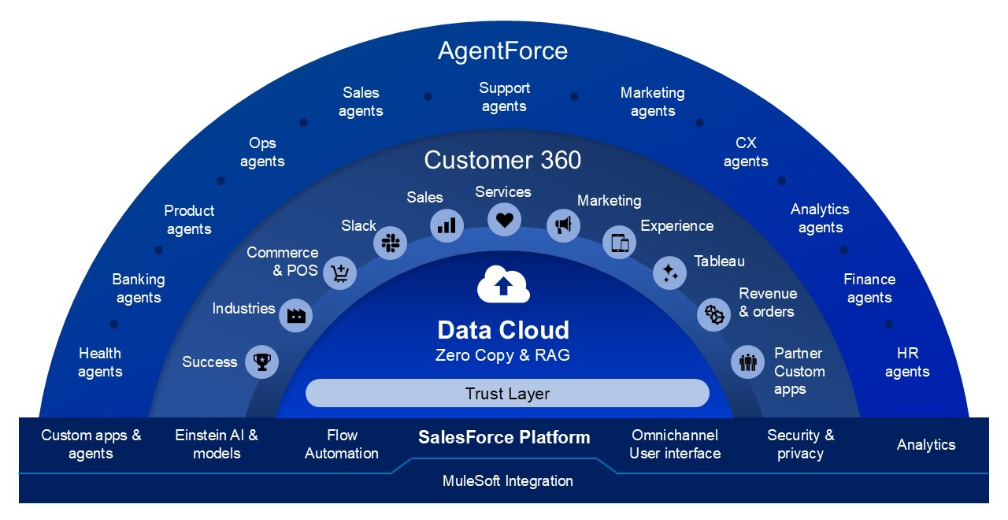
Image Source: Salesforce
As enterprises race to adopt autonomous AI, Agentforce implementation has become a strategic priority. However, deploying enterprise AI isn’t as simple as turning on a new feature. Success depends on the right data foundation, seamless integrations, governance, security, and a well-defined implementation strategy. Understanding what it takes to implement Agentforce effectively is the difference between a successful AI transformation and an expensive proof of concept that never scales.
Free Resource
Industry-wide Salesforce Agentforce Use Cases for 2026 and Beyond
Discover how the future of autonomous service works in your specific industry. Grab our comprehensive industry-wide guide to Salesforce Agentforce use cases.
Phase 1: Strategic Discovery and Outcome Architecture
The most successful Agentforce implementations begin with business strategy, not technology. Before configuring any AI agent, enterprise teams must clearly define:
- The business problem to solve
- The expected operational outcomes
- Success metrics
- Human-AI collaboration boundaries
- Governance requirements
Identify High-Value Use Cases
Organizations often fail when they try to deploy AI everywhere at once. Instead, they should prioritize:
- Repetitive operational tasks
- High-volume support interactions
- Knowledge-heavy workflows
- Multi-step manual processes
- Decision-support use cases
Example Enterprise Use Cases
| Industries | Agentforce Use Cases |
|---|---|
| Logistics | AI Shipment Orchestrator Agent |
| Manufacturing | Smart Lead-to-Order Conversion (Dealer / Distributor Network) |
| Banking | Intelligent Loan Pre-Approval & Offer Personalization |
| Recycling / Green Energy | Intelligent Renewable Energy Demand–Supply Optimization & Sales Acceleration |
| Healthcare | Intelligent Patient Care Coordination & Proactive Intervention |
| Real Estate & Property Management | AI-Powered Property Sales, Tenant Management & Maintenance Automation |
| Travel, Hospitality & Tourism | AI Concierge & Personalized Travel Experience Automation |
Define Outcome Based KPIs
Instead of measuring AI success only through adoption, enterprises should align Agentforce with measurable outcomes such as:
- Reduced case handling time
- Increased first-contact resolution
- Higher sales conversion rates
- Reduced operational cost
- Improved customer satisfaction
- Faster onboarding time
Build an AI Governance Council
Enterprise AI implementations require cross-functional alignment involving:
- Business stakeholders
- Enterprise architects
- Salesforce admins
- Security teams
- Legal and compliance teams
- Data governance leaders
This governance model keeps AI decisions aligned with organizational policy and ethical standards.
Phase 2: The Data Foundation and Readiness Audit
AI agents are only as effective as the data they can access. A common misconception is that the platform alone delivers intelligence — in reality, data quality, accessibility, and structure directly determine AI effectiveness.
Conduct a Data Readiness Assessment
Organizations should audit:
- CRM data quality
- Duplicate records
- Incomplete customer profiles
- Knowledge article accuracy
- Integration gaps
- Unstructured enterprise content
Poor-quality data often causes hallucinations, inaccurate recommendations, and unreliable automation.
Establish a Unified Data Layer
Modern Agentforce implementations rely on connected enterprise data. Organizations should evaluate:
- CRM data architecture
- ERP integrations
- Data warehouses
- API ecosystems
- Third-party business applications
Many enterprises leverage:
- Salesforce Data Cloud
- MuleSoft integrations
- External APIs
- Real-time event streaming
…to create unified customer and operational views.
Knowledge Management Optimization
Agentforce performs best when enterprise knowledge is:
- Structured
- Searchable
- Governed
- Frequently updated
- Contextually categorized
This includes:
- FAQs
- SOP documents
- Product manuals
- Internal process documentation
- Policy repositories
Data Security Classification
Not all data should be accessible to AI agents. Enterprises must classify:
- Sensitive data
- Confidential records
- Regulated information
- Role-based access permissions
- Compliance boundaries
This is critical in industries such as healthcare, banking, insurance, and government.
Phase 3: Technical Prerequisites and Environment Activation
Once the strategic and data foundations are ready, technical enablement begins.
Salesforce Environment Preparation
Organizations should validate:
- Salesforce edition compatibility
- Sandbox strategy
- API limits
- Identity management readiness
- Integration architecture
- Environment governance
Enable Required Salesforce Capabilities
Depending on the use case, enterprises may need:
- Einstein Trust Layer
- Data Cloud
- Service Cloud
- Sales Cloud
- Experience Cloud
- MuleSoft
- OmniStudio
- Flow Automation
- Prompt Builder
- Agent Studio Capabilities
- Vector Search Capabilities
Identity and Authentication Setup
Secure authentication is essential for enterprise-grade AI. Teams should configure:
- SSO
- OAuth integrations
- Role hierarchies
- Permission sets
- API security policies
- Session controls
Integration Architecture Planning
Agentforce agents often need real-time access to:
- ERP systems
- Inventory systems
- Payment gateways
- Knowledge repositories
- Legacy applications
- External databases
A scalable API-first integration strategy improves long-term maintainability.
Phase 4: Building the Agent (Context Engineering)
This is where implementation becomes truly transformational. The key to building intelligent enterprise agents isn’t just prompt creation — it’s Context Engineering.
What is Context Engineering?
Context engineering is designing how the AI agent:
- Retrieves enterprise knowledge
- Understands user intent
- Accesses business systems
- Applies reasoning
- Executes actions
- Maintains conversation continuity
In enterprise AI, context is everything.
The Three Levers of Context Engineering
Practitioners use Agent Script as a unified language to express subagents, instructions, actions, and rules in a single file:
1. Subagents – Define specialized agents and their expertise.
2. Instructions – Guide conversation flow, tone, and intent.
3. Actions and Rules – Execute actions and enforce mandatory business logic.
Agentforce Custom Action Selection
| Component | When to Use | Skills Required | Additional License Required? |
|---|---|---|---|
| Prompt Template | To invoke an LLM to generate a response. Prompt template actions are one way an agent uses RAG. | Low-code | Yes |
| Flow | To run low-code rules-based automation and record retrieval | Low-code | No |
| Apex code | To run pro-code rules-based automation and record retrieval | Pro-code | No |
| MuleSoft API | To retrieve data from legacy systems and other external applications in a complex enterprise environment | Pro-code | Yes |
| External Service | To retrieve data from REST APIs that support OpenAPI specs | Low-code | Yes |
| Predictive Model | To use predictive AI with your agent | Low-code | Yes |
How Agentforce Reasons
The Reasoning Engine uses Subagents, instructions, actions and rules to get work done. Since Agent Script fully defines the agent, it eliminates the black box of probabilistic routing. In short, it will:
- Classify Subagent: match a customer message to the most appropriate subagent based on its name and description.
- Execute Scripted Logic: run the scripted instructions and rules from the Script, before evaluating non-deterministic instructions.
- Apply Actions: if a task needs external data or an update, run the necessary actions and collect the results.
- Grounding Check: before responding, confirm the answer is based on accurate information and follows the Script’s guidelines.
The Atlas Reasoning Engine is the “brain” behind Salesforce Agentforce. It lets AI agents reason, plan, decide, and act autonomously — not just respond like a chatbot.
How Atlas Works
Atlas, Salesforce’s reasoning engine, enables Agentforce to understand requests, plan multi-step actions, execute the appropriate tools, and evaluate results before deciding what to do next. For a deeper look at how Atlas uses reasoning, retrieval, orchestration, and context to power Agentforce, see our detailed guide to the Atlas Reasoning Engine.
Key Capabilities
Atlas supports multi-step decision-making, autonomous workflow execution, Retrieval-Augmented Generation (RAG), context-aware conversations, dynamic tool selection, and human handoffs, with enterprise trust and governance supported through the Einstein Trust Layer.
Example
For example, when a telecom customer reports an internet outage while requesting a plan upgrade, Agentforce can identify the customer, check outage status, update or create a support case, recommend suitable plans, trigger an upgrade workflow, and escalate to a human when required—all within a single conversation.
Architecture Understanding:
At a high level, an Agentforce interaction flows from the user request → Atlas Reasoning Engine → subagents → actions → Salesforce systems. Subagents interpret and manage specific intents, while actions can invoke capabilities such as Flow, Apex, APIs, prompts, and data operations.
Note: From April 2026, Salesforce refers to Topics as Subagents and the Topic Selector as the Agent Router.
Define Agent Roles and Responsibilities
Each agent should have a clearly defined purpose, operational boundaries, approved actions, escalation logic, and human handoff workflows. These guardrails help ensure that agents can perform appropriate tasks while restricting actions such as unauthorized access to sensitive data or approvals beyond defined thresholds.
Prompt and Instruction Design
Enterprise prompts should be task-specific, structured, and explicit about business constraints, escalation paths, and expected actions. Clear instructions help reduce ambiguity and keep agent behavior aligned with business requirements.
Retrieval-Augmented Generation (RAG)
RAG enables Agentforce to ground responses in trusted enterprise knowledge and relevant business data, helping improve factual accuracy and reduce unsupported responses.
Workflow Automation Integration
Agentforce becomes operational when agents can connect with automation and enterprise systems through capabilities such as Salesforce Flow, Apex, APIs, event-driven workflows, and external orchestration systems. This enables agents to move beyond generating responses to executing business processes.
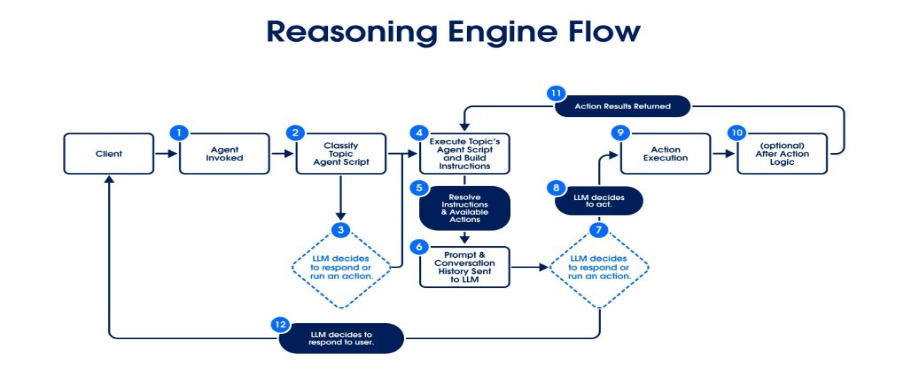
Image Source: Salesforce
Note: From April 2026, agent Topics are now called Subagents and the Topic Selector is now called Agent Router.
Define Agent Roles and Responsibilities
Every agent should have:
- A defined purpose
- Clear operational boundaries
- Approved actions
- Escalation logic
- Human handoff workflows
Example
A customer service agent may:
- Retrieve order details
- Summarize case history
- Recommend solutions
- Trigger workflows
- Escalate high-risk cases
But it may not:
- Approve refunds beyond thresholds
- Access financial records without authorization
- Modify restricted customer data
Prompt and Instruction Design
Effective enterprise prompts should:
- Be task-specific
- Include business constraints
- Define escalation paths
- Minimize ambiguity
- Use structured instructions
Retrieval-Augmented Generation (RAG)
Many enterprises implement RAG to improve factual accuracy, enabling Agentforce to:
- Pull trusted enterprise knowledge
- Reference real-time business data
- Reduce hallucinations
- Deliver grounded responses
Workflow Automation Integration
Agentforce’s real power emerges when AI agents connect directly with automation tools such as:
- Salesforce Flow
- Apex
- APIs
- Event-driven workflows
- External orchestration systems
This lets agents move from conversational AI to operational AI.
Phase 5: Rigorous Testing and Validation
AI testing must go beyond traditional application testing.
Functional Testing
Validate:
- Prompt accuracy
- Workflow execution
- API integrations
- Record access
- Agent actions
- Error handling
AI Behavior Testing
Teams should test:
- Hallucination scenarios
- Toxic responses
- Bias detection
- Escalation accuracy
- Compliance adherence
- Edge-case behavior
Human-in-the-Loop Validation
Enterprise AI should initially include:
- Human approvals
- Review checkpoints
- Escalation routing
- Monitoring dashboards
This reduces operational risk during early deployment.
Load and Performance Testing
Enterprise deployments must evaluate:
- Concurrent requests
- API throughput
- Response latency
- System scalability
- Peak operational traffic
Phase 6: Security, Trust, and Metadata DevOps
Security and governance are foundational pillars of enterprise AI.
Einstein Trust Layer
Salesforce’s Einstein Trust Layer provides a secure framework for using AI with enterprise data, helping organizations protect sensitive information, maintain data boundaries, and strengthen AI governance. For a deeper look at how Agentforce supports secure, enterprise-grade service, explore the Salesforce Agentforce Service Guide.
Metadata-Driven AI Governance
Agentforce implementations should follow DevOps best practices, including:
- Source control
- CI/CD pipelines
- Sandbox promotion strategies
- Version management
- Automated deployment validation
Compliance and Auditability
Organizations should establish:
- AI audit logs
- Prompt traceability
- Access monitoring
- Decision transparency
- Regulatory reporting
Role-Based AI Access
Different teams need different AI capabilities — for example:
- Sales agents may access opportunity insights
- Service agents may access customer history
- Finance teams may require stricter controls
Role-based AI governance minimizes operational risk.
Phase 7: Post-Launch ROI and Continuous Tuning
Launch is only the beginning. Top-performing enterprises continuously optimize AI agents using operational feedback and business metrics.
Measure Business Impact
Track metrics such as:
- AI containment rate
- Employee productivity
- Customer satisfaction
- Revenue impact
- Resolution time reduction
- Workflow efficiency gains
Continuous Prompt Optimization
Enterprise AI prompts should evolve regularly based on:
- User behaviour
- Failed interactions
- New business policies
- Product updates
- Compliance changes
Monitor AI Drift
AI performance may degrade over time due to:
- Outdated knowledge
- Process changes
- New customer behaviours
- Evolving regulations
Continuous monitoring prevents operational decline.
Scale Across Departments
Once initial implementations succeed, organizations can expand Agentforce into:
- Sales operations
- Supply chain
- HR automation
- IT operations
- Partner ecosystems
- Executive analytics
Common Enterprise Challenges During Agentforce Adoption
While Agentforce offers significant opportunities to automate workflows and enhance customer and employee experiences, successful adoption is rarely plug-and-play. As organizations move from pilot projects to enterprise-wide deployments, they often encounter challenges related to data readiness, system integration, governance, security, user adoption, and change management. Identifying these roadblocks early allows businesses to build a stronger implementation strategy, reduce deployment risks, and accelerate time to value.
1. Prompts vs. Agents
Agents aren’t the only generative AI tool on the Agentforce 360 Platform — prompt templates, built in Prompt Builder, are another. They let you define structured, reusable instructions that guide a generative AI model to produce specific outputs, referencing Salesforce data through fields, data graphs, and RAG. Like agents, prompt templates route through Salesforce’s trust layer, which honors permissions, masks sensitive data, and flags toxic outputs.
Prompt templates are single-turn and stateless — ideal for one-off tasks, such as rewording a sentence or summarizing a case, that don’t need memory or multi-step reasoning. They generate a response from the input and logic defined at design time; they don’t retain memory or take actions.
When to Use Prompt Templates
Prompt templates can be used standalone in an embedded AI solution or added to an agent as an action. Using one standalone is ideal when:
- Business context is well understood and stable
- The desired output follows a predictable format, though the response itself is not deterministic
- There is no need to evaluate different paths or take autonomous actions
- Ongoing context, or state, is not required
- Multi-step reasoning is not required
Prompt template use cases:
- Generating a structured record summary, like summarizing case notes
- Creating structured meeting notes
- Generating templated email responses
- Suggesting next best actions
- Identifying a sentiment analysis of a case
They can dynamically fill in data and generate responses at run time, but cannot reason through options or take action.
When to Use Agents
Agents autonomously decide what to do, in what order, and how — based on evolving context. Unlike a single prompt, they can plan, reason, call external actions (like API calls or database lookups), and react based on outcomes, choosing different paths as they learn mid-process. Agents are best when:
- The environment or context can change dynamically
- Multiple decisions or branches are possible based on data
- AI needs to replace or assist human judgment in making a choice or taking action
AI agent use cases:
- Triaging and routing incoming support cases
- Resolving booking issues by checking external systems and policies
- Managing multi-step workflows with feedback loops
- Drafting a case response email based on customer details, possible solutions, and relevant knowledge articles
- Scheduling an appointment based on service rep availability and customer preference
- Detecting events, such as software update issues, and proactively generating troubleshooting tasks or attempting remote resolution via an API call
2. Token Consumption & Knowledge Preparation
Problem: Agentforce consumes Einstein tokens whenever content (PDFs, documents, knowledge articles) is ingested or re-indexed. In enterprise SDLC, the same content is often uploaded across Dev, QA/UAT, and Production, driving repeated consumption and higher cost.
Key Challenges
- Duplicate ingestion across environments increases token usage.
- Frequent updates and re-indexing consume additional tokens.
- Poor-quality or duplicate content wastes AI token budgets.
- Large document repositories significantly increase implementation and maintenance costs.
Business Impact
- Higher AI operational costs.
- Reduced ROI from Agentforce adoption.
- Increased implementation and maintenance effort.
Best Practices
- Clean, validate, and deduplicate content before ingestion.
- Upload only production-ready knowledge assets.
- Batch updates to minimize re-indexing.
- Implement document governance and version control.
- Follow a “Prepare Once, Ingest Once” strategy and monitor token consumption across environments.
Key Recommendation: Treat enterprise knowledge as a governed asset. Preparing and governing content before ingestion reduces token waste, lowers AI costs, and improves response quality and ROI. Use Salesforce’s Digital Wallet app to track Einstein consumption — conversation volumes and processed tokens (Flex Credits).
3. Poor Data Quality
Poor or fragmented enterprise data is another major adoption challenge. AI agents depend on accurate, structured, real-time information; inconsistent CRM records, duplicate profiles, outdated knowledge articles, and disconnected systems all degrade performance, leading to hallucinations, bad recommendations, and low user trust. Enterprises must invest in data cleansing, governance, and a unified data architecture before scaling AI.
4. Lack of Governance
Without proper governance, enterprise AI can introduce operational, security, and compliance risk. Organizations often struggle to define ownership, approval processes, usage policies, and accountability, and AI agents touching sensitive data need strict access controls, auditability, and monitoring. Enterprises should form cross-functional AI governance councils spanning business leaders, security teams, architects, and compliance stakeholders to build trust and long-term sustainability.
5. Unrealistic Expectations
Agentforce is powerful but not plug and play. Many organizations underestimate the effort needed for data readiness, workflow design, integrations, testing, and change management. Rushing large-scale deployment causes operational inefficiency and low adoption. A phased rollout with clearly defined outcomes and KPIs, focused on iterative improvement rather than immediate perfection, is essential.
6. Change Management Resistance
Employee resistance is common, often driven by fear of job displacement, reduced control, or increased monitoring, and by low awareness that Agentforce supports rather than replaces employees. Successful enterprises invest in communication, training, and enablement to build confidence and trust and leadership should clearly communicate how AI improves productivity, reduces repetitive work and enhances decision-making.
Scalability: Best Practices for Scaling Agentforce Across Business Units
As organizations expand their AI initiatives, ensuring consistent performance across multiple departments becomes a critical priority. Scaling Agentforce successfully requires more than simply deploying additional AI agents—it demands a well-defined governance strategy, standardized processes, and continuous performance optimization.
By following proven best practices, businesses can maximize the value of salesforce agentforce AI, enabling teams across different business units to deliver seamless, intelligent, and scalable customer experiences while maintaining efficiency and control.
Start with Focused Use Cases
When introducing Agentforce, resist the temptation to roll it out across the entire organization at once. A more effective approach is to begin with a few high-impact use cases where AI can deliver quick, measurable results. For example, you might automate customer support inquiries, streamline lead qualification, or assist service agents with knowledge retrieval.
Starting small allows teams to test workflows, gather user feedback, and fine-tune AI performance before expanding to other departments. This phased approach minimizes risk while building confidence in the platform.
Build Reusable AI Components
As your AI initiatives grow, creating reusable components can significantly reduce implementation time and improve consistency. Instead of building every workflow from scratch, develop standardized prompts, reusable automation flows, API integrations, and structured knowledge repositories that different teams can leverage. This not only accelerates future deployments but also ensures that AI delivers consistent responses and follows the same business rules across the organization. Reusability makes scaling more efficient while reducing maintenance efforts over time.
Invest in AI Literacy
Technology alone doesn’t guarantee success—people need to understand how to use it effectively. Organizations should invest in AI education across every level of the business. Business users should learn how AI can simplify daily tasks and improve productivity. Salesforce administrators need to understand how to configure, monitor, and optimize AI agents. Developers and architects should be equipped to build scalable, secure AI solutions, while leadership teams should understand AI’s strategic value, governance requirements, and business impact.
A well-informed workforce is more likely to embrace AI confidently and use it responsibly. Hence make sure to train:
- Business users
- Admins
- Developers
- Architects
- Leadership teams
Prioritize Trust and Transparency
Successful AI adoption depends on trust. Employees and customers should always have a clear understanding of what AI is capable of, where its limitations lie, and when a human takes over the conversation. Setting realistic expectations helps prevent confusion and builds confidence in AI-assisted interactions.
Organizations should also be transparent about how AI-generated responses are created, how customer data is handled, and when users can escalate to a human representative. By making transparency a core part of the AI experience, businesses can foster stronger relationships with users while encouraging responsible AI adoption.
Case Study: How Everforth Quinnox Automated CDP Reporting Using Salesforce Agentforce for A Waste Management Company
We implemented Agentforce for one of our prestigious clients, a leading US-based organization in Waste Management, Recycling and Green Energy. The client uses the Net Zero Cloud (NZC) application within Salesforce as its sustainability management solution to track, analyse, and reduce its environmental impact. It enables the organization to monitor greenhouse gas (GHG) emissions, energy consumption, water usage, waste generation, and vehicle emissions.
For every reporting cycle, the client had to complete the CDP (Carbon Disclosure Project) questionnaire— a detailed, publicly disclosed report on emissions and methodology. Doing this meant manually searching through past disclosures, emissions data, and methodology documents to calculate and verify every answer, then cross-checking it against what had been reported the year before. It was slow, repetitive work, and because CDP responses are audited and made public, there was no room for error.
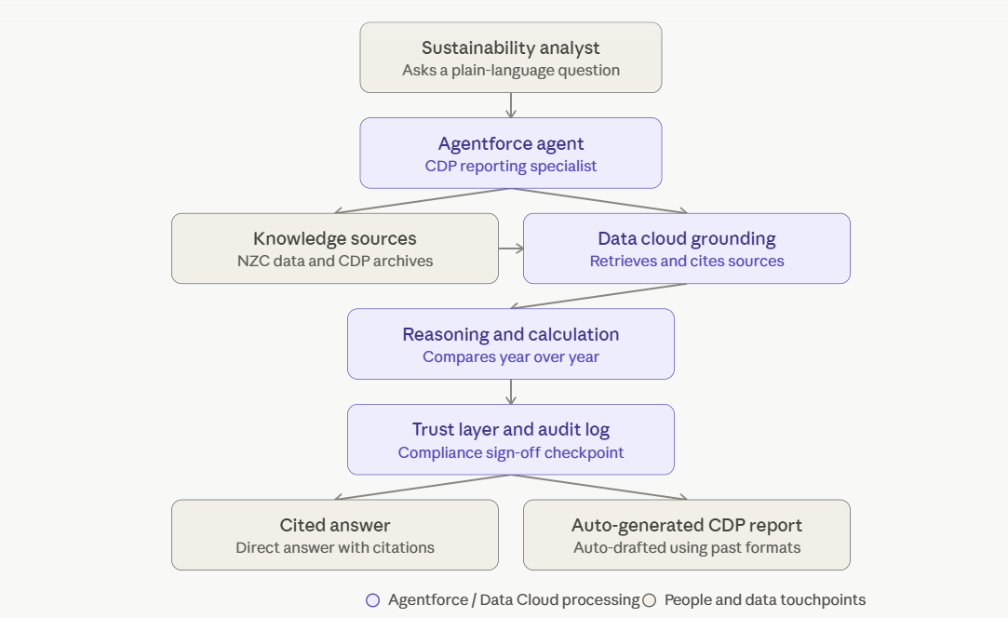
To address these challenges, we developed a purpose-built AI assistant powered by Salesforce Agentforce, designed exclusively for CDP reporting. Unlike a generic chatbot, this AI assistant functions as a domain-specific expert. It is trained exclusively on the organization’s verified sustainability documents and reporting history, enabling it to provide accurate, contextual, and trustworthy responses.
Key capabilities include:
- Answering CDP-related questions using only approved internal documents
- Automatically comparing the current reporting cycle with previous years’ disclosures
- Providing source citations for every response to ensure traceability and audit readiness
- Performing intelligent data calculations required for annual reporting
- Automatically generating new CDP documents by following the structure and format of historical reports while incorporating the latest validated data
- Maintaining consistency across reporting cycles through controlled, AI-driven document generation
Based on early usage, the client could reduce 60–70% in the time spent on CDP reporting tasks that previously required extensive manual research and calculations.
Previously, analysts had to manually review 200+ pages of the CDP report, perform calculations, and update the reports accordingly. Work that once consumed a significant portion of the reporting cycle can now be completed in a fraction of the time, allowing the team to focus on analysis and strategy rather than document searches, while maintaining the accuracy and traceability required for compliance reporting.
Conclusion: The Roadmap to Success
The rise of the Agentic Enterprise marks a major shift in how organizations operate, collaborate, and deliver customer experiences. Salesforce Agentforce moves enterprises beyond traditional automation toward intelligent, autonomous operations powered by trusted AI. However, realizing its full potential requires more than deploying AI agents—it demands a well-defined strategy that aligns data architecture, governance, security, integrations, and operational processes into a scalable AI ecosystem capable of delivering measurable business value.
At Everforth Quinnox, we help organizations turn this vision into reality through our Salesforce Agentforce services. From identifying high value Agentforce use cases and designing intelligent agent workflows to integrating enterprise data, implementing governance frameworks, and scaling AI across business functions, our experts guide businesses through every stage of their Agentforce journey.
Whether you’re exploring your first AI-powered agent or building an enterprise-wide agentic ecosystem, we can help you accelerate adoption, maximize ROI, and deploy trusted AI solutions that deliver lasting business impact.

Salesforce Consulting Manager, Everforth Quinnox
FAQs
The 4–6 week timeline is usually achievable only for a basic proof of concept or a limited pilot. A real enterprise rollout is a different story. Most organizations need to integrate multiple systems, clean and prepare data, define security and governance, test AI outputs, train users, and roll out in phases. Those activities—not the software installation itself—are what extend projects into the 6–14 month range. In most cases, the technology is the easy part; aligning people, processes, and data is what takes time.
A successful implementation typically requires a mix of business and technical expertise rather than a single specialist. Teams usually need Salesforce administrators and developers, integration experts, data architects, security and compliance specialists, AI or prompt design expertise, and business stakeholders who understand day-to-day workflows. Just as important is change management—ensuring employees know how and when to use AI effectively. The strongest projects are usually cross-functional rather than purely IT-led.
Most implementation failures have very little to do with the AI itself. The biggest issues are poor data quality, unclear business objectives, trying to automate broken processes, weak executive sponsorship, and underestimating integration complexity. Another common mistake is focusing on the technology instead of measurable business outcomes. Organizations that start with a clear use case, clean data, and realistic expectations tend to see much better results than those trying to deploy AI everywhere at once.
Not necessarily. Agentforce can work without Salesforce Data Cloud in many scenarios, particularly if your customer data already lives within Salesforce and your use cases are relatively straightforward. However, Data Cloud becomes much more valuable when you need to unify customer data from multiple systems, provide richer context to AI agents, or deliver highly personalized interactions. Whether you need it depends more on your data landscape than on Agentforce itself.
The software license is only one part of the overall cost. Enterprise TCO usually includes implementation services, systems integration, data preparation, customization, security and governance, testing, user training, ongoing support, and continuous optimization. Many organizations also invest in additional infrastructure, monitoring, and AI governance as adoption grows. For large enterprises, these implementation and operational costs can equal or exceed the initial software investment, which is why it’s important to evaluate the total business case—not just the licensing fees.