According to Salesforce research, 41% of your employees’ working hours are spent on tasks that should never reach a human desk. Nearly half of every working day – logged calls, routed tickets, qualified leads, templated follow-ups, repetitive case resolutions – absorbed by work that is structured, predictable, and entirely automatable. That’s not a technology gap. That’s a strategic leak. And for most enterprises, it’s been bleeding quietly for years.
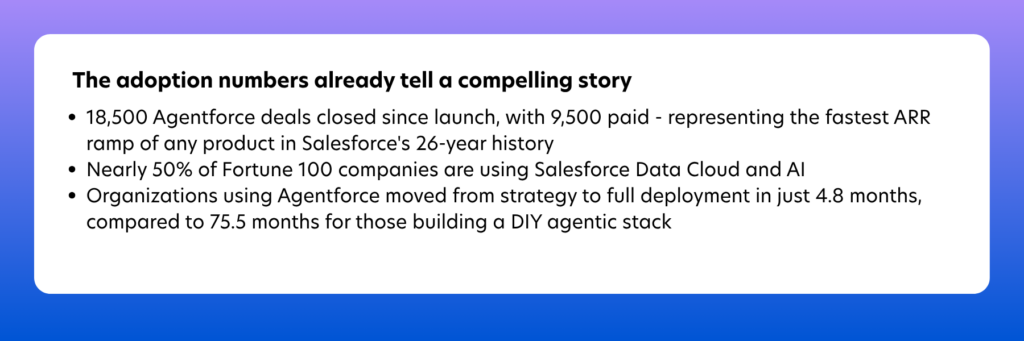
Now consider organizations that deployed Salesforce Agentforce moved from strategy to full production in an average of 4.8 months, and the platform has already crossed $500 million in ARR, growing 330% year-over-year, becoming the fastest-growing product in Salesforce’s 26-year history.
That kind of growth doesn’t happen because a product is clever. It happens because it solves a problem that every C-suite leader has felt and couldn’t name precisely for years.
The problem is this: CRM was built to store and surface information. But the actual work of acting on that information – the follow-ups, the resolutions, the qualifications, the outreach – was always left to humans. That gap between insight and action has been the single most expensive inefficiency in modern enterprise operations.
Salesforce Agentforce closes that gap. Not with better dashboards. Not with smarter suggestions. With autonomous AI agents that act – deciding, executing, and delivering outcomes across sales, service, marketing, and operations, around the clock, at a scale no human team can match.
This guide is written for the leaders making platform decisions, not the admins configuring them. It’s a fully-sourced, and strategically honest look at what Agentforce is, how it works, where it’s generating real ROI, where the honest challenges lie, and how the smartest organizations are approaching it right now.
Which industries are already turning Agentforce into measurable ROI, and how are they doing it?
Our 2026 report breaks down the ten highest-impact Agentforce use cases across financial services, retail, manufacturing, and more, mapped to the specific workflows, metrics, and deployment patterns driving results in each sector. Download the 2026 Agentforce Use Cases Report
A Complete Overview: What is Salesforce Agentforce?
Agentforce is Salesforce’s autonomous AI agent platform – a suite of tools that lets organizations build, deploy, and orchestrate AI agents capable of taking real, consequential business action across any function, without waiting at every step to be told what to do next.
Launched at Dreamforce in September 2024 and made generally available from October 2024, Agentforce represents what CEO Marc Benioff calls the “Third Wave of AI” – moving beyond information retrieval (Wave 1: search and analytics) and copilots that assist humans (Wave 2: ChatGPT-style suggestion tools) into agents that act independently within defined business guardrails.
Agentforce represents the Third Wave of AI - advancing beyond copilots to a new era of highly accurate, low-hallucination intelligent agents that actively drive customer success. Unlike other platforms, Agentforce is a revolutionary and trusted solution that seamlessly integrates AI across every workflow, embedding itself deeply into the heart of the customer journey.
Marc Benioff
Chair & CEO, Salesforce
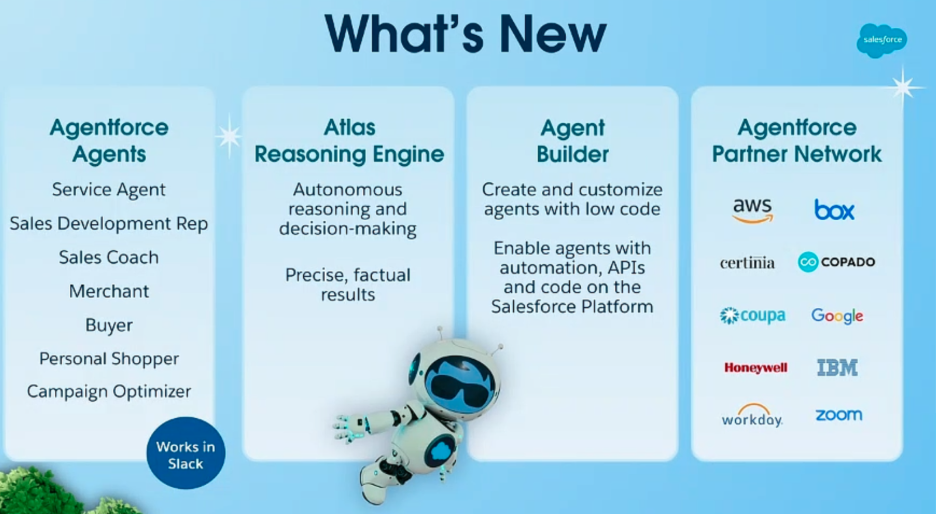
Source: Salesforce
Unlike the chatbots enterprises have been tinkering with since 2016, Agentforce agents aren’t passive. They don’t sit and wait for a prompt. They can be triggered by data events, business rule changes, API signals, or live customer interactions – and once triggered, they plan, decide, and execute multi-step tasks from start to finish.
Think of it this way: a traditional chatbot is a vending machine – insert input, receive output. Agentforce is a knowledgeable colleague who works every shift, never gets tired, remembers every customer interaction in the company’s history, and actually does things rather than just suggesting them.
What makes Agentforce structurally different from everything that came before:
- It operates proactively – agents can initiate action based on triggers, not just respond to requests
- It reasons contextually – decisions are grounded in live CRM, service, and Data 360 records, not static scripts
- It acts autonomously – completing multi-step workflows without a human in the loop at each stage
- It escalates gracefully – when complexity exceeds agent capability, it hands off to a human with full context, interaction history, and recommended next steps
- It scales infinitely – unlike a human team, there’s no capacity ceiling on a digital workforce
Agentforce is not positioned – nor should it be used – as a replacement for human talent. It is a force multiplier: it eliminates the repetitive, the routine, and the time-consuming so that humans can bring more strategy, creativity, and empathy to the moments that actually demand it.
How Does Salesforce Agentforce Works?
Most explanations of Agentforce lead with architecture diagrams and technical layers. Here’s a more useful lens: what actually happens, step by step, from the moment a customer reaches out to the moment their issue is resolved – without a human touching it.
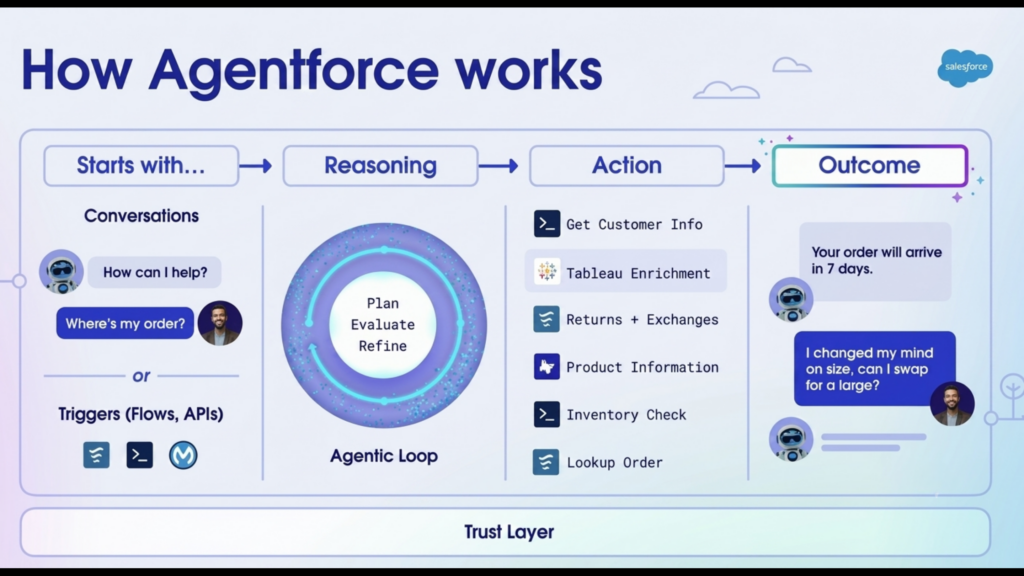
Step 1: The Customer Query Arrives
A customer contacts your business – via email, web chat, or phone. It doesn’t matter which channel. Agentforce is listening across all of them simultaneously. The moment the interaction lands, the agent is already active.
Step 2: Agentforce Analyzes Context
Before responding with a single word, the agent pulls everything it knows: the customer’s full CRM record, past interaction history, open cases, purchase data, preferences, and any relevant behavioral signals from Data 360. This isn’t keyword matching – it’s genuine contextual understanding, powered by the Atlas Reasoning Engine, Salesforce’s proprietary AI brain that builds a real-time picture of who this customer is and what they likely need.
By Q3 FY26, Salesforce processed over 3.2 trillion tokens through Agentforce gateways and 32 trillion records through Data 360 – a 119% year-over-year increase. (Source: CX Today) That’s the depth of context these agents are working from.
Step 3: Einstein AI Generates Insights
With context established, Einstein AI takes over – predicting what the customer needs, suggesting the most appropriate response, automating routine next steps, and flagging anything that requires elevated attention. This is where the agent moves from understanding to planning: formulating a multi-step action path, evaluating options, and selecting the best course based on business rules the organization has defined.
Step 4: The Agent Takes Action
This is what separates Agentforce from every copilot and chatbot that came before it. The agent doesn’t just recommend – it acts. It updates records, processes requests, sends communications, initiates workflows, or escalates to a human agent with a full context summary pre-loaded. All of this happens in real-time, across any channel, without waiting for a human to approve each step.
Agentforce handled over 380,000 customer support interactions within Salesforce’s own operations – resolving 84% autonomously, with only 2% requiring human escalation. (Source: Cirrus Insight) That ratio is what “taking action” looks like at enterprise scale.
Step 5: The Continuous Learning Loop
Every interaction makes the agent smarter. Agentforce adapts its tone, urgency calibration, and resolution pathways based on outcome data – what worked, what escalated, what the customer responded to. This isn’t a static deployment that requires quarterly retraining. It’s a system that compounds in value the longer it runs.
Key Insight: The reason Agentforce doesn’t hallucinate the way generic LLMs do is simple – it’s not guessing. Every decision is grounded in your organization’s own verified data. The agent queries; it doesn’t speculate. That’s the architecture of trust that makes enterprise deployment viable.
Key Features of Salesforce Agentforce
Agentforce isn’t a single product – it’s a platform built around eight core capabilities that work together to turn your CRM from a system of record into a system of action.
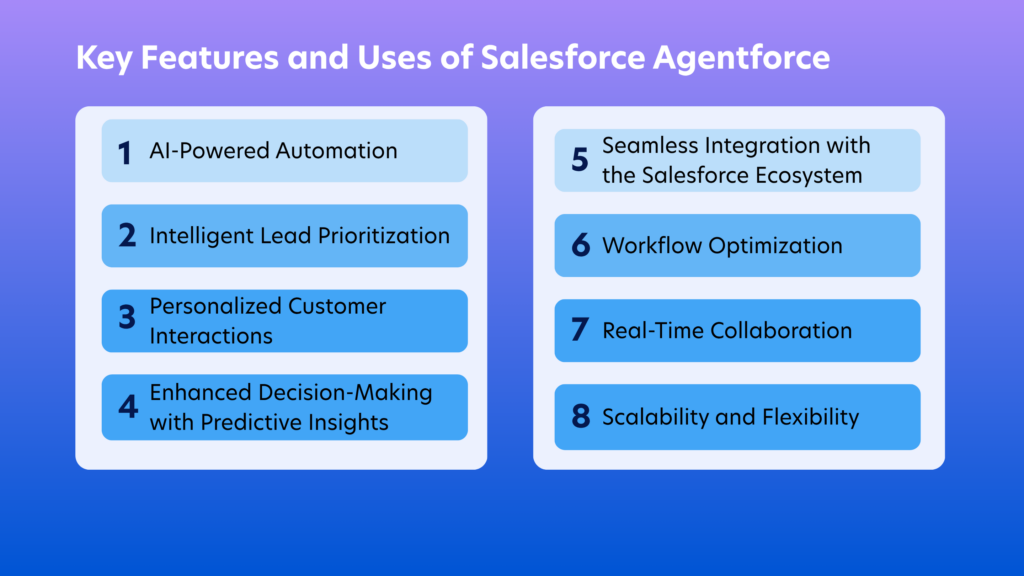
1. AI-Powered Automation: Agentforce agents execute repetitive, structured tasks end-to-end without human intervention – case resolution, record updates, appointment scheduling, and more – running 24/7 with zero fatigue. This is the foundational capability everything else is built on.
2. Intelligent Lead Prioritization: Using real-time CRM signals, behavioral data, and predictive scoring from Einstein AI, Agentforce identifies and surfaces the leads most likely to convert – ensuring your sales team spends time on the opportunities that actually matter, not the ones that just arrived first.
3. Personalized Customer Interactions: Every agent interaction is informed by a complete, real-time customer profile from Data 360 – purchase history, past interactions, preferences, and behavioral signals. The result: responses that feel personal at a scale no human team could sustain.
4. Enhanced Decision-Making with Predictive Insights: Agentforce doesn’t just automate existing decisions – it improves them. By surfacing predictive recommendations, next-best-action guidance, and risk flags grounded in live data, it helps both agents and human teams make faster, better-informed choices.
5. Seamless Integration with the Salesforce Ecosystem: Agentforce is natively embedded across Sales Cloud, Service Cloud, Marketing Cloud, Commerce Cloud, and Field Service, and connects outward through MuleSoft and the Agentforce Partner Network to ERPs, legacy systems, and third-party platforms. No rip-and-replace required.
6. Workflow Optimization: Beyond individual interactions, Agentforce orchestrates entire business workflows – routing, escalation, handoffs, and multi-step processes – eliminating the manual coordination that slows teams down and introduces errors.
7. Real-Time Collaboration: When a case exceeds agent capability, Agentforce escalates seamlessly to a human agent with the full interaction history, customer profile, and recommended next steps pre-loaded. The Omnichannel Supervisor console allows live monitoring and instant switching between AI and human handling without losing conversation continuity.
8. Scalability and Flexibility: There is no headcount ceiling on a digital workforce. Agentforce scales to any volume – seasonal spikes, global expansion, product launches, and is configurable to any industry, process, or business model through Agent Builder’s low-code/no-code environment.
Top Salesforce Agentforce Use Cases
The breadth of Agentforce’s applicability is one of its most underappreciated qualities. Unlike most AI tools that solve narrowly for one function, Agentforce cuts across every major industry vertical.
Here’s where it’s creating the most measurable impact – broken down by sector, with the real numbers.
1. Financial Services & Insurance
Financial services is one of the highest-stakes environments for AI deployment – and one of the fastest adopters of Agentforce. The use cases here go far beyond chatbots.
- Claims Processing Automation: Insurance companies are deploying Agentforce to handle first-notice-of-loss (FNOL) intake, automatically pull policy data, validate coverage, and initiate claims workflows – reducing a process that historically took days to under an hour for straightforward claims.
- Compliance Monitoring & Audit Trails: Agents continuously monitor transaction activity against regulatory rules, flag anomalies in real-time, and auto-generate documentation for compliance teams. This is particularly powerful for organizations operating under GDPR, Basel III, or Dodd-Frank requirements, where audit evidence must be comprehensive and timestamped.
- Financial Advisor Support: Wealth management firms are using Agentforce to surface client portfolio summaries, life event triggers, and recommended next-best-actions for human advisors before every client call – eliminating hours of manual CRM research per week per advisor.
In financial services, every minute a compliance analyst spends on manual case documentation is a minute not spent on genuine risk oversight. Agentforce doesn’t just accelerate the process – it creates a more reliable, auditable one.
2. Retail & Consumer Goods
Retail was among Agentforce’s earliest and most visible adopters and the results are setting the benchmark for what AI-powered CX can look like.
- Post-Purchase Support Automation: Returns, exchanges, order status, loyalty redemptions – the bulk of retail customer service volume is high-frequency and highly structured. Agentforce handles all of it autonomously, at any hour, with full order and account context.
- Personalized Promotion Delivery: Agents analyze purchase history and behavioral signals to trigger individually tailored promotions at the precise moment a customer is most likely to convert – not in a weekly batch email blast, but in real-time.
- Inventory & Fulfillment Queries: For multi-location retailers, Agentforce agents can check live inventory across store and warehouse systems, confirm availability, and proactively notify customers of delays – before the customer has to ask.
Real-world example: Saks Global deployed its first Agentforce agent in under 10 days. Their AI concierge, Sophie, handles routine queries while surfacing purchase history and style preferences to human agents – enabling what Saks calls a “VIP-level experience” at scale across all 38 North American stores.
– Source: [CX Today]
See how Everforth Quinnox helped one of North America’s largest bottling and distribution companies increase operational efficiency through Salesforce implementation.
Read the Success Story: Salesforce Transformation for a Leading Bottling & Distribution Enterprise
3. Manufacturing & Industrial Operations
Manufacturing is where the operational complexity of Agentforce becomes its most compelling differentiator. The sector is characterized by long sales cycles, complex quoting, distributed field operations, and enormous after-sales service requirements – every one of which is a target for autonomous agents.
- Sales Development & Lead Qualification: Industrial manufacturers with long B2B sales cycles are deploying Agentforce SDR agents to qualify inbound inquiries, validate decision-maker status, check service availability at specific locations, and schedule discovery calls – compressing early pipeline stages from weeks to days.
- Case & Service Ticket Management: Field service organizations are using Agentforce to triage inbound service cases, match them against knowledge base articles, auto-resolve known issues, and dispatch technicians with full asset and account context pre-loaded.
- Sales Coaching & Rep Enablement: Agentforce Coach agents analyze call transcripts and CRM opportunity data to provide sales reps with real-time feedback, deal-stage-appropriate coaching, and competitive objection handling – at a scale that no sales manager could sustain manually.
Everforth Quinnox × Waste Management Enterprise: PoC That Changed the Conversation
This one is worth examining in detail – because it illustrates exactly how a well-executed Agentforce proof-of-concept can transform a theoretical business case into an undeniable strategic mandate.
A large waste management enterprise evaluating whether Agentforce could meaningfully accelerate their sales and case management processes. Everforth Quinnox was brought into design and demonstrate three Agentforce agents – a Case Resolution Agent, an SDR (Sales Development Representative) Agent, and a Sales Coach Agent – all developed in a dedicated Salesforce sandbox over six weeks.
The baseline problem: The client’s existing case resolution data told a damning story. Knowledge-based support cases were taking an average of 2,821 days to resolve. Opportunity status changes averaged 165 days. Account ownership changes took 331 days. These weren’t outliers – they were the norm, measured from the client’s own live Salesforce data.
What Agentforce delivered in the PoC:
| Scenario | Current State | With Agentforce |
|---|---|---|
| Opportunity Status Change | 165 days | 10 days |
| Knowledge Article Resolution | 2,821 days | 11 days |
| Account Ownership Change | 331 days | 9 days |
- The Case Agent handled four distinct scenarios: resolving issues using knowledge articles, updating records directly (opportunity flips, account ownership changes), escalating to a human with a full case summary when needed, and creating structured tickets when no resolution path existed.
- The SDR Agent qualified leads 24/7 against defined criteria (decision-maker validation, service availability at specific addresses via third-party integration), sent personalized email outreach, found customer availability, and scheduled meetings — all autonomously.
- The Sales Coach Agent analyzed call transcripts from the client’s Denali Workspace, scored rep performance against deal-stage criteria, identified gaps in qualification (missing budget, timing, and competitive information), and delivered specific, actionable next steps – like a sales manager who attended every single call and never forgot what was said.
The strategic implication: What Everforth Quinnox demonstrated wasn’t just that Agentforce works. It was that when you ground the technology in a client’s actual data, processes, and pain points – rather than generic demos – the business case becomes self-evident. The numbers speak. The client’s own data speaks. And the conversation shifts from “should we evaluate this?” to “when do we scale it?”

The PoC phase is where organizations discover what’s truly possible – and where the gap between what Agentforce can do and what most vendors demonstrate becomes clear. Our approach is to ground every PoC in the client’s actual data, actual cases, and actual sales processes. That’s what makes the business case undeniable.
Murali G Sivanandam
Director – Salesforce, Everforth Quinnox
Key Benefits of Salesforce Agentforce
The business case for Agentforce isn’t hypothetical. It’s measurable across seven dimensions that organizations deploying it are already quantifying.
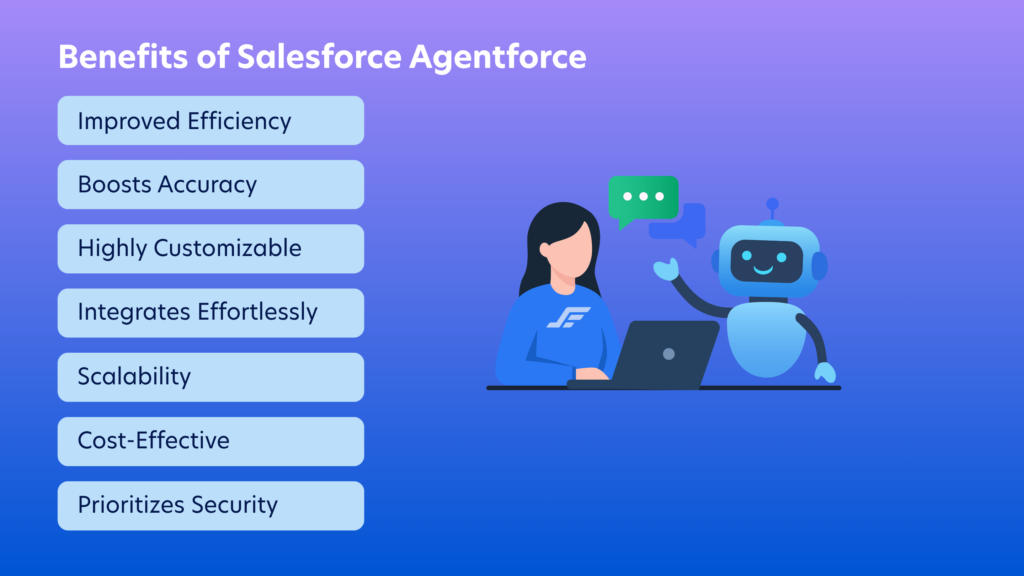
1. Improves Efficiency: Agentforce handles the mundane, high-volume tasks that consume your team’s time – freeing people for the complex, judgment-intensive work that actually requires a human. An estimated 41% of employee time is currently spent on repetitive, low-impact work. Agentforce directly reclaims it. (Source: Salesforce Trends in AI Report)
2. Boosts Accuracy: Unlike humans who work from memory, notes, and intuition, Agentforce agents leverage AI data-driven technology – grounded in live, verified CRM data – to make decisions and take actions based on solid facts, not approximations. The result is fewer errors, fewer escalations, and more consistent outcomes.
3. Highly Customizable: Through Agent Builder’s low-code/no-code environment, Agentforce can be configured to solve virtually any business problem – with tailored responses, instructions, and guardrails specific to your industry, process, and customer base. No two deployments look the same, because no two businesses are the same.
4. Integrates Effortlessly: Agentforce fits natively into your existing Salesforce ecosystem and connects outward via MuleSoft and the Agentforce Partner Network to hundreds of third-party platforms. Implementation is additive, not disruptive.
5. Scalability: A digital workforce has no headcount ceiling. Agentforce adjusts to any volume – from 100 daily interactions to 100,000 – making it as easy to work at expansion scale as at startup scale. When demand spikes, you don’t hire; you deploy.
6. Cost-Effective: By removing manual intervention from high-volume, structured workflows, Agentforce lowers operational costs directly. The Flex Credit pricing model (~$0.10 per agent action) ensures costs scale proportionally with value delivered, not headcount. Wiley achieved 213% ROI from its Service Cloud and Agentforce investment – a data point that speaks for itself. (Source: CX Today)
7. Prioritizes Security: Agentforceis built on the Einstein Trust Layer – Salesforce’s high-tech security architecture that uses data masking, zero-retention LLM processing, full audit logging, and role-based access controls to protect data privacy at every step. Enterprise-grade security isn’t an add-on. It’s the foundation.
See how Everforth Quinnox’s testing strategy helped significantly reduce application downtime while improving operational reliability.
Explore the Case Study: Reducing Application Downtime Through Strategic Testing
Salesforce Agentforce vs Traditional CRM Systems
To understand why Agentforce is a generational shift, it helps to see precisely what it replaces, and what it elevates.
| Dimension | Traditional CRM | Salesforce Agentforce |
|---|---|---|
| Primary role | Record system - stores and surfaces data | Action system - analyzes data and acts on it |
| User interaction | Human-driven; users query and navigate | Agent-driven; proactive triggers + human oversight |
| Availability | Business hours + async follow-up | 24/7/365, every channel, zero latency |
| Personalization | Template-based; batch segmentation | Real-time, individual-level, contextual |
| Task execution | Humans do the work; CRM informs them | Agents complete workflows; humans supervise |
| Scalability | Limited by headcount | Effectively unlimited digital workforce |
| Learning curve | Months to onboard, constant retraining | Agents configured once, improved continuously |
| Data utilization | Backward-looking reports and dashboards | Real-time decision input for live agent action |
| Cost model | Per-seat licensing | Per-action Flex Credits (≈ $0.10/action) |
The shift isn’t incremental. Traditional CRM was a system of record. Agentforce makes Salesforce a system of action. That’s not an upgrade. That’s a category change.
Agentforce Implementation & Best Practices
Agentforce’s low-code builder creates a tempting illusion: that deployment is plug-and-play. The reality is more nuanced – and getting implementation right is the difference between a transformative deployment and an expensive pilot that quietly dies. Here is the roadmap that enterprise implementations consistently validate:
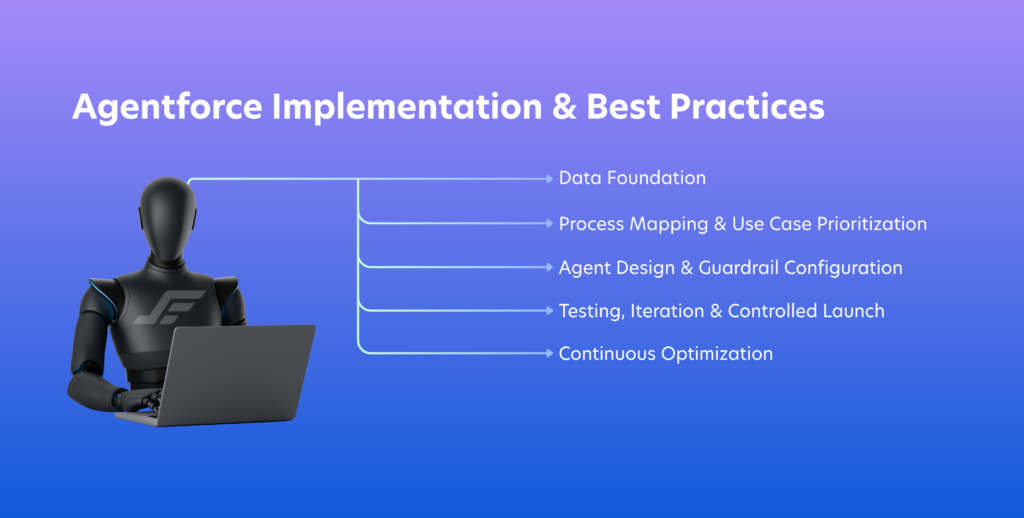
Phase 1: Data Foundation First (Weeks 1–4)
Agentforce’s power is directly proportional to the quality of the data it’s grounded in. Before building a single agent, audit your Salesforce data health:
- Are records complete, deduplicated, and consistently formatted?
- Are your knowledge bases current and well-structured?
- Is Data 360 connected to the data sources agents will need?
Organizations skipping this phase invariably encounter frustrating agent behavior downstream — not because of Agentforce limitations, but because agents surface whatever is in your data, accurately.
Phase 2: Process Mapping & Use Case Prioritization (Weeks 2–6)
Not all processes are equal candidates for agent automation. Prioritize by:
- Volume × repetitiveness – High-volume, repetitive tasks deliver the fastest ROI
- Escalation risk – Start with use cases where the cost of an agent error is low
- Data availability – Choose use cases where the supporting data is already clean
Begin with Tier-1 customer service or internal employee queries. Win quickly. Build confidence.
Phase 3: Agent Design & Guardrail Configuration (Weeks 4–10)
Before any agent goes live, define:
- Permitted action – what can the agent do without human approval?
- Escalation triggers – what signals should force a handoff to a human?
- Tone and persona – how should the agent communicate?
- Fallback protocols – what happens if the agent can’t resolve a case?
Well-designed guardrails are what distinguish production-ready Agentforce deployments from pilots that make customers uneasy.
Phase 4: Testing, Iteration & Controlled Launch (Weeks 8–14)
Use Salesforce’s sandbox environment to simulate real conversations across hundreds of scenarios. Test edge cases deliberately. Run shadow mode deployments where the agent responds alongside human agents before going fully autonomous.
Organizations using Agentforce moved from strategy to full deployment in just 4.8 months, versus 75.5 months for DIY agentic stacks – the platform handles complexity that would otherwise take years to engineer.
Phase 5: Continuous Optimization (Ongoing)
Monitor resolution rates, escalation patterns, customer satisfaction scores, and credit consumption weekly. Agentforce deployments improve as agents encounter more real-world variation. Build a feedback loop where human agents flag cases that should have been resolved autonomously – and use those insights to refine agent topics and actions.
Best Practice: Treat Agentforce like a new hire, not a software update. The first 90 days are an investment in teaching the agent your business. The returns compound exponentially from month three onward.
Exploring your first AI agent or scaling enterprise-wide automation, Everforth Quinnox can help you move from strategy to production faster.
Start Your Salesforce Agentforce Assessment: Salesforce Services by Everforth Quinnox
Future Trends: The Evolution of Salesforce Agentforce AI
Agentforce’s trajectory over the next 24–36 months points toward capabilities that will make today’s deployments look like early prototypes. Here’s what’s already in motion and what’s coming next:
1. Multi-Agent Orchestration - From Individual Agents to Digital Teams
Agentforce 3, deployed in June 2025, introduced multi-agent architecture – where multiple specialized agents collaborate on complex tasks, each contributing its domain expertise and passing context forward.
The implication: organizations can compose agent workflows where a sales agent qualifies a lead, a scheduling agent books a discovery call, a research agent populates the account with competitive intelligence, and a contracting agent prepares preliminary terms – all without a human initiating each step. This is the future of revenue operations.
2. Agentforce 360 and the Fully Unified Enterprise
Salesforce’s rebranding of Data Cloud as Data 360 at Dreamforce 2025, combined with the launch of Agentforce 360, signals a convergence: every Salesforce cloud, every data source, and every AI agent unified into a single operating model for the enterprise. According to CX Today, nearly 90% of Forbes Top 50 AI companies are already using Salesforce – the platform is becoming the infrastructure layer for AI-native business operations.
3. Voice-First Agent Interactions
The integration of voice AI into Agentforce – already underway through partnerships with communication platforms – will make agent interactions indistinguishable from human conversations in many service contexts.
4. Predictive and Prescriptive Action
Current Agentforce agents are primarily reactive to triggers – even if those triggers can be data-based. The next evolution is fully predictive agents that model likely customer needs and business events before they occur, and act preemptively. Churn prevention before the customer knows they’re unhappy. Upsell at the precise moment intent signals peak. Supply chain intervention before a fulfillment issue becomes a customer service call.
Conclusion
Agentforce is the most significant CRM evolution in a generation. The numbers confirm it. The case studies prove it. And the window for competitive advantage is open – but not indefinitely. The technology is the easy part. What separates transformative deployments from expensive pilots is the foundation underneath: clean data, well-governed agents, and a strategy that starts with business outcomes and works backward to the configuration.
The question isn’t whether to invest in agentic CRM. That decision has already been made by the market. The question is whether you have the right foundation, the right strategy, and the right partners to deploy it in a way that actually transforms your business.
This is where choosing your implementation partner matters as much as choosing the technology.
Everforth Quinnox approaches Salesforce not as a system to install, but as a strategic asset to build. As a Salesforce strategic partner with deep experience across financial services, biopharma, environmental solutions, consumer retail, and more, our work spans the full Salesforce lifecycle: discovery workshops and Customer 360 assessments, data migration and governance, complex system integration, CPQ, testing, and long-term Center of Excellence (COE) development.
The agentic enterprise isn’t a vision on a roadmap. It’s already operating, at scale, in the real world. The only question is whether your organization is building it or watching others do it first.

Lead, Marketing, Everforth Quinnox
FAQs
Chatbots follow scripts. Agentforce agents reason – they build action plans, execute multi-step workflows, and handle situations no script anticipated. One reacts; the other acts.
Enterprise and mid-market organizations with high volumes of repetitive customer or employee interactions – particularly in financial services, healthcare, retail, manufacturing, and staffing.
Yes. The Einstein Trust Layer delivers data masking, zero-retention LLM processing, full audit logging, and role-based access. GDPR, CCPA, HIPAA, and SOC 2 Type II are all supported.
No – Agent Builder is low-code/no-code. Complex enterprise deployments with custom integrations benefit from a skilled Salesforce implementation partner.
Yes, via the Agentforce Partner Network and MuleSoft, it connects to ERPs, legacy systems, third-party APIs, and communication platforms – no rip-and-replace required.