For years, organizations have invested heavily in customer service transformation. They implemented CRM platforms, introduced chatbots, built self-service portals, and trained service teams to handle increasingly complex customer expectations. Yet despite these investments, many enterprises continue to face the same challenge: scaling exceptional customer experiences without proportionally increasing operational costs.
The problem isn’t a lack of technology. It’s that most customer service technologies still depend on human intervention at critical moments. Traditional automation can answer simple questions, route cases, or retrieve information, but when customers require reasoning, judgment, or multi-step problem resolution, the process usually falls back to human agents.
This is where the conversation changes.
Salesforce Agentforce Service represents a fundamental shift from workflow automation to autonomous service execution. Instead of merely assisting customer support teams, Agentforce introduces AI agents capable of understanding context, making decisions, taking actions, and resolving customer issues with minimal human involvement.
Agentforce is redefining what’s possible in business and beyond, ushering in a new era of AI abundance and limitless workforces that augment every employee, build deeper customer relationships, and drive unprecedented growth and profitability.
Marc Benioff
Chair & CEO, Salesforce
As enterprises move into an era where service excellence becomes a competitive differentiator, understanding Agentforce Service is no longer optional. It is rapidly becoming a strategic consideration for organizations seeking to balance customer satisfaction, operational efficiency, and scalable growth.
What is Salesforce Agentforce Service?
Salesforce Agentforce Service is an AI-powered service platform that enables organizations to deploy autonomous digital agents capable of handling customer interactions, resolving cases, executing workflows, and supporting service operations across multiple channels.
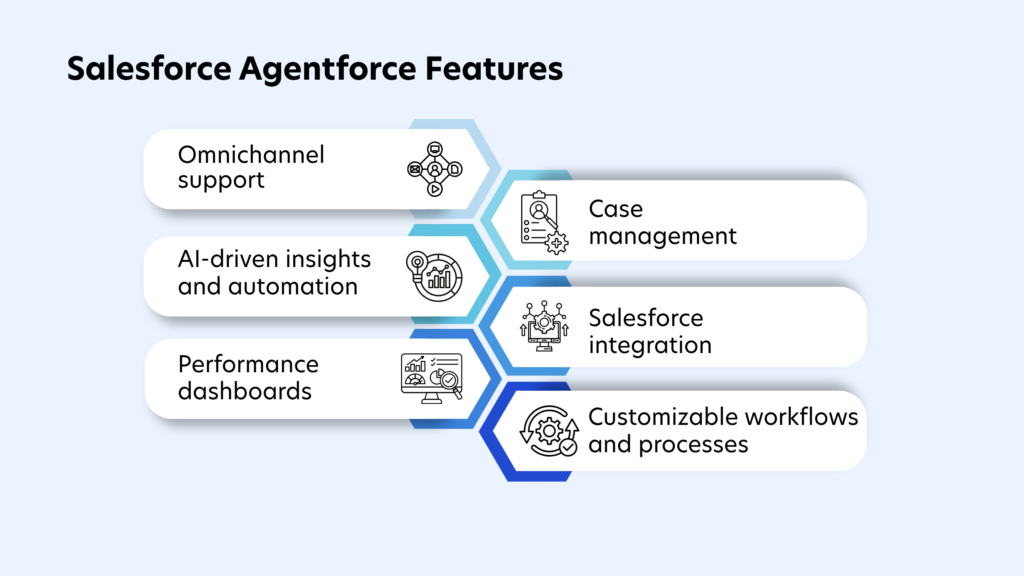
Unlike conventional conversational AI solutions that operate within predefined decision trees, Salesforce Agentforce leverages generative AI, enterprise data, business logic, and action frameworks to perform tasks dynamically.
At its core, Agentforce Service is designed to function as a digital workforce operating alongside human service representatives.
These AI agents can:
- Understand customer intent
- Analyze contextual business data
- Retrieve relevant information
- Execute approved business actions
- Resolve issues independently
- Escalate cases when human intervention is necessary
The significance of Agentforce Service lies in its ability to move beyond answering questions. It focuses on achieving outcomes.
For example, instead of simply explaining a return policy, an Agentforce Service agent can initiate the return process, generate shipping labels, update customer records, and notify stakeholders automatically.
This outcome-oriented approach represents the next phase of enterprise service transformation.
How Does Agentforce Service Work? The Architecture Explained
Moving from rule-based automation to true autonomous execution requires a fundamental shift in how AI interacts with enterprise data. Salesforce’s Agentforce addresses this with a robust, layered architecture engineered for reasoning and precision. At its core, the system doesn’t just process inputs—it orchestrates an interconnected stack of live data, cognitive logic, and trusted guardrails.
Agentforce Service is built on multiple interconnected layers that work together to enable autonomous decision making. Here is a breakdown of how the architecture functions and transforms raw customer data into independent, secure action.
1. The Experience Layer
Customers interact with Agentforce through channels such as:
- Web chat
- Mobile applications
- Messaging platforms
- Customer portals
- Contact centers
- Voice experiences
This layer serves as the interface where customer requests originate.
2. The Reasoning Layer
The reasoning engine is where Salesforce Agentforce differentiates itself from traditional bots.
Rather than following static conversation flows, the system evaluates:
- Customer intent
- Historical interactions
- Business rules
- Enterprise knowledge
- Real-time contextual data
This allows the AI agent to determine the most appropriate next action.
3. The Data Layer
Agentforce Service connects with:
- Salesforce CRM data
- Service Cloud records
- Knowledge bases
- External enterprise systems
- Third-party applications
- Data Cloud environments
The AI agent gains access to a unified view of customer information, enabling more accurate decisions.
4. The Action Layer
This is where intelligence becomes execution.
Agentforce agents can:
- Create cases
- Update records
- Schedule appointments
- Process requests
- Trigger workflows
- Initiate approvals
- Coordinate across systems
Instead of acting as a recommendation engine, Agentforce becomes an active participant in service operations.
5. The Governance Layer
Enterprise adoption requires trust.
Agentforce incorporates governance controls including:
- Role-based permissions
- Compliance frameworks
- Audit trails
- Human approval checkpoints
- Security controls
These safeguards ensure that autonomous actions remain aligned with organizational policies.
Agentforce Service vs. Einstein Bots: What's Actually Different?
When Salesforce introduced Agentforce, a collective sigh of confusion echoed through the ecosystem. Many admins and IT leaders immediately asked: “Wait, don’t we already have Einstein Bots for this?”
It is an understandable question. Both handle customer conversations, both live inside Salesforce, and both aim to deflect tickets from your human support team. But putting them in the same category is like comparing a programmable calculator to an autonomous vehicle. They are fundamentally different species of technology under the hood.
Here is the truth about what actually separates them.
1. Pre-Scripted Paths vs. Dynamic Reasoning
The core difference lies in how these two tools “think” and handle an unpredictable conversation.
- Einstein Bots (Intent Based): Think of an Einstein Bot as a digital decision tree. You, the admin, have to build the branches. It relies on Natural Language Processing (NLP) to map a customer’s message to a specific intent (like “Check Order Status”). If the customer stays on the path, it works flawlessly. If they veer off-script or throw three questions into one sentence, the bot hits a wall and triggers the dreaded “I’m sorry, I didn’t understand that” loop.
- Agentforce Service (Agentic AI): Salesforce’s Atlas Reasoning Engine processes a user’s query dynamically. Instead of executing a preset script, it uses a cyclical process called ReAct (Reason + Act) that analyzes the context, determines what data it needs, and figures out the best way to solve the problem on the fly—even if the customer changes their mind mid-chat. For a deeper look at the AI technology powering Agentforce, explore Salesforce Agentforce: The AI Technology Behind the Platform.
2. Conversational vs. Action-Oriented
What happens when a customer actually needs something fixed?
- Einstein Bots are great front-end greeters. They excel at surfacing FAQs, collecting baseline information (like an account number), and cleanly routing the case to a human agent when the heavy lifting begins. They chat, but they rarely execute complex backend processes without complex custom developer work.
- Agentforce is built to do the heavy lifting autonomously. It doesn’t just look up an order status; if a customer says, “My shoes arrived damaged, I need a smaller size, and please update my shipping address for future orders,” Agentforce can process all three requests in one go. It triggers flows, updates CRM fields, processes the exchange, and issues the new tracking number without human intervention
Side-by-Side: The Architectural Shift
To make things clear for your next architecture review, here is how the two stack up across the board:
| Capability | Einstein Bots | Agentforce Service |
|---|---|---|
| Core Technology | Rule-based dialogs + NLP | LLMs + Atlas Reasoning Engine |
| Conversation Style | Linear, menu-driven, or single-intent | Fluid, multi-intent, and context-aware |
| Data Scope | Primarily structured CRM data fields | Unified structured & unstructured data (via Data Cloud) |
| Setup Maintenance | Building and maintaining dialog trees | Defining "Topics," guardrails, and permitted actions |
| Execution Power | Basic data retrieval and case routing | Multi-step autonomous task execution |
The Big Takeaway: Einstein Bots ask questions to get a ticket to the right human. Agentforce acts like the human agent, aiming to resolve the issue entirely on its first try.
Do they replace one another?
Not necessarily. They can actually work as a team. You can keep your existing Einstein Bots as a high-volume triage layer at the absolute front line to handle basic traffic deflections. When a case requires actual reasoning, data synchronization across multiple systems, or multi-step execution, the bot can seamlessly hand off the heavy work to Agentforce.
Key Capabilities of Agentforce Service in 2026
If you looked at autonomous AI agents a couple of years ago, they felt like highly ambitious science experiments. Fast forward to 2026, and Agentforce Service has matured from a promising concept into a deeply integrated, rock-solid enterprise workhorse.
The focus has shifted away from simply making AI sound human, moving instead toward giving it the institutional memory, operational authority, and reasoning skills required to act like a tenured employee.
The breakthrough capabilities setting the standard for autonomous customer service this year center around five core operational pillars:
1. Advanced Multi-Step Reasoning (The Atlas Engine Evolution)
Early iterations of service bots struggled with context switching. If a customer changed their mind halfway through a return process, the AI would glitch or reset the conversation.
Today, Agentforce leverages advanced reasoning frameworks that allow it to pause a current task, handle an unexpected tangent or a secondary question, and then seamlessly loop back to finish the original process. It understands nuanced intent, interprets implied meaning, and builds its own logic paths on the fly rather than relying on static scripts.
2. Multi-Modal Omnichannel Fluency
Customer service no longer happens strictly in a tidy web-chat box. Salesforce Agentforce natively operates across voice, SMS, WhatsApp, and email with the exact same level of context.
If a customer begins an interaction by uploading a photo of a damaged part over a mobile app, Agentforce can analyze the image using computer vision, identify the part number, cross-reference the customer’s purchase history, and transition the conversation into an outbound voice call or SMS to finalize the replacement—all without losing a single shred of conversational data.
3. Native Data Cloud Orchestration
An autonomous agent is only as smart as the data it can access. Agentforce doesn’t just read basic CRM fields; it sits directly on top of Salesforce Data Cloud.
This means it has real-time access to a unified profile of the customer, combining unstructured data (like past PDF contracts or transcripts of previous calls) with structured data (like live inventory levels, shipping telematics, or IoT device logs). When a customer asks a complex question, Agentforce checks the entire enterprise ecosystem to provide an answer, not just the local Salesforce record.
4. Guardrails and Trust Layers (Zero Data Retention)
In 2026, data privacy is non-negotiable. Agentforce runs every single interaction through a sophisticated trust layer.
Before customer data ever hits an underlying large language model, the system automatically masks personally identifiable information (PII), filters out toxic language, and enforces strict corporate compliance boundaries. Furthermore, zero-data-retention policies ensure that proprietary customer data is never used to train external LLMs, protecting your intellectual property and maintaining strict data sovereignty.
5. Seamless Human-Agent Handoff (The Swarm Mentality)
Agentforce isn’t built to entirely eliminate human support teams; it is designed to supercharge them. When an issue escalates beyond the agent’s permitted guardrails or requires deep human empathy, the handoff is frictionless.
The human agent doesn’t just receive a blank screen or a messy text dump; they get a crisp, bulleted summary of the interaction so far, the exact reason for the escalation, and a couple of suggested next steps. While the human resolves the issue, Agentforce remains in the background, ready to instantly handle the follow-up tasks like drafting the confirmation email or updating the billing system.
The 2026 Reality Check: The metric for success has fundamentally changed. Companies are no longer measuring AI success by “ticket deflection rates” alone. Instead, they are tracking First-Contact Resolution (FCR) driven autonomously by AI – treating Agentforce as a revenue-protecting, problem-solving extension of the core team.
Industry Use Cases: Where Agentforce Service Delivers the Most Value
Knowing what a platform can do is entirely different from knowing exactly where to deploy it for maximum impact. The highest return on investment doesn’t come from automating simple FAQs—it comes from targeting deep operational bottlenecks unique to your vertical.
By exploring practical Salesforce Agentforce use cases across industries, we can pinpoint the exact environments where autonomous service agents transition from a luxury tool to an absolute operational necessity.
Let’s dive into the core industries where Salesforce Agentforce is making all the difference:
1. Financial Services
Financial institutions handle large volumes of customer inquiries involving:
- Account servicing
- Transaction support
- Loan status updates
- Policy information
Agentforce can streamline these interactions while maintaining compliance requirements.
2. Healthcare
Healthcare organizations can automate:
- Appointment scheduling
- Patient inquiries
- Insurance verification
- Care coordination workflows
This helps reduce administrative burdens on staff.
3. Telecommunications
Telecom providers frequently manage:
- Billing disputes
- Service outages
- Plan changes
- Device support
Agentforce can resolve many of these interactions autonomously.
4. Retail and Ecommerce
Retail organizations benefit from automation across:
- Order tracking
- Returns
- Exchanges
- Loyalty programs
- Product support
The result is a more responsive customer experience.
5. Manufacturing
Manufacturers can improve service operations by automating:
- Warranty claims
- Technical support requests
- Service scheduling
- Equipment maintenance inquiries
What Does It Take to Implement Agentforce Service? Key Considerations
The live demos for Agentforce are undeniably impressive. Watching an autonomous agent smoothly handle a multi-step customer dispute without a single line of hardcoded logic makes it tempting to look for a “Turn On” switch in your Salesforce Setup menu.
However, moving from a flashy demo to a secure, high-performing production environment takes intentional groundwork. Because Salesforce Agentforce relies on dynamic reasoning rather than rigid, pre-scripted paths, your implementation strategy has to shift. You aren’t building a conversation tree; you are training a digital employee.
Before you get started with your deployment project, here are the critical, real-world considerations your team needs to map out.
1. The Fuel: Data Hygiene and Accessibility
An autonomous agent is only as competent as the data it can access. If your internal documentation is outdated, or your CRM data is riddled with duplicates, Agentforce will confidently serve those errors to your customers.
- The Check: Audit your knowledge bases and structured data fields.
- The Requirement: You need a unified data strategy. Agentforce delivers its highest value when paired with Salesforce Data Cloud, allowing it to synthesize real-time data from across your entire enterprise ecosystem. If your data lives in isolated siloes, break those down first.
2. The Scope: Defining "Topics" and "Actions"
Instead of coding rigid dialog branches, implementing Agentforce requires you to define boundaries using Topics (the subjects the agent is allowed to handle) and Actions (the tasks it is permitted to execute, like running a Flow or invoking an Apex code snippet).
- The Challenge: Over-scoping on day one is a recipe for project delays. If you give the agent fifty different capabilities right out of the gate, testing and validation become a nightmare.
- The Strategy: Start narrow. Pick two or three high-volume, low-risk service scenarios (like processing simple order modifications or verifying warranty statuses). Perfect those actions, establish a baseline of success, and then scale the agent’s responsibilities.
3. The Boundaries: Guardrails and Compliance
Because Agentforce uses LLMs to formulate its responses, you must establish strict operational and ethical guardrails to keep the conversational AI on track.
- The Consideration: What should the agent never say? What sensitive data fields must be masked?
- The Solution: You need to configure the Einstein Trust Layer. Ensure your team sets up robust toxic-language filtering, PII (Personally Identifiable Information) masking, and clear fallback protocols for when a customer asks something entirely outside the agent’s corporate scope.
4. The Safety Net: Human-Agent Routing Logic
A successful autonomous agent rollout doesn’t replace your service desk; it realigns it. You have to design the exact threshold where the AI steps back and a human steps in.
- The Logic: Handoffs shouldn’t only happen when the AI gets confused. You need to map out high-emotion or high-stakes triggers such as a customer explicitly threatening to cancel an account or using frustrated language where the system instantly routes the interaction to a live agent via Omni-Channel, complete with a concise summary of the AI’s conversation history.
The Pre-Implementation Checklist
To keep your deployment moving smoothly, ensure your cross-functional team can check off these foundational boxes before configuring the platform:
| Implementation Pillar | Core Focus Area | Critical Question to Answer |
|---|---|---|
| Data Readiness | Knowledge Articles & CRM Hygiene | Is our external-facing documentation accurate and structured for AI ingestion? |
| Process Mapping | Salesforce Flows & Apex | Are our backend automation processes clean enough to be triggered autonomously? |
| Security & Trust | Einstein Trust Layer Config | Have we defined our PII masking rules and compliance boundaries? |
| Change Management | Human Support Team Alignment | Have we trained our live agents on how to receive and manage AI-escalated cases? |
Implementing Agentforce is less about traditional software development and much more about operational governance. The teams that find the most success are the ones that spend less time worrying about the AI’s vocabulary and more time ensuring its access to clean data and secure workflows is completely ironclad.
Agentforce Service vs. Agentforce IT Service: Don't Confuse the Two
As Salesforce expands the Agentforce ecosystem, confusion often arises between Agentforce Service and Agentforce IT Service.
While both leverage autonomous AI capabilities, they address fundamentally different business challenges.
Agentforce Service
Focuses on customer-facing service operations.
Primary objectives include:
- Customer support
- Case resolution
- Service experience improvement
- Customer satisfaction enhancement
Primary users include:
- Contact center teams
- Customer support organizations
- Service operations leaders
Agentforce IT Service
Focuses on internal IT operations and employee support.
Common use cases include:
- Password resets
- Access requests
- Incident management
- Employee service desk support
- IT workflow automation
Primary users include:
- IT departments
- Internal support teams
- Enterprise service management organizations
In simple terms, Agentforce Service serves customers while Agentforce IT Service serves employees.
Understanding this distinction helps organizations align investments with business objectives.
How to Choose the Right Agentforce Service Implementation Partner
Because Agentforce relies on an autonomous reasoning engine rather than rigid, pre-built scripts, deploying it is not a standard software configuration project. You are not just building software; you are onboarding a digital worker and granting it the authority to execute actions across your enterprise database.
Choosing the wrong implementation partner means risking a disorganized rollout that hallucinates errors or runs into data bottlenecks. To ensure your investment yields true operational value, prioritize partners who possess the following critical capabilities:
1. Industry Expertise
A partner with deep industry knowledge understands:
- Regulatory requirements
- Customer expectations
- Common service challenges
This expertise accelerates implementation success.
2. AI and Data Experience
Agentforce is fundamentally an AI platform.
Implementation partners should demonstrate strong capabilities in:
- AI strategy
- Data architecture
- Governance frameworks
- Responsible AI practices
3. Service Transformation Experience
The best partners do not simply configure technology.
They redesign service operations to maximize business outcomes.
4. Integration Capabilities
Agentforce must connect seamlessly with enterprise systems.
Partners should possess proven integration expertise across complex technology environments.
5. Adoption and Change Management Support
Technology implementation is only part of the journey.
Organizations need partners who can guide stakeholder alignment, workforce readiness, and operational adoption.
6. Long-Term Strategic Vision
The ideal partner views Agentforce as part of a broader transformation roadmap rather than a standalone deployment project.
Evolving from Isolated Pilots to Enterprise Execution: The Everforth Quinnox Advantage
As a Salesforce-native AI transformation partner, Everforth Quinnox specializes in helping organizations industrialize Agentforce across entire enterprise ecosystems.
Rather than treating autonomous AI as an isolated conversational tool, Everforth Quinnox focuses on transforming Salesforce from a traditional CRM platform into an intelligent, real-time execution layer by integrating Agentforce-driven autonomous agents and AI copilots directly into your existing infrastructure across Sales Cloud, Service Cloud, Experience Cloud, Marketing Cloud, and Net Zero Cloud.

At Everforth Quinnox, our specialized expertise turns Salesforce from a traditional CRM into an intelligent, real-time execution engine. We don’t just build basic chat interfaces; we engineer production-grade Agentforce Service deployments that possess the full operational authority to update records, trigger workflows, and drive measurable ROI from day one.
Murali G Sivanandam
Director – Salesforce, Everforth Quinnox
The core of our approach focuses on the strategic orchestration of Agentforce, Einstein AI, and Salesforce Data Cloud. By aligning these three critical pillars, we enable enterprises to evolve from disconnected, single-use AI pilots into production-grade, multi-cloud AI systems. This structural alignment ensures your autonomous agents have the unified context, strict guardrails, and backend access required to solve complex customer challenges independently – turning your AI strategy into a measurable driver of tangible business outcomes.
What truly sets our deployments apart is the cross-pollination of deep domain vertical expertise with our elite, dedicated AI engineering team of 250+ certified AI and data experts together with decades of deep, real-world experience across specialized, high-stakes sectors, including Banking, Financial Services, and Insurance (BFSI), Consumer Retail, Manufacturing, Logistics, Utilities, and Supply Chain.
Conclusion
Salesforce Agentforce Service represents one of the most significant advancements in enterprise service technology because it shifts automation from task execution to outcome delivery. It enables organizations to deploy AI agents that do more than communicate – they reason, decide, and act.
Yet the true value of Agentforce is not found in the technology itself. It emerges when organizations combine intelligent automation with strong governance, quality data, thoughtful service design, and effective human collaboration.
The enterprises that succeed in the coming years will not be those that simply deploy AI. They will be the ones that reimagine service operations around autonomous capabilities while keeping customer trust and business value at the center of every decision.
Agentforce Service is not merely the next evolution of customer support technology. It is a glimpse into how customer service organizations will operate in the AI-first enterprise of the future.

Deputy Manager, Marketing, Everforth Quinnox
FAQs
It is Salesforce’s autonomous AI platform built specifically for customer support. Unlike traditional chatbots, it uses an advanced reasoning engine to understand user intent, make independent decisions, and execute multi-step workflows (like processing refunds or modifying orders) without requiring a human script.
Einstein Bots are rigid, rule-based decision trees that map conversations to pre-programmed menu options or specific phrases. Agentforce is dynamic and agentic; it uses Large Language Models (LLMs) to reason through unpredictable customer requests on the fly, handling complex, multi-intent conversations without breaking.
No. Service Cloud is the core Salesforce CRM application where customer data, cases, and workflows live. Agentforce Service is an autonomous intelligence layer that sits on top of Service Cloud, acting as an independent digital worker that can read that CRM data and execute actions within it.
Enterprises can expect a significant increase in First-Contact Resolution (FCR) rates because the AI can actually complete backend tasks rather than just routing tickets. This directly reduces average handle times, slashes case backlogs, and allows human support agents to focus exclusively on high-emotion, high-value customer issues.
You need two foundational elements: clean, well-structured internal knowledge bases (for the AI to read) and accessible, automated backend workflows like Salesforce Flows or Apex actions (for the AI to execute). A unified data layer, ideally powered by Salesforce Data Cloud, is also critical for real-time context.
Yes. It operates within the Einstein Trust Layer, which automatically masks personally identifiable information (PII), blocks toxic outputs, and ensures strict role-based data access compliance. It also enforces a strict zero-data-retention policy, meaning external AI models are never trained on your proprietary data.
Agentforce protects customer and enterprise data through Salesforce’s Einstein Trust Layer, which applies controls such as data masking, secure data access, auditability, and zero-retention policies for supported LLM interactions. These safeguards help ensure sensitive data remains protected while AI agents access only the information and actions permitted by enterprise security and governance policies.
A targeted, initial implementation covering two or three high-volume use cases can take anywhere from 4 to 8 weeks. Because you are configuring “Topics” and “Actions” rather than hardcoding complex dialogue logic, deployment timelines are significantly faster than traditional chatbot builds, though scaling across an entire enterprise will take longer.
Technically yes, if your in-house Salesforce team has strong Data Cloud engineering experience and clean, pre-existing Flows. However, most enterprises use a partner to avoid common pitfalls like over-scoping the agent’s capabilities, failing to establish proper security guardrails, or deploying the agent on top of fragmented, siloed data.
No. If your support volume is very low, or if your customer queries are highly subjective and require deep emotional empathy rather than data-driven execution, the investment may not be justified. It delivers the highest return for businesses facing high ticket volumes, repetitive operational bottlenecks, and complex data environments.