Introduction
Enterprise AI is rapidly moving beyond traditional chatbots, and Salesforce Agentforce is at the center of this transformation. Unlike conventional bots that simply answer questions or follow predefined workflows, Agentforce introduces autonomous AI agents capable of reasoning, making decisions, and executing business processes across sales, service, marketing, commerce, and operations.
However, while enthusiasm around Agentforce continues to grow, many businesses struggle to realize its full potential. The challenge is rarely the technology itself—it is identifying the right opportunities for deployment. Organizations often implement AI agents for low-impact tasks and as a result, they fail to achieve meaningful improvements in customer experience, operational efficiency, employee productivity, or revenue growth.
The reality is that not all Salesforce Agentforce use cases deliver the same business impact. Some applications can significantly reduce service workloads, accelerate deal cycles, eliminate operational bottlenecks, and provide real-time decision support, while others may generate only incremental gains. Without a clear understanding of where Agentforce creates the greatest value, organizations risk underutilizing a platform designed to function as a digital workforce rather than just another automation tool.
To maximize return on investment, business leaders need to understand where autonomous agents can drive measurable outcomes, how Agentforce’s underlying architecture enables those outcomes, and what implementation strategies separate successful deployments from unsuccessful ones.
Through this article, we explore ten high-impact Salesforce Agentforce use cases that are expected to define enterprise AI adoption in 2026.
The Transition from Assistive Chatbots to Autonomous Digital Coworkers
To understand why Salesforce Agentforce AI is a structural shift for business, let us first revisit how we got here. Enterprise AI has evolved across three distinct waves:
| Era | Core Technology | The User Experience | The Bottleneck |
|---|---|---|---|
| Wave 1: The Chatbot | Deterministic, keyword-based decision trees. | "If user types 'Order Status', trigger Script B." | Exceptionally rigid. Slight variations in phrasing completely broke the flow, causing dead ends or frustrating human escalations. |
| Wave 2: The Copilot | Generative AI and Large Language Models (LLMs). | Conversational and fluent, acts as a passive assistant summarizing records or drafting text when prompted. | Structurally passive. It can write an email response for you, but you still have to read it, approve it, copy-paste it, and click "Send." |
| Wave 3: The Coworker | Autonomous Agentic AI (Agentforce). | Task-driven execution. You assign a role, strict guardrails, and platform tools (actions). | Minimal. The agent loops through reasoning, accesses real-time data, and executes multi-step workflows autonomously. |
Moving Beyond the "Prompt and Wait" Paradigm
The easiest way to understand the difference between an assistive copilot and an autonomous digital coworker is to think about hiring an administrative assistant.
With a traditional GenAI copilot, you are managing a brilliant but hyper-passive assistant. Every single morning, you have to write out exact instructions like “Please open Salesforce, look up Account X, write a draft to the client asking about their late invoice, and let me see it.” The assistant does exactly that and then sits quietly at their desk waiting for your next text prompt. You are still the bottleneck.
An Agentforce digital coworker, by contrast, behaves like an experienced teammate. You assign it a broad operational domain (a “Topic”) and hook it up to your company’s systems. When a complex event occurs—like a high-tier client’s product usage dropping significantly – the agent doesn’t wait for you to ask it for a report. It proactively investigates.
Agentforce represents the Third Wave of AI - advancing beyond copilots to a new era of highly accurate, low-hallucination intelligent agents that actively drive customer success. Unlike other platforms, Agentforce is a revolutionary and trusted solution that seamlessly integrates AI across every workflow, embedding itself deeply into the heart of the customer journey.
Marc Benioff
Chair & CEO, Salesforce
It autonomously queries Data Cloud to pull the client’s support history, references internal policy guidelines via Retrieval-Augmented Generation (RAG), orchestrates a Salesforce Flow to generate a tailored renewal proposal, updates the CRM records, and leaves a complete audit trail ready for execution. It actively offloads the operational burden, transforming AI from a tool you talk to, into a workforce that works for you.
Architectural Foundations of Salesforce Agentforce AI
The true differentiation of Agentforce lies in its native architecture. It is not an abstract, third-party large language model (LLM) loosely bolted onto a CRM via an API wrapper. Instead, Agentforce is built directly into the core metadata layer of the Salesforce 360 platform.
This deep integration yields several critical architectural advantages:
- Shared Metadata Awareness: Because Agentforce lives within the core platform, it inherently understands your unique configuration including custom objects, validation rules, sharing models, and permissions without requiring custom software development or model retraining.
- Agile Extensibility: Admins and developers do not need to build complex orchestrators from scratch. Instead, they leverage existing platform assets. A Salesforce Flow built years ago to automate an internal business process can instantly be exposed to an Agentforce agent as a discrete “Action,” allowing the agent to execute that complex workflow whenever its reasoning path demands it.
- Dynamic Modality: The architecture abstracts the underlying LLM, allowing the platform to swap or orchestrate across different foundational models behind the scenes, matching the complexity of the task to the most efficient, capable model available.
The Atlas Reasoning Engine as the Cognitive Core for Action
If Agentforce is the digital worker, the Atlas Reasoning Engine is its brain. Rather than relying on standard, single-shot linear prompting where an LLM simply guesses the next token based on a single input – Atlas utilizes an advanced inference framework modeled on the ReAct (Reason + Act) pattern.
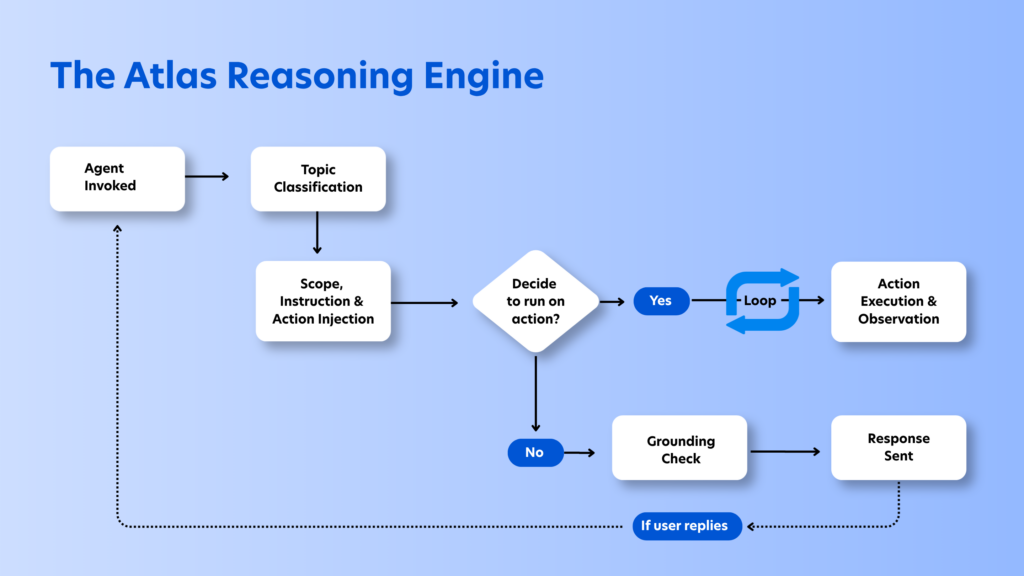
When an agent is triggered, the Atlas Reasoning Engine processes the interaction through a continuous, four-stage cognitive loop:
1. Plan: Atlas maps the incoming request against a defined Topic (the agent’s operational domain). It evaluates the user’s intent and establishes a multi-step execution strategy based on the specific instructions assigned to that topic.
2. Evaluate: The engine cross-references its plan against organizational rules, checking if the proposed path is valid, safe, and logical. If critical variables are missing, it formulates clarifying questions to ask the user.
3. Refine: Atlas adjusts its plan based on evaluation feedback, ensuring the upcoming execution steps perfectly align with both semantic intent and hard business rules.
4. Retrieve: The engine performs semantic and keyword searches via RAG, gathering real-time data across structured records and unstructured documents to ground its next step in factual truth.
This loop repeats seamlessly, allowing the agent to reason-act-observe until the overarching objective is accomplished or handoff to a human is required.
Grounding Actions with Data Cloud and Zero-Copy Integration
An AI agent’s reasoning is only as good as the data it can access. Historically, fueling an enterprise AI system required building and maintaining incredibly complex, brittle ETL (Extract, Transform, Load) data pipelines to move data from external data warehouses into the CRM.
Agentforce entirely bypasses this hurdle by deeply embedding itself with Salesforce Data Cloud. Data Cloud ingests, harmonizes, and unifies data from disparate enterprise silos including data lakes, legacy databases, websites, and device logs into a single, real-time data engine.
Through Salesforce’s Zero-Copy Integration architecture, Agentforce can read and reason over data residing in external warehouses like Snowflake, Databricks, Google BigQuery, and Amazon Redshift without moving or replicating a single byte of data. By querying the data at its source, Agentforce operates on a unified, real-time view of the customer, eliminating data synchronization lag and drastically reducing storage costs.
Ensuring Compliance Through the Einstein Trust Layer
Deploying autonomous agents at enterprise scale demands absolute certainty regarding security, privacy, and compliance. Agentforce achieves this through the Einstein Trust Layer, an enterprise-grade security architecture that inspects every transaction passing between the reasoning engine and foundational LLMs.
The Trust Layer enforces five rigid safety measures:
Data De-Identification and Masking: Before a prompt is sent to an external LLM, the Trust Layer scans the payload for Personally Identifiable Information (PII), payment card industry (PCI) data, and proprietary data, replacing it with secure tokens.
Strict Toxicity Scoring: All incoming queries and outgoing responses are continuously evaluated for toxicity, bias, hate speech, or inappropriate phrasing, blocking non compliant interactions instantly.
The Zero-Retention Guarantee: Salesforce enforces strict, legally binding agreements with model providers ensuring that no enterprise data sent to the LLM is ever cached, stored, or used for model training.
Contextual Role-Based Access Control: Agentforce automatically respects existing Salesforce data sharing rules. If a human user or an external customer does not have permission to view a specific object or field in Salesforce, the agent cannot access or leverage that data during its reasoning process.
Audit Trail Observability: Every link in an agent’s chain-of-thought, the exact prompts sent, the data retrieved via RAG, and the resulting actions executed are recorded in a secure, immutable log for admin review and compliance auditing.
10 High-Impact Salesforce Agentforce Use Cases for 2026
By embedding autonomous reasoning directly into vertical workflows, Agentforce allows diverse industries to move beyond static, chat-based deflection and enter the era of proactive, end-to-end task execution.
Below is a detailed look at how these autonomous digital coworkers are transforming core operational workflows across ten enterprise sectors in 2026.
1. Autonomous Customer Support and End-to-End Case Resolution in Agentforce Service
Traditional service bots can deflect cases by surfacing links to FAQs, but the Salesforce Agentforce Service Agent actively resolves them. If a customer messages an e-commerce brand to modify a complex order, the agent doesn’t just provide instructions. It verifies the customer’s identity, checks the order status in real-time via Data Cloud, references the company’s cancellation and shipping policy documents, calculates partial refunds, updates the ERP system using a MuleSoft API, and updates the Salesforce Case to a closed status – all within a single conversation.
2. Strategic Sales Pipeline Execution and Deal Acceleration
The Agentforce Sales Agent functions as an always-on virtual strategist for account executives. It continuously analyzes account health scores, recent product utilization drops, and contract renewal timelines within Sales Cloud.
If a high-value account exhibits a churn risk or an upsell signal, the agent proactively summarizes the account’s entire operational history, cross-references recent support tickets, drafts a hyper-targeted renewal proposal, and queues it up for the account executive to review and send with a single click.
3. Intelligent Lead Qualification and Automated Routing
Instead of relying on basic web forms that sort leads by simple geography or company size, Agentforce acts as an autonomous inbound Sales Development Representative (SDR). It engages web traffic in deep, contextual, natural-language dialogues to uncover specific pain points, technical stacks, and budget boundaries. The agent evaluates this data against ideal customer profiles (ICPs) in real-time, updates lead scores, populates custom CRM fields, and schedules meetings directly onto the optimal account executive’s calendar based on complex routing rules.
4. Hyper-Personalized Marketing Journeys Driven by Real-Time Data
Marketing automation historically relied on rigid segment lists updated on a nightly batch schedule. Agentforce Marketing Agents monitor streaming data feeds in Data Cloud such as real-time mobile app interactions, web abandoned carts, and changing local weather patterns. The agent can dynamically alter an active customer journey, generating personalized email content, SMS copy, or tailored product recommendations tailored to that exact millisecond of interaction, drastically increasing conversion velocity.
5. Commerce and Order Management Automation for Scalable Operations
In B2B and B2C commerce, inventory volatility and supply chain friction can devastate customer satisfaction. Agentforce Commerce Agents act as proactive operational backstops. If a major warehouse experiences a logistical delay, the agent identifies all impacted downstream orders, checks alternative fulfillment centers for substitute inventory, drafts proactive update communications to business buyers, and updates back-end order management schemas to re-route shipping vectors seamlessly.
6. Eliminating Silos Through Cross-Cloud Process Orchestration
Enterprise workflows frequently stall when passing work across departmental lines—from Sales to Billing, or Service to Field Operations. Agentforce natively spans these boundaries by operating across the entirety of the Salesforce Customer 360 platform.
When a sales contract marks as “Closed/Won,” an agent can automatically trigger a sequence that spans across clouds: provisioning the customer asset record in Service Cloud, spinning up a billing schedule in Revenue Lifecycle Management, and alerting the onboarding team via Slack.
7. Streamlining Internal Operations and Employee Support via the Employee Agent
Internal HR and IT helpdesks are routinely bogged down by repetitive inquiries. The Agentforce Employee Agent integrates seamlessly into internal corporate channels like Slack or Microsoft Teams.
Employees can ask complex questions such as, “How do I add my newborn to my health insurance plan, and what is our parental leave rollover policy?” The agent interprets the query, securely accesses internal HR policy documents, guides the employee through document submission, and orchestrates the back-end case routing to HR specialists if unique exemptions are needed.
8. Knowledge Management and Self-Improving Enterprise Enablement
Enterprise knowledge bases degrade quickly when articles become outdated or poorly tagged. Agentforce actively manages its own operational environment. By monitoring common themes in escalated customer service cases, the agent can flag gaps in company documentation. It can automatically ingest raw technical release notes or internal Slack discussions, draft clean, compliance-ready knowledge articles, and submit them to human editors for approval – creating a closed-loop, self-improving data ecosystem.
9. Natural Language Analytics and Executive Decision Support
Instead of waiting days for analytics teams to build custom dashboards, executives can converse directly with their data using Agentforce integrated with Tableau. An executive can ask, “Show me why profit margins dipped in our European sector last quarter, and pinpoint the top three driving operational costs.” The agent writes the underlying analytical queries, searches for statistical anomalies, generates clean visualizations, and accompanies the charts with structured, narrative-driven business summaries.
10. Proactive Platform Automation and Salesforce Admin Productivity
Agentforce radically accelerates time-to-value for internal IT teams and Salesforce system administrators. Through low-code interfaces, admins can use natural language to design automated workflows, draft complex validation rules, or generate formula fields. Furthermore, the agent can monitor platform health, flag performance bottlenecks in Apex code, identify underutilized custom fields, and suggest architecture cleanups to keep the enterprise instance highly optimized.
Advanced Strategies for Scaling Salesforce Agentforce Use Cases
As organizations mature from deploying isolated, single-purpose agents to managing enterprise-wide agentic ecosystems, advanced orchestration strategies become vital.
Multi-Agent Orchestration and the Primary-Agent Hierarchy
An enterprise should not have one monolithic, over complicated agent trying to handle thousands of unrelated tasks. Instead, scalability is achieved through a decoupled, hierarchical architecture. Organizations deploy a single, consumer-facing Primary Agent that serves as the universal router.
When a user interacts with the system, the Primary Agent analyzes the intent and safely delegates the request to a fleet of specialized, back-end Sub-Agents (e.g., a specialized Billing Agent, an Inventory Agent, or an Onboarding Agent). Once the Sub-Agent completes its specific mission, it passes the results back to the Primary Agent to synthesize the final output to the user. This modularity ensures individual agents remain highly performant, easy to debug, and simple to maintain.
Ecosystem Intelligence with Agent-to-Agent and Model Context Protocols
Enterprise ecosystems extend far beyond the borders of Salesforce. To unlock true autonomy, Agentforce agents leverage open framework protocols like the Model Context Protocol (MCP) and advanced Agent-to-Agent communication APIs. This allows an Agentforce agent to securely communicate and negotiate with external AI agents running inside non-Salesforce architectures (such as custom agents built on AWS, Google Cloud, or Microsoft Azure), exchanging structured context, executing cross-platform transactions, and breaking down multi-enterprise walls.
Measuring Business Value and ROI with Salesforce Agentforce Service
Shifting operational workflows to autonomous agents requires a parallel shift in how leadership teams measure operational efficacy and track financial investments.
Key Performance Indicators from Containment Rates to First Contact Resolution
While traditional metrics remain relevant, agentic deployment introduces critical new Key Performance Indicators (KPIs):
| Metric | Traditional Definition | Agentic Era Definition |
|---|---|---|
| Containment Rate | The % of users who exit an IVR or bot without speaking to a human. | The % of complex, multi-step customer cases resolved entirely end-to-end by an autonomous agent without human intervention. |
| First Contact Resolution (FCR) | Resolving a customer issue during their initial phone call or chat. | The speed at which an agent instantly pulls RAG data and executes platform actions to resolve a case on the very first interaction. |
| Average Handle Time (AHT) | The duration of a support interaction. | Shifts from a metric of speed to an indicator of complexity; simple cases drop to seconds, freeing human agents to dedicate longer times to high-empathy scenarios. |
| Human Elevation Rate | The percentage of cases passed to human tiers. | A metric to isolate training deficiencies, highlighting where new Agent Topics, instructions, or Salesforce Actions need to be built. |
Transitioning to Outcome-Based Pricing via Flex Credits
The economic model of enterprise software is fundamentally evolving. Traditional software procurement relies on fixed seat-based licensing, which forces companies to pay for capacity regardless of actual usage or delivered value.
Salesforce has pioneered a consumption-based pricing mechanism built around Flex Credits and Conversations. For customer-facing deployments, organizations can opt for a predictable flat rate of $2.00 per complete conversation. Alternatively, for broader deployment across customer, employee, and voice channels, businesses can leverage the Flex Credits model.
Under this model, organizations pre-purchase or pay-as-you-go for credits priced at $500 per 100,000 Flex Credits. A standard, discrete Agentforce action (such as executing a database lookup, triggering a Salesforce Flow, or issuing an API call) consumes exactly 20 Flex Credits ($0.10 per action), while a voice-driven action consumes 30 Flex Credits ($0.15 per action). This shifts software expenditure from fixed operational overhead to a variable cost model linked directly to quantifiable business outcomes and executed work.
Implementation Best Practices for a Trusted Salesforce Agentforce AI
Deploying an autonomous agentic ecosystem requires rigorous planning and a structured operational methodology. Here are few implementation best practices to follow:
1. The Crawl-Walk-Run Strategic Roadmap for Deployment
Enterprises must resist the urge to automate their most convoluted, high-risk workflows on day one. A structured phase-gate deployment strategy mitigates risk and ensures steady value delivery:
- Crawl: Begin with internal employee-facing use cases or low-risk customer-facing topics. Focus on read-only interactions where the agent utilizes RAG to surface accurate policy or product answers. Keep a human-in-the-loop to review outputs before they are shared.
- Walk: Expand to read/write transactions. Allow the agent to interact directly with customers to update records, trigger standard Salesforce Flows, and modify objects. Establish clear exception boundaries where the agent seamlessly routes the interaction to a live human agent when thresholds are breached.
- Run: Deploy multi-agent architectures, open cross-platform API calls, and fully autonomous orchestration layers across complex, multi-cloud enterprise processes.
2. Defining Ethical Guardrails and Human-in-the-Loop Controls
Autonomy does not mean an absence of management. Admins must configure strict Guardrails within the Agentforce Builder. These are immutable boundary rules that define exactly what an agent cannot do.
For instance, an admin can establish a guardrail stating that an agent can issue a customer billing credit up to $100 autonomously, but any modification exceeding that value must pause the interaction and route an approval task to a human manager’s queue.
3. Data Readiness as the Critical Precondition for Agent Reliability
The ultimate success of an Agentforce deployment depends entirely on the cleanliness, structure, and accessibility of your enterprise data. If your Salesforce instance is cluttered with duplicate records, obsolete fields, and unstructured knowledge documents containing conflicting policy guidance, the reasoning engine will inevitably output flawed conclusions.
Prioritizing data governance, establishing robust identity resolution rules within Data Cloud, and auditing knowledge content are absolute prerequisites for building a reliable, high-performing digital workforce.
Conclusion: Embracing the Future of Connected Work in 2026
The emergence of Salesforce Agentforce represents a permanent shift in how modern enterprises scale their operations, engage with customers, and empower their workforce. By wrapping advanced, non-linear reasoning around a secure metadata architecture and real-time data engine, Agentforce elevates artificial intelligence from a passive conversational tool into an active operational partner.
Organizations that strategically implement this platform by prioritizing data readiness, instilling rigorous ethical guardrails, and leaning into consumption-based economic models will unlock unprecedented structural efficiencies, leaving legacy, manual business processes far behind.
The future of work is connected, autonomous, and agentic. The companies that build their digital workforces today are the ones that will dominate the competitive landscape of tomorrow.

Deputy Manager, Marketing, Everforth Quinnox
FAQs
Traditional chatbots follow predefined scripts and decision trees. They work well for simple, repetitive questions but struggle when conversations become more complex or unexpected.
Salesforce Agentforce is designed to be much more capable. Instead of following fixed rules, it uses AI to understand context, reason through requests, and take actions on a user’s behalf. It can access business data, execute workflows, and connect with enterprise systems to complete tasks rather than simply answering questions.
Einstein Copilot is an AI assistant that helps user complete tasks by providing recommendations, generating content, or answering questions. The user remains in control and decides what action to take.
Agentforce goes a step further by enabling autonomous AI agents. These agents can make decisions within defined guardrails, execute multi-step workflows, interact with business systems, and complete tasks with minimal human intervention. In short, Einstein Copilot assists users, while Agentforce enables AI to act on their behalf.
Yes. Agentforce is designed to work beyond Salesforce. AI agents can integrate with external applications, enterprise systems, and third-party APIs to retrieve information, update records, trigger workflows, and complete business processes across multiple platforms.
This allows organizations to automate end-to-end workflows instead of limiting AI to Salesforce data alone.
Successful Agentforce deployments start with high-quality data. AI agents need access to accurate, well-organized, and properly governed information to make reliable decisions.
Before implementation, organizations should review their data quality, remove duplicate or outdated records, define access permissions, and ensure key business processes are documented. Strong governance and security controls are equally important, especially when AI agents interact with sensitive customer or business data.
Traditional Salesforce licensing is typically based on the number of users who access the platform. Agentforce introduces an outcome-based approach, where costs are linked to the work AI agents perform such as completing tasks, resolving customer requests, or executing business actions.
This gives organizations more flexibility because pricing is tied to the value the AI delivers rather than simply the number of employees using the software. The exact pricing model depends on the specific Agentforce edition and the type of AI actions being used.