Introduction
Enterprise AI is entering a new era—one that extends far beyond copilots and conversational assistants.
Across industries, CIOs, CTOs, and customer experience leaders are confronting a critical reality: generating answers is no longer the benchmark for AI success. The real value lies in enabling AI systems to understand business context, reason through complex scenarios, orchestrate workflows, and take accountable action across enterprise environments.
This shift from conversational AI to autonomous, action-oriented intelligence is reshaping enterprise technology strategies and it is precisely why Salesforce Agentforce AI has become one of the most significant developments in this evolving technological landscape.
At the core of Agentforce is the Atlas Reasoning Engine, Salesforce’s cognitive architecture designed to power intelligent, autonomous agents. Unlike traditional generative AI assistants that primarily respond to prompts, Atlas evaluates intent, retrieves contextual enterprise data, reasons through multi-step tasks, orchestrates workflows, and executes actions within defined business guardrails.
For enterprise leaders, this represents far more than another AI capability or platform enhancement. It signals a fundamental evolution in how organizations deploy AI—from tools that assist employees to systems that actively participate in business operations.
Industry analysts increasingly identify agentic AI as the next major wave of enterprise transformation. Salesforce positions Agentforce as a digital labor platform capable of deploying autonomous AI agents across customer service, sales, marketing, and operational functions. Early insights from Salesforce indicate that the Atlas Reasoning Engine can significantly improve response relevance, decision quality, and workflow execution accuracy, helping organizations move beyond isolated AI interactions toward scalable operational intelligence.
As enterprises seek to unlock measurable business outcomes from AI investments, understanding how the Atlas Reasoning Engine works, and why it matters has become essential for technology and business leaders alike.
Why Traditional Enterprise AI Models Are Reaching Their Limits
The first generation of enterprise AI delivered significant gains in productivity. Organizations rapidly adopted AI-powered copilots to summarize conversations, generate content, assist customer service teams, automate routine tasks, and improve employee efficiency at scale.
While these capabilities created measurable value, they also exposed a fundamental limitation: most AI systems were designed to assist work—not to understand, coordinate, and execute it within the complexity of enterprise operations.
As organizations expanded AI adoption from isolated use cases to mission-critical business processes, the shortcomings of traditional AI architectures became increasingly apparent. Many enterprise AI solutions continued to struggle with challenges such as:
- Limited understanding of business context and organizational priorities
- Inconsistent reasoning across multi-step tasks and workflows
- Hallucinations and unreliable outputs in high-stakes decision environments
- Fragmented access to enterprise data and systems
- Limited ability to execute actions within governed business processes
- Difficulties maintaining trust, security, compliance, and auditability at scale
These limitations become particularly evident in large enterprise ecosystems such as Salesforce, where customer interactions, operational workflows, business rules, and data systems are deeply interconnected.
Consider a customer escalation scenario. Resolving the issue often requires far more than generating a response or surfacing information. The AI system must be able to understand the broader business context and coordinate actions across multiple functions and systems. This may involve:
- Analyzing historical customer interactions across CRM records
- Accessing order, billing, or service management systems
- Evaluating service-level agreements (SLAs) and contractual obligations
- Triggering remediation workflows and approvals
- Coordinating actions across sales, service, operations, and support teams
- Enforcing governance, security, and compliance requirements throughout the process
In reality, these scenarios demand a combination of contextual understanding, reasoning, decision-making, and action orchestration—capabilities that extend far beyond the scope of traditional AI assistants.
This is where the enterprise AI landscape is beginning to shift. Organizations are increasingly moving from AI systems that simply generate outputs to AI systems capable of reasoning through complex business situations, coordinating workflows, and driving outcomes autonomously within defined guardrails.
The Atlas Reasoning Engine, which powers Salesforce Agentforce, was designed to address precisely this challenge. Rather than functioning as a standalone conversational assistant, it serves as the reasoning layer that enables AI agents to interpret intent, evaluate context, orchestrate enterprise workflows, and take governed action across business systems.
In many ways, Atlas represents Salesforce’s response to one of the most important questions facing enterprise AI today: how do organizations move from AI-assisted work to AI-driven execution?
Did You Know?
Salesforce CEO Marc Benioff recently stated that AI initiatives including Agentforce contributed to nearly 30% productivity improvements internally across engineering and operational workflows.
What Is the Atlas Reasoning Engine?
The Atlas Reasoning Engine is the orchestration and reasoning layer behind Salesforce Agentforce.
Salesforce describes Atlas as the “brain” of Agentforce – a system designed to simulate human-like planning, reasoning, contextual understanding, and decision-making across enterprise workflows.
At a strategic level, Atlas represents a transition from prompt-driven AI to reasoning-driven enterprise automation.
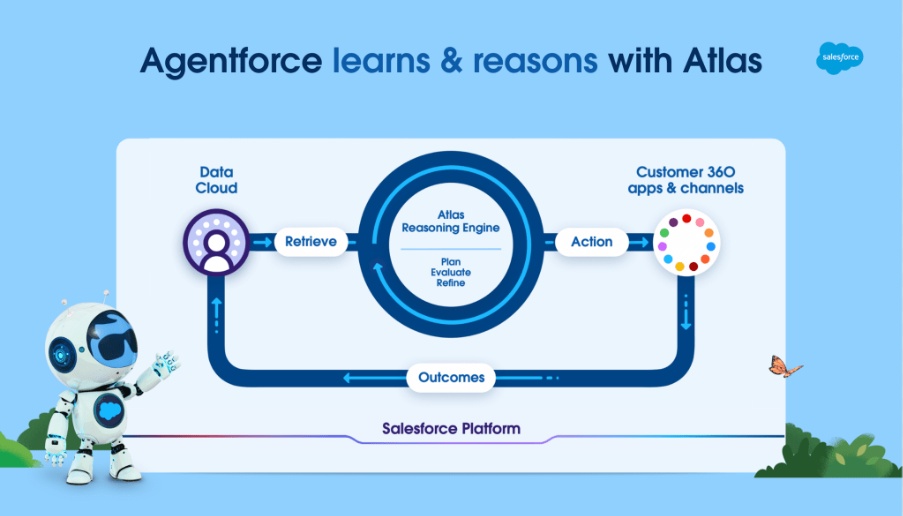
Image credit: Salesforce
Rather than simply generating responses, Atlas evaluates:
- User intent
- Enterprise context
- Available data sources
- Workflow dependencies
- Business rules
- Action pathways
- Confidence thresholds
It then dynamically determines the next-best action.
This distinction is critical.
Enterprise leaders are increasingly recognizing that scalable AI adoption depends less on model size and more on orchestration intelligence; the ability to combine reasoning, retrieval, governance, workflows, and execution into a trusted operational system.
The Core Technologies Behind Salesforce Agentforce AI
1. System 2 Reasoning Architecture
One of the defining concepts behind Atlas is “System 2” reasoning.
Borrowed from cognitive science, System 2 reasoning refers to deliberate, analytical, multi-step decision-making rather than immediate reactive responses.
Salesforce engineering teams describe Atlas as using inference-time reasoning to evaluate tasks more carefully before generating outputs or executing actions.
This allows Salesforce Agentforce AI to:
- Break down complex tasks
- Evaluate multiple pathways
- Self-reflect before execution
- Retrieve additional information when confidence is low
- Improve accuracy in enterprise workflows
For enterprise environments, this is especially important.
A customer support AI agent cannot simply “guess” a refund policy.
A sales AI agent cannot hallucinate pricing approvals.
A service workflow cannot trigger operational actions without governed reasoning.
Atlas introduces a more controlled reasoning framework designed for enterprise-grade reliability.
2. Graph-Based Workflow Orchestration
Another major innovation is Atlas’ graph-based orchestration model.
According to Salesforce Trailhead documentation, the Atlas Reasoning Engine operates through graph-based reasoning structures that orchestrate actions, variables, and workflow transitions.
In practical terms, this means AI agents can:
- Navigate multi-step workflows
- Coordinate parallel processes
- Dynamically select actions
- Route tasks across systems
- Adapt decisions based on evolving context
This architecture becomes increasingly valuable in large enterprises where workflows span:
- CRM systems
- ERP environments
- Customer support platforms
- Knowledge bases
- Supply chain systems
- External APIs
- Human approval layers
Instead of operating as isolated chat interfaces, Salesforce Agentforce agents become orchestrated participants within enterprise operating models.
3. Advanced Retrieval and Contextual Intelligence
Enterprise AI effectiveness depends heavily on context.
Atlas incorporates advanced retrieval-augmented approaches that continuously pull enterprise knowledge, customer history, workflow states, and operational data into the reasoning process.
This significantly changes how AI interacts with enterprise systems.
Rather than generating generic responses from static model memory, Salesforce Agentforce AI can:
- Access live business context
- Retrieve relevant enterprise records
- Analyze workflow states
- Reference policy frameworks
- Interpret customer history dynamically
For customer experience leaders, this creates opportunities to move from reactive service models toward intelligent, proactive engagement.
Why CIOs Are Paying Attention to Salesforce Agentforce
The emergence of reasoning engines like Atlas reflects a broader shift in enterprise operating models.
Organizations are no longer evaluating AI solely as a productivity tool.
They are evaluating AI as an operational layer.
That distinction matters because enterprises now face mounting pressure to:
- Reduce operational complexity
- Scale service delivery without linear hiring growth
- Improve customer responsiveness
- Increase workforce productivity
- Modernize legacy workflows
- Accelerate digital transformation initiatives

The rise of Salesforce Agentforce AI signals the beginning of agentic enterprise operations. AI is no longer confined to generating responses — it is evolving into a reasoning layer capable of coordinating customer engagement, workflows, and enterprise decisions autonomously. Organizations that modernize their customer ecosystems and operational architectures today will be best positioned to unlock the full value of Agentforce tomorrow.
Murali G Sivanandam
Director – Salesforce, Everforth Quinnox
Analyst firms including Gartner and McKinsey have increasingly emphasized that enterprises will need governed, orchestrated AI ecosystems rather than isolated AI assistants.
This is where Salesforce Agentforce AI becomes strategically relevant.
Its value proposition is not simply conversational AI.
It is enterprise workflow intelligence.
The Atlas Reasoning Engine enables organizations to embed AI-driven reasoning directly into customer engagement, employee productivity, and operational decision-making.
The Enterprise Governance Advantage
One of the biggest barriers to enterprise AI adoption remains trust.
Executives continue to raise concerns around:
- Data security
- Compliance
- Explainability
- Governance
- Hallucination risks
- Workflow accountability
Salesforce has positioned Atlas within its broader enterprise trust architecture, including Hyperforce infrastructure and governed deployment models.
This becomes particularly important in regulated industries where AI systems must operate within strict policy and compliance boundaries.
According to Salesforce engineering insights, Atlas was intentionally rolled out through phased deployments in high-security environments before broader expansion.
For enterprise leaders, this highlights a critical market reality:
The future winners in enterprise AI may not simply be the companies with the largest models.
They may be the organizations that can operationalize AI safely at scale.
Operational Impact Across Industries
The Atlas Reasoning Engine has cross-industry implications because nearly every enterprise function is becoming workflow-driven and data-intensive.
Customer Service
AI agents can autonomously:
- Resolve service requests
- Retrieve account histories
- Trigger workflows
- Escalate intelligently
- Personalize responses
- Reduce resolution times
Sales Operations
Agentforce AI can help:
- Prioritize leads
- Coordinate follow-ups
- Analyze customer signals
- Automate workflow actions
- Surface contextual recommendations
Employee Experience
Internal AI agents can support:
- IT service management
- HR workflows
- Knowledge retrieval
- Operational approvals
- Enterprise search
Supply Chain and Operations
Reasoning-driven agents can assist with:
- Workflow coordination
- Inventory analysis
- Order management
- Exception handling
- Cross-system orchestration
This evolution signals a broader enterprise transition toward AI-native operations.
Everforth Quinnox Perspective: Building AI-Ready Customer Operations
While the emergence of agentic AI platforms such as Salesforce Agentforce represents a significant leap forward, technology alone is rarely the determining factor in AI success. The true differentiator lies in an organization’s ability to provide AI systems with the context, connectivity, and operational intelligence required to make informed decisions and execute actions effectively.
For many enterprises, this remains a challenge.
Customer data, service operations, business processes, and enterprise applications often exist across fragmented systems and disconnected workflows. As a result, AI initiatives frequently encounter limitations—not because the models lack sophistication, but because the underlying ecosystem lacks the integration and visibility needed to support intelligent decision-making at scale.
As organizations begin deploying autonomous AI agents, the quality of the operational foundation becomes increasingly important. To reason effectively and drive meaningful outcomes, AI systems require:
- A unified view of customer, operational, and business data
- Real-time visibility into workflows and business processes
- Seamless connectivity across enterprise applications and platforms
- Intelligent automation frameworks that enable action orchestration
- Secure, governed access to enterprise information
- Scalable integration architectures capable of supporting enterprise-wide AI adoption
Without these foundational elements, even the most advanced AI agents risk operating in silos, limiting their ability to deliver measurable business value.
Creating AI-Ready Customer Ecosystems
At Everforth Quinnox, we believe that the future of enterprise AI is built on connected customer ecosystems. Our Salesforce-led transformation approach focuses on helping organizations modernize customer operations, unify business processes, and establish the digital foundations required to support reasoning-driven AI at scale.
From AI Experiments to Enterprise-Scale Execution
As autonomous AI agents become embedded across customer service, sales, and operational workflows, enterprises will need environments where AI can securely access context, understand business processes, coordinate actions, and operate within governance frameworks.
This is where transformation expertise becomes critical.
Everforth Quinnox helps organizations bridge the gap between AI ambition and operational reality by enabling:
- Customer experience transformation initiatives
- AI-enabled service modernization programs
- Intelligent workflow orchestration and automation
- Salesforce platform modernization
- Connected digital ecosystems
- Enterprise-scale AI transformation strategies
By establishing connected customer operations and intelligent workflow architectures, organizations can move beyond isolated AI pilots and create the conditions for scalable, enterprise-wide AI adoption.
As platforms like Salesforce Agentforce continue to evolve, the enterprises that realize the greatest value will be those that invest not only in AI capabilities, but also in the operational foundations that allow AI to reason, act, and deliver outcomes across the business.
The Future of Enterprise AI Is Agentic and Operational
For decades, enterprise technology has focused on helping people work more efficiently. The next era of AI is about enabling systems to understand context, reason through complexity, orchestrate processes, and execute actions with greater autonomy and accountability.
In that future, AI will no longer function as a standalone conversational layer sitting on top of business applications. Instead, it will become an embedded operational intelligence layer—one that continuously connects data, workflows, decisions, and actions across the enterprise.
The Atlas Reasoning Engine offers an early glimpse into this evolution. By combining contextual understanding, reasoning, workflow orchestration, and governed action execution, it moves enterprise AI closer to becoming a true participant in business operations rather than simply a tool that responds to requests.
For CIOs, CTOs, Salesforce leaders, and customer experience executives, the question is no longer whether AI will reshape enterprise operations; its more about whether organizations are prepared to capitalize on it.
The enterprises that will lead in the age of agentic AI will not necessarily be those with the most AI tools. They will be the ones that build connected data ecosystems, modernize operational processes, establish trusted governance frameworks, and create the foundations that allow AI to reason and act at scale.

Head – Digital Marketing, Everforth Quinnox
FAQs
Salesforce Agentforce AI is Salesforce’s autonomous AI platform designed to enable intelligent AI agents that can reason, retrieve enterprise context, orchestrate workflows, and execute business actions across customer engagement and operational environments.
The Atlas Reasoning Engine is the core reasoning and orchestration architecture powering Salesforce Agentforce AI. It enables AI agents to analyze intent, evaluate workflows, retrieve contextual data, and determine next-best actions in real time.
No. Atlas does not require Salesforce Data Cloud to function; however, Data Cloud (now Salesforce Data 360) can enhance Agentforce by giving agents access to unified data from multiple sources. Agentforce can also work with Salesforce CRM data, knowledge, and connected external systems depending on the use case.
The Atlas Reasoning Engine helps enterprises move from reactive AI assistance toward intelligent operational automation. Its reasoning capabilities improve workflow accuracy, contextual understanding, and enterprise decision support while maintaining governance and compliance.
Everforth Quinnox helps enterprises build connected customer ecosystems that support AI-driven operations through Salesforce modernization, intelligent workflow orchestration, customer experience transformation, enterprise integration, and scalable digital transformation initiatives.