The honest answer to manual testing vs automation testing is that it was never a choice between two options. It is a decision about proportion. Every QA function has a finite amount of capacity, and the real question is how much of it goes to scripted execution and how much goes to human judgment.
Manual testing puts a person in front of the application. They follow a test plan or explore freely, and they use judgment to decide whether what they are seeing is correct. Automation testing hands that execution to scripts, which run predefined steps and compare the result against an assertion without anyone watching.
Both catch defects. They just catch different ones. The useful conversation, therefore, is not about which discipline wins. It is about what should be automated, what should remain manual, and why – based on factors such as release cadence, business risk, application stability, test repeatability, maintenance effort, and the rate at which the application changes.
This guide sets out how to make that call, what it costs either way, and where the line now sits after AI has moved it.
Manual Testing vs Automation Testing: A Side-by-Side Comparison
The clearest way to see the difference is to line the two up against the criteria that actually shape a testing budget: speed, cost behavior over time, coverage limits, and how much upkeep each approach demands.
| Criterion | Manual testing | Automation testing |
|---|---|---|
| Execution speed | Paced by human effort. A full regression pass can take days. | Runs in minutes and executes in parallel across environments. |
| Cost profile | Low to start, then scales linearly with every additional cycle. | Front-loaded investment, then near-zero marginal cost per run. |
| Coverage ceiling | Limited by team size and available hours. | Limited mainly by infrastructure and script coverage. |
| Repeatability | Varies between testers and between runs. | Identical every time, which makes results comparable. |
| Defects caught | Usability gaps, visual anomalies, workflow logic that looks wrong to a person. | Functional regressions, data mismatches, performance degradation, broken integrations. |
| Maintenance | Test cases need updating, but no code to repair. | Scripts break when the interface changes and need continuous upkeep. |
| Fit with CI/CD | Cannot gate a pipeline. Feedback arrives after the fact. | Triggers on every commit and blocks broken builds automatically. |
| Scalability | Scales by hiring. | Scales by adding compute. |
Speed, Coverage, and Execution Consistency
Automation wins all three, and it is not close. A regression suite that takes a team three days to work through runs in under an hour unattended. But the bigger advantage is not simply speed. It is repeatability. Automated tests execute the same steps and the same validations on every run, which means results can be compared from one release to the next. Inconsistent manual execution produces results that cannot, and that makes trend analysis impossible.
Cost Profile: Linear Spend vs Front-Loaded Investment
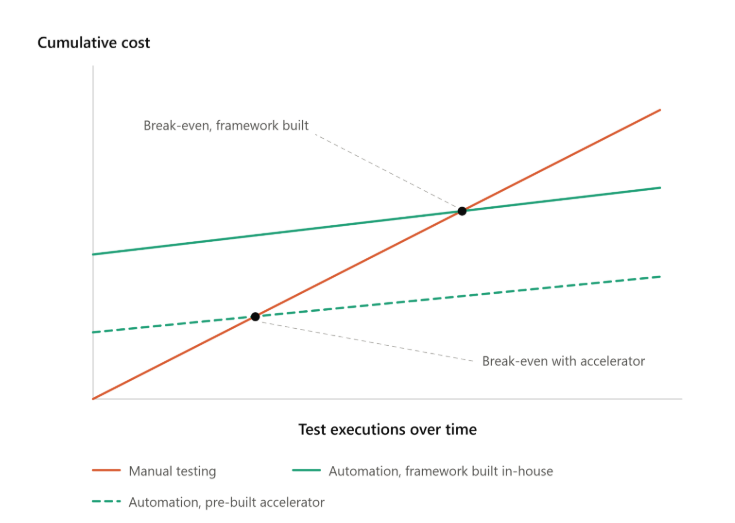
Manual testing is cheap to start and expensive to sustain. Every release cycle costs roughly what the last one did, so the total spend rises in a straight line with release frequency. Automation inverts this. There is real upfront cost in tooling, framework build, and script authoring, but once a test exists, running it again costs almost nothing. The two cost profiles eventually reach a break-even point. Understanding where that point sits for a particular application is what turns the automation decision from instinct into a business case, and it depends on release frequency, test volume, requirement stability, maintenance effort, and the expected lifespan of the automation.
The Defect Classes Each Approach Catches
Scripts find what they were told to look for. They are excellent at catching functional regressions, data mismatches, broken integrations, and performance degradation, because those failures show up as an assertion that no longer holds. What scripts cannot do is notice that something looks wrong. A misaligned button, a confusing error message, or a workflow that technically passes but makes no sense to a user will sail through a green test run.
Which Types of Testing Can and Cannot Be Automated
Some categories automate cleanly. API testing, unit testing, regression, smoke, load, and data validation are all deterministic, repeatable, and assertion-friendly. Functional test automation and automated regression testing are usually the first places teams see returns.
Others resist automation by nature. Usability testing, exploratory testing, and accessibility judgment calls need a person. Types of manual testing such as ad-hoc probing and user acceptance testing stay manual not because the tooling is immature, but because the thing being evaluated is subjective.
The calculation shifts again in large enterprise landscapes, where enterprise application testing across interconnected systems makes full automation of end-to-end journeys considerably harder than automating any single application in isolation.
When Manual Testing Still Delivers More Value
Manual testing earns its place wherever the outcome depends on judgment rather than assertion. That covers more ground than the automation-first narrative usually admits.
Exploratory and Ad-Hoc Testing for Unknown Unknowns
Automated tests are designed around known expectations. They are excellent at repeatedly validating conditions that have been defined, but far less effective at discovering problems nobody anticipated when the tests were written. Exploratory testing exists to find those. A tester who understands the domain will follow a hunch, combine inputs in an order no requirement document described, and surface the defect that only appears when three edge conditions align. It is also the fastest route to reproducing a customer-reported issue in production, because a person can chase the symptom rather than execute a fixed path.
Usability and User Experience Validation
Nothing in an automated suite can tell you whether a flow feels right. Whether the error copy is reassuring or alarming, whether the checkout takes one step too many, whether the interface makes sense to someone encountering it for the first time. These are commercial questions with revenue attached, and they need a human answer.
New Features with Unstable Requirements
Automating a feature whose requirements are still moving is a reliable way to write scripts twice. While a feature is in flux, manual testing is both faster and cheaper. Automation makes sense once the behaviour has settled.
Physical-Digital and Hardware-Dependent Workflows
Contactless payments, card readers, barcode scanners, kiosk hardware, and IoT device interactions all involve a physical step that is expensive to simulate. In many cases the cost of building the harness exceeds the cost of testing it manually for the life of the product.
Where Manual Testing Breaks Down at Scale
The common challenges in manual software testing are structural rather than a reflection of tester skill. Coverage is capped by available hours. Results vary between people. Repetitive execution invites fatigue errors. And crucially, manual testing cannot gate a deployment pipeline, so feedback always arrives after a build has already moved forward. These limitations of manual testing are precisely what automation exists to solve.
When Automation Testing Is the Only Viable Option
Automation becomes the practical option when the volume, frequency, precision, or execution duration exceeds what human teams can reasonably deliver within the required timeframe.
Regression and Smoke Suites Across Every Release
Regression is where automation compounds. The same assertions run against every build, at no additional cost per run, catching the breakages that new code introduces into existing functionality. Teams weighing a shift in ratio should also consider the reusability and coverage gains automation delivers beyond raw execution speed.
High-Volume and Data-Driven Validation
Reconciling millions of records through an ETL pipeline, or validating a calculation engine across thousands of input permutations, is arithmetic at a scale no team can staff. Automated data validation handles this comfortably and produces an auditable record of what was checked.
Performance, Load, and Resilience Testing
Simulating concurrent user load to find the point where an application degrades cannot be done by hand. Performance testing is automation by definition. The same applies to resilience and endurance testing, where systems are subjected to sustained load, service failures, infrastructure disruptions, or recovery scenarios over extended periods.
Automation makes it possible to generate controlled conditions, collect performance metrics, identify degradation patterns, and repeat the same scenarios consistently.
Cross-Browser and Cross-Device Coverage at Scale
The matrix of browsers, versions, operating systems, and device form factors expands faster than any team can cover manually. The teams that manage this well treat matrix selection as a design decision, structuring cross-browser testing so it stays maintainable rather than expanding coverage indefinitely.
CI/CD Quality Gates and Continuous Testing
This is the capability manual testing structurally cannot provide. Automated suites act as a gate, triggering on every commit and blocking a broken build before it reaches an environment anyone depends on. Without automation, continuous delivery is continuous deployment with hope attached.
How AI Has Redrawn the Line Between Manual and Automation Testing
The traditional manual versus automation trade-off rested on two assumptions: that scripts are expensive to write, and that they are expensive to keep working. AI has weakened both, which moves the boundary rather than erasing it.
Gartner projects that by 2028, 70 percent of enterprises will have integrated AI-augmented software testing tools into their software engineering toolchain, a significant increase from approximately 20 percent in early 2025. That is a fast reallocation of where testing effort goes, and it changes the arithmetic behind every automation decision being made today.
Self-Healing Suites and the Collapse of Maintenance Drag
Historically, the biggest hidden cost in test automation was repair. A developer renames an element, and forty scripts fail overnight for reasons that have nothing to do with product quality. Self-healing test automation detects the change and updates the locator without human intervention, which removes a large share of the upkeep that used to cap automation ROI.
Agentic Test Generation and the Falling Cost of Authoring
Test cases can now be generated from plain-language requirements rather than written line by line. Lower authoring cost means the break-even threshold falls, which pulls a whole tier of low-frequency test cases that were previously not worth automating into scope.
What Remains Genuinely Human in an AI-Augmented QA Practice
The manual remit is narrowing toward judgment rather than execution: deciding what to test, interpreting ambiguous results, and evaluating whether the product is genuinely usable. At the same time, AI testing services for AI-embedded applications introduce defect classes around model accuracy, bias, and non-deterministic output that neither conventional scripts nor conventional manual scripts were designed to catch.
A Framework for Deciding What to Automate and What to Test Manually
Most teams decide this case by case, which produces an automation suite that reflects whoever had time rather than where the value sits. A repeatable scoring model fixes that.
Four Factors That Determine the Right Approach
- Repetition frequency: how many times will this test run over the next twelve months?
- Business risk: what does a failure here cost in revenue, compliance exposure, or reputation?
- Requirement stability: how likely is the underlying behaviour to change this quarter?
- Data volume: does validating this properly require more permutations than a person can execute?
Score each test case from one to five on all four. The pattern that emerges is more useful than any single score.
The Decision Matrix
- High repetition, high stability: automate first. This is where payback is fastest and most certain.
- High risk, low repetition: automate selectively, and keep manual verification at the point of sign-off.
- Low stability, any risk level: test manually until the behaviour settles, then reassess.
- High data volume, any stability: automate the data validation layer even if the interface stays manual.
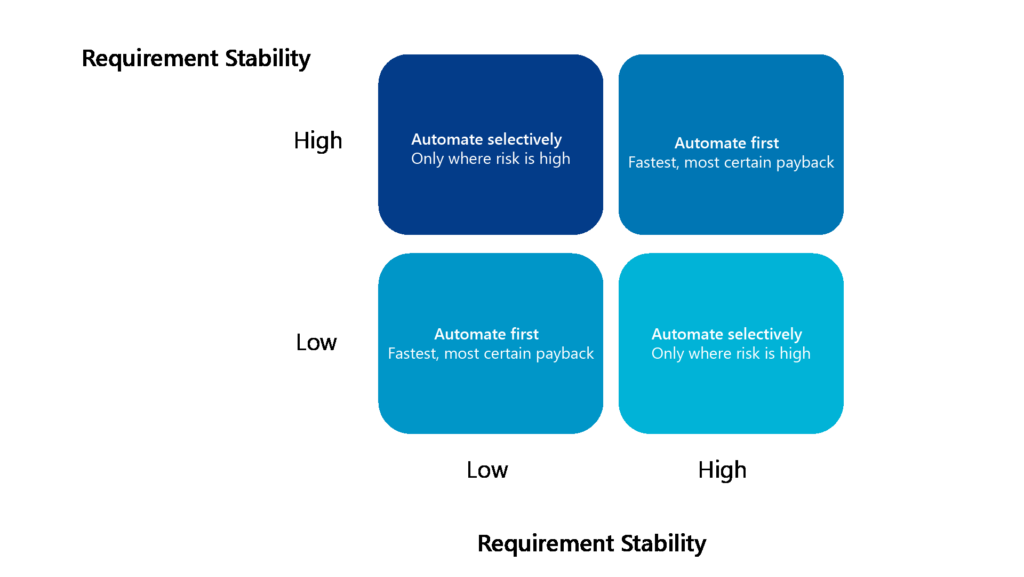
Anything scoring low on repetition, low on risk, and low on volume probably does not need a formal test at all, which is a finding worth acting on in its own right.

“The teams that struggle with this aren’t the ones automating too little or too much. They’re the ones who never made the decision consciously. Their automation suite is a record of who had spare capacity in which sprint, not a reflection of where the risk actually sits. Once you score test cases against repetition, risk, and stability, the answer usually turns out to have been obvious for a while.”
Bighneswar Parida
Director – Quality Engineering, Everforth Quinnox
Worked Example: A Customer Onboarding Journey
Take a digital account opening flow. Identity verification and credit decisioning are high risk, high volume, and stable, so they automate. The document upload step touches device hardware and varies by platform, so it stays partly manual. The final review screen is a usability question, and a person should look at it before every major release. One journey, three different answers, arrived at by the same method.
Applied consistently across a portfolio, this is how one global food and beverage business reached 90 percent coverage across test scenarios without a matching increase in QA headcount.
The Economics of Test Automation: Building Your Break-Even Model
Test automation ROI is calculable, and the calculation is straightforward enough that there is no excuse for treating it as a matter of opinion.
Calculating the Break-Even Point for a Test Case
Take the hours to author and stabilise the script, add the expected annual maintenance hours, and divide by the manual execution hours saved per run. The result is the number of executions needed before the script pays for itself. Compare that against how often the test will actually run. If a suite runs weekly, most scripts clear the bar inside a quarter. If it runs twice a year, many will never clear it at all.
The Maintenance Trap and How to Avoid It
The mistake is modelling the build cost and ignoring the upkeep. An automation suite is a codebase, and it decays like one. Suites left to rot produce flaky failures, teams stop trusting the results, and the investment quietly becomes a liability. This is closely related to the challenges and myths in test automation, chief among them the assumption that a passing suite means working software.
Framework Build Cost Is Avoidable
A significant share of first-year automation spend goes into building the framework itself rather than testing anything. Pre-built accelerators remove that line item entirely. QFAST, Everforth Quinnox’s codeless automation framework, ships with reusable component libraries and CI/CD integrations across UI, API, and data layers, and is provided within the engagement at no licensing cost. One software provider built 1,200 test cases in five months on that basis rather than spending the first quarter constructing a framework.
Building a Hybrid Testing Strategy That Scales
Once the allocation is decided, it needs an operating model. Three patterns work, and the right one depends on how the delivery teams are structured.
The Sequential Model: Stabilize Manually, Then Automate
Manual testing carries new features through the unstable phase. Once behaviour settles, the stable paths are automated and folded into the regression suite. Simple, low-risk, and the default choice for teams new to automation.
The Parallel Model: Automated Backends, Human-Tested Front Ends
Automation covers APIs, data layers, and services, where interfaces change slowly. Manual testers work the front end, where the interface and the experience are still moving. Both run at once, which suits products with a stable core and a fast-changing surface.
The Integrated Model: Both Disciplines Inside the Same Sprint
The most mature pattern. Scripts handle environment setup and data seeding so that testers spend their time exploring rather than preparing. Automation runs as a gate, manual testing runs as investigation, and both close inside the sprint.
Governance: Where a Testing Center of Excellence Fits
Any of these models will drift without oversight. Sustaining a consistent allocation across multiple programmes needs a testing center of excellence to hold the standards, tooling decisions, and quality gates in one place, rather than leaving each squad to invent its own answer.
Where Manual Testing Remains Non-Negotiable in Regulated Industries
In regulated environments the manual component is not a maturity gap. It is a requirement, and no amount of automation removes it.
User Acceptance Testing and Business Sign-Off
UAT exists so that the people accountable for a process confirm it works as the business intends. That accountability cannot be delegated to a script. The constraint in these programmes is usually business validation capacity rather than test execution speed, which is what shaped the work delivered for an investment bank that needed UAT completed before a major programme could progress.
Audit Trails and Regulatory Traceability
Regulators ask what was tested, by whom, against which requirement, and with what result. Automation produces excellent execution evidence. Manual testing produces the human attestation that sits alongside it. Most compliance frameworks expect both.
What This Looks Like in Financial Services
Monument Bank offers a clear example, automating client onboarding, account opening, and lending origination journeys while keeping manual validation at the regulatory checkpoints. The same balance applies in capital markets, where automation in Calypso testing compresses trade lifecycle validation without removing business sign-off.
Metrics That Reveal Whether Your Testing Mix Is Working
Four test automation metrics will tell you whether the current allocation is working. Any one of them in isolation will mislead.
Defect Escape Rate
The share of defects found in production rather than in testing. Rising escape rate with rising automation coverage means the suite is testing the wrong things. This is the single most diagnostic number available.
Automation Coverage and Suite Stability
Coverage without stability is worthless. Track the percentage of test cases automated alongside the percentage of automated runs that fail for reasons unrelated to product defects. A flaky suite at 80 percent coverage is worse than a reliable one at 50.
Cost of Quality
Total spend on prevention, detection, and correction, including the cost of production incidents. Most organisations cannot state this figure, which is why the automation business case so often stalls. Reducing total cost of quality through zero-maintenance automation is where the strongest returns tend to sit.
Cycle Time and Release Frequency
If automation investment is not shortening the gap between code complete and release, it is not delivering the thing it was bought for.
Building In-House vs Engaging a Testing Partner
The last question is who does the work. It is a genuine build-or-buy decision and deserves the same scrutiny as any other.
The Capability and Cost Checklist
- Framework build: months of engineering effort before a single test runs, unless a pre-built accelerator is used.
- Tooling: licences, infrastructure, device and browser access, and the overhead of managing vendor relationships.
- Skills: automation engineering, performance engineering, security testing, and domain knowledge are different specialisms and rarely sit in one team.
- Governance: someone has to own standards, coverage decisions, and maintenance discipline over time.
Establishing an Objective Baseline Before You Invest
Before committing budget in either direction, an evidence-driven assessment of quality engineering maturity gives you a factual starting point rather than a perception-based one. QAScan, the Everforth Quinnox maturity framework, scores current practice across people, process, tooling, and automation coverage, then produces a phased roadmap with short, medium, and long-term targets.
How Everforth Quinnox Approaches the Manual and Automation Balance
Everforth Quinnox works as an Intelligent Quality Engineering consultancy rather than a staffing supplier or tool reseller, and the allocation decision is treated as an engineering question with a defensible answer. Engagements typically begin with a QMRI assessment to establish where automation is genuinely warranted, followed by delivery through QFAST across UI, API, and data layers, with manual capability retained where judgment, usability, or regulatory sign-off requires it. Domain assurance teams then align the resulting mix to sector-specific workflows and compliance obligations, which is what keeps the ratio defensible in regulated environments.
The full capability set is set out under enterprise software testing services, spanning test advisory, automation, AI testing, performance, security, and continuous testing.
Getting the Balance Right
The goal was never 100 percent automation. It is to release faster without giving up the quality of the experience, and those two things are in tension only when the allocation is wrong.
Three things to do next. Audit the current release cycle and record where testing hours actually go. Classify every test case as repeating or one-off, then score it against risk and stability. Automate in descending order of business value rather than in order of technical convenience.
Teams that do this consistently tend to find the same thing: the automation candidates were obvious all along, and the reason they had not been automated was that nobody had made the decision explicit.

Assistant Manager, Marketing, Everforth Quinnox
Frequently Asked Questions
Score each test case on four factors: how often it will run, how much business risk attaches to failure, how stable the underlying requirement is, and how much data volume proper validation demands. Tests that are frequent, stable, and data-heavy should be automated. Tests that depend on judgment, or that cover behavior still in flux, should stay manual. The output is a ratio, not a binary choice.
Manual testing relies on a person interacting with the application and applying judgment. Automated testing relies on scripts checking predefined assertions. Manual is slower, less repeatable, and scales by hiring, but catches usability and experience defects. Automation is fast, consistent, and scales with infrastructure, but only finds what it was told to look for and needs continuous maintenance.
For the defects it is suited to, yes. Exploratory testing regularly surfaces issues no automated suite would catch, because scripts can only fail in anticipated ways. What manual testing cannot do is match automation on volume, speed, or consistency, and it cannot act as a gate in a CI/CD pipeline. Effectiveness depends entirely on which class of defect is being hunted.
API, unit, regression, smoke, load, performance, and data validation testing all automate well, because they are deterministic and assertion-friendly. Functional testing automates in large part. Usability testing, exploratory testing, ad-hoc testing, and user acceptance testing resist automation, because the criterion being evaluated is a human judgment rather than a fixed expected result.
Coverage is capped by available hours. Results vary between testers and between runs. Repetitive execution produces fatigue errors. Regression cycles lengthen as the application grows. And manual testing cannot gate a deployment pipeline, so feedback always arrives after a build has moved forward.
There is no universal figure, and any number quoted without context should be treated with suspicion. What matters is that the automated share covers the repetitive, stable, high-risk paths, and that suite stability stays high. A reliable suite at 50 percent coverage delivers more than a flaky one at 80 percent.
Divide the authoring and annual maintenance hours by the manual hours saved per execution. That gives the number of runs needed to break even. Suites that run weekly typically clear it within a quarter. Suites that run twice a year often never do. Self-healing capability and pre-built frameworks both shorten the payback period considerably.
Start by filtering rather than converting. Score the existing manual suite against repetition, risk, stability, and data volume, and automate only what clears the threshold. Then rewrite each qualifying case with explicit preconditions, deterministic test data, and a single unambiguous assertion. Manual cases written for a human reader usually contain assumptions that need to be made explicit before a script can run them reliably.