Accelerate IT operations with AI-driven Automation
Automation in IT operations enable agility, resilience, and operational excellence, paving the way for organizations to adapt swiftly to changing environments, deliver superior services, and achieve sustainable success in today's dynamic digital landscape.
Driving Innovation with Next-gen Application Management
Next-generation application management fueled by AIOps is revolutionizing how organizations monitor performance, modernize applications, and manage the entire application lifecycle.
AI-powered Analytics: Transforming Data into Actionable Insights
AIOps and analytics foster a culture of continuous improvement by providing organizations with actionable intelligence to optimize workflows, enhance service quality, and align IT operations with business goals.

In the era of digital transformation, Artificial Intelligence (AI) has emerged as a game-changer for businesses, offering opportunities to enhance efficiency, reduce costs, and foster innovation. According to PwC’s survey, nearly half (49%) of technology leaders report that AI is now “fully integrated” into their companies’ core business strategies. Yet, despite this impressive level of integration, many businesses still struggle to unlock the full potential of AI, revealing a critical gap between adoption and tangible business value. This disconnect underscores that simply implementing AI doesn’t necessarily translate to measurable outcomes, highlighting the need for more effective, strategic AI adoption.
This is where AI advisory services play a critical role in bridging the gap between AI adoption and its successful implementation. For businesses across industries, the complexities of choosing the right AI tools, integrating them into existing systems, managing data quality, and ensuring compliance with regulations can seem overwhelming. By offering expert guidance, strategy, and industry-specific insights, AI advisory services can help businesses avoid costly mistakes, reduce risks, and achieve their AI goals faster and more efficiently.
Whether referred to as AI adoption consulting, artificial intelligence advisory services, or AI strategy advisory, the core purpose remains the same: providing organizations with a structured path from AI ambition to measurable business impact. From assessing AI readiness and identifying high-value use cases to establishing governance frameworks and building internal AI capabilities, these services act as the connective tissue between technology potential and business reality.
What is AI Advisory Service and Why is it Important?
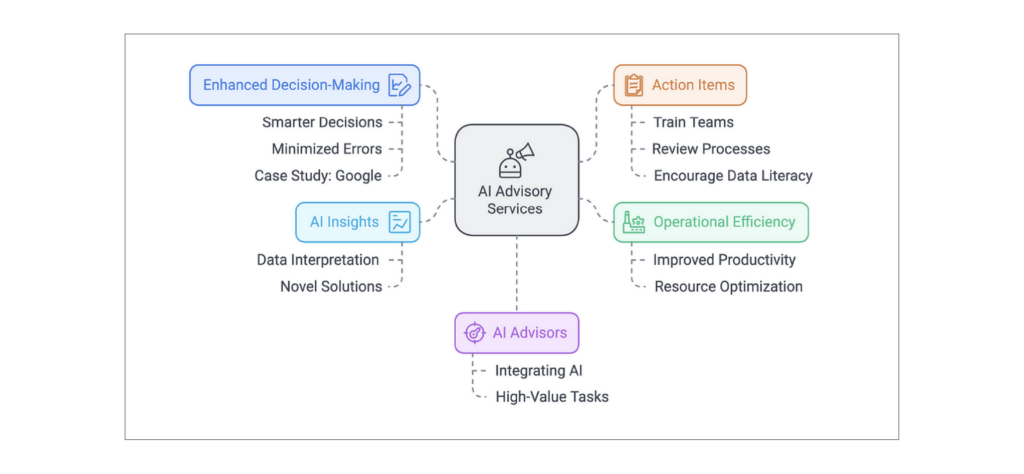
AI advisory services are specialized consulting services that guide businesses in understanding, integrating, and maximizing the value of AI technologies. These services offer expert advice on the most appropriate AI tools and strategies, provide insights into data analytics, and help businesses navigate challenges like data privacy and security concerns.
With AI continuing to reshape industries across the globe, businesses need expert guidance to ensure they are making informed decisions that align with their strategic objectives. AI advisory professionals can provide the following:
- Technology Selection: Which AI tools, frameworks, and platforms are best suited for your business needs?
- Integration: How do you integrate AI solutions into existing workflows and systems?
- Strategy Development: What are the long-term strategies for adopting AI in your business?
- Risk Mitigation: How can businesses minimize risks related to data privacy, ethics, and security?
- AI Maturity Assessment: What is the organization’s current state of AI readiness across data infrastructure, talent capabilities, and governance posture? A thorough maturity assessment helps advisory teams identify gaps and prioritize the highest-impact starting points for AI adoption.
- Trust and Transparency: How can organizations build confidence in AI-driven decision-making among leadership, employees, and customers? AI advisors help establish explainability standards, human-in-the-loop oversight, and transparent communication practices that make AI outputs actionable and trustworthy.
Challenges AI Advisory Services Help Address
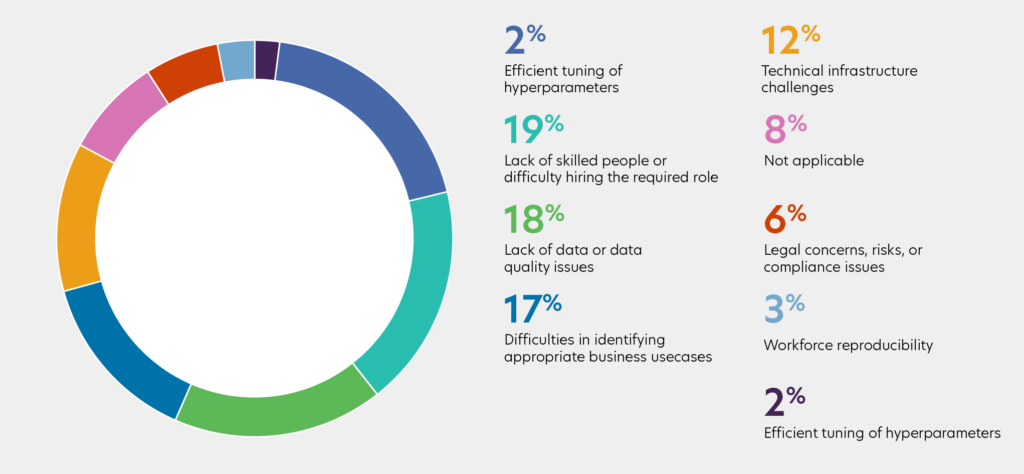
While the potential of AI is vast, the path to successful AI adoption can be fraught with challenges. Infact as per Mckinsey, over the next three years, while 92% of companies plan to boost their AI investments, yet only 1% of leaders consider their organizations “mature” in AI deployment.
Adopting AI can be complex and overwhelming, especially for businesses that lack the expertise or resources to navigate it effectively. AI advisory services are designed to help businesses overcome common obstacles, including:
1. Lack of Expertise and Understanding
AI technologies are vast and multifaceted, and it’s easy for businesses to become overwhelmed by the variety of options available. From machine learning (ML) to natural language processing (NLP), AI applications span across numerous domains, and understanding how these can be tailored to solve specific business challenges is no small feat.
AI advisory services bridge this gap by offering specialized knowledge that helps businesses make data-driven decisions about what AI technologies are most suited to their objectives.
2. High Implementation Costs
AI implementation can be costly, especially for businesses with limited technical expertise. However, through AI advisory services, companies can ensure they are investing in the right solutions that deliver long-term value. These services guide businesses in determining which AI tools will provide the best ROI, ultimately optimizing costs.
3. Data Challenges
AI models rely on large amounts of quality data. However, many businesses struggle with the collection, storage, and management of data needed to build effective AI systems. AI advisory services help businesses assess their data readiness, identify data gaps, and recommend strategies for data collection and governance.
4. AI Governance, Ethics, and Regulatory Compliance
With AI comes significant responsibility. Everforth Quinnox provides AI governance and advisory services that help businesses align with the EU AI Act, NIST AI RMF, GDPR, and OECD AI Principles. Our generative AI advisory services for regulated sectors support responsible AI implementation with governance, compliance, transparency, and risk management. .
5. Scalability
Adopting AI on a small scale is one thing, but scaling it across an entire organization is another. AI advisory services help businesses strategize their approach for scalable AI deployment, ensuring that AI solutions can evolve with the business as it grows and changes.
6. Building Organizational Trust in AI-Driven Decision-Making
AI advisory services help organizations build trust in AI-driven decision-making through explainable AI, human-in-the-loop workflows, governance frameworks, and continuous feedback mechanisms. Advisory firms ensure AI systems remain transparent, accountable, and aligned with business goals, enabling confident enterprise-scale AI adoption.
7. Building Organizational Trust in AI-Driven Decision-Making
AI advisory firms help organizations build trust in AI-driven decision-making through explainable AI, transparent governance frameworks, human-in-the-loop workflows, and continuous feedback systems. These practices make AI recommendations easier to understand, improve accountability, and enable businesses to scale AI adoption with confidence while reducing resistance from stakeholders and end users.
How the AI Advisory Process Works
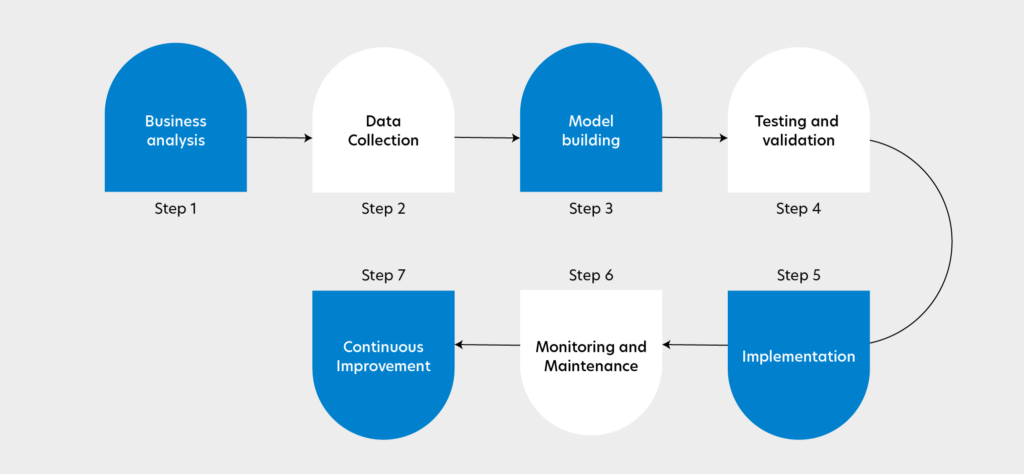
AI advisory services generally follow a structured process that involves several key steps to ensure businesses adopt AI successfully. Here’s how the process works:
1. Assessment and Diagnostics
Key criteria for selecting AI advisory services include expertise in data readiness, infrastructure scalability, AI governance, and workforce capabilities. Effective AI advisory solutions assess an organization’s AI maturity, identify gaps in compliance and technology readiness, and recommend scalable AI initiatives aligned with business goals, helping companies avoid costly implementation challenges and maximize ROI from AI investments.
2. Strategy and Roadmap Development
Once the assessment is complete, AI advisors work with the business to develop a tailored AI strategy. This includes defining specific objectives, selecting the right AI technologies, and creating a detailed implementation roadmap that outlines timelines, resource allocation, and risk management strategies.
3. Proof of Concept and Pilot Validation
AI advisory services accelerate AI enablement by using proof-of-concept projects to validate technical feasibility, data readiness, and business impact before full-scale deployment. The role of AI advisory firms in driving business value from AI includes reducing implementation risks, testing real-world use cases, securing stakeholder confidence, and creating scalable AI strategies that deliver measurable ROI.
4. Technology Selection and Integration
AI advisory services assist businesses in selecting the best AI tools and platforms that align with their strategic goals. They also guide the integration process, ensuring that AI solutions work seamlessly with existing systems and processes.
5. Training and Change Management
AI transformation advisory services help enterprises build AI-ready cultures through leadership alignment, role-specific training, and trusted human-AI collaboration. Experienced advisors for enterprise technology adoption support change management by improving AI literacy, establishing internal AI champions, and creating trust-based workflows that help organizations scale AI beyond pilot programs into long-term operational success.
6. Continuous Monitoring and Optimization
AI technology advisory services help businesses maintain reliable AI systems through MLOps and LLMOps frameworks that automate monitoring, retraining, governance, and performance optimization. Automated experience advisory services improve model accuracy, reduce operational risks, and ensure AI systems continue delivering trusted business outcomes through scalable lifecycle management, version control, and continuous performance evaluation.
How AI Advisory Services Translate Insights into Measurable Business Results
One of the most critical questions organizations face when investing in AI is: how do we know it is working?
The gap between generating AI insights and translating them into measurable business outcomes is where many AI initiatives stall. AI advisory services bridge this gap by establishing clear frameworks that connect AI outputs to tangible business metrics from the very beginning of the engagement.
The process starts with defining AI-specific KPIs that align directly with business objectives. Rather than tracking only technical metrics like model accuracy or processing speed, advisory teams help organizations identify outcome-oriented measures: revenue impact from AI-driven pricing or personalization, cost reduction from automated workflows, cycle time improvements in operations, customer satisfaction gains from AI-enhanced service, or risk reduction from predictive analytics. Each AI initiative is mapped to one or more of these business outcomes, creating a clear line of sight from model output to balance sheet impact.
Advisory firms also establish measurement infrastructure including dashboards, reporting cadences, and attribution models that help organizations track AI’s contribution to business results over time, not just at launch. This includes A/B testing frameworks to measure AI impact, baseline metrics captured before deployment, and regular performance reviews that compare actual outcomes with projected business goals.
For example, an AI-powered pricing engine deployed in retail should not just report that it generated 10,000 price recommendations; it should demonstrate that those recommendations led to a measurable increase in revenue or margin per transaction. Similarly, a predictive maintenance system in manufacturing should track not just the number of alerts generated but the actual reduction in unplanned downtime and maintenance costs.
This focus on measurable outcomes is also what enables AI advisory to deliver long-term value: by continuously tracking results, advisory teams can identify underperforming models, recommend retraining or redeployment, and ensure that the organization’s AI investments compound over time rather than plateau after the initial implementation.
Industry Use Cases for AI Advisory Services
AI is transforming industries across the globe, and AI advisory services play a crucial role in helping businesses unlock AI’s full potential. Below are a few examples of how AI advisory is helping businesses in different industries:
1. Manufacturing
For manufacturers evaluating AI advisory services, several industry-specific considerations are worth noting. Manufacturing environments involve legacy OT (operational technology) systems that require specialized integration approaches, real-time data processing constraints on the shop floor, and strict safety and compliance requirements that AI solutions must not compromise. A qualified AI advisory partner should have experience navigating these constraints and should be able to demonstrate outcomes from similar manufacturing deployments.
2. Retail
AI enables personalized customer experiences, demand forecasting, and inventory management. AI advisory services assist retailers in deploying recommendation engines, chatbots, and AI-driven inventory systems. For example, AI can analyze customer behavior and provide personalized product recommendations, boosting sales and customer satisfaction.
3. Marketing
AI advisory services are helping marketing teams move beyond intuition-based campaigns to data-driven strategies that deliver measurable ROI. Advisory firms assist with implementing AI-powered customer segmentation, predictive lead scoring, content personalization engines, and multi-touch attribution models. Generative AI is also transforming content workflows, enabling marketing teams to produce personalized creative assets at scale while maintaining brand consistency. For organizations with large customer bases, AI-driven churn prediction and lifetime value modeling help allocate marketing budgets to the highest-impact segments.
4. Logistics/Supply Chain
Logistics firms can better optimize delivery routes, forecast demand, and improve warehouse management through the implementation of AI-powered route optimization tools, predictive demand forecasting systems, and real-time tracking solutions. This is helping them reduce cost, faster deliveries, and improve customer satisfaction.
5. Banking, Financial Services, and Insurance (BFSI)
AI is transforming the BFSI sector with fraud detection, risk management, and customer service automation. AI advisory services help financial institutions adopt AI models for credit scoring, fraud detection, and personalized financial advice. For instance, AI can analyze transaction data to detect fraudulent activities in real time, minimizing financial losses.
6. Construction
AI advisory helps construction firms implement AI-driven tools for project scheduling, cost estimation, and risk management. Further, AI can also enhance site safety by analyzing data from wearable devices to predict potential safety hazards.
7. Regulated Sectors
Industries operating under heavy regulatory oversight — including pharmaceuticals, government, defense, and critical infrastructure — face unique challenges in AI adoption. AI advisory services for regulated sectors focus on ensuring that AI systems meet auditability requirements, that model decisions can be explained to regulators, and that data handling complies with sector-specific standards. Advisory teams help these organizations navigate frameworks such as the EU AI Act, FDA guidelines for AI in healthcare, and financial services regulations around algorithmic decision-making, ensuring that innovation does not come at the cost of compliance.
8. Other Industries
AI advisory services also benefit industries such as healthcare, education, and energy. For example, in healthcare, AI is being used for diagnostic imaging, drug discovery, and patient monitoring, while in energy, AI is helping optimize grid management and predictive maintenance for power plants.
Building an AI Center of Excellence for Long-Term Success
As organizations move beyond initial AI pilots, one of the most impactful steps an AI advisory service can recommend is establishing an internal AI Center of Excellence (CoE).
A CoE serves as the centralized hub for AI governance, best practices, reusable assets, and talent development, ensuring that AI initiatives across different business units remain aligned, consistent, and scalable.
An effective AI CoE typically includes a cross-functional steering committee with representation from IT, data science, business operations, legal, and compliance. The CoE establishes standards for model development, data handling, and deployment that all AI projects must follow, preventing the fragmentation that occurs when individual teams build AI solutions in isolation.
It also maintains a repository of reusable components including pre-trained models, data pipelines, integration templates, and evaluation frameworks that accelerate new AI projects and reduce duplicated effort. AI advisory services support CoE development by helping organizations define the optimal structure such as centralized, federated, or hybrid models, while building skill matrices, training roadmaps, and governance mechanisms that keep AI initiatives aligned and scalable.
For enterprises with 250 or more AI practitioners, a well-structured CoE can reduce time-to-deployment for new AI use cases by 30–50% while maintaining consistent quality and compliance standards.
The Future of AI Advisory: Agentic AI and Enterprise Platforms
The AI advisory landscape is evolving rapidly, driven by advances in generative AI and the emergence of agentic AI systems that can autonomously plan, execute, and iterate on complex tasks. As these technologies mature, AI advisory services are expanding their scope from traditional analytics and automation to helping organizations design, deploy, and govern AI agents that operate with increasing levels of autonomy.
Agentic AI introduces new advisory challenges: defining appropriate levels of agent autonomy, designing guardrails and fallback mechanisms, establishing oversight protocols, and ensuring that autonomous AI actions remain aligned with business objectives and regulatory requirements.
Advisory teams are also helping enterprises build scalable AI platforms – leveraging MLOps toolchains, model registries, and reusable agent architectures – that support rapid deployment of new AI capabilities across business units without rebuilding infrastructure for each use case.
For organizations exploring generative AI and agentic workflows, advisory services provide critical guidance on evaluating foundation models, managing prompt engineering at scale, controlling hallucination and output quality, and integrating generative capabilities with enterprise data securely.
This forward-looking advisory work ensures that businesses are not just adopting today’s AI tools but building the architectural foundations that will support the next generation of intelligent systems.
How Everforth AI (EAI) Studio Can Help Your Business
Everforth AI (EAI) Studio offers comprehensive AI advisory services that can support businesses in their AI journey. EAI Studio combines deep AI expertise with a tailored approach, ensuring that businesses of all industries receive the right advice for their specific challenges.
Whether you are a large enterprise or a startup, EAI Studio offers a wide range of AI services, unlocking new efficiencies, improving decision-making, and driving growth.
EAI Studio’s approach spans the full AI advisory lifecycle, from initial assessment through scaled deployment:
Advisory and Assessment: Our AI maturity assessment frameworks evaluate your organization’s data readiness, infrastructure, talent, and governance posture, providing a clear starting point for your AI journey. We identify the highest-impact use cases and build prioritized roadmaps aligned with your business objectives.
Prototyping and Validation: Through rapid proof-of-concept development, we help you validate AI’s potential before committing to full-scale investment. Our prototyping services test technical feasibility, data pipeline reliability, and business impact in weeks, not months.
AI Build and Integration: From production-ready AI applications to enterprise-wide deployments, our build services deliver scalable solutions that integrate seamlessly with your existing systems — including predictive analytics, intelligent automation, personalized experiences, and generative AI capabilities.
AI Governance and Security: Our governance frameworks ensure your AI initiatives meet regulatory requirements (EU AI Act, NIST AI RMF), maintain algorithmic fairness, and operate with full transparency and auditability across the organization.
Deployment and ML/LLM Ops: Our end-to-end ML/LLM Ops services ensure that AI models stay accurate, relevant, and cost-efficient long after launch — with automated monitoring, retraining pipelines, drift detection, and performance optimization.
With 250+ AI and data experts and 50+ pre-built accelerators, EAI Studio brings the depth and speed to turn your AI vision into measurable business outcomes.
Conclusion
AI is no longer a competitive advantage. It is a competitive requirement. But adoption alone is not enough. The organizations seeing real returns from AI are those that pair implementation with strategic advisory: aligning AI initiatives to business outcomes, building trust in AI-driven decision-making, establishing governance that keeps pace with regulation, and investing in the operational practices that ensure AI systems deliver value long after launch. AI advisory services provide the expertise, structure, and accountability needed to bridge the gap between AI ambition and measurable business results — whether you are launching your first pilot or scaling AI across the enterprise.
Ready to accelerate your AI vision? Connect with our AI experts today and let’s make it happen.
Frequently Asked Questions (FAQs)
AI advisory services provide expert guidance to businesses on how to integrate, implement, and optimize Artificial Intelligence (AI) technologies. These services help companies select the right AI tools, align AI strategies with business goals, ensure data quality, and manage AI risks like security and ethics. By offering tailored advice and hands-on support, AI advisory services ensure that businesses make informed decisions, avoid common pitfalls, and unlock the full potential of AI for improved efficiency, innovation, and growth.
While both AI advisory and AI consulting services offer expertise to businesses, their focus differs. AI advisory services typically provide long-term strategic guidance, helping businesses understand the broader implications of AI adoption and aligning it with organizational goals. They focus on high-level strategy, AI roadmap development, and risk management.
On the other hand, AI consulting services often focus on the technical aspects of implementing AI solutions, such as system integration, software deployment, and process optimization. AI consultants are more hands-on and typically work on specific projects, whereas AI advisors provide ongoing strategic support.
AI advisory services benefit a wide range of industries, especially those where AI can drive significant innovation and operational improvements. Some of the top industries include:
Manufacturing: For predictive maintenance, production optimization, and quality control.
Retail: To enhance customer experience, demand forecasting, and inventory management.
Healthcare: For improving diagnostic accuracy, patient care, and operational efficiency.
Finance: In fraud detection, risk management, and customer service automation.
Supply Chain & Logistics: To optimize routes, inventory management, and demand forecasting.
Energy: For predictive maintenance and optimizing grid management.
Other industries like construction, education, and government also benefit from AI advisory services to drive efficiencies and improve decision-making.
AI advisory services assist businesses in developing a clear AI strategy that aligns with their overarching goals. They guide the selection of the right AI tools, frameworks, and deployment methods. Furthermore, they ensure businesses have a robust governance framework to manage the ethical, legal, and operational implications of AI.
In terms of governance, AI advisors help companies establish policies for data privacy, security, algorithm transparency, and regulatory compliance. This ensures that AI systems are deployed responsibly, with proper oversight, and minimize risks like bias, security vulnerabilities, and legal challenges.
When selecting an AI advisory firm, businesses should consider the following key factors:
Expertise and Experience: Look for firms with a proven track record in AI implementation, ideally with experience in your specific industry.
Tailored Solutions: Choose firms that offer customized solutions based on your unique business needs and objectives.
Reputation and References: Check client testimonials and case studies to ensure the firm has delivered successful AI projects.
Holistic Approach: Ensure the firm takes a comprehensive approach, covering strategy, integration, governance, and optimization.
Innovation: Choose firms that stay ahead of AI trends and technologies to provide cutting-edge solutions.
Support and Training: Consider firms that provide ongoing support, training, and change management to ensure smooth adoption of AI.
AI advisory services help translate AI insights into measurable business results by providing expert guidance on aligning AI initiatives with strategic objectives, selecting the right tools and frameworks, managing data quality, and defining KPIs that tie AI outputs to tangible outcomes such as cost reduction, revenue growth, or operational efficiency improvements.
Building trust in AI-driven decision-making requires a multi-layered approach that addresses both technical and organizational concerns. AI advisory firms help by implementing explainability practices that make AI reasoning transparent to non-technical stakeholders, designing human-in-the-loop workflows where AI augments rather than replaces human judgment, and establishing clear escalation protocols for high-stakes decisions. Advisors also guide organizations in creating feedback loops where end users can flag and correct AI outputs, fostering continuous improvement. Additionally, robust AI governance, including bias audits, fairness testing, and transparent model documentation, builds the institutional confidence needed for leadership to act on AI recommendations at scale.
AI advisory services benefit any organization looking to adopt, scale, or optimize AI, but certain business profiles see the highest impact. Large enterprises with complex legacy systems benefit from advisory guidance on integration and change management. Companies in regulated industries (financial services, healthcare, pharmaceuticals) need advisory support for compliance-aligned AI governance. Manufacturers benefit from advisory expertise in predictive maintenance, quality control, and OT-IT integration. Retailers and consumer-facing businesses gain from advisory help with personalization, demand forecasting, and customer analytics. Even startups benefit, particularly when building AI-first products and need strategic guidance on technology selection, data architecture, and scalable deployment without overinvesting in infrastructure too early.
Manufacturers should evaluate several industry-specific factors before engaging an AI advisory firm. First, assess your data readiness: do you have sufficient sensor data, production logs, and quality records in accessible, clean formats? Second, consider your OT-IT integration challenges, as manufacturing environments often involve legacy operational technology systems that require specialized integration approaches. Third, evaluate whether the advisory firm has demonstrated experience with manufacturing-specific use cases such as predictive maintenance, computer vision for quality inspection, supply chain optimization, and shop floor safety. Fourth, understand the compliance and safety requirements that AI solutions must not compromise, including industry standards and workplace safety regulations. Finally, look for advisory partners who can demonstrate measurable outcomes from comparable manufacturing deployments, not just generic AI expertise.