AI can generate an answer in seconds. But when that answer influences a financial decision, customer interaction, risk assessment, or operational action, one question becomes difficult to ignore: Where did the data behind that answer actually come from?
That question is becoming increasingly important as enterprises move from traditional analytics to generative AI, machine learning, AI agents, and real-time decisioning. Data now travels through an increasingly complex chain of applications, databases, APIs, transformation pipelines, cloud platforms, data warehouses, semantic layers, and AI systems.
The problem is not simply that enterprises have more data. It is that they have less visibility into how that data changes as it moves.
Data lineage provides that visibility.
It creates a traceable map of where data originated, how it was transformed, where it moved, and which downstream assets depend on it. For AI, this traceability becomes particularly important because the quality of an AI output is inseparable from the quality, context, and history of the data behind it.
This is why data lineage is moving from a data-management concern to an AI-readiness capability.

“As AI moves deeper into enterprise decision-making, knowing what the model produced is only half the equation. Organizations also need to know where the underlying data came from, what changed it, and whether that history can be trusted.”
Vineet Kumar, Senior Manager
AI & Data, Everforth Quinnox
What Is Data Lineage?
Data lineage is the documented or automatically captured record of how data moves through an organization – from its source, through transformations and processing steps, to its downstream destinations
Think of it as a digital trail for enterprise data. For example, consider a retailer building an AI model to predict customer demand. The model may consume customer transactions from a CRM, product information from an ERP, inventory data from a warehouse system, and behavioral information from a digital commerce platform.
That information may then pass through ETL or ELT pipelines, cleansing rules, joins, aggregations, feature engineering processes, and analytical models before reaching the AI system.
Data lineage connects those dots. It can show:
Source systems → ingestion → transformation → curated datasets → analytical models → AI/ML model → application or decision
Lineage can be viewed in two directions.
- Upstream lineage answers: Where did this data come from?
- Downstream lineage answers: Where is this data being used?
That makes lineage valuable for both root-cause analysis and impact analysis. If a dashboard suddenly reports an unexpected figure, teams can trace upstream to investigate the source. If an engineer wants to change a database column, they can look downstream to understand which reports, applications, pipelines, or models could be affected.
A simple example
Suppose an AI-powered lending application uses a field called customer income. The lineage may reveal:
Payroll system → CRM → data warehouse → income normalization → customer risk dataset → ML feature → credit-risk model
Without lineage, a data scientist may only see the final feature. With lineage, the organization can investigate the entire chain – including the original source, transformations, ownership, refresh history, and downstream dependencies.
That distinction matters when an AI decision needs to be investigated or challenged.
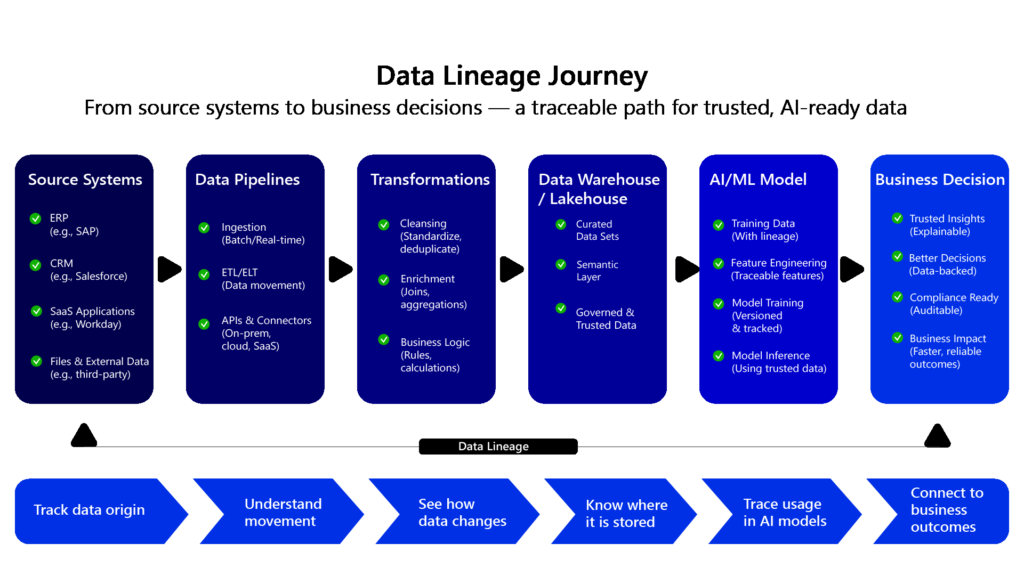
Types of Data Lineage
Not all lineage provides the same level of visibility. The right approach depends on how granular the organization needs its traceability to be and how widely data moves across its architecture.
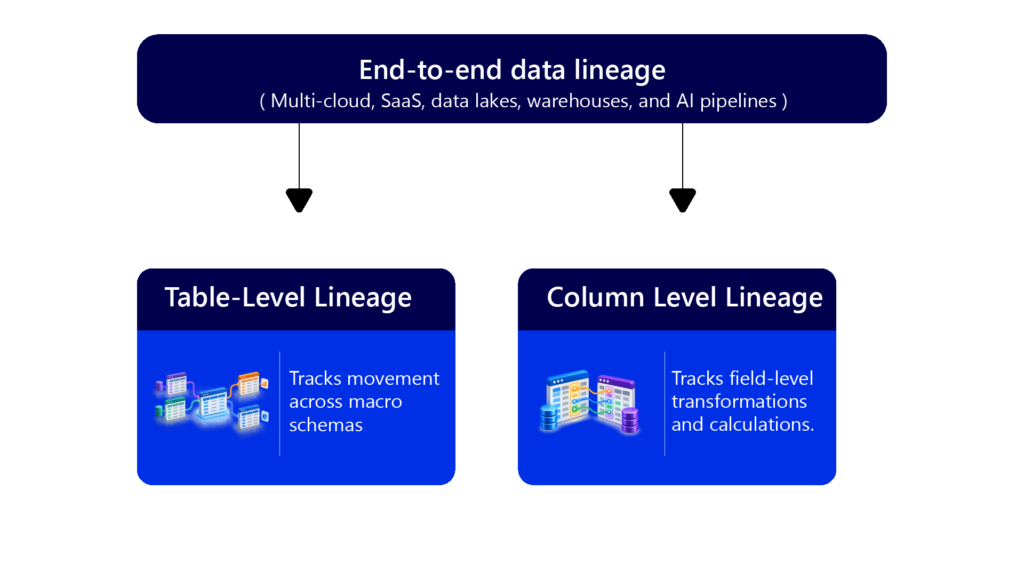
Table-Level vs. Column-Level Lineage
Table-level lineage provides a high-level architectural map showing how entire datasets, schemas, or tables flow between systems. It answers broad questions like, “Does our marketing database feed our customer data platform?”
For example:
Customer_Master → Customer_Analytics
This is useful for understanding broad dependencies. But it may not answer a more precise question: Which fields in Customer_Master actually created which fields in Customer_Analytics?
That is where column-level lineage becomes important.
Column-level lineage drills down to the microscopic level, tracking individual attributes or fields (e.g., mapping how customer_income_raw transforms through a logarithmic function into normalized_income_feature inside an AI training set). For AI debugging, column-level precision is non-negotiable.
For Example:
Customer_Master.customer_id → Customer_Analytics.customer_id
or:
Orders.amount + Orders.tax → Customer_Analytics.total_value
This level of granularity becomes particularly valuable for regulated data, sensitive attributes, financial reporting, data quality investigations, and AI feature engineering. Modern lineage implementations increasingly support field-level relationships, although coverage varies by platform and workload.
End-to-End Lineage Across Systems
Enterprise data rarely stays within one platform.
A typical data flow could involve:
- SAP or other ERP systems
- CRM platforms
- APIs
- SaaS applications
- Data lakes
- Cloud warehouses
- ETL/ELT pipelines
- BI platforms
- Machine learning platforms
- AI applications
End-to-end lineage attempts to connect these environments into one traceable chain. This is where many organizations encounter a practical challenge: lineage may be excellent inside one platform but disappear at the boundary between platforms.
For AI initiatives, those gaps matter. An AI model may be hosted in one environment while the training data originated in another, and the operational data feeding inference comes from a third.
Design-Time vs. Run-Time Lineage
Design-time lineage is statically parsed from code repositories, dbt manifests, and ETL pipeline definitions before execution. It helps engineers understand intended data flows during architecture reviews.
Run-time lineage captures what actually happened during execution. The distinction is important.
A pipeline may be designed to transform Dataset A into Dataset B. But if the pipeline changes dynamically, fails partially, invokes different logic, or uses runtime parameters, the actual data path may differ from the documented design.
The strongest lineage strategy therefore combines declared architecture with observed execution, rather than assuming documentation always represents production reality.
Data Lineage vs. Data Provenance: What Is the Difference?
The terms data lineage and data provenance are often used interchangeably, but they emphasize different dimensions of traceability. Data lineage primarily focuses on the movement and transformation of data through systems and processes.
Provenance is broader. It describes information about the origin, history, entities, activities, and agents involved in producing or influencing a data asset.
A simple way to distinguish them is:
| Concept | Primary question |
|---|---|
| Data lineage | Where did the data move, and how was it transformed? |
| Data provenance | What is the history and origin of this data, including the activities or entities involved? |
For example, lineage might show that a customer dataset moved from a CRM into a warehouse and was transformed by a particular pipeline. Provenance may additionally capture information about the dataset’s origin, processing activity, responsible agent, or contextual history.
For enterprise AI, the two can complement each other. Lineage provides the map; provenance provides additional historical context. Together, they help organizations build a stronger evidence trail around data.
How Is Data Lineage Captured?
Building an automated lineage map across a sprawling enterprise data stack requires balancing depth, performance, and maintenance overhead. Tools typically rely on three core capture methodologies:
| Capture Method | How It Works | Primary Trade-Offs |
|---|---|---|
| Static Code Parsing | Analyzes SQL scripts, DAG files (Airflow), and transformation code repositories to infer dependencies. | High accuracy and context-rich, but suffers from human error and high maintenance overhead. Strength: Provides business context alongside technical lineage. |
| Metadata Tagging | Enforces programmatic or manual tagging standards at the database and object level during development. | High accuracy and context-rich, but suffers from human error and high maintenance overhead. Strength: Provides business context alongside technical lineage. |
| Observability-Based Inference | Monitors query logs, network traffic, and runtime execution metadata passively at the system level. | Captures real-world execution reality seamlessly, but requires deep instrumentation and incurs compute overhead. Strength: Provides visibility into real execution rather than only intended architecture. |
The practical answer for large enterprises is often a combination of these approaches.
A mature lineage capability should not simply produce a visually impressive graph. It should continuously reconcile metadata from multiple sources and distinguish between declared relationships and observed relationships.
Open standards such as OpenLineage illustrate this direction by representing lineage around datasets, jobs, runs, inputs, outputs, and extensible metadata facets.
“The gold standard of enterprise data architecture isn’t just collecting everything – it’s maintaining absolute visibility into how raw inputs morph into automated business outcomes.”
Vineet Kumar, Senior Manager
AI & Data, Everforth Quinnox
Data Lineage Tools: What Should Enterprises Evaluate?
The data lineage tools market has matured rapidly, with market valuations crossing billions as organizations scale out data governance. Rather than chasing specific vendor rankings, data leaders should evaluate tooling platforms against four critical evaluation vectors:
| Tool category | Primary role | Typical value |
|---|---|---|
| Data catalogs | Discover and contextualize data assets | Search, ownership, metadata and lineage |
| Data governance platforms | Connect lineage with policies and controls | Governance, compliance and stewardship |
| Data observability platforms | Monitor data and pipeline behavior | Operational visibility and root-cause analysis |
| Cloud-native lineage services | Track data within cloud ecosystems | Automated lineage across supported services |
| Open lineage frameworks | Standardize lineage collection | Interoperability across data environments |
| Enterprise data management platforms | Combine metadata, lineage and governance | Enterprise-wide visibility |
However, the most important question is not “Which tool has the best lineage graph?”
It is: “How much of our actual data estate can the tool reliably trace?”
Enterprises should evaluate at least four dimensions:
Coverage:
Can lineage span legacy applications, SaaS platforms, databases, cloud services, ETL/ELT tools, BI systems, APIs, and AI/ML platforms?
Granularity:
Does it stop at table-level object dependencies, or does it offer deep column-level parsing for complex SQL and Python code?
Refresh Cadence:
Does lineage update dynamically in real time via run-time metadata ingestion, or does it rely on batch scans that quickly grow stale?
Integration Surface:
Does the platform offer robust APIs and open standards (like OpenLineage) to feed metadata directly into your operational data catalogs and CI/CD pipelines?
This is also where implementation expertise becomes important. A lineage platform is only as useful as the architecture, metadata strategy, integrations, ownership model, and operating processes surrounding it.
Explore how modern enterprises structure their data environments by visiting our comprehensive Data Governance Service Page to accelerate your architectural maturity.
Why AI Systems Depend on Data Lineage
AI systems amplify the importance of data traceability. A conventional analytics report might be challenged because someone questions the number displayed on a dashboard.
An AI system introduces a much broader set of questions:
- What data trained in the model?
- Which datasets were used for validation?
- Where did a particular feature originate?
- When was the source data last updated?
- Which transformations were applied?
- Did the underlying data change after deployment?
- Which version of the dataset influences output?
- Which downstream AI applications depend on that data?
Without lineage, answering these questions can become a manual investigation across multiple teams and platforms. This is especially important as AI moves from experimentation into production.
A 2025 Dun & Bradstreet survey found that 54% of organizations using or implementing AI expressed concerns about the trustworthiness and quality of the data they were using for AI. A separate Precisely study reported that only 12% of respondents considered their data sufficiently high quality and accessible for AI.
These findings point to a fundamental issue: AI readiness is not simply about selecting a model. It also depends on the condition and visibility of the data foundation underneath it. Lineage contributes to that foundation by connecting AI outputs to their upstream evidence.
Imagine an AI model suddenly producing a sharp change in its predictions.
Without lineage, engineers may start investigating the model itself. With lineage, they can first ask: What changed upstream?
Perhaps a source system changed a field definition. Perhaps a transformation rule was modified. Perhaps a third-party dataset stopped refreshing. Perhaps a data pipeline introduced an unexpected join.
Lineage does not automatically prove that an AI output is correct. What it does provide is something equally important for operational AI: a mechanism for tracing the evidence behind the data used by the system.
As explored in our deep dive on Data Governance for AI, automated lineage acts as the foundational root of trust for regulatory compliance, bias mitigation, and model explainability. Without it, enterprises cannot isolate poisoned training data, meet emerging AI transparency mandates, or verify intellectual property compliance.
Common Data Lineage Failures Enterprises Should Watch For
Organizations frequently stumble when deploying data lineage initiatives. Avoid these three systemic pitfalls:
1. Coverage Stops at the Warehouse Boundary
An organization may have excellent lineage from its data warehouse to its BI dashboards while having little visibility into how the underlying information arrived there.
The result is partial lineage masquerading as end-to-end lineage.
For AI, this is particularly risky because critical training or inference data may originate outside the warehouse entirely.
2. Lineage Documents Intent Rather Than Reality
A diagram may accurately represent how a pipeline was designed but fail to capture what happens during runtime.
Dynamic workflows, custom code, changing dependencies, failed jobs, runtime parameters, and manual interventions can create differences between expected and actual data movement.
Lineage should therefore be treated as a living operational capability, not a one-time architecture document.
3. Nobody Owns Broken Lineage
Lineage is ultimately a cross-functional responsibility.
- If a source changes its schema, who updates the metadata?
- If a connector stops reporting lineage, who fixes it?
- If a transformation changes the meaning of a field, who validates the impact?
Without clearly assigned ownership, lineage gradually becomes stale. The objective should not be to create the largest possible lineage graph.
It should be to create a lineage capability that has coverage, freshness, context, ownership, and operational accountability.
The Future of Data Lineage Is AI-Aware
Data lineage is evolving beyond a static map of databases and pipelines.
As enterprises connect data platforms with machine learning models, foundation models, AI agents, vector databases, retrieval pipelines, and real-time decision systems, lineage increasingly needs to describe relationships between data assets and AI assets.
That means organizations will need to understand not only: Where did this dataset come from? but also:
- Which model used it?
- Which AI application depends on it?
- Which source changed before the model’s behavior changed?
- What downstream decisions could be affected?
This creates an important shift. The future of lineage is not simply about documenting the past. It is about creating enough contextual visibility to operate AI safely and intelligently in the present.
Conclusion: Data Lineage Is Becoming an AI Infrastructure Capability
Data lineage may have started as a way for data teams to understand dependencies and support governance. But its role is expanding.
In an AI-driven enterprise, lineage can connect the dots between data sources, transformations, models, applications, and business outcomes. It can help teams investigate data quality issues, assess change impact, understand dependencies, support audits, and create a stronger evidence trail for AI systems.
Most importantly, lineage helps answer a question that will become increasingly important as AI takes on higher-value decisions: “Can we trace the information behind this outcome?”
Organizations that treat lineage as a static documentation exercise may struggle to keep pace with increasingly dynamic data and AI environments. Organizations that treat it as a continuously updated capability – connected to metadata, observability, integration, governance, and AI workflows – can build a much stronger foundation for trustworthy enterprise AI.
Because the future of AI will not depend only on how intelligent the model is. It will also depend on how well the enterprise understands the data behind it.
Ready to build a stronger data foundation for AI? Data lineage is only one part of becoming AI-ready. From data integration and transformation to governance, AI-ready data preparation, and managed data services, Everforth Quinnox helps enterprises build the foundation required for scalable AI.
Talk to our AI & Data experts about building a connected, traceable, and AI-ready data ecosystem.

Lead, Marketing, Everforth Quinnox
Frequently Asked Questions About Data Lineage
Data lineage helps organizations understand the data behind AI models and outputs. It can show where training or inference data originated, what transformations were applied, and which upstream changes could affect model behavior. This makes lineage an important component of AI readiness, traceability, and operational transparency.
Data lineage primarily focuses on how data moves and changes across systems and processes. Data provenance provides broader information about the origin and history of a data asset, including the activities or entities involved in producing it. The two capabilities can complement each other.
Common types include table-level lineage, column-level lineage, end-to-end lineage, design-time lineage, and run-time lineage. Table-level lineage provides a broader view of relationships between datasets, while column-level lineage provides more granular visibility into individual fields and transformations.
Key evaluation criteria include coverage, granularity, refresh cadence, integration capabilities, scalability, metadata support, and compatibility with existing data and AI infrastructure. Enterprises should also determine whether a tool can trace data beyond a single platform or warehouse.
Yes. Lineage can help teams identify where problematic data originated and understand which downstream datasets or processes may be affected. This can accelerate root-cause analysis and help data teams understand the impact of data-quality issues.
Lineage can provide traceability into how sensitive or regulated information moves through enterprise systems. This can support auditability, impact analysis, accountability, and documentation requirements, although lineage itself does not constitute a complete compliance framework.
Everforth Quinnox’s AI & Data capabilities cover areas including data integration and transformation, data modeling, data governance and security, AI-ready data preparation, managed data services, and data warehousing. Its AI services also span advisory, prototyping, AI application development, ML/LLM Ops, and AI governance.