Accelerate IT operations with AI-driven Automation
Automation in IT operations enable agility, resilience, and operational excellence, paving the way for organizations to adapt swiftly to changing environments, deliver superior services, and achieve sustainable success in today's dynamic digital landscape.
Driving Innovation with Next-gen Application Management
Next-generation application management fueled by AIOps is revolutionizing how organizations monitor performance, modernize applications, and manage the entire application lifecycle.
AI-powered Analytics: Transforming Data into Actionable Insights
AIOps and analytics foster a culture of continuous improvement by providing organizations with actionable intelligence to optimize workflows, enhance service quality, and align IT operations with business goals.
Introduction
According to Market Research Future (MRFR), the global data migration market is projected to reach USD 30.7 billion by 2034, reflecting how deeply migration has become embedded in enterprise transformation agendas not as a backend IT activity, but as a strategic enabler of modernization, cloud adoption, and data-driven decision-making.
At the same time, the challenges and risks surrounding enterprise data migration remain a significant concern. This is not just perception – even leading analyst firm Gartner estimates that over 83% of data migration initiatives either fail outright or exceed their planned timelines and budgets, primarily due to inadequate planning, weak governance, and insufficient validation frameworks. In large-scale environments, these failures go far beyond schedule overruns. They can lead to broken integrations, partial or complete data loss, extended operational downtime, and in severe cases, regulatory non-compliance or audit failures.
The underlying issue is not a lack of intent, but a lack of structure. Many organizations approach migration with fragmented visibility, incomplete information, or an overly technical mindset that underestimates business complexity. This often results in poorly defined roadmaps, weak dependency mapping, and an “execution-first” approach that sacrifices governance for speed – ultimately affecting both revenue and reputation.
The solution lies in adopting a structured, programme-level approach to migration – one that is deliberate, governed, and designed for scale from day one. However, the challenge is that many organizations are still unclear on how to begin or how to operationalize such a framework effectively.
In this blog, we explore what enterprise data migration truly means, why it fails at scale, and how organizations can adopt a structured, programme-level framework to execute it successfully while managing complexity, risk, and change at enterprise scale.
What is Enterprise Data Migration?
According to BCG’s analysis, 35% of insurance applications still operate on legacy systems that are not cloud-ready. Meanwhile, technical debt compounds at nearly 20% annually — meaning a system carrying $1 million in technical debt today could double that burden within four years (PwC, 2026).
Enterprise data migration is the structured process of moving large volumes of data across systems, platforms, or environments at an organizational scale typically involving multiple business units, legacy applications, cloud platforms, and heterogeneous data sources.
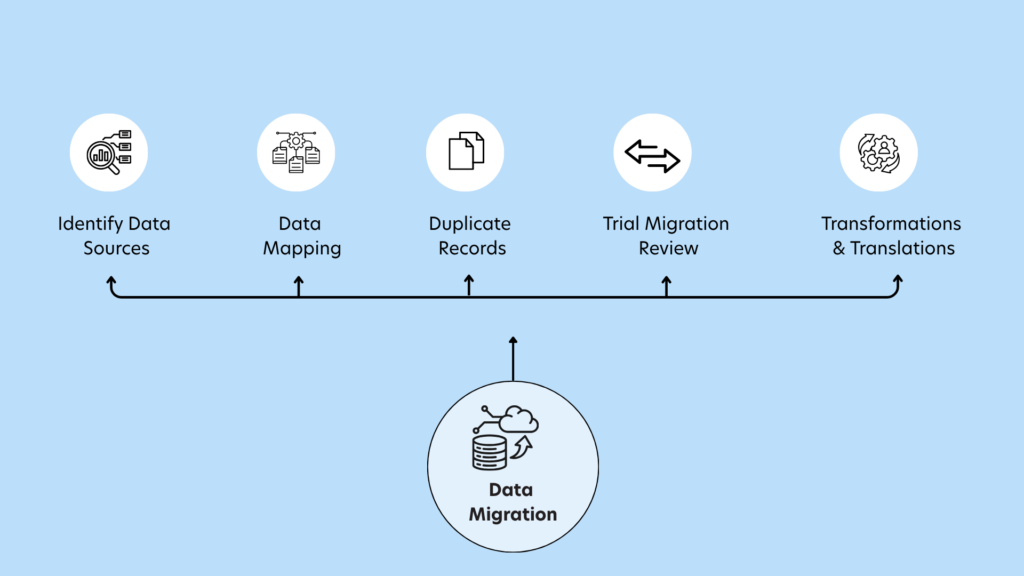
Unlike simple data transfer tasks, enterprise data migration is not just about copying data from one place to another. It involves preserving data accuracy, integrity, relationships, context, and business meaning while ensuring that applications and business processes continue to function without disruption.
In most enterprises, this process includes migrating:
- Core transactional data from legacy systems (such as ERPs or CRMs)
- Analytical data warehouses and data lakes
- Unstructured data like documents, logs, and multimedia files
- Streaming and real-time data pipelines
- Metadata, business rules, and reference data
At its core, enterprise data migration is a business-critical transformation initiative, not just a technical operation. It often supports broader objectives such as cloud adoption, system modernization, mergers and acquisitions, regulatory compliance, and enabling advanced analytics or AI-driven decision-making.
Why it is different from standard data migration?
1. Deferred Data Quality Assessment
What makes enterprise data migration fundamentally different is scale and complexity:
- Scale: Often involves terabytes to petabytes of data
- Complexity: Thousands of interconnected systems and dependencies
- Continuity: Minimal or zero downtime requirements for critical operations
- Governance: Strict compliance, security, and audit requirements
- Stakeholder involvement: Multiple business, IT, and regulatory teams
Why Enterprise Data Migration Fails at Scale
Despite being a foundational step in most digital transformation programs, enterprise data migration continues to be one of the most failure-prone initiatives in modern IT. What makes it particularly challenging is the sheer complexity that emerges when scale, legacy systems, and business-critical dependencies intersect.
Understanding why these failures occur is the first step toward building a migration strategy that is resilient, governed, and designed to succeed at scale.
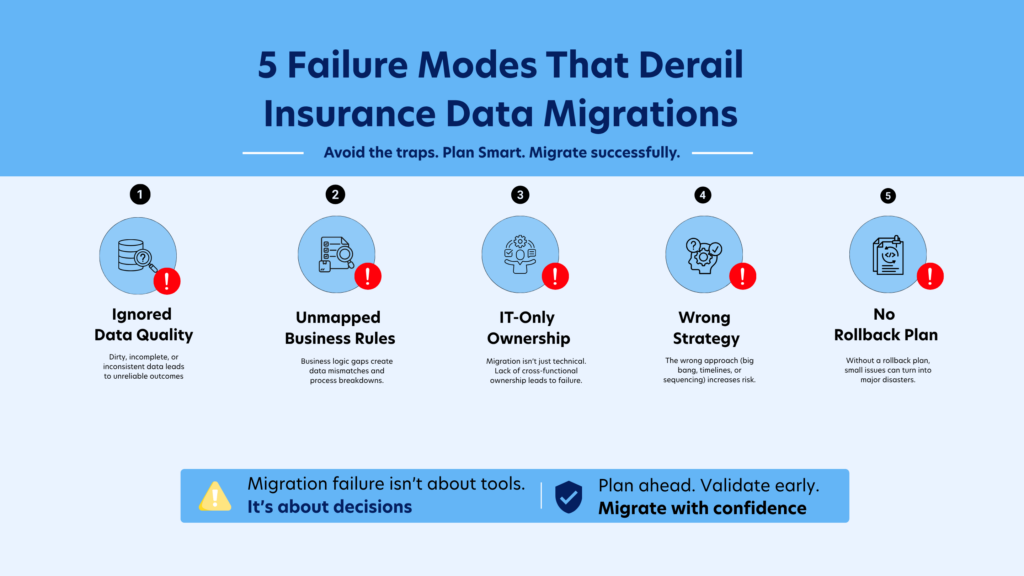
1. Treating migration as just an IT project
One of the biggest reasons enterprise migrations fail is because they are treated as IT projects rather than business transformation initiatives.
Most organizations ignore the fact that data is not just a collection of records—it powers customer experiences, financial operations, compliance processes, and critical business decisions. When business stakeholders are not actively involved, organizations risk losing important context, resulting in disruptions even if the migration is technically successful.
2. Hidden complexity in data
Enterprise data is rarely clean or neatly organized. Over time, systems evolve in layers, and this creates hidden complexity such as duplicate records, conflicting definitions of the same business terms, outdated fields that are still being used by downstream applications, and old logic that no longer exists in documentation. Without proper discovery and understanding upfront, migrations end up moving these problems into the new system instead of fixing them.
3. Weak validation approach
Many migration programs rely on very basic validation checks like matching row counts or confirming schemas. While these checks are useful, they don’t tell the full story. In large-scale environments, even small mismatches can snowball into major issues when they affect millions or billions of records. What looks “correct” at a surface level may still be wrong in business terms.
4. Too many teams, unclear ownership
Enterprise migrations usually involve multiple teams including data engineers, application owners, infrastructure teams, security, compliance, and business users. Without clear ownership and coordination, things start to fall through the cracks. Dependencies are missed, decisions are delayed, and no one has full visibility into the end-to-end process.
5. Ignoring the impact on people and processes
Even when the technical migration goes smoothly, organizations often struggle after go-live. The reason is simple: people and processes don’t change as easily as systems do. Users are expected to adapt to new workflows, new interfaces, and new ways of working often with little training or preparation.
Without proper change management, adoption becomes the biggest hidden risk in the entire migration.
Understand the full landscape of data migration challenges.
From legacy system incompatibility to mid-migration data quality failures – a structured breakdown of the challenges and how leading teams address them.
How to Plan Enterprise Data Migration: A Programme-Level Framework
Given the scale, complexity, and risks involved, organizations cannot afford to approach migration as a one-time project with a fixed start and end date.
Instead, enterprise data migration must be managed as a strategic programme—one that brings together stakeholders, processes, technology, and governance under a common framework.
Organization should have a structured programme-level data migration plan that helps reduce risk, maintain business continuity, improve visibility, and ensure that migration delivers long-term business value rather than short-term technical gains.
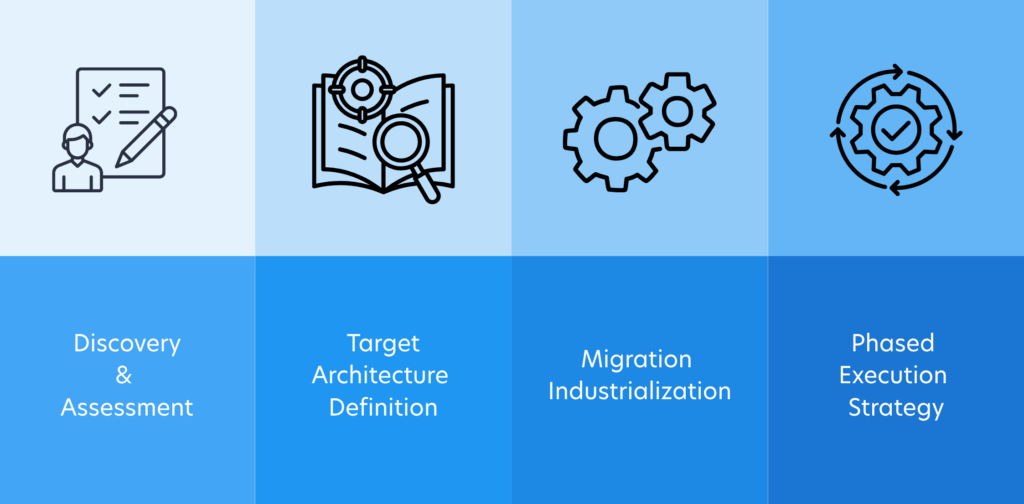
1. Discovery and Assessment
This phase establishes clarity on what actually exists within the enterprise:
- Full system and data inventory
- Data profiling across sources
- Business criticality mapping
- Dependency and risk analysis
The outcome is not just documentation; instead a decision framework that identifies data migration risks and prioritizes what matters most to the business.
2. Target Architecture Definition
Migration success is heavily influenced by the quality of the destination architecture. This includes:
- Cloud or hybrid infrastructure design
- Data modelling and transformation strategy
- Integration patterns (batch, streaming, CDC)
- Security, compliance, and access control models
A strong target architecture ensures the migration is not just a relocation, but a modernization.
3. Migration Industrialization (Migration Factory Model)
At scale, manual execution breaks down. Enterprises move toward a factory model that introduces:
- Standardized pipelines and reusable components
- Automated transformation logic
- Repeatable validation frameworks
- Parallel migration streams
This shifts migration from artisanal execution to engineered scalability.
4. Phased Execution Strategy
Rather than attempting full-scale cutovers, enterprises should adopt controlled rollout strategies:
- Pilot migrations to validate assumptions
- Domain-based wave execution
- Incremental cutovers with rollback capability
- Continuous reconciliation between source and target
This reduces risk while enabling continuous learning.
Industry-Specific Considerations: Where Enterprise Migrations Get Complicated
One of the biggest misconceptions about enterprise data migration is that it follows a universal blueprint. While the underlying methodology may be consistent, every industry introduces unique requirements that influence planning, governance, validation, and execution. As a result, a migration strategy that works well for one industry may not be suitable for another.
This is why successful enterprise migrations require more than technical expertise; they demand a deep understanding of industry-specific challenges.
Banking and Financial Services
Financial institutions manage enormous volumes of highly sensitive transactional data that must remain accurate, traceable, and available at all times. A single inconsistency can have significant consequences, ranging from incorrect account balances and failed transactions to regulatory penalties and reputational damage. Additionally, financial organizations must maintain complete audit trails and comply with stringent regulatory frameworks throughout the migration process.
For this sector, success is measured not just by moving data successfully, but by preserving transactional integrity, maintaining customer trust, and ensuring uninterrupted regulatory compliance
Healthcare and Life Sciences
Healthcare organizations deal with some of the most sensitive data in existence—patient records, clinical histories, diagnostic reports, and research data. Migrating this information requires balancing accessibility with strict privacy and security requirements.
The challenge is often compounded by fragmented legacy systems that have evolved over decades. Moreover, hospitals, clinics, laboratories, and insurance providers frequently operate on different platforms, making data standardization and interoperability difficult.
Any disruption or loss of information can directly impact patient care, making accuracy and reliability non-negotiable. In healthcare, migration success is ultimately tied to maintaining data integrity while ensuring continuity of care and regulatory compliance.
Retail and eCommerce
Modern retail ecosystems rely on interconnected systems for inventory management, order processing, customer engagement, pricing, and personalized experiences. Migrating large volumes of transactional and customer data while maintaining real-time operations presents in such a complex setup is a significant challenge. Even brief disruptions can affect inventory visibility, order fulfillment, or customer experiences across digital and physical channels.
As a result, retail organizations require migration strategies that prioritize speed, scalability, and near real-time synchronization to ensure business continuity throughout the transition.
Manufacturing and Logistics
Manufacturing and logistics organizations operate within highly interconnected ecosystems where data flows continuously between production systems, warehouses, suppliers, transportation networks, and enterprise applications.
Many organizations also rely on Internet of Things (IoT) devices that generate massive streams of operational data. Migrating this information is often complicated by dependencies on legacy ERP systems, supply chain platforms, and production management applications.
The challenge lies in maintaining synchronization across these interconnected systems while avoiding disruptions that could impact production schedules, inventory levels, or delivery timelines. In this industry, migration success is closely tied to operational continuity and supply chain resilience.
Managing a Multi-Petabyte Migration: Reporting, Validation, and Orchestration
Migrating data at the petabyte scale is an entirely different challenge from a conventional data migration project. At this level, organizations are dealing with billions of records, multiple interconnected systems, and continuous business operations that cannot afford disruption. The sheer volume of data means that even minor errors can quickly escalate into major business issues.
This is why successful multi-petabyte migrations require more than just moving data from a source to a target environment. Organizations need complete visibility into migration progress and robust validation mechanisms to ensure data accuracy, and intelligent orchestration to coordinate hundreds of moving parts. Together, these capabilities help reduce risk, maintain business continuity, and ensure the migration stays on track.
1. Real-Time Observability: Maintaining Visibility across the Migration Journey
When migrating massive datasets, teams need a clear view of what is happening at every stage of the process. Without real-time visibility, identifying issues becomes difficult, leading to delays, data inconsistencies, and operational risks.
Modern migration programmes rely on centralized dashboards and monitoring tools that provide insights into:
- Data throughput across pipelines: Monitoring how much data is being transferred and whether migration pipelines are performing as expected.
- Latency between source and target systems: Tracking delays that could impact synchronization and business operations.
- Error distribution and failure patterns: Identifying recurring issues before they affect larger portions of the migration.
- Progress across migration waves: Understanding which datasets have been successfully migrated and which still require attention.
Real-time observability enables teams to make informed decisions quickly, address bottlenecks proactively, and maintain confidence throughout the migration lifecycle.
2. Advanced Validation Models: Ensuring Data Accuracy at Scale
One of the biggest misconceptions in data migration is that validation ends once record counts match between the source and target systems. While basic checks are important, they are not enough when dealing with petabytes of business-critical data.
At enterprise scale, validation must go beyond structural verification and focus on ensuring that data remains accurate, complete, and meaningful after migration.
Modern validation frameworks typically include:
- Statistical consistency checks: Comparing data patterns and distributions between source and target environments to identify discrepancies.
- Referential integrity verification: Ensuring relationships between records remain intact and business logic is preserved.
- Schema drift detection: Identifying unintended changes to data structures during migration.
- AI-assisted anomaly detection: Using intelligent algorithms to detect unusual patterns, missing values, or inconsistencies that traditional validation methods might miss.
These advanced data migration validation best practices help organizations achieve both structural accuracy (the data looks correct) and semantic accuracy (the data behaves as expected within business processes).
3. Intelligent Orchestration: Coordinating Complex Migration Workflows
Large-scale migrations involve far more than transferring files. Multiple systems, applications, databases, and teams must work together in a coordinated manner. Without proper orchestration, dependencies can be missed, processes can fail, and downtime risks increase significantly.
Intelligent orchestration platforms help organizations manage complexity by automating and coordinating critical migration activities.
Key orchestration capabilities include:
- Dependency-aware execution sequencing: Ensuring systems and datasets are migrated in the correct order to avoid downstream failures.
- Automated retries and failure recovery: Resolving temporary issues without requiring manual intervention.
- Cross-system synchronization: Keeping source and target environments aligned during phased migrations.
- Controlled rollback mechanisms: Allowing teams to safely revert changes if unexpected issues arise.
By automating workflow management and reducing manual coordination, orchestration helps organizations maintain stability even in highly complex migration environments.
Change Management and Operational Handoff at Enterprise Scale
Many migration initiatives achieve their technical objectives but struggle to deliver business value because users are not prepared, processes are not updated, or operational teams lack the knowledge needed to support the new system. This is why change management and operational handoff are essential components of any enterprise migration strategy.
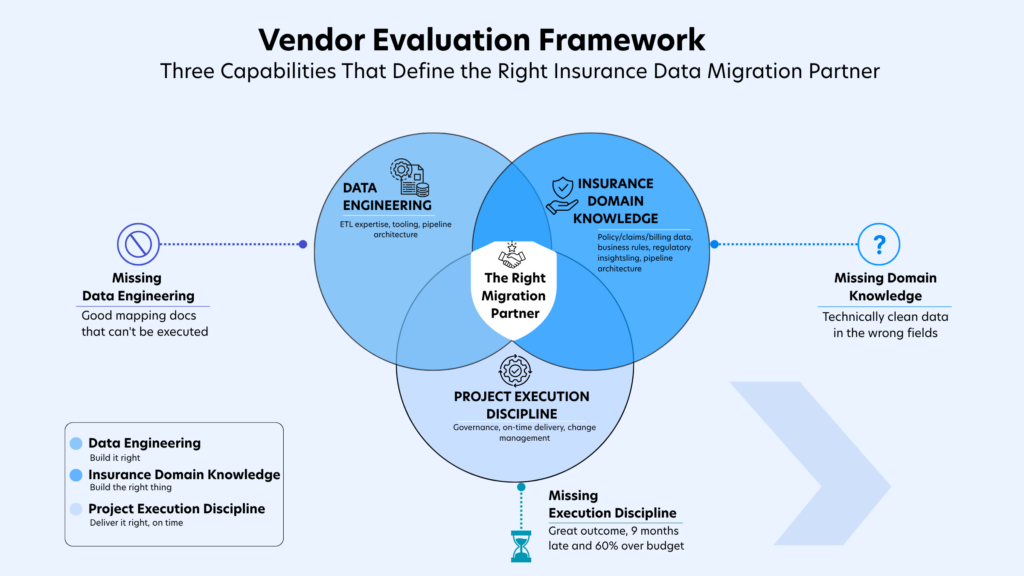
See a real-world example of all three domains in practice.
How Everforth Quinnox delivered an AI-powered insurance data integration transformation – with faster timelines, higher accuracy, and measurable business outcomes.
1. Operational Transition: Preparing Teams for the New Environment
When a new platform or system is introduced, operational teams need to be equipped with the knowledge and processes required to manage it effectively. Without a structured transition plan, organizations may experience increased support requests, slower issue resolution, and reduced productivity after go-live.
A successful operational transition typically includes:
Training Support and Operations Teams
IT support teams, administrators, and operational staff must understand how the new environment works. This includes system functionality, troubleshooting procedures, escalation paths, and performance monitoring practices. Proper training helps teams respond confidently to issues and maintain service quality from day one.
Updating Business Processes and Standard Operating Procedures (SOPs)
Migration often changes how data is accessed, managed, or processed. Existing workflows and operating procedures may no longer align with the new system. Organizations should review and update documentation, process guidelines, and SOPs to ensure teams follow consistent and efficient practices.
Aligning Monitoring and Incident Response Models
The tools and methods used to monitor system performance may also change after migration. Teams need updated monitoring frameworks, alerting mechanisms, and incident response plans to identify and resolve issues quickly in the new environment.
2. Continuity Planning: Minimizing Business Disruption
Even with careful planning, migrations can introduce unforeseen challenges. This makes business continuity planning a critical safeguard throughout the migration process.
Organizations should prepare for:
Parallel System Operations During Transition
In many enterprise migrations, legacy and target systems operate simultaneously for a defined period. Running systems in parallel allows teams to validate data, compare outputs, and ensure operational stability before fully retiring the old environment.
Structured Rollback Strategies
No migration plan is complete without a fallback option. If critical issues arise after deployment, organizations need clearly defined rollback procedures that allow them to restore operations quickly and minimize business impact.
Business Continuity Safeguards
Critical business functions must remain operational throughout the migration journey. This may involve contingency planning, backup processes, disaster recovery mechanisms, and stakeholder communication plans to ensure uninterrupted service delivery.
3. Adoption Enablement: Driving User Confidence and Engagement
One of the most overlooked aspects of enterprise migration is user adoption. A system can be technically flawless, but if employees struggle to use it effectively, the migration cannot be considered successful.
Adoption enablement focuses on helping users understand, embrace, and gain value from the new system. This includes:
- Early communication about upcoming changes
- User training and onboarding programs
- Dedicated support channels during transition periods
- Continuous feedback collection and improvement
Engaging users throughout the migration process helps reduce resistance to change and builds confidence in the new environment. When employees understand the benefits of the migration and feel supported during the transition, adoption rates improve significantly.
How Everforth Quinnox Supports Enterprise Data Migration at Scale

Conclusion
The complexity around enterprise data migration is real, but so is the opportunity. When executed with discipline, governance, and industrialized engineering practices, migration becomes more than a necessity—it becomes a catalyst for modernization.
The enterprises that succeed are those that stop asking how to move data, and start asking how to move it without losing meaning, momentum, or trust.

Deputy Manager, Marketing, Everforth Quinnox
FAQ’s Related to Insurance Data Migration
Enterprise data migration is the process of moving large volumes of data from one system, platform, or environment to another while ensuring the data remains accurate, secure, and usable. The goal is not just to transfer data, but to maintain business continuity, preserve data integrity, and support broader transformation initiatives such as cloud adoption, system modernization, or mergers and acquisitions.
Enterprise data migration is critical because it enables organizations to modernize legacy systems, improve operational efficiency, enhance data accessibility, and support digital transformation initiatives. As businesses adopt cloud platforms, AI technologies, and advanced analytics, migrating data becomes essential to unlocking the full value of these investments. A well-executed migration also helps organizations improve data quality, strengthen compliance, and create a scalable foundation for future growth.
Some of the most common challenges in enterprise data migration include poor data quality, incomplete planning, hidden system dependencies, regulatory compliance requirements, and business disruption during migration. Large enterprises often manage data across multiple systems, making it difficult to identify and validate all relationships and dependencies. Without strong governance, testing, and change management processes, organizations may face data loss, downtime, cost overruns, or delayed project timelines
Banks should approach enterprise data migration as a strategic business transformation programme rather than a standalone IT project. The process should begin with a comprehensive assessment of existing systems, data quality, regulatory requirements, and operational dependencies. Banks must establish strong governance frameworks, define clear migration roadmaps, and implement rigorous validation processes to ensure transactional integrity and compliance throughout the migration.
Given the sensitivity of financial data, banks should also prioritize risk management, real-time monitoring, rollback planning, and business continuity measures. Leveraging automation, AI-driven data profiling, and phased migration approaches can help reduce risk, minimize downtime, and ensure a seamless transition while maintaining customer trust and regulatory compliance.