Accelerate IT operations with AI-driven Automation
Automation in IT operations enable agility, resilience, and operational excellence, paving the way for organizations to adapt swiftly to changing environments, deliver superior services, and achieve sustainable success in today's dynamic digital landscape.
Driving Innovation with Next-gen Application Management
Next-generation application management fueled by AIOps is revolutionizing how organizations monitor performance, modernize applications, and manage the entire application lifecycle.
AI-powered Analytics: Transforming Data into Actionable Insights
AIOps and analytics foster a culture of continuous improvement by providing organizations with actionable intelligence to optimize workflows, enhance service quality, and align IT operations with business goals.
Data migration risk is not limited to large corporations. It affects every organization that moves, upgrades, or consolidates data systems. What begins as a routine migration can quickly turn into an expensive, time-consuming challenge if the right safeguards are not in place. Research consistently shows that most migration projects do not go as planned.
According to Experian and Gartner, 83% of data migrations either fail or exceed their original budget or timeline. Similarly, a Forbes report found that only 36% of data migration projects stay within budget, and just 46% are delivered on time
These numbers are not the result of poor effort. They reflect the hidden complexity that accompanies every migration project. A single missed dependency, an incorrect mapping rule, or a mismatch between source and target systems can have far-reaching consequences once the system goes live. Lost or corrupted data, compliance failures, extended downtime, and unreliable analytics are all common outcomes when migration risks are underestimated.
This article explores the most significant data migration risks and how to address them before they impact your project. It also includes a practical assessment to help you evaluate your current migration readiness and identify where your strategy may need improvement.
A recent survey found that 48% of M&A professionals are now using AI in their due diligence processes, a substantial increase from just 20% in 2018, highlighting the growing recognition of AI’s potential to transform M&A practices.
The Biggest Data Migration Risks (And Why They Differ by Approach)
Every data migration project carries its own risks, depending on the strategy chosen.
- A lift and shift move can drag legacy problems into the new environment, creating technical debt.
- Transformational migrations, where data structures are rebuilt, bring mapping and compatibility headaches.
- And cloud migrations add another layer of risk, especially around data security and compliance if residency rules are ignored.
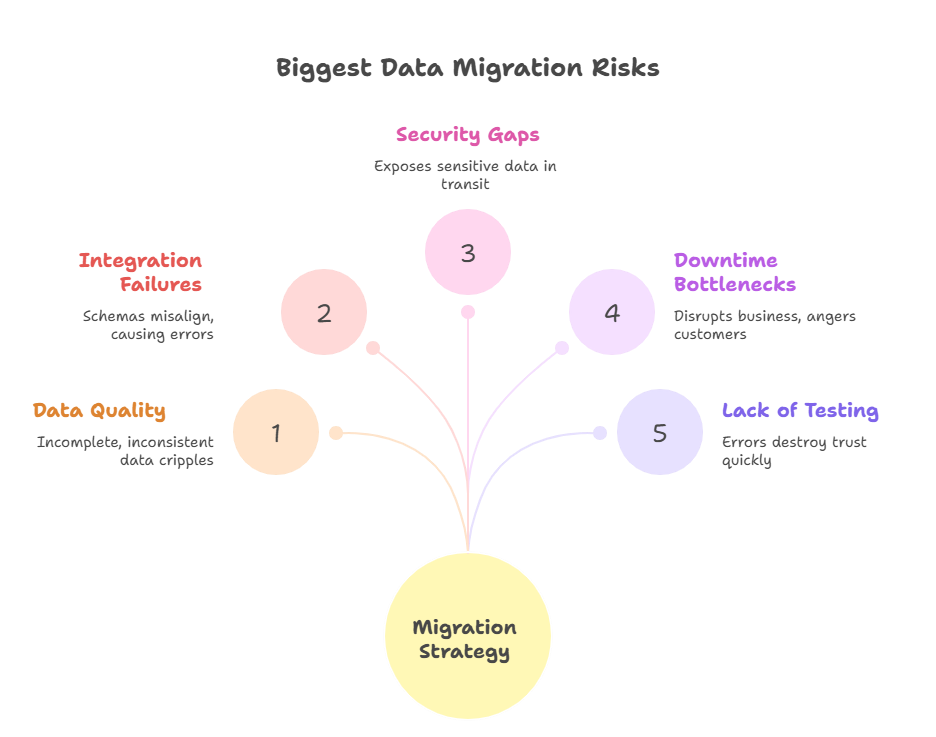
Here are the most common migration risks and how to manage them:
1: Data Quality Issues:
Data quality issues are the usual suspects. Incomplete, duplicated, or inconsistent data can cripple analytics and daily operations. Most of these flaws come from legacy systems with weak governance or no standards at all. Once migration begins, those inconsistencies come into full view and can block proper mapping between source and target fields. The result can be inaccurate reports, bad insights, or failed transactions in production.
Fix: Cleanse and profile your data before migration. Set up validation rules and use automation to catch anomalies early – before they cause production failures.
2: Integration Failures
Integration failures can break downstream systems and frustrate everyone involved. They usually happen when source and target schemas do not align. Even a small difference in date formats or field lengths can cause data loss or processing errors.
Fix: Conduct early system analysis, pre-go-live testing, and document every transformation rule. ETL tools or middleware can bridge most integration gaps if configured correctly.
3: Security and Compliance Gaps
Security and compliance gaps can do more than slow a project; they can create front-page problems. Weak encryption or bad access controls expose sensitive data in transit. Regulations like GDPR, HIPAA, or SOC 2 are not optional, and ignoring them can cost more than any migration budget.
Fix: Encrypt data end to end, secure every transfer path, and audit access throughout the process. That is how you keep both auditors and lawyers happy.
4: Downtime and Performance Bottlenecks
Downtime and performance bottlenecks hit the bottom line. Poor planning or slow transfers can disrupt business, anger customers, and eat into revenue. Bandwidth limits, bad testing, or underestimating data volume often lie at the root.
Fix: Schedule migrations when traffic is low, simulate workloads beforehand, and use phased or parallel moves to keep systems running while data shifts.
5: Lack of Testing
Skipping testing causes trouble. Post migration errors and data gaps destroy trust fast.
Fix: Run testing across all phases – unit, system, and user acceptance. Always have a rollback plan ready if something breaks post-deployment.
Understanding these risks – and how they differ by migration type – is the first step toward reducing them. With clear visibility, teams can allocate resources wisely and ensure the migration aligns with long-term business goals.
How to Run a Data Migration Risk Assessment (With Template)
Running a data migration without a proper risk assessment is like flying without navigation – you may take off, but you will not know where or how safely you will land. A well-structured data migration risk assessment acts as your flight plan: it identifies turbulence early, clarifies what to monitor, and ensures every system and stakeholder is ready for takeoff.
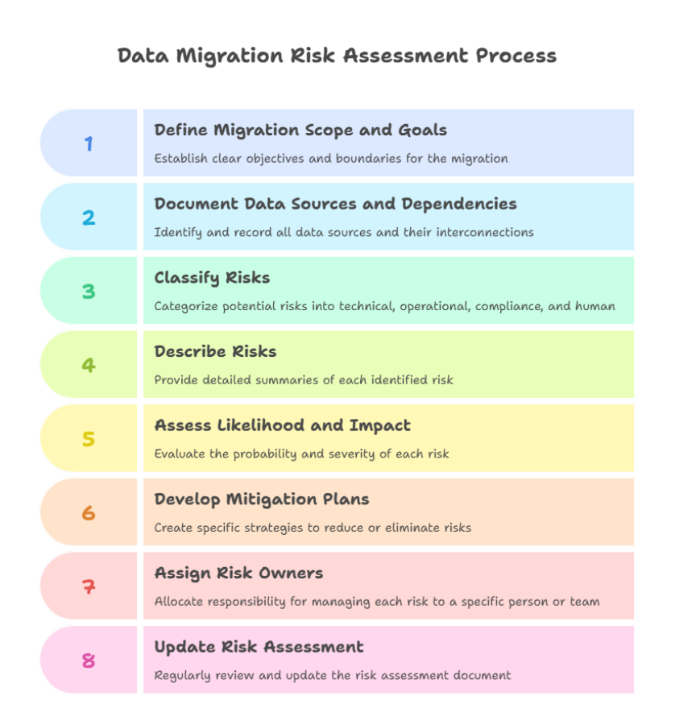
Step 1: Define the Scope and Objectives
Start by outlining what success looks like. Which systems and data sets are being moved? What transformations are required? What performance or business outcomes do you expect? A clear scope draws the line between what matters and what distracts. It prevents scope creep and ensures teams evaluate risks tied only to critical assets.
Step 2: Identify Risks Across Categories
Every migration carries risks across four main areas:
- Technical: Integration mismatches, data corruption, or incompatible formats.
- Operational: Downtime, resource bottlenecks, or unclear ownership.
- Compliance: Unencrypted transfers, privacy breaches, or regional data residency issues.
- Human: Miscommunication, poor coordination, or lack of expertise
Classifying risks into these categories creates structure and makes prioritization easier.
Step 3: Assess Likelihood and Impact
Not all risks are created equal. Estimate how likely each risk is to occur and how severe the impact would be. A low-likelihood but high-impact event – such as data leakage – deserves immediate attention. Use a simple High–Medium–Low scale for both dimensions.
Step 4: Create a Mitigation Plan and Assign Ownership
For each risk, outline specific countermeasures. Avoid vague actions like “monitor closely.” Instead, define steps such as “implement encryption protocols,” “run data reconciliation scripts,” or “schedule downtime during low-traffic hours.” Then, assign clear ownership – accountability ensures follow-through.
Step 5: Maintain a Living Risk Register
A migration is never static, so neither should your assessment be. Update your risk log regularly as you hit new phases – from initial testing to full deployment. Continuous updates ensure no new threats slip through unnoticed.
Step 7: Continuously Monitor and Refine
Treat your risk assessment as a living framework, not a one-time document. Revisit it after each testing phase, refine it after simulations, and keep it updated post-migration to maintain operational integrity.
Here’s a simple assessment framework:
| Risk Category | Risk | Description | Likelihood and Impact | Mitigation Plan | Owner |
|---|---|---|---|---|---|
| Technical | Incompatible data formats | Source and target schemas do not align | High | Implement ETL tools and test mappings | Data Engineering Team |
| Operational | Extended Downtime | Cutover may impact critical systems | Medium | Schedule migration during off-hours, use phased deployment | IT Operations |
| Compliance | Unencrypted data in transit | Sensitive data may be exposed | High | Apply encryption protocols, perform audits | Security Team |
| Human | Poor team coordination | Miscommunication during migration | Medium | Hold daily stand-ups and clear reporting lines | Project Manager |
A thoughtful risk assessment does more than preventing disasters – it builds organizational confidence. Teams move faster, stakeholders trust the process, and your data arrives safely, cleanly, and ready for business.
Also Read: Data Migration Validation Best Practices
Strategies That Minimize Downtime During Data Migration
Downtime is one of the most visible and potentially costly risks during a data migration. To maintain operational continuity and user trust, it is essential to plan and execute strategies that minimize disruption.
Phased Migration:
Moving data in smaller, manageable stages helps limit exposure and ensures that critical operations remain functional while portions of the system are updated. This approach allows teams to validate results incrementally, correct issues in earlier phases, and reduce the chance of large-scale failure. Phased migration is particularly useful for complex systems or those with high interdependencies.
Parallel Systems:
Running old and new systems simultaneously during the transition provides a fallback option in case of errors. Users can continue accessing the legacy environment while the new system undergoes testing and validation. Parallel operations allow for real-time comparisons between the two systems, helping confirm that migrated data and processes perform as expected before full cutover.
Automated Testing:
Automated testing tools can validate data integrity, schema consistency, and application performance throughout the migration. These tools detect discrepancies quickly and enable faster remediation, reducing the risk of extended downtime. Continuous validation during the process also improves confidence in the final migrated system.
Change Freeze Periods:
Implementing a change freeze on source systems during migration prevents data inconsistency. When updates or modifications occur during the migration window, they can lead to mismatched or missing data in the target system. Clearly communicating the freeze period to all stakeholders ensures coordination and avoids unexpected data changes.
Rollback Planning:
Even with meticulous planning, unforeseen issues may arise. A well-defined rollback plan allows teams to restore previous system states quickly if migration errors occur. Rollback procedures should be tested beforehand to confirm they work as intended, ensuring rapid recovery and minimal business impact.
Communication Protocols:
Transparent communication with users, stakeholders, and technical teams builds confidence and reduces confusion. Informing users about migration timelines, potential impacts, and contingency plans ensures they are prepared for temporary slowdowns or restricted access. Consistent updates throughout the process reinforce trust and help manage expectations.
By combining phased execution, automation, and strong communication, organizations can reduce downtime, protect data integrity, and achieve smoother transitions during migration projects.
Get a step-by-step guide to ensure a smooth transition in our Data Migration Checklist.
What Teams Forget Post-Migration (And Why It Matters)
Many organizations celebrate migration completion too soon, assuming that success is defined by data transfer alone. However, the post-migration phase is where hidden issues often emerge. This phase is critical for confirming that the new system performs as expected and that the data migrated is both accurate and secure.
Data Validation:
After migration, teams must verify that all records are complete, accurate, and accessible. Even a small percentage of missing or corrupted data can disrupt reporting, analytics, and business operations. Validation should include checks for record counts, data integrity, relationships between entities, and application behavior. Automated validation tools or sampling techniques can streamline this process and identify discrepancies early.
Performance Tuning:
The new environment may have different infrastructure characteristics, indexing strategies, or resource configurations. Without tuning, queries that once ran efficiently might become slow or unstable. Teams should analyze performance metrics, optimize indexes, adjust caching mechanisms, and recalibrate system resources to ensure that the new platform meets expected performance levels.
Security Reassessment:
Security settings from the old environment may not be translated directly to the new one. Teams should review user roles, access permissions, encryption standards, and compliance configurations. This is especially important for industries governed by data protection laws such as GDPR or HIPAA. A post-migration security audit helps confirm that sensitive data remains protected, and that compliance obligations continue to be met.
Documentation and Training:
Updated documentation ensures that administrators and end-users understand how to operate within the new system. Changes in data structures, workflows, and access procedures should be clearly documented. Providing user training and onboarding sessions promotes adoption and reduces resistance to change.
Neglecting these follow-up steps can result in degraded system performance, security vulnerabilities, and frustrated users. Post-migration validation, tuning, and communication transform the migration from a technical success into a long-term business improvement.
Want to see real impact from data reconciliation in banking? Read the full case study.
Conclusion
Data migration is not just a technical task; it is a strategic process that defines how well your organization adapts, scales, and safeguards its most valuable asset -data. Success depends on proactive risk management, detailed planning, and consistent validation at every step.
By applying a structured data migration risk assessment, using a proven data migration risk assessment template, and following best practices for data migration risks and mitigation, organizations can eliminate the most common data migration problems that lead to downtime, compliance gaps, or data loss.
True migration success comes from visibility and control. That is exactly what Qinfinite delivers. Our intelligent application management platform equips you with AI-driven data profiling, automated orchestration, real-time migration tracking, and post-migration optimization – helping you move from risk management to performance acceleration.
Do not let uncertainty slow your transformation. With Qinfinite, every migration becomes a precise, secure, and future-ready evolution.
Schedule a FREE 120-minute consultation with our Qinfinite experts today and start your migration journey with confidence.
FAQs About Data Migration Risk
Data migration risk is the chance that something could go wrong when moving data from one system to another. It can include losing data, corrupting files, or moving inaccurate information. In simple terms, it is possible that your data might not arrive safely or correctly in its new location.
Data migration is risky because it involves moving critical information that the business depends on. Systems may have different data formats, structures, or rules. If the process is not carefully planned and tested, the migration can lead to data loss, downtime, security issues, or errors in how applications run. These problems can affect business operations and decision-making.
Organizations often face several recurring challenges during data migration, including:
Data quality issues such as duplicates, missing fields, or outdated information
Incompatible data formats between source and target systems
Incomplete or failed transfers that leave gaps in data sets
System downtime that disrupts operations
Security and compliance risks if sensitive data is exposed or moved incorrectly
Lack of testing and validation that leads to undetected errors after migration
A data migration risk assessment involves identifying, analyzing, and mitigating potential risks before and during the migration process. Here is a simple approach:
Define the scope and objectives of the migration. Know what data will move, where it is going, and why.
Assess data quality in the source system to identify duplicates, errors, or missing values.
Evaluate system compatibility to ensure the new environment can handle the data structure and format.
Identify critical risks such as security gaps, downtime, or regulatory concerns.
Plan risk mitigation strategies, including data backups, validation checks, and rollback procedures.
Test the migration in phases before the final cutover to confirm data accuracy and system performance.
Monitor and validate results after the migration to ensure everything transferred correctly.
A structured risk assessment gives you visibility into what could go wrong and helps you build a clear plan to get the migration right the first time.