We have seen banking transform from a physical walk-in through to phone/online web and then to a mobile app. The bank of future will not be an app on a phone or a physical branch – it will be an invisible, ambient, autonomous financial engine integrated directly into daily life.
For the better part of two decades, “digital transformation” in financial services meant wrapping decades-old core processes in sleek, mobile-first interfaces. Every workflow aimed to make humans incrementally more productive: loan officers processing applications slightly faster; compliance teams reviewing anomalies more efficiently. The inherent constraint remained: software could only move as fast as humans use it.
As we look toward 2030, a fundamental paradigm shift is unfolding: the screen itself is disappearing, and human-speed processing is becoming obsolete. We are already evidencing ecosystems emerging where banking is an integral part not only through payments integrations but through spot loans, financing etc.
Driven by the rise of Gen Z and Gen Alpha – who view banking not as a destination to visit, but as an invisible utility – the industry is transitioning from reactive digital apps to proactive, agentic orchestration.
Recent industry analysis underscores the scale of this shift:
- McKinsey & Co estimates that Agentic AI could drive $700B to $800B in net value creation across global banking by automating complex workflows and re-architecting customer interactions.
- World Economic Forum research reports that the global embedded finance ecosystem is expected to reach $7.2 trillion in size by 2034.
- Traditional task performance in financial AI systems is now doubling every 7 to 9 months, rendering linear five-year IT roadmaps obsolete almost as soon as they are signed off by executive committees.
Future market leaders will not be defined by who has the highest-rated mobile app, but by who builds the most resilient, composable, and autonomous financial engine behind the scenes.
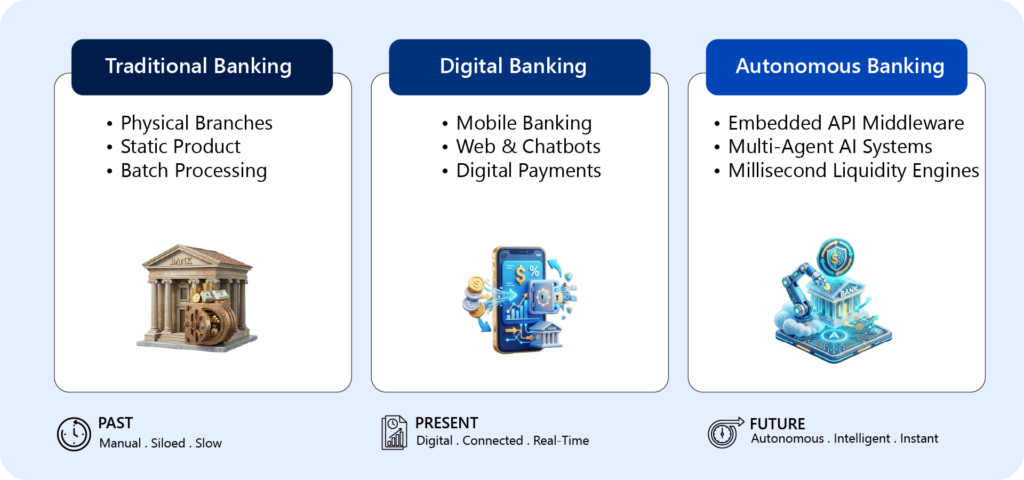
The Exponential Evolution Trends
Transformation in banking happens in exponential waves rather than comfortable linear slopes. Applying traditional planning cycles to autonomous systems creates a structural mismatch.
The roadmap below outlines the maturity trajectory top-tier financial institutions are navigating right now:
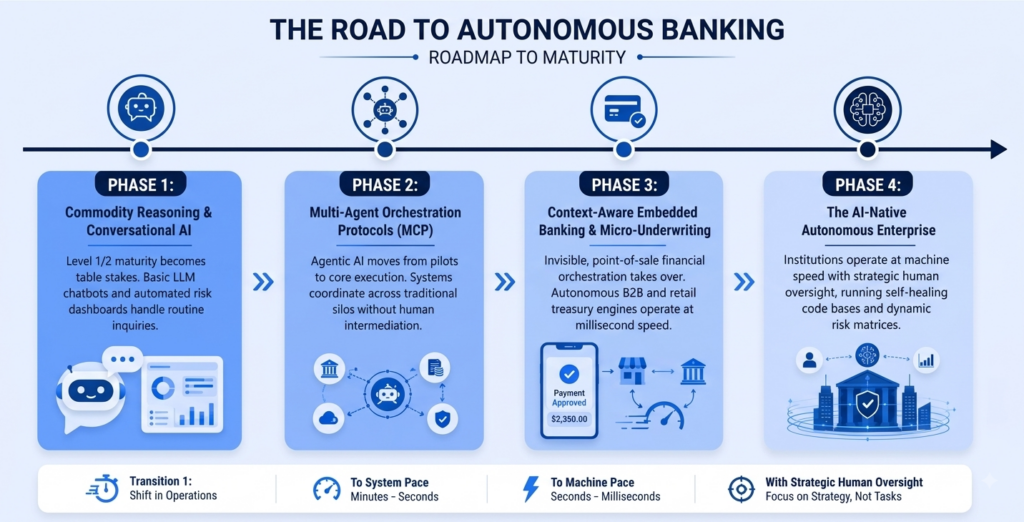
- Commodity Reasoning & Conversational AI (The Baseline): Basic LLM chatbots, predictive credit scoring, and automated compliance reviews become standard commodity features. Banks still stuck in multi-year rollouts of basic conversational UI find themselves competing on yesterday’s technology.
- Multi-Agent Orchestration Protocols (The Inflection Point): Multi-Agent Systems (MAS) transition from experimental labs into core production infrastructure. Protocol layers allow specialized agents to coordinate across traditional banking silos – pulling ledger data, running regulatory checks, and executing trades simultaneously without human committee handoffs.
- Context-Aware Embedded Finance & Micro-Underwriting: Point-of-sale finance, dynamic B2B cash-flow orchestration, and automated micro-credit run invisibly via APIs. Real-time contextual underwriting replaces historic credit bureau pulls.
- The AI-Native Autonomous Enterprise: Market share converges around AI-native institutions that operate at machine speed with strategic human oversight. Banks operating under human-speed constraints with machine assistance struggle to compete on cost, agility, or personalized yield.
The Structural Evolution: Designing for the Autonomous Consumer
Gen Z and Gen Alpha do not want to manage cash flows, analyze static balance sheets, or manually shift money between accounts. They expect their financial environment to operate autonomously in the background – optimizing wealth, liquidating idle balances, and adjusting risk parameters in real time.
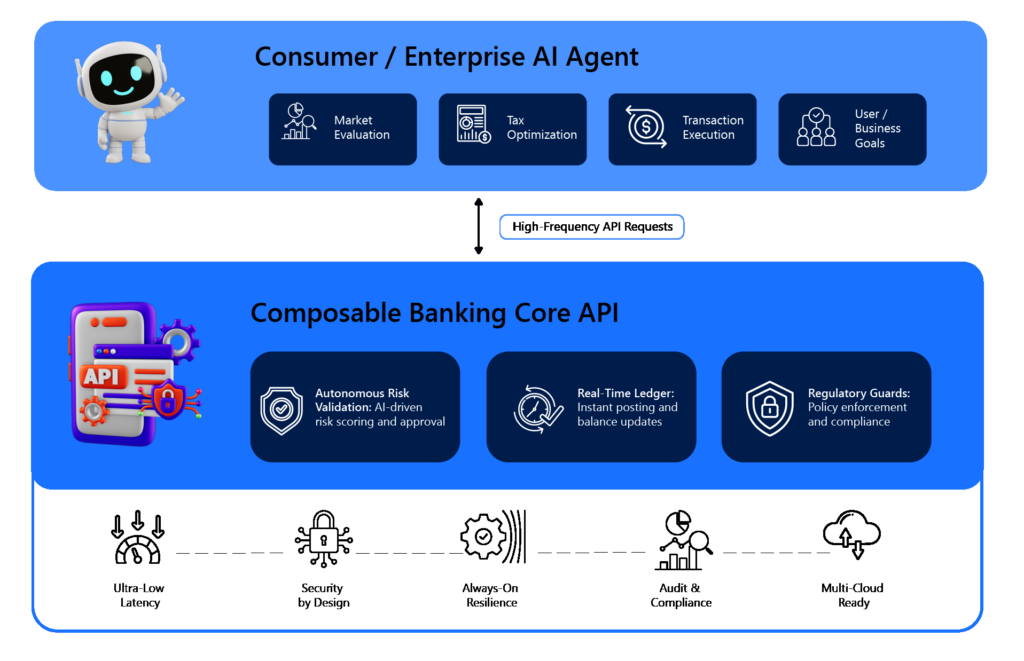
Key Behavioral & Technological Shifts
1. Autonomous Cash-Flow Orchestration: Rather than sending a “low-balance alert,” an AI agent autonomously transfers idle capital from a high-yield instrument moments before a bill clears, liquidating fractional equities only when necessary to optimize tax efficiency. The bank’s role shifts from notifier to executor – which means the bank’s systems need to be trustworthy enough, and auditable enough, to be given that authority in the first place.
2. Agent-to-Agent Commerce: Consumer AI agents will negotiate interest rates, execute FX conversions, and purchase financial products directly from bank API endpoints without a human ever tapping a smartphone screen. This changes what a “customer interface” even means: the primary consumer of a bank’s APIs increasingly won’t be a person tapping a screen, but another AI agent making a request on a person’s behalf. Banks need to design and document their APIs for machine consumers, not just human ones.
3. Proactive Risk Management at Machine Speed: Traditional risk management relies on periodic (monthly or quarterly) reviews. AI agents enable real-time risk monitoring with immediate balance-sheet adjustments as macroeconomic conditions shift – closing the gap between when a risk emerges and when the institution actually responds to it, from weeks down to seconds.
Navigating Core Industry Challenges & The Legacy Paradox
While the vision of autonomous banking is compelling, the path forward is constrained by steep structural hurdles that keep banking executives up at night:
1. The Legacy Infrastructure Bottleneck:
Ripping and replacing legacy core banking systems or enterprise capital market engines introduce unmanageable operational risk and regulatory friction. These systems often represent decades of accumulated business logic, and a rip-and-replace approach risks losing institutional knowledge that was never fully documented anywhere else.
2. The "Black Box" Compliance Fear:
Regulators require explainability, audit trails, and strict risk guardrails. Unchecked autonomous systems risk compounding errors at scale if not properly governed – a single flawed decision rule, once automated across millions of accounts, can turn a minor bug into a systemic incident before a human ever notices.
3. The "Bolt-On" Fallacy:
Most banks attempt to bolt AI onto existing human-centric workflows, creating fragmented silos that preserve the underlying operational delays they were meant to fix. A chatbot in front of a five-day manual approval process is still a five-day approval process – just with a friendlier front end.
4. Data Fragmentation:
Enterprise data trapped across disparate mainframes prevents AI agents from getting the contextual memory they need for accurate reasoning. An agent that can see a customer’s checking account but not their mortgage, credit card, and investment accounts in the same system will make worse decisions than a human loan officer who at least knows to ask.
The Dual-Engine Architectural Strategy
To solve this paradox without triggering core outages, market leaders are adopting a Dual-Engine Architecture:
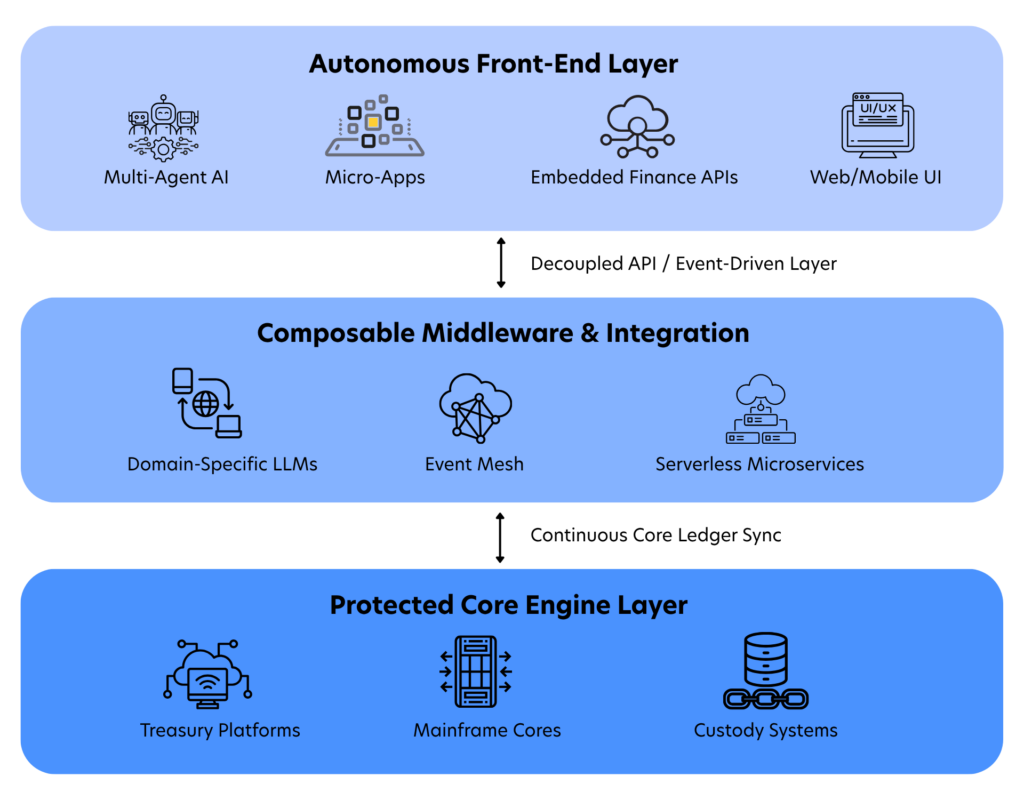
1. Isolate & Protect the Core:
Keep core ledgers and treasury engines focused on high-security, regulated, high-throughput transaction settlement. This layer changes rarely, and deliberately so – it’s the system of record, and its stability is what makes everything built on top of it trustworthy.
2. Abstract via Composable Middleware:
Wrap legacy backends in cloud-native microservices and event-driven integration layers (e.g., serverless ESBs, custom API wrappers). This is the translation layer: it lets modern, fast-moving agentic systems talk to decades-old core systems without either side needing to change how it fundamentally operates.
3. Innovate at the Edge:
Deploy specialized AI agents, mobile experiences, and developer portals that iterate continuously without altering underlying core ledger code. Because this layer is decoupled, teams can ship weekly or daily without touching the systems that regulators and auditors care most about.
The practical benefit of this separation is that it changes the conversation with risk and compliance teams. Instead of asking “can we modernize the core,” which is a multi-year, high-risk question, you’re asking “can we add a new agent-facing capability at the edge,” which is a much smaller, much faster, much lower-risk question – repeated as many times as the business needs.
Continuous Resilience: The Invisible Operations Layer
When financial platforms update constantly and run autonomous workflows, software testing cannot remain a slow, manual step before release. When AI agents execute thousands of micro-transactions per second, testing and verification must be as autonomous as the software itself.
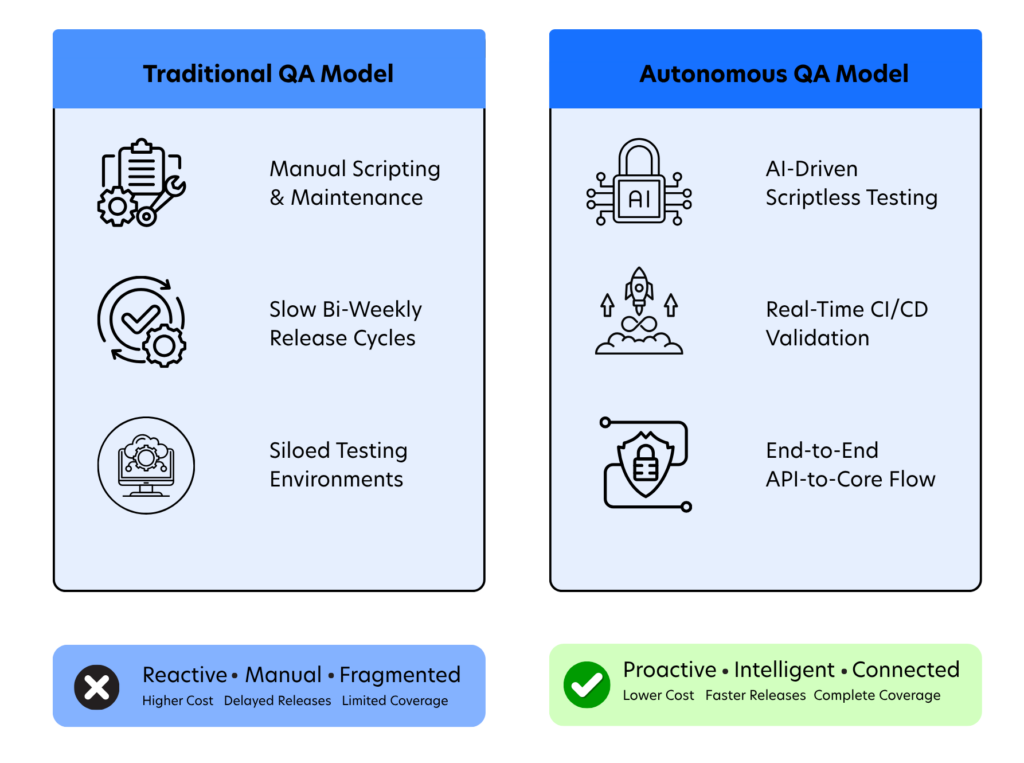
Leading digital-first financial institutions demonstrate how cloud-native microservice engineering and automated testing pipelines accelerate market delivery. By decoupling their client onboarding architectures and wrapping core services in robust integration layers, digital challenger banks can roll out new deposit facilities and complex onboarding journeys in days rather than quarters.
Explore more on why QA in software testing is mission-critical to your digital success.
Similarly, in capital markets and treasury ops, institutions leverage proprietary frameworks to process complex cross-asset trade data, streamline regulatory reporting, and eliminate end-of-day reconciliation bottlenecks without disrupting Business-As-Usual (BAU) operations. In practice, this means testing shifts from being a gate at the end of a release cycle to a continuous, always-on layer running underneath every change – closer to how a modern SaaS platform operates than how a traditional bank’s IT department has historically worked.
The C-Suite Strategic Execution Blueprint: 6 Actionable Steps
To move from linear digital transformation to an AI-native autonomous enterprise, banking leadership must execute these six core imperatives today.
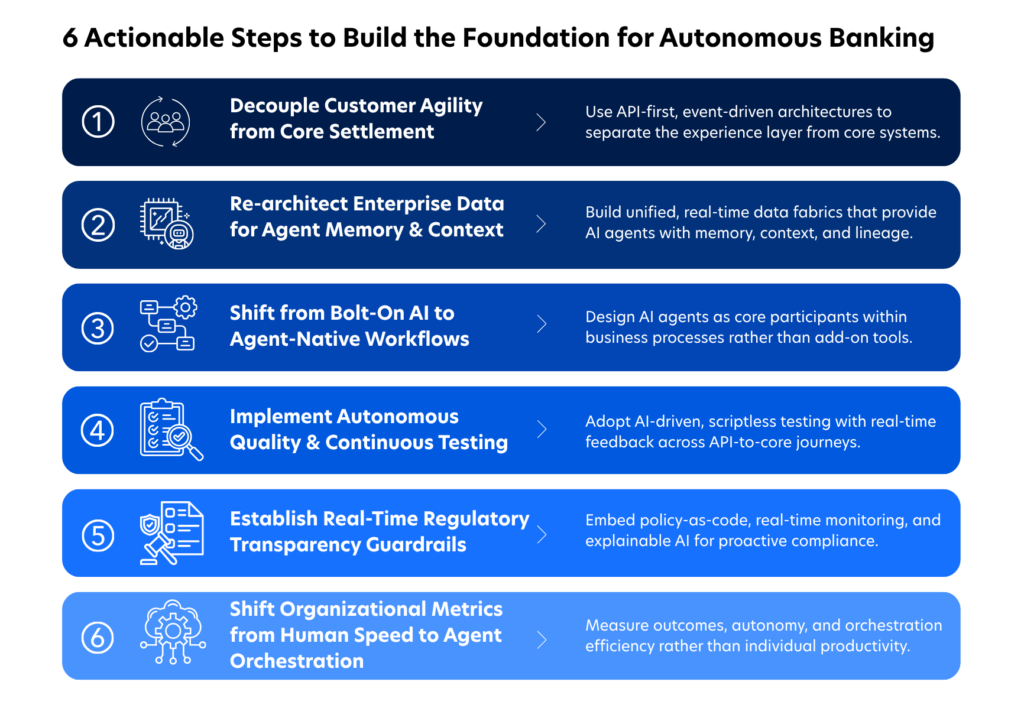
1. Decouple Customer Agility from Core Settlement
Stop waiting for a full core banking platform replacement. Wrap legacy mainframes and complex treasury tools in composable microservices and API abstractions. Let front-end teams deploy weekly while back-end systems run uninterrupted. The goal isn’t to avoid core modernization forever – it’s to stop making every front-end improvement hostage to a multi-year core replacement program that may never finish.
2. Re-architect Enterprise Data for Agent Memory & Context
AI agents are only as safe as the data feeding them. Traditional data governance focused strictly on security access; agent-ready data requires embedded context, business logic, and transactional memory so autonomous agents can reason safely across systems. This typically means building a unified context layer – something closer to a customer data platform than a traditional data warehouse – that agents can query in real time rather than waiting on overnight batch jobs.
3. Shift from "Bolt-On" AI to Agent-Native Workflows
Adding a chatbot to an existing manual approval process yields incremental cost savings at best. Redesign operational workflows from the ground up around autonomous multi-agent coordination, repositioning human teams to focus on exception management and strategic oversight. The workflows worth redesigning first are usually the ones with the most manual handoffs today – loan origination, KYC/AML review, and dispute resolution are common starting points.
4. Implement Autonomous Quality & Continuous Testing
Replace manual testing cycles with intelligent, scriptless test automation pipelines. Automate multi-layer validation across mobile apps, middleware APIs, and backend ledgers to ensure zero downtime during rapid code releases. This is as much a cultural change as a technical one: QA teams shift from executing test scripts to defining and governing the automated test coverage that scripts used to provide.
Check out this relevant piece on Software Testing For Banking: Application Testing as Software (ATaS)
5. Establish Real-Time Regulatory Transparency Guardrails
Address compliance fears by building deterministic, auditable decision trails into agent networks. Ensure every autonomous action logs its context, reasoning parameters, and policy checks in real time for instant regulatory review. Done well, this actually gives regulators better visibility than most manual processes ever did – a permanent, queryable log beats a paper trail reconstructed after the fact.
6. Shift Organizational Metrics from Human Speed to Agent Orchestration
Transition operational KPIs away from “time-per-task” toward “agent orchestration effectiveness” and “exception handling efficiency.” Structure engineering teams to continuously train, govern, and optimize autonomous workflows rather than process manual transactions. If your KPIs still reward speed of manual throughput, your teams will keep optimizing for a world you’re trying to move past.
How Everforth Quinnox Accelerates This Journey
Everything in this piece points to the same underlying truth: the banks that win the next four years won’t be the ones with the boldest AI vision, but the ones who can actually execute against it without breaking what already works.
That is the gap Everforth Quinnox spends its time closing. Everforth Quinnox combines deep banking domain expertise with modern digital engineering, which shows up across three core areas:
Protecting the core legacy systems by modernizing around them safely, ensuring load-bearing logic remains untouched while unlocking front-end agility, building the composable middleware layer – serverless microservices, event-driven architectures, and API abstractions – that makes agentic AI possible. Paired with our advanced test automation framework, Application Testing as Software (ATaS), we replace slow manual QA with continuous validation. This allows front-end teams to deploy at machine speed while maintaining complete stability and compliance.
Put together, this allows clients to move from pilot to production without the usual trade-off between speed and safety. The institutions that get this right treat 2026 not as a deadline, but as the year they stop bolting AI onto old workflows and start building the composable foundation that everything after 2027 depends on.
Ready to transform digital banking architecture for 2026 and beyond? Connect with our expert today.

Executive Vice President and Europe Head, Everforth Quinnox
FAQ’s Related to Autonomous Banking
Digital banking digitizes traditional banking services through websites and mobile apps, while autonomous banking uses AI agents to make decisions and perform financial tasks on behalf of customers. It shifts banking from user-driven interactions to intelligent, automated orchestration.
Agentic AI enables autonomous software agents to analyze data, make contextual decisions, collaborate with other AI systems, and execute complex banking workflows. It helps financial institutions improve efficiency, personalize customer experiences, and operate at machine speed while maintaining governance.
Composable architecture allows banks to modernize without replacing their entire core banking infrastructure. By using APIs, microservices, and event-driven integration, banks can rapidly introduce AI capabilities while preserving the stability and security of legacy systems.
AI-powered banking systems evolve continuously, making traditional testing approaches insufficient. Continuous testing validates APIs, applications, integrations, and AI workflows in real time, helping ensure reliability, compliance, security, and uninterrupted customer experiences.
Banks can build governance into AI systems by implementing explainable AI, audit trails, policy-based decision engines, continuous monitoring, and real-time compliance controls. These capabilities help maintain transparency while meeting regulatory requirements.
A dual-engine architecture separates stable core banking systems from agile digital services. The core continues processing transactions securely, while composable middleware and AI applications enable faster innovation, frequent updates, and new customer experiences.