Accelerate IT operations with AI-driven Automation
Automation in IT operations enable agility, resilience, and operational excellence, paving the way for organizations to adapt swiftly to changing environments, deliver superior services, and achieve sustainable success in today's dynamic digital landscape.
Driving Innovation with Next-gen Application Management
Next-generation application management fueled by AIOps is revolutionizing how organizations monitor performance, modernize applications, and manage the entire application lifecycle.
AI-powered Analytics: Transforming Data into Actionable Insights
AIOps and analytics foster a culture of continuous improvement by providing organizations with actionable intelligence to optimize workflows, enhance service quality, and align IT operations with business goals.
As financial institutions accelerate digital transformation, software testing for banking has crossed a critical threshold: it is no longer merely a validation step at the end of development cycles. Today, testing is foundational to customer experience, operational resilience, and regulatory confidence.
Emerging industry research shows that AI is reshaping how software engineering work gets done. According to Gartner’s Software Engineering 2030: The Impact of AI, AI-enabled tools are increasingly integrated into development and quality workflows, fundamentally changing how engineering organizations operate.
At the same time, digital experience expectations in banking are rising. Forrester’s The State of Digital Experiences in Banking, 2025 highlights how leading banks are embracing technology and customer insights to elevate engagement and deliver richer, more intuitive digital interactions.
In this new era, testing must evolve from a gated checkpoint into continuous, intelligent, experience-centric quality assurance; and that’s where Application Testing as Software (ATaS) comes in.
What is Software Testing for Banking?
Software testing for banking is the practice of validating financial applications, payment systems, and digital banking platforms to ensure transaction accuracy, regulatory compliance, security, and reliable customer experiences across interconnected systems such as core banking, APIs, mobile apps, and digital channels.
Unlike general software testing, banking system testing operates in a high-stakes environment where even minor defects can lead to financial loss, regulatory issues, or loss of customer trust.
At its core, banking software testing focuses on ensuring that systems handling transactions, customer data, payments, and integrations behave exactly as intended. This includes everything from checking whether a funds transfer completes successfully to confirming that sensitive user information remains protected against unauthorized access.
Why Traditional Software Testing for Banking Is No Longer Enough
Legacy testing models were built for slower, milestone-based delivery cycles. They focused on defect counts, regression gates, and manual verification. In a “waterfall” context, where releases occurred quarterly, these models worked with acceptable risk profiles.
Today’s banking environment is markedly different:
- Frequent releases powered by DevOps and CI/CD pipelines
- Complex ecosystems comprising core systems, APIs, mobile apps, cloud services, and third-party integrations
- Evolving regulatory requirements that demand traceable, auditable validation
- Customer expectations for always-on digital reliability
The mismatch between demand and capability leads to bottlenecks:
- Regression cycles become longer than development cycles
- Manual testing becomes a blocker to release velocity
- Metrics like pass/fail rates fail to reflect the customer experience
This leads to a situation where a seemingly successful test suite may still release software that frustrates customers or violates compliance requirements; a risk no bank can afford.
Introducing ATaS (Application Testing as Software)
Traditional automation has helped, but it stops short of solving the core problem: testing remains reactive, siloed, and human-intensive.
Application Testing as Software (ATaS) redefines testing as an AI-driven, outcome-oriented service, where quality is measured by experience assurance and business continuity, not just defect counts.

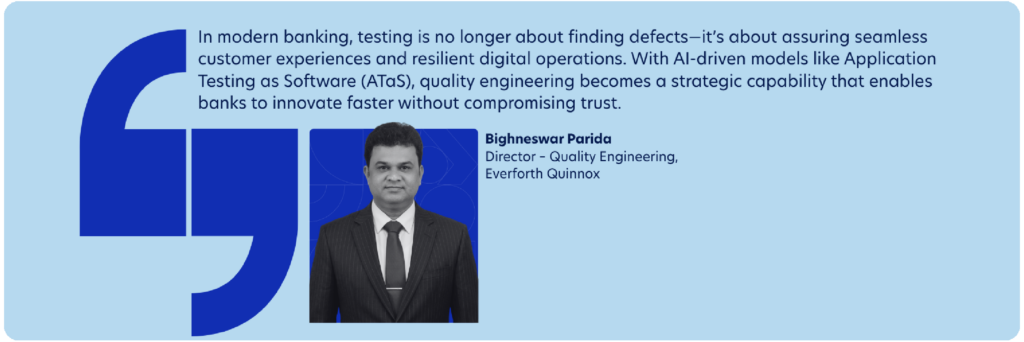
In modern banking, testing is no longer about finding defects—it’s about assuring seamless customer experiences and resilient digital operations. With AI-driven models like Application Testing as Software (ATaS), quality engineering becomes a strategic capability that enables banks to innovate faster without compromising trust.
Bighneswar Parida
Director – Quality Engineering, Everforth Quinnox
ATaS is a fundamentally different operating model for quality engineering, with four key characteristics:
1. Autonomous Test Agents at Scale
ATaS enlists AI agents to generate test cases autonomously, execute them across environments, and self-heal when UI changes occur.
This dramatically increases automation coverage and reduces maintenance overhead – a critical advantage for banking environments where systems evolve rapidly.
AI in software testing is no longer aspirational; it mirrors industry trends where AI becomes intrinsic to engineering workflows. Gartner research indicates that by 2030, AI will touch all information technology work, with 75% of tasks done by humans augmented with AI and the remaining 25% executed autonomously
2. Experience-Level Agreements (XLAs) Instead of Pass/Fail Metrics
Traditional metrics like error counts and test coverage give limited insight into real outcomes.
ATaS moves the focus toward Experience-Level Agreements (XLAs) measuring quality in terms of actual user experience:
- Transaction success rate
- Response times for key journeys
- Ease of use in mobile channels
- Customer satisfaction indicators
This shift aligns quality engineering with business and CX goals, not just defect reduction.
Forrester’s broader research on digital banking experiences shows that banks must leverage emerging tech to redefine how customers interact with services, reinforcing why quality must be measured by experience, not internal metrics alone.
3. Continuous Validation Across Workflows
Instead of episodic regression testing, ATaS embeds continuous validation into development pipelines.
Automated regression suites run 24/7 against real business workflows, reducing surprises late in the release cycle and lowering production defect density, which is a major cost driver in banking software delivery.
Industry research on digital experience quality underscores the stakes: according to Forrester’s Total Experience Score insights, many banks are struggling to deliver consistent digital experiences, negatively affecting loyalty and retention. Continuous validation helps address that gap by identifying experience regressions before customers do.
4. Predictive Quality Insights From Telemetry Data
Rather than waiting for a defect to surface in testing or production, ATaS leverages telemetry – logs, performance data, and usage patterns – to predict likely failure points.
This proactive stance on quality moves banks toward predictive assurance, where risks are anticipated and remediated before they materialize.
Operational Impact Across the Banking Enterprise
Modernizing software testing through ATaS delivers measurable impact across functions:
- Retail and Digital Banking teams can release features faster with confidence in performance and stability.
- Risk & Compliance teams gain automated, auditable validation aligned to regulatory expectations.
- IT Operations see fewer production incidents and lower Mean Time to Resolution (MTTR).
- Business and Product leaders benefit from predictability and reduced rework costs.
Instead of application testing being the final gate before release, it becomes an integrated quality backbone that strengthens digital services across every customer touchpoint of your bank.
Transforming Quality Engineering for Modern Banks
Everforth Quinnox has supported leading banks across the US and UK in transforming outdated quality practices into resilient engineering platforms. Our approach with ATaS powered by is not merely about automation; it’s about quality engineering that scales with complexity, speed, and risk.
This includes:
- Intelligent automation that self-adapts across environments
- Outcome-centric metrics aligned to experience quality
- Continuous validation of business-critical workflows
- Predictive insights that anticipate risk before it hits production
You can explore broader transformation imperatives for retail banking in our perspective paper:
Access Now: Banking at a Crossroads: Reimagining Technology for the Next Era of Financial Services
Case Study: AI-powered Software Testing for Banking
Monument Bank Limited, a UK-based neo bank, recognised the need to augment its existing Quality Engineering team with a testing partner who could speed up the testing cycle time and automate its testing procedures to increase its commercial success. Monument understood that this would call for a shift in its testing culture, building on its agile software development methodology, as the need of the hour to enable a successful digital transformation journey.
Everforth Quinnox helped Monument deliver complex cross-product customer journeys with our AI-powered test automation platform via client onboarding, account opening, transactions, lending origination, and client servicing journeys which resulted in successful business outcomes:
Through its collaboration with Everforth Quinnox, Monument could transform its testing culture and embrace automated end-to-end testing as part of its agile software delivery. Monument no longer relied on manual testing for complex test scenarios that spread across pan mobile, Web and API components.
Furthermore, Qyrus’s automation capabilities helped Monument shorten testing cycles and boost output, helping the company execute its expansion plans successfully. As a result of collaborative efforts in 2023, Monument could switch from its previous release cycle of every three to four months to a monthly release cadence. You can access the complete case study here.
Software Testing for Banking as a Strategic Growth Lever
The business outcomes of ATaS are tangible:
- Enhanced automation coverage increases release confidence
- Reduction in production defects lowers remediation cost
- Experience-driven quality improves customer loyalty and adoption
- Predictive quality capabilities make releases more predictable
In an industry where digital friction leads directly to customer attrition, quality engineering becomes a competitive advantage, not a cost center.
Looking Ahead: Quality Becomes Autonomous, Predictive, and Experience-First
The future of software testing for banking lies in autonomous quality engineering where AI moves beyond assisting engineers to augmenting and orchestrating quality outcomes, continuously and intelligently.
For banking leaders, the question is no longer whether to automate testing, but how to transform testing into an integrated, AI-powered foundation for innovation, risk mitigation, and customer experience excellence.
Application Testing as Software (ATaS) is the next step in that journey.

Head – Digital Marketing, Everforth Quinnox
FAQs About End-to-End Testing
Banking applications operate in highly interconnected environments that include core banking platforms, payment networks, digital channels, regulatory reporting systems, and third-party fintech integrations. Testing must validate not only functionality but also data integrity, transaction accuracy, security controls, and audit trails. This makes end-to-end validation and integration testing far more critical than in many other industries.
Application Testing as Software (ATaS) treats testing as a continuously running capability rather than a project phase. Instead of executing isolated test cycles, testing activities are embedded across the software lifecycle and aligned with business workflows. This allows banks to validate critical processes such as onboarding, payments, and lending on a continuous basis.
When testing becomes more integrated and automated, banks typically see faster release cycles, improved system stability, and fewer production incidents. Teams also gain better visibility into quality risks before deployment. Over time, this leads to more predictable delivery of digital initiatives and greater confidence in large transformation programs.