Introduction
A lender rolls out a new credit-scoring model. The data feeding it is spotless: every field has an owner, every source is catalogued, and every access request is logged. The audit goes smoothly. Six months later, approval rates for one customer segment have quietly slipped; complaints are climbing, and nobody can say who is responsible for a model that was technically built on perfectly governed data.
That gap is the heart of the AI governance vs data governance question. Most leadership teams already know they need “governance” before scaling AI. What they struggle with is the sequence, and whether the program they already run covers what AI actually puts at risk. It usually does not. Gartner has warned that through 2026, organisations will abandon 60% of AI projects that are not supported by AI-ready data, which tells you how much rides on getting the foundations right. But foundations alone do not tell you whether a model is behaving fairly once it is live.
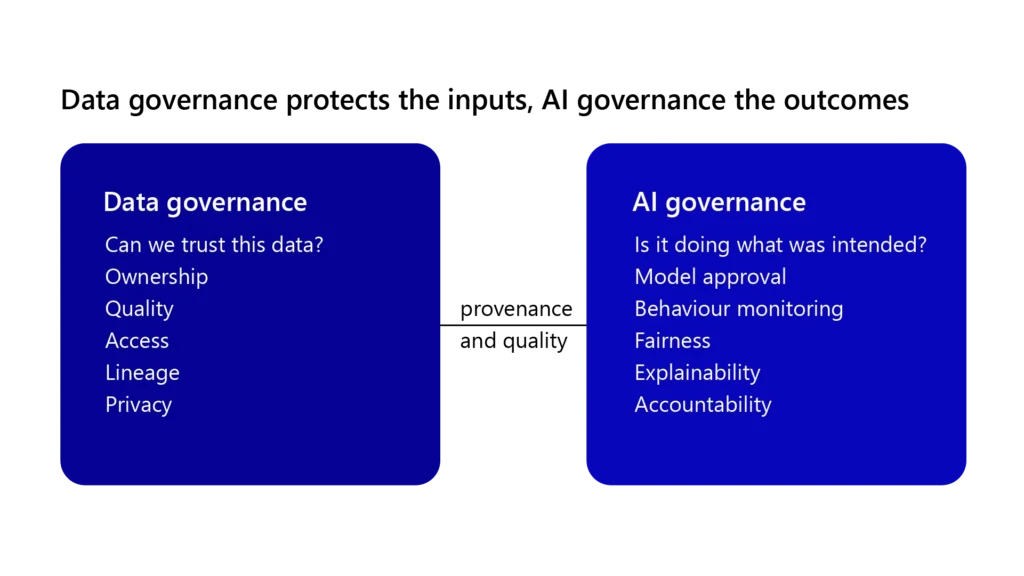
This post separates the two disciplines, shows where they overlap, and gives you a practical answer to the question in the title.
What is data governance?
Data governance is the set of rules, roles, and controls that make sure an organization’s data can be trusted and used responsibly. In practice it covers five things:
- Ownership: A person accountable for each critical data set.
- Quality: Agreed standards for accuracy, completeness, and consistency.
- Access: Who can see or change what, and why.
- Lineage: Where data came from, how it moved and what changed along the way.
- Privacy: handling personal and sensitive data in line with the law.
Strip it back and data governance answers one question: can we trust this data, and are we allowed to use it? The full build-out of policies, roles and processes sits in our data governance framework guide. If you need hands-on help standing it up, our data governance services team can take it from there.
What is AI governance?
AI governance is the system of policies, oversight and accountability that makes sure AI models and AI-driven decisions are safe, fair, explainable and aligned with what the business intended. Where data governance looks at the raw material, AI governance looks at the machine built from it, and at the decisions that machine makes.
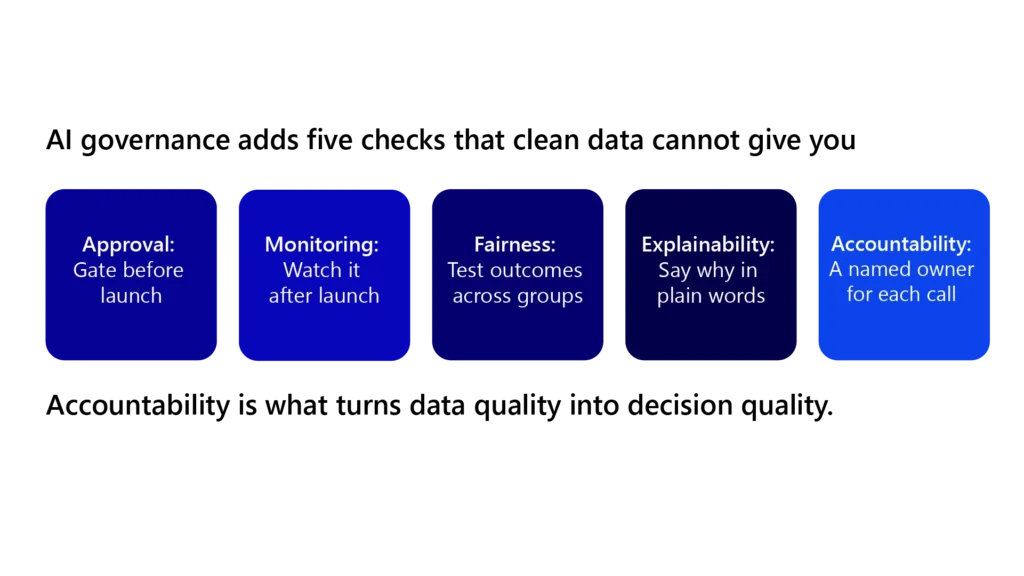
If you are asking “what is AI governance” because a regulator, a board member or a customer has just asked you about it, here is what it typically includes:
- Model approval: a defined route for deciding which models are allowed into production, and on what evidence.
- Behavior monitoring: tracking how a model performs after the launch, not just before it.
- Fairness: testing whether outcomes differ unjustifiably across groups of people.
- Explainability: being able to say, in plain language, why a model produced a particular result.
- Accountability: a named human or committee who decides when something goes wrong.
This half of the pair is the less understood one, mainly because AI systems change after they ship. A data set sits still until someone edits it. A model keeps responding to the world and sometimes learns the wrong lessons from it. That is why AI governance cannot be treated as a data-governance checkbox with a new name.
The core difference in one line
Data governance protects the inputs. AI governance protects the outcomes.
- Data governance asks: is the data accurate, accessible, and compliant?
- AI governance asks: are the systems acting on that data doing what was intended, and who answers when they are not?
Here is how they compare side by side.
| Data governance | AI governance | |
|---|---|---|
| Scope | Data assets across their lifecycle: creation, storage, movement, use, retirement | AI models and AI-enabled decisions across their lifecycle: design, training, approval, deployment, monitoring, retirement |
| What it controls | Data quality, definitions, access rights, retention, lineage, consent | Model approval, risk classification, performance and drift, fairness testing, explainability, human oversight |
| Who owns it | Chief Data Officer, data owners and stewards, privacy and security teams | Cross-functional AI risk or ethics committee, model owners, risk and compliance leads, often with CDO or CRO sponsorship |
| Risks it addresses | Bad or inconsistent data, unauthorized access, privacy breaches, regulatory fines for data misuse | Biased or unsafe outputs, model degradation, opaque decisions, unclear accountability, reputational and legal exposure from automated decisions |
| Regulations behind it | GDPR, CCPA, HIPAA, India's DPDP Act, sector data rules | EU AI Act, sector model-risk expectations, emerging national AI guidance, plus the data laws that still apply |
Three Failures a Data Governance Program Will Never catch
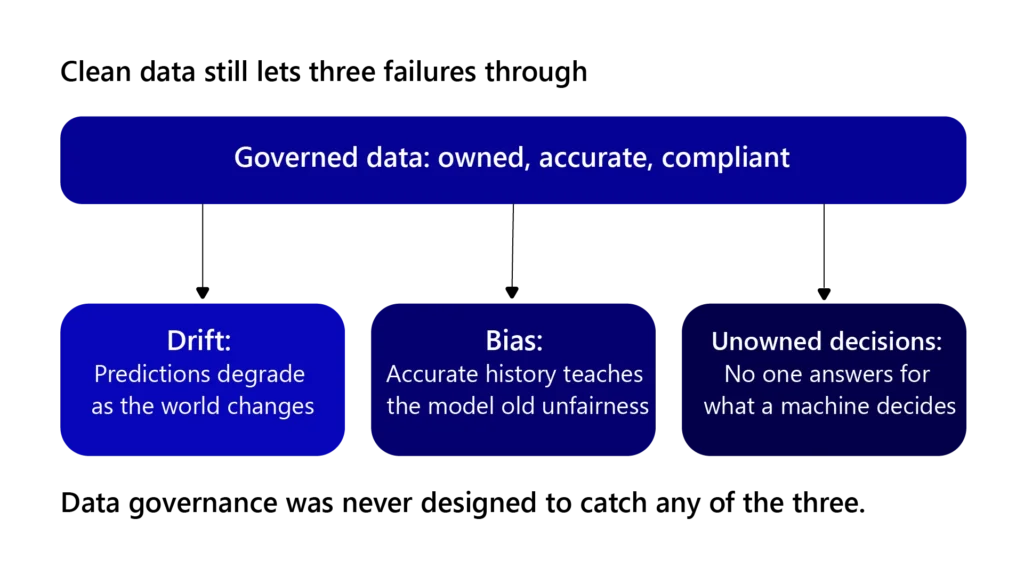
A mature data governance program can still miss the failures that matter most in AI. These are the areas it was never designed to catch.
1. Model behavior and drift in production
A model is only as good as the world it was trained on, and the world moves. Customer behavior shifts, fraud patterns evolve; a new product changes what “normal” looks like. The data pipeline can be flawless while the model’s predictions quietly get worse.
Data governance checks the data on the way in. It does not watch the model’s performance on the way out. AI governance does, with thresholds, alerts and a clear trigger for retraining or switching a model off.
2. Fairness, bias and explainability
Perfectly accurate data can still produce an unfair model. If historical decisions were skewed, an accurate record of those decisions teaches the model to repeat them. Spotting that takes fairness testing across groups, and the ability to explain a decision to a customer, an auditor or a regulator. “The data was clean” is not an answer to “why was this person declined?”
3. Accountability for autonomous decisions
The more a system decides on its own, the more important it becomes to name who is answerable. Who signed off the model? Who reviews its exceptions? Who steps in when it acts outside its remit? Data governance assigns accountability for data. It has no view on accountability for a decision a machine made at 3 a.m. AI governance fills that gap.
CTA: For a deeper look at the data side of this equation, read our piece on governing data for AI.
Why one depends on the other
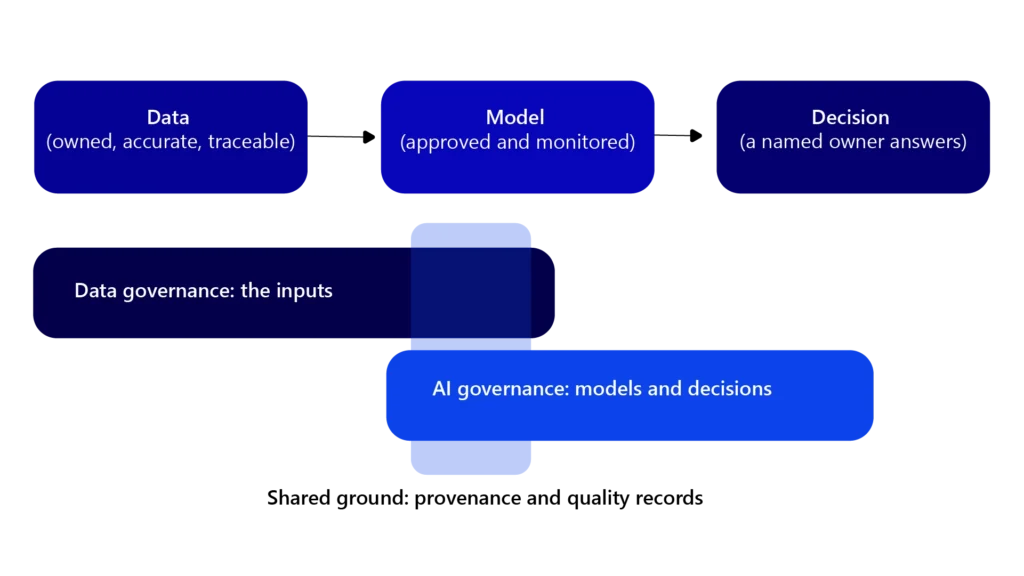
It is tempting to treat these as rival programs competing for budget. They are closer to two halves of one chain.
- Data governance supplies evidence. To assess a model, you need to know what it was trained on, where that data came from, whether it was permitted for this use, and how good it was. Without provenance and quality records, an AI reviewer is working blindly.
- AI governance supplies accountability. Good data does not guarantee a good decision. It takes approval gates, monitoring and a named owner to turn data quality into decision quality.
Neither is enough alone. Data governance without AI governance gives you trustworthy inputs and unexamined outputs. AI governance without data governance gives you tidy review processes sitting on top of data nobody can vouch for.
What an AI governance framework covers
An AI governance framework is the working structure that turns the principles above into repeatable practice. At a high level it covers six building blocks:
- Model inventory: a single register of every model in use, including the ones teams built quietly or bought inside a vendor tool. This is where most organizations are the weakest. Even among those with an AI governance policy, only 34% regularly audit for unsanctioned AI
- Risk tiering: sorting models by the harm they could cause, so a marketing recommender and a loan-approval model do not face the same review.
- Approval gates: checkpoints a model must pass before it goes live, with evidence attached.
- Monitoring: ongoing checks on performance, drift and fairness once the model is running.
- Incident response: a defined path for what happens when a model misbehaves, from escalation to rollback.
- Documentation: records of purpose, data used, testing done and decisions made, so any model can be explained after the fact.
CTA: If you want the practical, compliance-minded view, our guide to AI compliance best practices is a good companion read.
So, the question remains what do you need first?
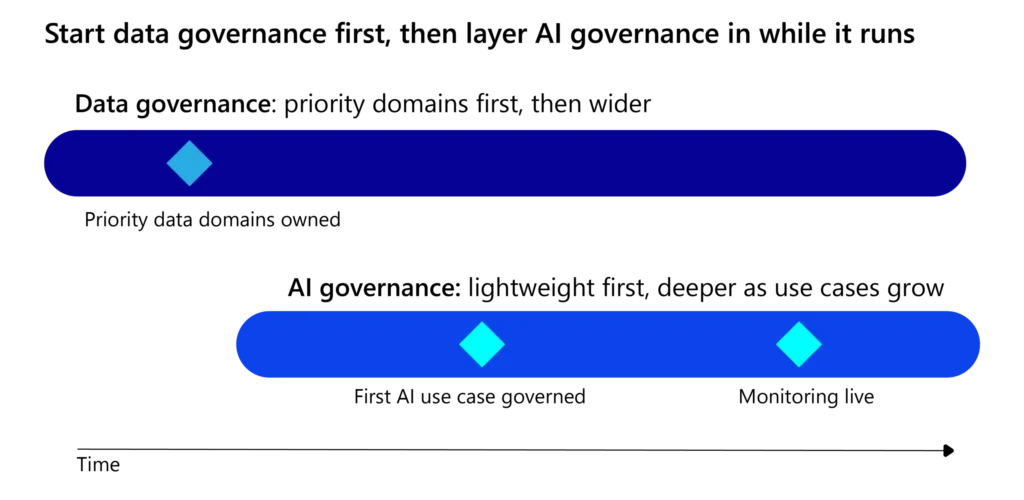
You need data governance first, but you should not wait for it to be finished before starting AI governance.
The sequence is straightforward. You cannot responsibly assess a model if you cannot say what data went into it, so basic data governance (ownership, quality standards, lineage for the data your AI will use) has to come first. But treating it as a strict, completed phase one is where many programs go wrong. Teams spend a year perfecting data policy while AI pilots multiply in the background with no approval route, no monitoring and no named owner. By the time the data program is “done”, dozens of ungoverned models are already in production.

“Data governance gives you trustworthy input. It doesn’t tell you what a model does with them once it’s live. The organizations that scale AI well start with their data, but they don’t wait for it to be perfect before putting accountability around their models.”
Krishna Kumar Chakirala,
Head of AI & Data, Everforth Quinnox
The practical approach is to run them in overlapping waves:
1.Start with data governance for the data your AI depends on, not all enterprise data at once. Pick the two or three data domains feeding your highest-value AI use cases.
2.Stand up lightweight AI governance in parallel: a model inventory, a simple risk tier and one approval gate. It does not need to be elaborate to be useful.
3.Deepen both as use cases grow, adding monitoring, fairness testing and incident response as your AI footprint expands.
A five-question readiness test
If any answer is “not sure”, that is where to start:
1. Can we list every AI model running in the business today, including those inside vendor tools?
2. For our top three models, can we trace the data they were trained back to its source?
3. Does every live model have a named owner?
4. Would we know within a week if a model’s accuracy or fairness started slipping?
5. Could we explain any single automated decision to a regulator, in plain language?
The gap between the two is where most programs stall: data teams assume AI risk belongs to the data scientists, and AI teams assume the data is someone else’s problem. Someone must own the handoff.
Who owns each, and can one team hold both?
Data governance usually sits under a Chief Data Officer or a data governance council, with stewards in each business domain. AI governance tends to be a cross-functional body that brings together risk, legal, compliance, data science and the business, often sponsored by the CDO, CRO, or CIO.
Can one team hold both? In smaller organizations, yes, and it is often sensible. A single governance function with two clearly defined remits avoids duplicated meetings and conflicting rules. In larger ones, the two tend to separate, because AI governance needs risk, legal and ethics voices that a data office does not always include. Either way, what matters is that responsibilities are written down and that the two groups share a regular forum.
CTA: Not sure where your organization sits today? Talk to our team about AI governance consulting for a practical starting point or explore our data governance services if your foundations need attention first.
Data strategy vs data governance
These two get confused constantly, so a quick disambiguation completes the picture. Data strategy decides what to build and in what order: which data assets matter, which use cases to fund, which platforms to invest in and how data supports business goals. Data governance decides the rules that apply along the way: who owns the data, what quality is acceptable, and who may use it.
Strategy sets directions. Governance keeps the journey safe. You need both, and a strategy without governance tends to produce impressive plans on unreliable data.
Conclusion
AI governance vs data governance is not a contest. Data governance protects what goes into your AI. AI governance protects what comes out and decides who answers it.
Start with the data your most important AI use cases rely on. Put lightweight AI oversight in place right alongside it. Then keep the two talking. Organizations that get this sequencing right spend less time firefighting and more time scaling AI with confidence.
If you are planning your next step, our team can help you build the foundations and oversight together. Explore our AI governance consulting and data governance services or read the data governance framework guide to see what a full program looks like.
Ready to govern your data and your AI without slowing either down? Speak to a Everforth Quinnox expert about the next step.

Assistant Manager – Marketing (Analyst Relations), Everforth Quinnox
Frequently asked questions
Data governance manages the quality, ownership, access and compliance of data. AI governance manages the models built on that data: whether they are approved, monitored, fair, explainable and overseen by an accountable person. One covers the inputs, the other covers the behaviour and outcomes.
You need at least a basic level of data governance first, because you cannot assess a model without knowing what data trained it. But you should not wait for a complete data programme. Start with the data behind your priority AI use cases and begin lightweight AI governance in parallel.
In smaller organisations, one team can hold both if each remit is clearly defined. In larger ones they are usually separate, with AI governance drawing in risk, legal and compliance voices. In both cases the two need a shared forum so nothing falls between them.
Yes, in part. For high-risk AI systems the Act sets expectations around the quality and management of the data used to train, validate and test them. That makes data governance a practical prerequisite for compliance. For detail on how this applies to your situation, see our AI governance consulting page.
At a high level: a model inventory, risk tiering, approval gates, ongoing monitoring, incident response and documentation. Together these give you a repeatable way to approve, watch and answer for every model in use.