Introduction
As organizations become more data-driven, the challenge is no longer simply collecting or storing data. The bigger challenge is ensuring that data is trusted, understood, protected, accessible to the right people, and used consistently across the enterprise.
Poor data quality can have a significant financial impact on enterprises, with a widely cited Gartner estimate putting the average annual cost at $12.9 million per organization. As businesses expand their use of cloud platforms, analytics, generative AI, and autonomous agents, ensuring that data is accurate, secure, consistent, and fit for purpose becomes increasingly important.
A data governance framework provides the structure for doing exactly that. It defines who is accountable for data, how decisions are made, which policies apply, how data quality and compliance are measured, and how governance becomes part of everyday business and technology operations.
This becomes particularly important as organizations adopt cloud platforms, analytics, generative AI, and autonomous AI agents. Poorly governed data can introduce inconsistent reporting, privacy and compliance risks, duplicated information, and unreliable AI outputs.
A well-designed framework connects people, processes, technology, and measurement so that data governance becomes an operating capability rather than a collection of disconnected policies.
What Is a Data Governance Framework?
A data governance framework is a structured system of roles, policies, processes, decision rights, standards, and technologies used to manage data throughout its lifecycle.
It establishes how an organization makes decisions about data and who is accountable for those decisions. Depending on the organization, governance may cover areas such as:
- Data ownership and accountability
- Data quality and validation
- Metadata and data cataloging
- Data classification
- Access and security
- Privacy and regulatory compliance
- Data lifecycle management
- Master and reference data
- Data architecture and standards
- Data usage and sharing
- AI and analytics use cases
The important distinction is that a framework is broader than a policy document.
A policy might state that sensitive customer data must be protected. A framework determines who classifies that data, which standards apply, which systems enforce the controls, how exceptions are approved, and how compliance is measured.
In other words, a policy defines a rule; a governance framework establishes the operating mechanism that makes the rule actionable.

“A strong data governance framework turns data from an unmanaged asset into a trusted foundation for business and AI.”
Chetan Kerhalkar
Director – Service Delivery, Everforth Quinnox
The Pillars of Data Governance
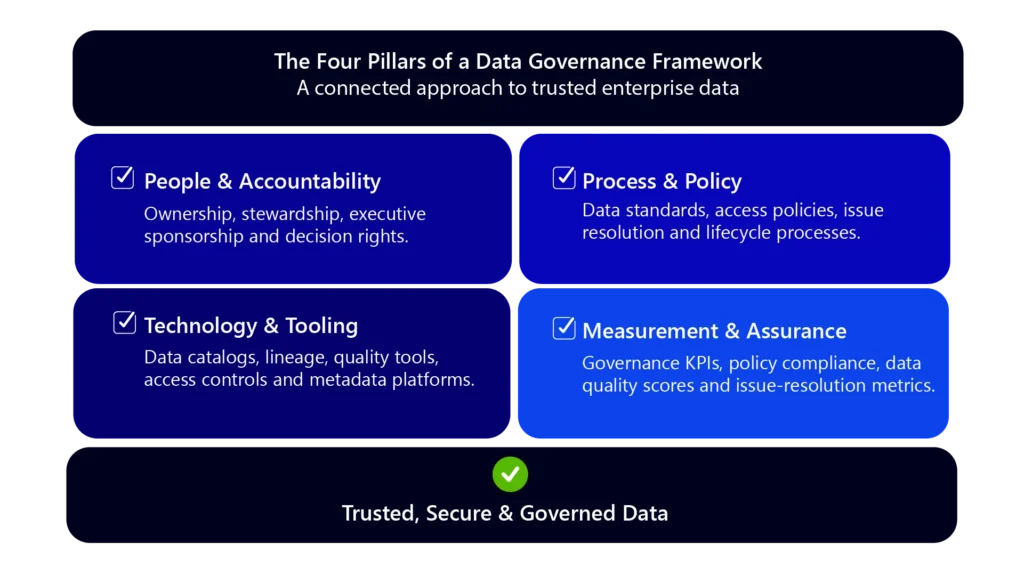
An effective data governance framework typically brings four interconnected dimensions together: people and accountability, process and policy, technology and tooling, and measurement and assurance.
People and Accountability
Governance starts with clearly defined ownership.
Organizations need to establish who is accountable for particular data domains, who manages data on a day-to-day basis, who defines standards, and who has authority to resolve disputes.
Typical responsibilities include:
- Executive sponsorship
- Data ownership
- Data stewardship
- Governance leadership
- Domain accountability
- Technical custodianship
- Compliance and risk oversight
Without clear accountability, governance decisions can become ambiguous. A data quality problem, for example, may be identified by a technology team but ultimately require a business owner to determine what the data should mean.
Process and Policy
Processes translate governance principles into repeatable activities.
A governance framework should define processes for areas such as:
- Data classification
- Data quality management
- Access requests
- Metadata management
- Data issue resolution
- Data lifecycle management
- Data retention and disposal
- Privacy and compliance
- Data sharing
- Policy exceptions
- New data source onboarding
Policies provide the rules, while processes explain how those rules are applied.
Technology and Tooling
Technology enables governance to operate at enterprise scale.
Depending on the organization’s needs, the technology layer may include:
- Data catalogs
- Metadata management platforms
- Data lineage tools
- Data quality solutions
- Master data management platforms
- Identity and access management
- Privacy and security controls
- Data classification tools
- Data observability platforms
- Workflow and governance portals
Technology should support the governance operating model rather than become the operating model itself. Buying a data catalog, for example, does not automatically create ownership, accountability, or consistent definitions.
Measurement and Assurance
Governance also needs measurable outcomes.
Organizations can track metrics such as:
- Percentage of critical data elements with assigned owners
- Data quality scores
- Number and age of unresolved data issues
- Metadata completeness
- Policy compliance
- Access review completion
- Data lineage coverage
- Time required to resolve governance issues
- Number of policy exceptions
- Adoption of governed data assets
These measures help governance leaders demonstrate whether the framework is improving data reliability and reducing operational or regulatory risk.
Data Governance Roles and Responsibilities
A data governance framework needs clearly defined roles. Titles vary between organizations, but the underlying responsibilities tend to remain similar.
Chief Data Officer
The Chief Data Officer (CDO) typically provides executive leadership for enterprise data strategy and governance.
Depending on the organization, the CDO may be responsible for:
- Establishing the governance vision
- Securing executive sponsorship
- Defining enterprise data priorities
- Establishing governance structures
- Aligning data initiatives with business strategy
- Monitoring governance performance
- Resolving cross-functional issues
The CDO does not necessarily own every piece of enterprise data. Instead, the role generally provides the leadership and accountability structure through which data ownership is established.
Data Owners
Data owners are business stakeholders accountable for particular data domains or datasets.
For example, a business leader might own customer data while another leader owns financial data.
Their responsibilities may include:
- Defining business requirements
- Establishing acceptable quality levels
- Approving access principles
- Resolving business-level data disputes
- Defining critical data elements
- Supporting regulatory and compliance requirements
Data ownership should sit close to the business context because determining whether data is fit for purpose often requires domain knowledge.
Data Stewards
Data stewards translate governance requirements into day-to-day data management activities, helping maintain definitions, quality, metadata, and issue resolution within their domains. They connect business expectations with operational data practices and help ensure that governance standards are consistently applied.
For a deeper look at strategic data management, see strategic data management.
Domain and Technical Custodians
Domain custodians help manage governance within specific business or data domains. They may coordinate standards, issues, definitions, and governance activities across teams.
Technical custodians, meanwhile, are responsible for the technical environments in which data is stored, processed, secured, or transmitted. They may manage databases, cloud platforms, pipelines, access controls, and technical metadata.
Keeping business ownership distinct from technical custodianship is important. The team operating a database should not automatically be considered the business owner of everything stored in it.
RACI-Style Data Governance Responsibilities
A RACI-style model can make decision rights more explicit. The exact allocation should be adapted to the organization’s structure.
| Governance activity | CDO | Data Owner | Data Steward | Technical Custodian | Governance Council |
|---|---|---|---|---|---|
| Define enterprise governance strategy | A/R | C | C | C | A |
| Define business data requirements | C | A/R | R | C | C |
| Establish data definitions | C | A | R | C | C |
| Manage data quality issues | C | A | R | R | C |
| Manage technical controls | C | C | C | A/R | C |
| Approve major policy changes | R | C | C | C | A |
| Resolve cross-domain disputes | R | R | C | C | A |
| Monitor governance KPIs | A/R | C | R | C | C |
| Approve significant exceptions | R | C | C | C | A |
R = Responsible, A = Accountable, C = Consulted. Organizations may add an I = Informed designation where appropriate.
The purpose of this table is not to prescribe one organizational structure. It is to make decision rights visible and prevent accountability gaps.
The Data Governance Council
A data governance council provides a cross-functional forum for making enterprise-level governance decisions.
Its composition depends on organizational size and complexity but may include representatives from:
- Data and analytics
- Business functions
- IT and architecture
- Information security
- Privacy and legal
- Risk and compliance
- Enterprise architecture
- AI or advanced analytics teams
Composition
The council should include people with sufficient authority to make decisions—not simply representatives who can discuss issues but cannot resolve them.
Business representation is particularly important because governance decisions often involve trade-offs between control, usability, cost, and business value.
Cadence
The council might meet monthly for routine governance and convene more frequently during major transformation programs.
Operational governance can occur more frequently through domain-level forums or stewardship teams.
The objective is not to create meetings for their own sake. Governance forums should exist to make decisions, resolve issues, establish standards, and monitor outcomes.
Decision Rights
The council may have authority over:
- Enterprise data standards
- Cross-domain definitions
- Governance policies
- Major exceptions
- Data ownership disputes
- Critical data quality issues
- Enterprise data priorities
- Significant compliance concerns
Decision rights should be documented, so teams know when an issue can be resolved within a domain and when it needs escalation.
Escalation
A practical escalation path might move from:
Data steward → Data owner → Domain governance forum → Enterprise data governance council → Executive sponsor
Not every issue needs not to reach the council. A mature framework resolves issues at the lowest appropriate level while reserving enterprise forums for matters that cross domains or carry material risk.
The Data Governance Operating Model
Organizations generally adopt one of three broad governance operating models: centralized, federated, or hybrid.
| Operating model | How it works | Advantages | Trade-offs |
|---|---|---|---|
| Centralized | Governance authority sits primarily within a central team | Consistency and clear enterprise standards | Can become disconnected from domain needs |
| Federated | Individual business/data domains manage governance within common principles | Strong domain ownership and business context | Can create inconsistent practices |
| Hybrid | Central team establishes enterprise standards while domains execute governance | Balances consistency and domain autonomy | Requires clear decision rights and coordination |
Centralized Model
In a centralized model, a central data governance function establishes most standards, policies, and processes.
This can be useful where organizations need strong consistency or are establishing governance for the first time.
The challenge is scale. A central team can become a bottleneck if every governance decision requires centralized approval.
Federated Model
A federated model gives individual domains greater responsibility for governance.
For example, finance, HR, supply chain, and customer domains may each have dedicated stewards and governance practices operating within broader enterprise principles.
This provides strong business context but requires mechanisms to prevent every domain from defining data differently.
Hybrid Model
A hybrid model combines centralized standards with distributed execution.
A central governance team might define enterprise principles for security, metadata, quality, and classification, while domain teams own the implementation and day-to-day decisions.
For many large enterprises, this approach can provide a practical balance between standardization and business autonomy.
What the Policy Set Covers
A data governance framework should be supported by a structured policy of inventory rather than a single generic data policy.
Depending on the organization’s regulatory environment and data landscape, the policy set may include:
Data Classification Policy
Defines categories such as public, internal, confidential, or restricted data and establishes the controls associated with each category.
Data Quality Policy
Defines quality dimensions, thresholds, critical data elements, monitoring requirements, and remediation responsibilities.
Data Access Policy
Establishes principles for granting, reviewing, modifying, and revoking access to data.
Data Privacy Policy
Defines requirements for collecting, processing, storing, sharing, and retaining personal or sensitive information.
Metadata and Data Catalog Policy
Establishes expectations for business definitions, technical metadata, ownership, lineage, and catalog maintenance.
Data Retention and Disposal Policy
Defines how long different categories of data should be retained and how they should be securely disposed of.
Data Lifecycle Policy
Covers how data moves from creation and acquisition through use, archival, and eventual disposal.
Data Sharing Policy
Defines requirements for internal and external data sharing, including approvals, security controls, contracts, and permitted uses.
Data Issue Management Policy
Establishes how data quality or governance issues are logged, prioritized, assigned, escalated, and resolved.
AI Data Usage Policy
As AI adoption grows, organizations may also need policies covering data used to train, fine-tune, evaluate, ground, or otherwise interact with AI systems.
The policy inventory should be maintained as part of the governance framework and mapped to accountable owners, controls, and review schedules.
A Data Governance Implementation Plan
Implementing governance across an enterprise is rarely a single project. A phased approach allows organizations to establish the operating model while demonstrating measurable value.
A practical starting point is to work in 90-day increments.
First 90 Days: Establish the Foundation
The initial phase should focus on understanding the current state and establishing accountability.
Key activities can include:
1.Identify executive sponsorship.
2.Define governance objectives and scope.
3.Identify priority data domains.
4.Establish initial governance roles.
5.Create an inventory of critical data assets.
6.Identify critical data elements.
7.Assess major data quality and compliance risks.
8.Establish the governance council.
9.Define initial policies and decision rights.
10.Establish baseline metrics.
The goal is not to govern every dataset immediately. It is to establish the structure and prioritize where governance can create the most value.
Days 91–180: Operationalize Governance
The second phase turns the initial framework into repeatable processes.
Organizations can:
- Implement stewardship workflows
- Establish data quality rules
- Expand metadata and catalog coverage
- Define lineage for critical data
- Implement access governance
- Formalize issue management
- Establish policy exception processes
- Introduce governance dashboards
- Expand governance to additional domains
At this stage, governance should begin appearing within existing business and technology workflows rather than operating as a separate activity.
Days 181–270: Scale and Integrate
The next increment can focus on scaling governance across more data domains and integrating it with enterprise technology.
Potential activities include:
- Expanding data ownership
- Automating quality monitoring
- Integrating governance with data platforms
- Extending lineage
- Connecting governance with security and privacy controls
- Improving metadata automation
- Integrating governance into cloud and modernization programs
- Establishing more sophisticated governance KPIs
Beyond 270 Days: Continuous Improvement
Mature governance becomes an ongoing operating capability.
The organization can periodically review:
- Governance effectiveness
- Policy relevance
- Data quality trends
- Regulatory requirements
- Technology changes
- New data products
- AI use cases
- Business priorities
This is important because data environments continuously change. A framework that is not maintained can quickly become disconnected from the systems and business processes it is supposed to govern.
Data Governance Framework Examples
Several established industry frameworks can help organizations structure their governance initiatives. Three commonly referenced examples are DAMA-DMBOK, DCAM, and EDM Council frameworks.
DAMA-DMBOK
The DAMA-DMBOK body of knowledge provides a broad reference model covering multiple data management disciplines, including governance, architecture, metadata, data quality, security, master data, and other areas.
Organizations can use it as a reference for understanding the breadth of enterprise data management capabilities.
DCAM
The Data Management Capability Assessment Model (DCAM) from EDM Council provides a capability-oriented approach for assessing and developing data management and governance maturity.
It can help organizations understand current capabilities and identify areas requiring improvement.
EDM Council
The EDM Council provides industry resources and frameworks covering areas such as data management, data governance, risk, and data standards.
These frameworks should generally be treated as reference points rather than templates to copy wholesale. An organization’s regulatory environment, operating model, technology landscape, and business priorities should determine how governance is actually implemented.
Governing Data for AI
AI changes the data governance equation because models and AI agents can consume, transform, retrieve, and generate information at a significantly greater scale.
Traditional governance asks questions such as:
- Who owns this data?
- Is it accurate?
- Who can access it?
- Where did it come from?
- How long should it be retained?
AI introduces additional questions:
- Can this data be used to train or ground an AI system?
- What sensitive information could be exposed through an AI application?
- Can an agent retrieve data outside its authorized scope?
- How should data provenance be captured?
- How should AI-generated outputs be evaluated?
- Can model or agent decisions be traced back to governed data sources?
This means organizations need to connect data governance with AI-specific controls around provenance, access, privacy, usage, model context, and accountability. Explore data governance for AI to understand how governance requirements evolve for AI-driven environments.
Organizations building enterprise AI capabilities can also consider AI governance consulting to establish governance structures spanning AI risk, data, compliance, and operational controls.
Conclusion
Building an effective data governance framework is not a one-time exercise. It requires clearly defined roles, consistent standards, measurable controls, and regular reviews to ensure data remains accurate, accessible, secure, and fit for its intended use.
As organizations adopt new platforms and expand their use of AI, these practices must evolve alongside the data landscape. Regularly assessing governance policies, addressing gaps, and aligning controls with business objectives helps keep the framework relevant and effective.
Furthermore, with the right data governance services, organizations can strengthen governance practices, address evolving data management challenges, and establish a dependable foundation for analytics and AI. Ultimately, a well-maintained framework enables businesses to manage data with greater confidence, meet compliance requirements, and unlock greater value from their data assets.

Deputy Manager, Marketing, Everforth Quinnox
FAQs
The build vs. buy decision in AI is the choice between developing an AI capability internally or adopting a prebuilt AI solution. In practice, enterprises can take a hybrid approach—buying commodity technologies such as foundation models and AI platforms while building the context, integrations, workflows, and business logic specific to their organization.
Context helps AI understand an organization’s data, processes, business rules, systems, policies, and decision-making patterns. Without sufficient context, AI may provide generic answers or recommendations. Context-aware AI can produce more relevant outputs by connecting information to the specific business situation.
There is no universal answer. Enterprises should evaluate factors such as the strategic importance of the use case, level of customization required, proprietary data, integration complexity, governance requirements, and potential for differentiation. A hybrid build-and-buy approach can allow organizations to use existing AI technologies while building capabilities around their unique business context.
Enterprises can consider building the capabilities that differentiate their business, including contextual knowledge, business rules, data relationships, integrations, workflows, governance mechanisms, and agent orchestration. Foundation models, cloud infrastructure, AI platforms, and other commoditized components can often be purchased or reused.
A modular contextual layer can separate an organization’s business knowledge, rules, integrations, and governance from the underlying AI model or platform. This can make it easier to adopt new models or AI technologies without rebuilding the entire AI architecture, giving enterprises greater flexibility as the AI ecosystem evolves.