Introduction
For years, application management was largely measured by a familiar set of questions: How quickly are incidents resolved? Are applications available? Are SLAs being met? Are support costs under control?
Those measures still matter but they no longer tell the whole story.
As enterprises move deeper into cloud, modernize legacy estates, adopt SaaS, and embed AI into business applications, application management services (AMS) best practices must evolve from keeping applications operational to continuously improving how they perform, scale, adapt, and create business value.
The challenge is not simply the growing number of applications. It is the growing complexity around them. Applications now operate across hybrid environments, depend on interconnected services and APIs, support increasingly critical business processes, and may incorporate AI capabilities that introduce new requirements for governance, observability, security, and human oversight.
A modern AMS model therefore needs to connect operational excellence with business outcomes, application portfolio decisions, automation, user experience, and continuous improvement.
In this blog, we explore a strategic framework built around seven application management services best practices to help IT leaders strengthen operational resilience, improve application value, and build an AMS model that is ready for the demands of cloud and AI.
Why AMS Best Practices Matter More After Cloud and AI
Cloud and AI have changed the operating environment for enterprise applications and, in turn, what organizations should expect from application management services.
A traditional application landscape was often relatively predictable: applications ran in defined environments, releases followed established cycles, and support teams focused primarily on incidents, problems, changes, and service requests.
Today’s application landscape is considerably more dynamic.
Applications may span multiple cloud environments, connect to dozens of APIs and third-party services, exchange data across business platforms, and change continuously through DevOps and agile delivery. Google Cloud’s current application-management guidance, for example, emphasizes defining clear application boundaries, reflecting business capabilities, establishing ownership, and continually refining application models as business and technical environments change.
AI adds another layer of complexity and opportunity.
AI can help application teams detect anomalies, analyze logs, correlate incidents, identify probable root causes, retrieve knowledge, recommend remediation, and automate repetitive operational work. More advanced models are beginning to introduce AI agents capable of performing multi-step operational tasks with varying degrees of autonomy. IBM’s current AMS approach describes this evolution as agentic application operations, where AI agents analyze application health, predict issues, automate remediation, and work under human governance.
But greater intelligence does not eliminate the need for discipline. It increases it.
The question for IT leaders is no longer simply:
“How do we support our applications efficiently?”
It is:
“How do we operate, optimize, govern, and continuously improve an application estate that is becoming more distributed, interconnected, and intelligent?”
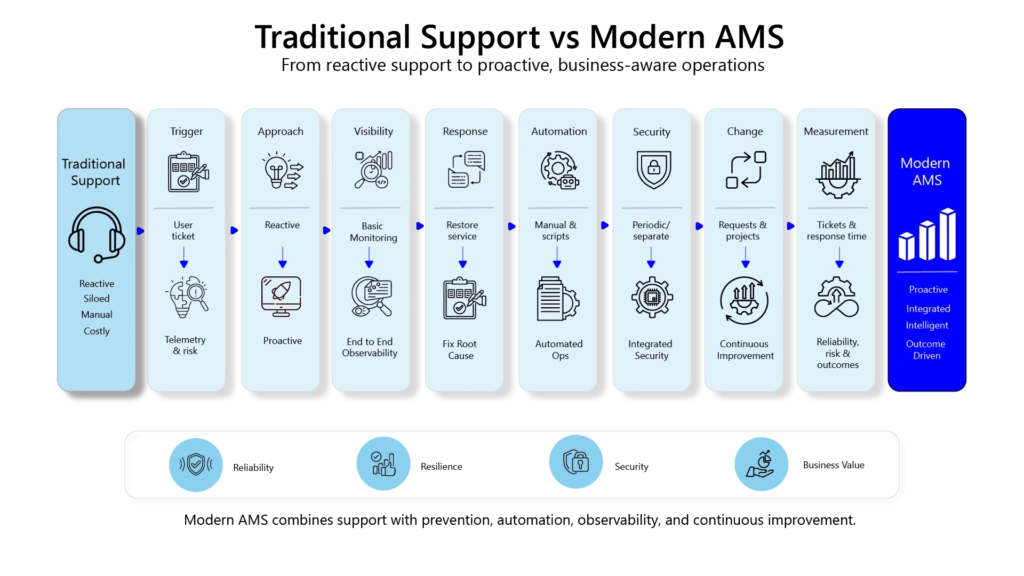
That requires a different AMS mindset built around three shifts:
- From infrastructure-centric to application-centric management
Cloud environments can contain thousands of individual resources. Managing them effectively requires understanding which resources collectively support a business application and what that application means to the business.
- From reactive support to proactive operations
Instead of waiting for users to report problems, modern application management should use observability, analytics, automation, and AI to identify potential issues earlier and prevent recurring failures.
- From SLA compliance to business value
An application can achieve 99.9% availability and still frustrate users, slow down a critical process, or constrain business growth.
The real measure of AMS maturity is therefore not how efficiently an organization resolves yesterday’s problems. It is how effectively it prevents problems, improves application health, and enables tomorrow’s business priorities.
Beyond Support: 7 Best Practices for Modern Application Management
Modern application management is no longer about responding to issues as they arise. As application estates become more complex, AMS teams need a more deliberate approach to governance, knowledge, performance, portfolio decisions, automation, and continuous improvement.
The following seven practices provide a strategic foundation for moving beyond reactive support toward modern application management services that are proactive, intelligent, outcome-driven, and aligned with evolving business priorities.

1. Start With a Clear Operating Model and Governance
A successful AMS engagement does not begin with a ticket queue. It begins with clarity.
As application estates become more complex, responsibilities can quickly become fragmented across business owners, application teams, infrastructure teams, cloud teams, security teams, vendors, and managed service providers.
When ownership is unclear, the consequences are predictable:
- Incidents move between teams before reaching the right resolver.
- Changes require multiple approvals without clear accountability.
- Business priorities are disconnected from technology decisions.
- Technical debt remains unresolved because nobody owns the outcome.
- Modernization decisions become difficult to make.
A strong application management strategy starts by defining how accountability works across the application lifecycle.
Establish ownership at the application level
Every critical application should have clearly identified ownership not just a technical contact.
At minimum, define:
- Business owner: Accountable for the business capability and outcome.
- Application owner: Accountable for application health, lifecycle, and technology decisions.
- Operations owner: Accountable for day-to-day service performance.
- Security and risk ownership: Responsible for relevant controls and risk decisions.
- Provider responsibilities: Clearly defined where AMS is externally managed.
Define decision rights not just responsibilities
A RACI chart alone is rarely enough.
The operating model should answer questions such as:
- Who can authorize a production change?
- Who can approve automated remediation?
- Who decides whether an application should be modernized?
- Who accepts residual technical risk?
- Who determines the appropriate service tier?
- Who makes the call during a critical incident?
This is particularly important when AI becomes part of operations. An AI agent may be able to identify a probable root cause or execute a remediation, but governance must define which actions can happen autonomously and which require human approval.
Build governance around business criticality
Not every application requires the same level of operational rigor.
Classify applications according to factors such as:
- Business criticality
- Revenue impact
- Regulatory exposure
- Customer impact
- Data sensitivity
- Availability requirements
- Recovery requirements
- Integration complexity
This allows monitoring, support coverage, automation, resilience, and escalation to be aligned with actual business risk.
The objective is straightforward: Governance should make accountability and decision-making clearer not create another layer of administration.
2. Build a Structured Transition and Knowledge Transfer Plan
One of the most underestimated risks in AMS is transition.
Organizations often approach transition as a documentation exercise: collect architecture diagrams, application manuals, support procedures, known errors, and escalation contacts, then hand everything to the incoming team.
That is not enough.
An effective transition transfers the ability to operate the application, not simply information about it.
The incoming team needs to understand not only how an application works but also why it works the way it does, what can go wrong, how the business is affected, and which decisions require caution.
What should transition capture?
A structured transition should cover six layers of knowledge.
1. Application architecture
Document application components, environments, integrations, APIs, databases, infrastructure dependencies, third-party services, and data flows.
2. Business context
Identify the business processes supported by the application, critical transaction periods, downstream dependencies, user groups, and the consequences of service disruption.
3. Operational knowledge
Capture incident patterns, monitoring requirements, batch jobs, known errors, operational procedures, maintenance windows, and escalation paths.
4. Technical knowledge
Transfer information about repositories, configurations, deployment processes, security controls, recovery procedures, environments, and dependencies.
5. Historical knowledge
Review major incidents, recurring problems, previous fixes, failed remediation attempts, architectural decisions, and known technical-debt areas.
6. Practical knowledge
Use shadowing, reverse shadowing, walkthroughs, simulations, and controlled incident scenarios to validate that the team can actually operate the application.
This last layer is often overlooked.
A document can tell an engineer what to do. A simulated incident can reveal whether the engineer knows when, why, and in what sequence to do it.
Make knowledge usable by both people and machines
This becomes increasingly important as organizations introduce automation and AI.
A knowledge base designed only for human browsing may not provide the structured context needed by AI-powered support systems. Operational knowledge should increasingly be:
- Searchable
- Structured
- Contextual
- Version-controlled
- Connected to applications and services
- Linked to known errors and resolutions
- Regularly reviewed
The goal is to turn institutional knowledge into an operational asset rather than allowing it to remain trapped in the experience of individual engineers.
3. Move From SLAs to Business and Experience Outcomes (BLAs/XLAs)
SLAs have an important role in AMS.
Response time, resolution time, availability, and service-request targets create accountability and provide a baseline for operational performance.
But SLA compliance can sometimes hide a bigger problem.
Imagine a critical employee application with a 30-minute incident-resolution target. The AMS team consistently meets that target. Yet employees still spend several hours each week navigating a slow, cumbersome process.
Operationally, the service provider is performing.
From the business’s perspective, the experience is not good enough.
This is why mature AMS organizations need to supplement traditional SLAs with Business Level Agreements (BLAs) and Experience Level Agreements (XLAs).
BLAs connect application performance to business outcomes
Instead of stopping at technical metrics, BLAs can connect service performance to outcomes such as:
- Order-processing continuity
- Claims-processing turnaround
- Revenue-generating transactions
- Employee productivity
- Customer conversion
- Business-process cycle time
- Regulatory compliance
The emphasis shifts from:
“Was the service restored?”
to:
“Was the business process protected?”
XLAs add the user's perspective
XLAs extend measurement into the actual experience of employees, customers, or other users.
Depending on the application, this could include:
- User satisfaction
- Digital friction
- Task completion
- Transaction success
- Employee effort
- Customer-impacting incidents
- Experience consistency
The strongest measurement model combines all three:
| Measurement layer | What it tells you |
|---|---|
| SLA | Is the service operating within agreed technical parameters? |
| XLA | Are users experiencing the service effectively? |
| BLA | Is the application supporting the intended business outcome? |
This changes the conversation with business stakeholders.
Instead of reporting only:
“Application availability was XYZ%.”
An AMS team could report:
“Application availability remained at XYZ%, while critical transaction completion improved by X% and recurring user-impacting incidents declined by Y%.”
The second version gives leadership a much clearer view of whether technology is actually improving the business.
4. Apply Application Portfolio Management to Prioritize Effort
Not every application should receive the same investment.
Yet without a structured portfolio view, application support can become driven by ticket volume, historical budgets, internal escalation patterns, or whichever application happens to be creating the most noise.
This is where Application Portfolio Management (APM) becomes a critical part of modern AMS.
APM provides a structured way to understand applications across factors such as business value, cost, usage, risk, lifecycle, technical health, and strategic alignment.
What application portfolio management best practices should achieve
A useful APM framework should help answer five questions:
1. What do we have?
Createan accurate inventory of applications, owners, technologies, dependencies, costs, and users.
2. What does each application contribute?
Map applications to business capabilities and processes.
3. What does each application cost?
Understand licensing, infrastructure, support, vendor, enhancement, and modernization costs.
4. What risk does each application carry?
Assess technology obsolescence, security exposure, compliance requirements, resilience, vendor dependency, and operational risk.
5. What should we do next?
Determine whether to invest, modernize,consolidate, tolerate, replace, or retire.
Move from inventory to investment decisions
The real value of APM is not knowing that an organization has 1,000 applications.
It is knowing which 100 deserve investment, which 200 require modernization, which can be consolidated, and which should eventually disappear.
A practical portfolio model can group applications into four broad categories:
Invest: High business value and strong strategic relevance.
Modernize: Business-critical applications constrained by aging architecture, technology, or scalability.
Tolerate: Necessary applications where significant investment is not currently justified.
Retire or consolidate: Redundant, low-value, costly, or high-risk applications.
This turns AMS from a support activity into an input for technology investment strategy.
It also helps connect day-to-day support data with longer-term portfolio decisions. For example, repeated incidents, rising support effort, specialist dependency, and increasing technical debt can become evidence for modernization rather than isolated operational statistics.
5. Automate Support and Shift Left with Intelligent Application Management
Traditional AMS relies heavily on people to identify, investigate, resolve, document, and close operational issues. While this model can work at a smaller scale, it becomes increasingly difficult to sustain as application landscapes grow more complex, distributed, and interconnected.
Every new application, integration, cloud environment, and release introduces more events to monitor and more potential points of failure. At the same time, support teams often spend a significant portion of their time handling repetitive activities – triaging tickets, checking logs, running standard diagnostics, restarting services, following known remediation steps, updating tickets, and maintaining documentation.
The answer is simply not adding more people. It is to redesign repetitive operational work around automation and intelligence.
Intelligent Application Management combines automation, AI, observability, knowledge, and human expertise to create a more proactive support model. Instead of waiting for users to report an issue, intelligent systems can continuously monitor application health, identify anomalies, correlate events across systems, and trigger predefined remediation actions.
For example, a recurring application failure that previously required a user to raise a ticket, an L1 engineer to investigate, and an L2 team to diagnose can potentially be detected and resolved automatically. The system can identify the pattern, validate the condition against known rules or historical incidents, execute an approved remediation workflow, and document the action—all with human intervention reserved for situations that require judgment or approval.
Shift Left from Resolution to Prevention
Automation also enables AMS teams to shift left by moving problem identification and resolution closer to the source.
Instead of escalating every issue to specialized support teams, organizations can equip L1 teams, developers, application owners, and automated agents with the knowledge and tools required to resolve common issues earlier. Self-service capabilities, automated diagnostics, knowledge recommendations, and guided remediation can reduce unnecessary escalations and improve resolution speed.
A mature shift-left model can progressively move activities from:
L2/L3 intervention → L1 resolution → self-service → automated resolution → predictive prevention
This does not mean eliminating human expertise. Rather, it ensures that skilled engineers spend less time on repetitive operational tasks and more time addressing complex problems, improving application resilience, and driving modernization.
Build Automation Around the Full Incident Lifecycle
The greatest value comes when automation is applied across the entire support lifecycle rather than to isolated tasks.
- Detect: Continuously monitor applications, infrastructure, integrations, and user experience to identify anomalies.
- Diagnose: Correlate alerts, logs, events, dependencies, and historical incidents to determine likely causes.
- Decide: Use predefined rules, AI recommendations, and business policies to determine the appropriate response.
- Remediate: Automatically execute approved actions such as restarting services, clearing queues, rerunning failed jobs, or routing issues to the right team.
- Validate: Confirm that the application or service has returned to the expected state.
- Document: Automatically capture the incident, actions taken, resolution, and relevant knowledge for future use.
- Learn: Feed incident patterns and outcomes back into the knowledge and automation layer to continuously improve resolution.
This creates a closed-loop application management model, where every incident becomes an opportunity to improve the system rather than simply another ticket to close.
From Reactive AMS to Intelligent Operations
The ultimate goal is to move AMS from a ticket-driven support function to an outcome-driven operating model.
Instead of asking:
How quickly did we resolve the incident?
organizations can begin asking:
Why did the incident occur, could we have prevented it, and what can we automate so it does not happen again?
That shift changes the economics and value of AMS. Fewer repetitive tickets, faster resolution, lower escalation volumes, improved application availability, and reduced dependence on manual intervention can allow organizations to scale application operations without proportionally scaling support teams.
The result is not just a more automated AMS environment. It is an intelligent application management model that continuously detects, learns, improves, and prevents while keeping human expertise focused where it creates the greatest value.
The evolution toward AI agents
AI agents can take this a step further.
Instead of simply providing a recommendation, an AI agent can potentially execute a defined sequence of operational tasks.
Consider a recurring application incident:
Detect → Investigate → Correlate → Recommend → Remediate → Validate → Document
An AI-enabled workflow could:
1. Detect an abnormal application behavior.
2. Correlate telemetry with recent changes.
3. Compare the pattern with historical incidents.
4. Identify the probable root cause.
5. Retrieve the relevant runbook.
6. Recommend an approved remediation.
7. Execute a low-risk action within defined guardrails.
8. Validate whether service health has recovered.
9. Record what happened and update the knowledge base.
This is where AI agents in application management can move AMS from reactive support toward semi-autonomous operations.
Keep humans in the loop where it matters
Autonomy should be risk-based.
For example:
Low risk: Automated health checks or known, reversible remediation.
Moderate risk: AI recommendation followed by engineer approval.
High risk: Human decision and explicit authorization before execution.
This is especially important for production changes, regulated applications, security-sensitive environments, and actions that could affect customers or business-critical processes.
6. Establish Continuous Improvement and Technical-Debt Reduction
An AMS team that resolves the same incident every month is not necessarily performing well.
It may simply be becoming more efficient at treating the symptom.
Mature AMS asks a harder question:
Why does this problem keep coming back?
Every recurring incident should be viewed as a potential improvement signal.
It may point to:
- Weak application architecture
- Fragile integrations
- Missing automation
- Inadequate monitoring
- Poor release practices
- Knowledge gaps
- Infrastructure limitations
- Outdated technology
- Accumulated technical debt
Make problem management outcome-oriented
Instead of measuring only how many problems were closed, measure whether recurring failure patterns actually disappear.
For example:
Old model:
“25 problem records closed this quarter.”
Better model:
“Recurring incidents from the top five failure patterns declined by 31% after root-cause remediation.”
The second metric demonstrates actual improvement.
Treat technical debt as an operational issue
Technical debt is often discussed as an engineering concern.
In AMS, it is also an operational concern.
A legacy dependency may increase incident risk. An unsupported framework may restrict security updates. A fragile integration may require specialist intervention every time a release occurs. A poorly structured application may make even minor enhancements expensive.
A technical-debt register should therefore capture:
- Business impact
- Operational impact
- Security or compliance risk
- Technology constraint
- Remediation effort
- Cost of deferral
- Dependencies
- Owner
- Target remediation period
This creates a more compelling basis for investment.
Instead of:
“The application needs modernization.”
The business case becomes:
“The current architecture is increasing operational effort, limiting release velocity, and creating measurable resilience and support risk.”
That is a conversation business leaders can act on.
Reserve capacity for improvement
If every AMS resource is consumed by incidents and service requests, improvement will always be postponed.
A mature model deliberately creates capacity for:
- Automation
- Root-cause elimination
- Technical-debt remediation
- Performance optimization
- Knowledge improvement
- Modernization
- Experience enhancement
Run and improve need to operate together.
7. Measure What Matters: KPIs and Reporting That Drive Action
A dashboard is not a strategy.
Organizations can collect hundreds of AMS metrics and still struggle to answer the most important question:
Are our applications getting better?
The answer requires a balanced measurement framework.
1. Operational KPIs
These measure the efficiency and reliability of service delivery.
Examples include:
- Mean time to detect (MTTD)
- Mean time to restore (MTTR)
- First-contact resolution
- Incident volume
- Reopen rate
- Change success rate
- SLA compliance
- Automation rate
- Backlog aging
2. Application health KPIs
These indicate whether the underlying application estate is improving.
Examples include:
- Recurring incident rate
- Application performance
- Availability
- Error rates
- Defect leakage
- Technical-debt exposure
- Unsupported technology exposure
- Release quality
3. Experience KPIs
These reveal whether users are actually benefiting from improvements.
Examples include:
- User satisfaction
- Digital friction
- Critical transaction completion
- Employee effort
- Customer-impacting incidents
- Experience-level compliance
4. Business KPIs
These connect application management to enterprise priorities.
Examples include:
- Revenue-impacting downtime
- Business-process cycle time
- Productivity improvement
- Cost avoided through automation
- Application total cost of ownership
- Value delivered through modernization
The goal is to progress from descriptive reporting to diagnostic and predictive reporting.
Instead of:
“Incident volume increased by 8%.”
A more useful report would say:
“Incident volume increased by 8%, driven primarily by three recurring integration failures. Addressing the highest-frequency failure pattern could eliminate a significant proportion of repeat incidents.”
The first statement describes what happened.
The second helps leadership decide what to do.
That is what effective AMS reporting should accomplish.
Building Your AMS Best-Practice Framework: Where to Start
Implementing all seven practices simultaneously can be difficult, particularly for organizations with fragmented ownership, inconsistent processes, or limited application visibility.
A more practical approach is to establish a baseline and mature the AMS model progressively.
Step 1: Build a reliable application baseline
Before optimizing the portfolio, understand it.
Create a baseline covering:
- Application name and owner
- Business capability
- Criticality
- Users
- Technology stack
- Hosting environment
- Integrations
- Vendor dependencies
- Cost
- Support model
- Lifecycle stage
- Known risks
- Technical debt
The objective is not to create an enormous repository of information.
Therefore, collect the information required to make better decisions.
Step 2: Segment applications by business criticality
A revenue-generating customer application should not necessarily be managed in the same way as a low-risk internal application.
Define service tiers using factors such as:
- Business impact
- User impact
- Regulatory requirements
- Availability requirements
- Recovery objectives
- Data sensitivity
- Integration complexity
Then align support coverage, monitoring, resilience, automation, and governance accordingly.
Step 3: Assess AMS maturity
Evaluate the current model across five dimensions:
Governance: Are ownership and decision rights clear?
People: Do teams have the required technical and business expertise?
Process: Are incident, problem, change, release, and knowledge processes consistent?
Technology: Are monitoring, observability, automation, and ITSM capabilities sufficiently integrated?
Outcomes: Are you measuring business and user impact as well as operational activity?
This creates a realistic starting point instead of assuming that every part of AMS needs transformation.
Step 4: Identify the highest-value automation opportunities
Do not begin with:
“Where can we use AI?”
Begin with:
“Where are teams spending significant time on repetitive work, and where could automation reduce cost, risk, or resolution time?”
Then determine whether the right answer is:
- Rules-based automation
- Workflow automation
- Machine learning
- Generative AI
- AI agents
- Or simply a better process
This prevents AI adoption from becoming a technology exercise disconnected from operational value.
Step 5: Create an improvement backlog
Bring improvement opportunities into one prioritized backlog.
Include:
- Recurring incidents
- Automation opportunities
- Technical debt
- Performance issues
- Experience gaps
- Security and compliance risks
- Modernization candidates
- Portfolio rationalization opportunities
Prioritize them based on business impact, risk, effort, and strategic alignment.
Step 6: Build an outcome-based scorecard
Bring operational, application, experience, and business measures together.
Leadership should be able to answer four questions:
1. Are our applications stable?
2. Are users experiencing effective services?
3. Are we reducing operational risk and cost?
4. Are our applications becoming easier to change and more valuable to the business?
If the answer to those questions cannot be found in the AMS dashboard, the measurement model needs to evolve.
The Strategic Shift: From Application Support to Application Value Management
The biggest change in modern AMS is not the introduction of another monitoring platform, automation tool, or AI capability.
It is a change in mindset.
As Purnachandra Moparthi, Director of Global Service Line at Everforth Quinnox, rightly said,“The real shift is in how organizations think about the application estate. Instead of treating every application as an isolated support responsibility, leaders need to understand where technology creates value, where it introduces risk, and where intervention can make the greatest difference.”
He further adds,“An AMS team that resolves the same incident faster every quarter is getting better at the wrong thing. The moment you start asking why the ticket exists at all, application support stops being a cost line and becomes the input to your modernization roadmap.”
Traditional application support tends to follow a linear pattern:
Incident → Resolution → Closure
A modern application management model should operate as a continuous loop:
Observe → Understand → Prevent → Automate → Improve → Modernize
That distinction changes the role of application management services within the enterprise.
AMS is no longer simply about maintaining applications after they have been built. It can provide the operational intelligence needed to influence application design, portfolio decisions, modernization priorities, automation investments, and business outcomes.
This is also where the question of what application management services cover becomes broader than traditional application support.
They should increasingly encompass application operations, observability, incident and problem management, release and change support, application health, knowledge management, automation, portfolio insights, continuous improvement, technical-debt reduction, and modernization enablement.
The objective is not to manage more applications with more people.
It is to create an operating model in which:
- Humans focus on judgment, innovation, and complex decisions.
- Automation handles predictable, repeatable work.
- AI identifies patterns and assists with reasoning.
- AI agents execute bounded workflows where appropriate.
- Governance controls risk and accountability.
- Portfolio insights guide investment.
- Operational data drives continuous improvement.
That is the direction in which modern application management services are evolving.
For enterprises, the opportunity is significant. A well-designed AMS model can become more than a mechanism for reducing support costs. It can become a strategic capability for improving application health, increasing operational resilience, accelerating modernization, and ensuring technology continues to support changing business priorities.
The question is no longer whether an enterprise needs application management.
The more important question is whether its current model is designed for the complexity of the applications it will operate tomorrow.
The future of AMS belongs to organizations that can move from managing incidents to managing outcomes and from maintaining applications to continuously improving their value.

Deputy Manager, Marketing, Everforth Quinnox
Frequently Asked Questions
Effective AMS goes beyond resolving incidents. Best practices include proactive monitoring, clearly defined SLAs and XLAs, standardized ITIL-aligned processes, automation of repetitive tasks, continuous application optimization, robust knowledge management, and regular performance reviews. Organizations should also focus on aligning application support with business outcomes, rather than measuring success only by ticket volumes or resolution times.
An SLA (Service Level Agreement) measures operational performance against predefined service targets, such as response time, resolution time, system availability, and ticket closure rates. An XLA (Experience Level Agreement) focuses on the user’s actual experience and business impact—for example, employee satisfaction, application usability, productivity, or the effort required to resolve an issue. In modern AMS, SLAs ensure service reliability, while XLAs help ensure the service delivers a positive business and user experience.
AMS success should be measured through a combination of operational, financial, user-experience, and business metrics. Key measures include application availability, SLA compliance, mean time to resolve (MTTR), first-contact resolution, incident volume, automation rates, cost per ticket, user satisfaction, and business-impact metrics such as productivity and application adoption. The strongest AMS models combine these measures to demonstrate not just how efficiently applications are supported, but how effectively they enable business outcomes.
A strong AMS transition plan should cover application discovery and assessment, documentation and knowledge transfer, stakeholder and dependency mapping, support-process definition, SLA/XLA baselining, tooling and access setup, risk identification, and clear ownership across teams. It should also include shadowing and reverse-shadowing, transition milestones, readiness criteria, and a controlled handover to steady-state operations. A phased transition helps minimize business disruption and ensures the support team is ready before taking full ownership.
Automation reduces manual effort, accelerates issue resolution, and enables teams to move from reactive support to proactive application management. Routine activities such as incident classification, monitoring, ticket routing, health checks, remediation, testing, and reporting can be automated. When combined with AI and intelligent orchestration, automation can also identify patterns, predict potential issues, recommend remediation, and continuously optimize application operations—allowing AMS teams to focus more on improvement and innovation and less on repetitive support tasks.