Introduction
An application can be technically available and still hold a business back. Slow incident resolution, recurring defects, outdated integrations, poor user experience, and applications that cannot keep pace with changing business needs can quietly erode productivity long before they become visible as major failures.
Consider a retailer whose checkout starts buckling during a flash sale, or a bank whose mobile app stall when customers need it most. In 2026, customers rarely wait for technology to catch up. They switch apps, switch brands, and share the experience instantly. For businesses, application performance and reliability are no longer just IT concerns—they directly influence customer experience and business outcomes.
That is why application management services (AMS) have evolved far beyond traditional application support. Today, enterprises need more than a team that responds when something breaks. They need an approach that can proactively identify issues, automate routine operations, improve performance, modernize aging applications, and continuously align the application landscape with business priorities.
As application portfolios become increasingly complex with cloud, SaaS, legacy systems, custom applications, and AI-enabled platforms operating side by side – effective application management requires a strategic, end-to-end approach to run, optimize, modernize, and continuously improve the applications the business depends on.
This blog explores what application management services are, what they include, how they differ from traditional application support, the business value they deliver, and what enterprises should consider when building a modern AMS strategy.
Application Management Services, Defined
AMS is the structured, end-to-end management of enterprise applications across their full lifecycle — from deployment and optimization through ongoing support and eventual retirement. It’s the discipline that keeps the software an organization depends on running reliably, securely, and in step with business goals.
AMS typically spans three connected layers:
- Application maintenance services — routine updates, bug fixes, and performance tuning.
- Application support services — end-user support, incident resolution, and troubleshooting.
- Enterprise application management — governance, compliance, and integration across large, often multi-cloud, application portfolios.
Unlike ad-hoc break-fix support, modern AMS is proactive and automation-led. Instead of waiting for something to break, AI-driven monitoring and orchestration are increasingly used to catch issues before users ever notice them. Think of it as the difference between a fire department and a fire-prevention team: one responds after the smoke alarm goes off, the other rewires the building so the alarm rarely trips at all.
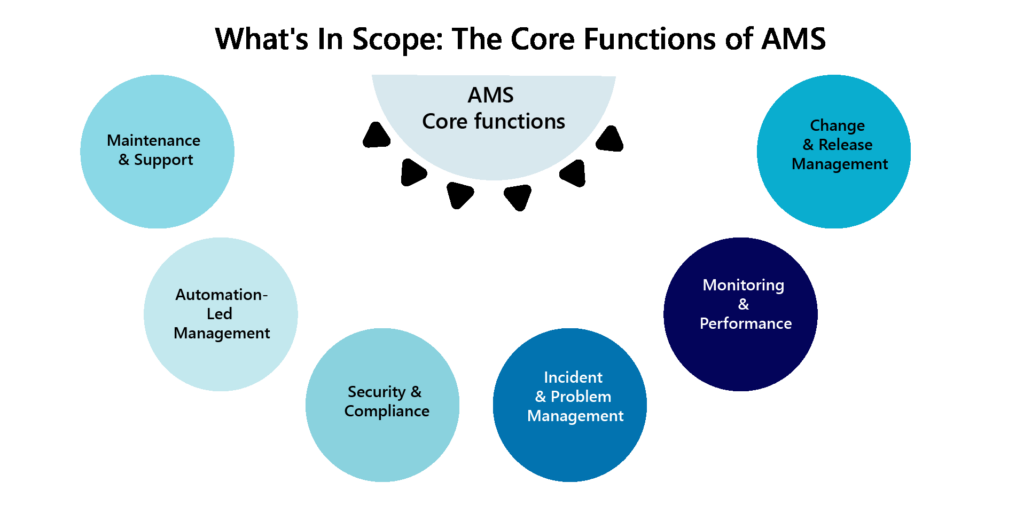
Core Functions of AMS
- Application maintenance and support: Regular patching, upgrades, and bug resolution to keep systems stable.
- Monitoring and performance management: Continuous tracking of application health, availability, and real user experience.
- Incident and problem management: Structured processes that resolve issues fast and stop them from recurring.
- Change and release management: Coordinating updates, new features, and deployments without disrupting the business.
- Security and compliance: Guarding applications against vulnerabilities while meeting regulatory standards.
- Automation-led management: Using AI agents, bots, and orchestration platforms to cut manual effort and speed up resolution.
Application Management Services: Delivery Models
There is no one-size-fits-all approach to application management. The right delivery model depends on factors such as the complexity of the application landscape, in-house capabilities, business criticality, cost objectives, and the level of control an organization needs.
Enterprises can choose to manage applications internally, engage an external provider, or combine both approaches through a hybrid model. Each model offers a different balance of control, expertise, scalability, responsiveness, and cost.
Understanding these delivery models helps organizations determine not just who should manage their applications, but how application management should be structured to support long-term business and technology goals.
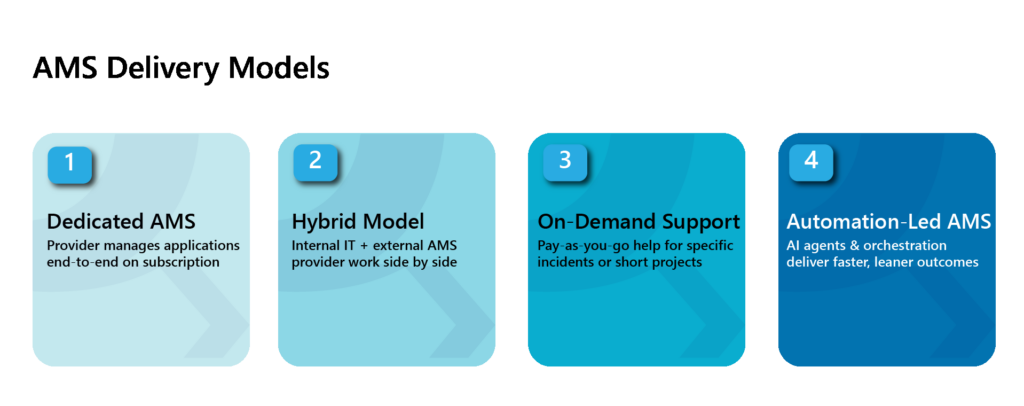
The Four Models Enterprises Choose Between
- Dedicated AMS as a service: A provider manages applications end-to-end, usually on subscription — ideal for predictable costs and outcomes.
- Hybrid model: Internal IT collaborates with external application management services providers for specialized or overflow support.
- On-demand support: Pay-as-you-go help for specific incidents or short-term projects.
- Automation-led AMS: Providers lean on AI agents and orchestration platforms to deliver faster, leaner outcomes with less human touch per ticket.
Where Each Model Shows Up in the Real World
- Retail: Keeping e-commerce platforms elastic enough to survive peak-season traffic spikes without downtime.
- BFSI: Keeping transaction systems secure, compliant, and available around the clock.
- Manufacturing: Maintaining ERP uptime so production and supply chains don’t stall.
- Healthcare: Supporting patient-facing applications where outages simply aren’t an option.
The right model usually isn’t a single choice made once — most enterprises land somewhere on a spectrum, starting with on-demand or hybrid support for lower-risk systems and graduating to dedicated, automation-led AMS once trust in the provider’s outcomes has been established.
Who Uses AMS and When It Makes Sense
AMS can be particularly valuable when application environments become too complex to manage effectively with traditional support models, when business-critical systems require round-the-clock reliability, or when IT teams need to shift their focus from keeping applications running to driving continuous improvement.
The key question, therefore, is not simply “Do we need AMS?” but “Where can application management services create the greatest business and technology value?”
Typical Users Include
- Large enterprises: Running hundreds of applications, they need structured governance plus automation-led management to keep pace.
- Mid-sized businesses: Looking for cost efficiency and scalability without growing IT headcount.
- Digital-native firms: Using AMS to stay agile while keeping their own teams focused on product innovation.
Signals That It's Time for AMS
- IT teams are buried under a growing incident backlog.
- Applications are core to customer experience, and downtime simply isn’t acceptable.
- Leadership wants to shift from reactive firefighting to proactive optimization.
- Cost predictability and transparency have become strategic priorities.
Key Benefits of Application Management Services
When structured strategically, AMS can help enterprises improve the reliability, performance, and resilience of their applications while enabling IT teams to focus on higher-value business priorities.
Here are the key benefits enterprises can realize through application management services:
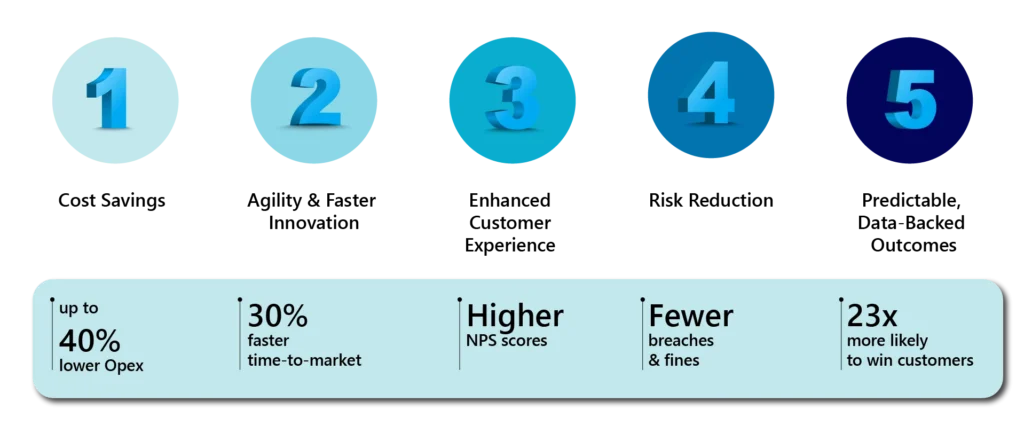
Cost Savings
AMS reduces IT overhead by consolidating support, automating repetitive work, and preventing costly downtime. McKinsey research notes that automation in IT operations can cut operational costs by as much as 40%, while Gartner’s downtime figures above show exactly what’s at stake if applications aren’t proactively managed.
Agility & Faster Innovation
By lifting the maintenance burden off IT teams, AMS frees them to focus on transformation instead of triage. Forrester has found that businesses leveraging modern AMS can achieve up to 30% faster time-to-market for new features, and McKinsey reports that companies combining AMS with AI and machine learning can see up to 50% faster development cycles.
Enhanced Customer Experience
Stable, responsive applications translate directly into customer satisfaction and loyalty. Forrester research consistently shows that companies prioritizing application reliability post higher Net Promoter Scores than their slower-moving peers.
Risk Reduction
AMS strengthens application security and keeps organizations aligned with industry regulations, lowering the risk of breaches, fines, and reputational damage.
Predictable, Data-Backed Outcomes
With AMS as a service, enterprises gain cost transparency and measurable outcomes. IDC has found that data-driven organizations are roughly 23 times more likely to acquire customers and 19 times more likely to be profitable and AMS platforms are increasingly the source of that operational data.
Steps to Implement AMS
Implementing application management services is more than transitioning application support to a new team or provider. It requires a clear understanding of the existing application landscape, business priorities, operational gaps, and the outcomes the organization expects AMS to deliver.
The following steps can help organizations build and implement an AMS model that is aligned with both technology requirements and business goals:
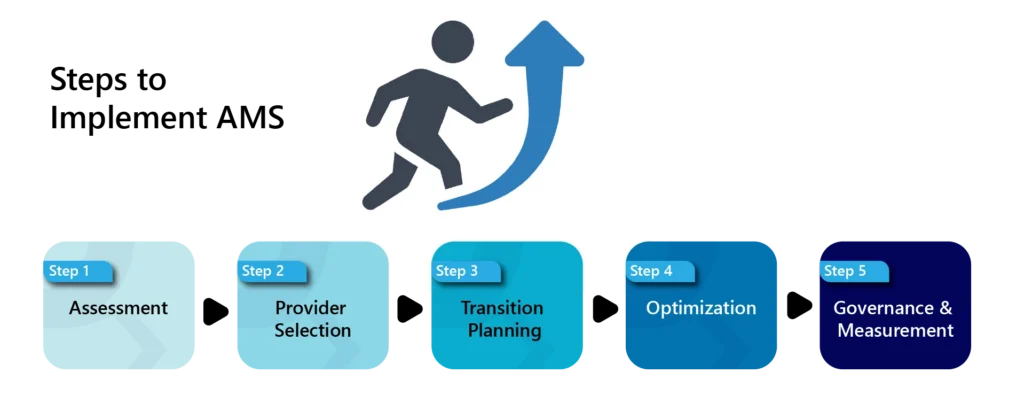
Step 1 — Assessment: Evaluate the current application landscape. Identify the critical apps, pain points, and inefficiencies that will define AMS priorities.
Step 2 — Provider Selection: Choose an application management services provider with proven expertise, automation capability, and industry alignment and favor outcome-based contracts over time-and-material ones.
Step 3 — Transition Planning: Build a phased plan. Start with non-critical applications to prove out the process, then move mission-critical systems once confidence is established.
Step 4 — Optimization: Use automation, AI agents, and predictive analytics to keep improving performance, with AMS wired directly into DevOps pipelines.
Step 5 — Governance & Measurement: Set KPIs — MTTR, SLA adherence, user satisfaction — and governance frameworks that keep everyone accountable.
How AMS Is Evolving in 2026

- AI agents are taking over triage: Intelligent agents now handle incident triage, root cause analysis, and increasingly self-healing — cutting resolution time without waiting on a human queue.
- Outcome-based delivery is replacing time-and-material contracts: Providers are being paid for measurable business results, not hours logged.
- DevOps integration is now the default: AMS is increasingly wired into agile and DevOps practices for continuous, low-friction releases.
- Predictive analytics is moving AMS upstream: Teams are using data to anticipate issues before they ever reach the user.
- Cross-vendor transparency is replacing opaque SLAs: Enterprises increasingly demand unified visibility across every provider touching their application estate.
Conclusion
Application management services provide a way to move from keeping applications operational to continuously improving their business value. With the right combination of proactive monitoring, automation, modernization, governance, and domain expertise, enterprises can make their application landscape more resilient, responsive, and aligned with changing business needs.
The real measure of AMS is not simply how quickly a ticket is closed or how many incidents are resolved. It is whether applications perform better, users have better experiences, technology teams can focus on innovation, and the business can adapt faster.

Assistant Manager – Marketing (Analyst Relations), Everforth Quinnox
FAQs About Application Management Services
Application management is holistic — it covers governance, optimization, and full lifecycle management. Application maintenance is narrower: bug fixes, patches, and updates.
AMS stands for Application Management Services — the structured management of enterprise applications across their lifecycle.
AMS typically includes monitoring, incident resolution, upgrades, integration, and analytics — everything needed to keep an application portfolio healthy and aligned with the business.
AMS focuses specifically on applications. Managed services cover broader IT functions, including infrastructure, networks, and security.