Accelerate IT operations with AI-driven Automation
Automation in IT operations enable agility, resilience, and operational excellence, paving the way for organizations to adapt swiftly to changing environments, deliver superior services, and achieve sustainable success in today's dynamic digital landscape.
Driving Innovation with Next-gen Application Management
Next-generation application management fueled by AIOps is revolutionizing how organizations monitor performance, modernize applications, and manage the entire application lifecycle.
AI-powered Analytics: Transforming Data into Actionable Insights
AIOps and analytics foster a culture of continuous improvement by providing organizations with actionable intelligence to optimize workflows, enhance service quality, and align IT operations with business goals.
According to Forbes study, roughly 95% of enterprise generative AI pilots deliver no measurable return on investment (ROI), and the report puts the production-reach rate for custom-built enterprise AI tools at around 5%. That’s not a technology problem. Interviews behind the report point again and again to the same root cause: tools that looked impressive in a demo but couldn’t hold context, adapt to real workflows, or survive contact with messy, real-world data.
Every enterprise has a graveyard of initiatives that looked great in a demo and disappeared six months later. Technology worked. The vendor delivered it. And yet nothing made it to production. The culprit, often, is a simple structural confusion in the poc vs pilot framework—two phases that sound similar, serve completely different purposes, and require very different rules of engagement: the Proof of Concept (PoC) and the Pilot.
Go deeper: The complete AI PoC playbook
This blog covers the PoC vs. Pilot framework. Our step-by-step guide takes you further, with a structured approach to define objectives, select AI models, prepare data, and build a business case that clears the decision gate.
If this sounds familiar, our guide to fixing stalled AI PoCs breaks down exactly where these initiatives get stuck.
Getting this right isn’t a matter of labelling exercises correctly. It’s a matter of knowing exactly what bet you’re placing, what question you’re trying to answer, and how much it will cost you if you’re wrong.
Key Insight: The failure Forbes documented isn’t a technology failure – it’s a sequencing failure. Teams skip straight to a live deployment without ever isolating whether the underlying tech can do the job. PoC and Pilot exist to separate those two risks, so you’re never betting both at once.

The PoC: Your Cheapest Way to Find Out If It's Even Possible
A Proof of Concept is a technical investigation – a controlled experiment designed to answer a single, clearly bounded question before any significant investment is made.
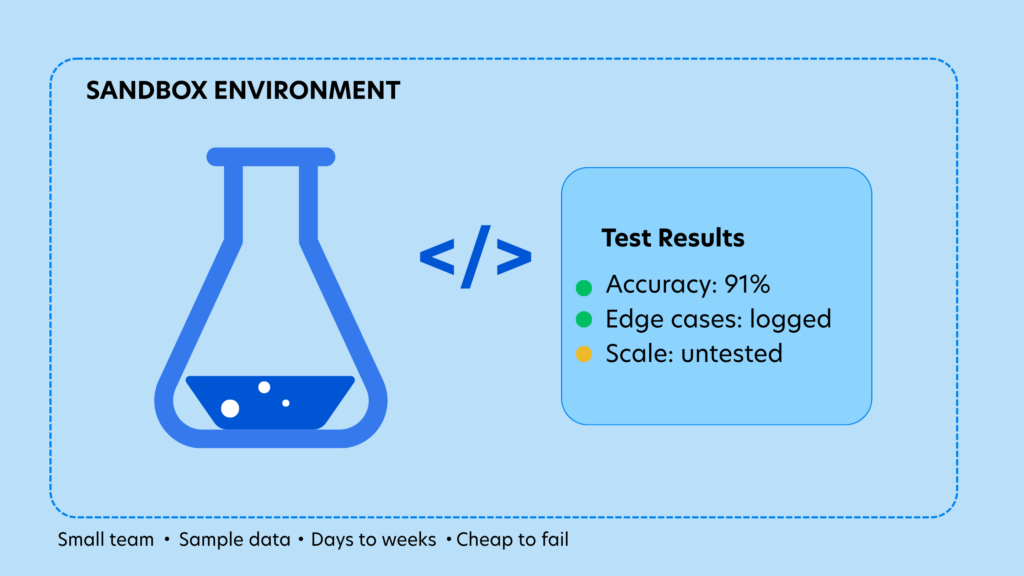
It lives in a sandbox – and getting that PoC environment set up correctly is half the battle. It uses sample or synthetic data. It involves a small technical team and no real-end users. It runs for days to a few weeks — never months. And it is, by design, deliberately cheap.
The PoC’s only job is to answer: “Can this work – technically – for our specific use case?”
Not “will our users like it.” Not “will it fit into our workflows.” Not “can we scale it.”
Just: does the underlying technology survive first contact with our environment, our data formats, and our requirements?
Explore more on why QA in software testing is mission-critical to your digital success.
What a PoC Looks Like in Practice: Three Quick Examples
Insurance: A large insurer wants to know whether an AI model can classify incoming claims documents by type and urgency, before a human ever touches them. Rather than building a full integration, the IT team gathers 500 sample documents from historical archives, runs the model in an isolated environment, measures classification accuracy against a manually labelled ground truth, and documents every edge case where the model stumbles. This is a natural fit for generative AI PoC approaches, since the task is fundamentally about extracting and classifying unstructured content.
Banking: A retail bank wants to test whether a large language model can summarize customer complaint transcripts accurately enough to route them to the right department. The team pulls 300 anonymized transcripts, runs them through the model, and has compliance staff score the summaries for accuracy and omissions – no live customer interactions involved.
Manufacturing: A plant wants to know if a computer-vision model can spot defects on a component line. Engineers feed it a static library of images from past quality-control audits — good parts and known-defective parts — and check whether the model’s detection rate clears a usable threshold, entirely offline. Where the “model” is really a set of coordinating agents rather than a single classifier, this starts to look more like an agentic AI PoC than a traditional one.
None of these involve live transactions, real customers, or system integration. That’s the point. A PoC is an honest, cheap attempt to find out whether the idea is technically viable before committing budget to anything larger.

“A PoC is not a smaller pilot. It’s a different instrument, built to answer a different question – the moment teams treat it as a scaled-down pilot, they lose the thing that makes a PoC valuable: its cheapness to fail.”
Krishna Kumar Chakirala,
VP – AI & Data Engineering, Everforth Quinnox
| Dimension | Detail |
|---|---|
| Primary question | Can this technology work for our use case? |
| Environment | Sandbox, isolated from production systems |
| Data | Sample, synthetic, or anonymised historical data |
| Users | Technical team only - no real end users |
| Duration | Days to a few weeks |
| Cost | Low - intentionally minimal |
| Success metric | Pass/fail on technical feasibility |
| Output | A go/no-go recommendation with documented findings |
A PoC that fails is not a failed project. It’s a cheap answer to an important question.
The Pilot: Where Theory Meets Real Users (and Real Resistance)
A Pilot is an operational validation – a real-world, bounded deployment that tests whether a technically proven idea actually performs inside your organization’s people, processes, and systems.
Where a PoC asks “can it work?”, a Pilot asks: “Does it work here – with our data, our teams, and our workflows?”
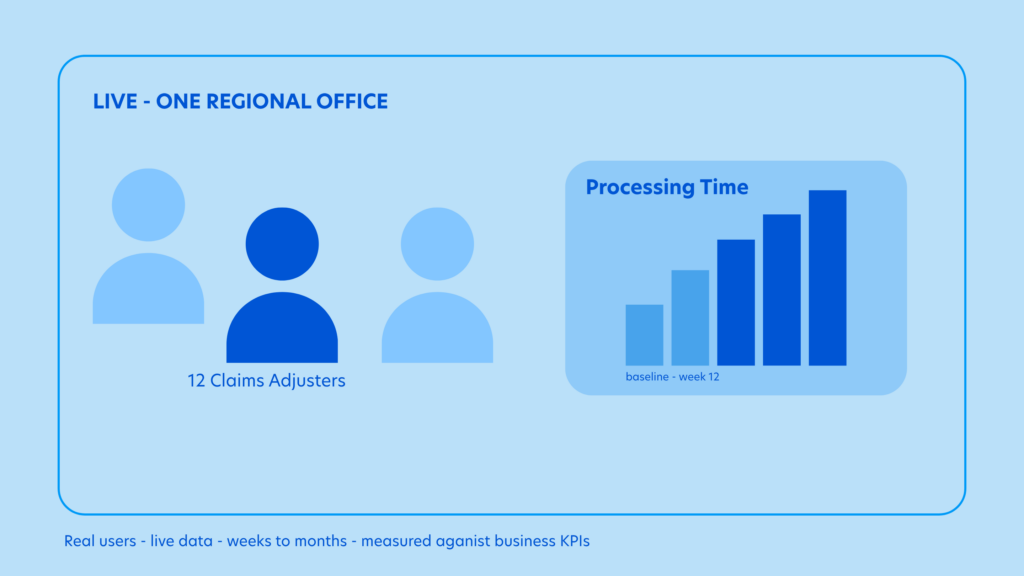
A pilot runs with real users. It uses live or production-representative data. It integrates, at least partially, with the systems it will eventually replace or complement. It runs for weeks to several months. And it is measured not on technical performance alone, but on actual business outcomes: adoption rates, processing time, error reduction, user satisfaction, cost impact.
Back to the Insurer: The Pilot Begins
Back to the insurer: the PoC delivered strong results – 91% classification accuracy on sample data. Technology works. Now the real test begins.
The team runs a 90-day pilot in one regional claims office. Twelve claims’ adjusters use the tool on all incoming documents for that office. The system is integrated with the existing claims management platform. Weekly feedback sessions capture friction points and workflow gaps. Metrics tracked include processing time against baseline, escalation rates, adjuster trust in AI outputs, and critically – the data quality issues that never showed up in the sandbox.
That’s a Pilot. It’s bounded: one office, 12 users. But it’s real – real documents, real data,
| Dimension | Detail |
|---|---|
| Primary question | Does this work in our real environment? |
| Environment | Live or near-live, bounded to one team/region/process |
| Data | Live or production-representative data |
| Users | Real end users - specific cohort or business unit |
| Duration | Weeks to several months |
| Cost | Moderate - real resources, real integration work |
| Success metric | Business KPIs: adoption, efficiency, ROI |
| Output | Evidence base for full production rollout - or a structured kill decision |
A Pilot that fails is not a failed project either – if it has clear exit criteria and a decision-maker ready to act on the findings.
PoC vs. Pilot? So... Which One Do You Actually Need
PoC vs. Pilot? So… Which One Do You Actually Need
Start with a PoC if:
- The technology is new to your organization or unproven for your specific use case
- You have genuine technical uncertainty – “we don’t actually know if this is possible”
- You need a fast, cheap way to rule ideas in or out before committing budget
- You’re comparing multiple technical approaches and need a basis to decide
Skip the PoC, go straight to a Pilot if:
- The technology is mature and proven at scale elsewhere
- A credible vendor or peer organization has already demonstrated feasibility in a comparable environment
- The real uncertainty isn’t technical – it’s about user adoption, workflow fit, or change management
- You have sufficient prior evidence from analogous implementations to treat feasibility as settled
- You have sufficient prior evidence from analogous implementations to treat feasibility as settled
The honest gut check: Ask two questions:
- Are we genuinely unsure whether this will technically work? → If yes, PoC first.
- Are we confident it works, but unsure whether we can absorb it? → Pilot first.
If you’re answering both with “a bit of both,” you likely need the PoC to be shorter and sharper – not a hybrid that tries to answer operational questions in a sandbox.
If you’re unsure where your organization even stands before you start, an AI readiness assessment is a useful gut check before you scope either one.
The Challenges Organizations Actually Face: 5 Common Traps
Understanding the definitions is the easy part. Executing them well is not. Here are the points where organizations most often lose momentum – or money.
1. No Success Criteria Defined Upfront
The single most costly mistake in both PoC and Pilot planning is starting without a written definition of what “success” looks like. Without it, teams retroactively justify whatever happened. A PoC where the model performed at 65% accuracy becomes “directionally promising.” A pilot with 20% user adoption becomes “a learning experience.” Both descriptions might be technically fair – but without predefined criteria, the organization has no basis for a clear go/no-go decision, and the initiative drifts.
Fix: Write the exit-criteria document before the experiment begins. “This PoC succeeds if the model achieves >85% classification accuracy on the test dataset.” “This Pilot succeeds if >70% of participating users have adopted the tool into daily workflow within 60 days.”
2. PoC Scope Creep - When Sandboxes Become Pilots in Disguise
A PoC that starts adding real users, real data, and real stakeholder pressure isn’t a PoC anymore – but it also doesn’t have a governance, success metrics, or business ownership for the pilot program. This hybrid state is where initiatives go to stall. The team is too invested to kill it; the effort isn’t structured enough to advance it.
Fix: Set a hard boundary at the start. If you need to answer operational questions, run a pilot. If you need to answer technical questions, run a PoC. Not both at once.
For a clearer sense of where a PoC ends, and a pilot or MVP begins, see PoC vs. MVP vs. Prototype.
3. The Pilot-to-Production Gap
This is where the majority of enterprise AI initiatives are currently dying, and the scale is larger than most executives assume. According to industry research that’s built on interviews with 150 leaders, a survey of 350 employees, and analysis of roughly 300 AI deployments, found that only about 5% of custom enterprise AI pilots reach production with measurable financial impact.
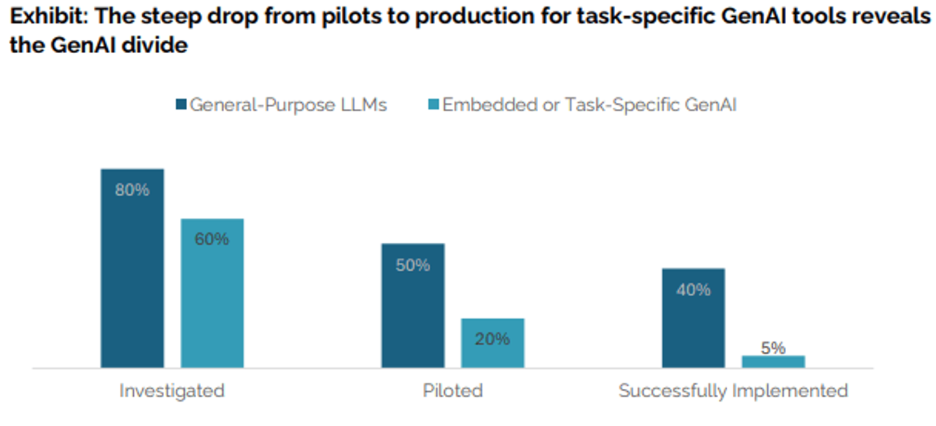
Source: MIT Research
A pilot clears. The results are positive. And then – nothing. The initiative sits in a state of “promising but not prioritized” for months; the business owner moves on, the team re-orgs, and the next budget cycle funds something newer.
“The output of a pilot is a decision, not a document.” A successful pilot that doesn’t end in a scheduled scale/extend/stop decision hasn’t actually finished – it’s just paused indefinitely, which is a slower way of failing.
Fix: The pilot must end with a scheduled, executive-level decision meeting – not a report that goes into a shared folder. The output of a pilot is a decision, not a document.
4. Underestimating Data Readiness
Many pilots fail not because the technology is wrong, but because the production-grade data pipeline was never built. The pilot ran on cleaner, better-structured data than the business actually has day-to-day – and nobody discovered this until the production rollout. This is worth taking seriously on its own terms: data quality is often the real blocker to AI success, not the model.
Fix: Make data profiling part of both the PoC and Pilot scope. Understand the gap between your “demo data” and your real data early, not late.
5. Treating Change Management as an Afterthought
This is the most overlooking point in enterprise technology programs. Many pilot failures trace back not to model performance or system integration, but to user adoption. Staff don’t trust the output. The managers didn’t communicate why. The tool solves a problem the team didn’t feel they had. No training was built into the pilot plan.
One recurring pattern from MIT’s interviews: employees quietly kept using their own personal AI tools even after a sanctioned pilot was underway – a kind of shadow-IT vote of no confidence in the “official” rollout. That’s rarely a technology signal. It’s usually a trust and workflow-fit signal.
Key Insight: If your pilot participants are quietly falling back on their own tools, that’s not a footnote – it’s your most honest piece of pilot data. Adoption gaps rarely show up in the metrics dashboard first; they show up in what people do when nobody’s watching.
Fix: Name a change management lead at the start of the Pilot, not the production rollout. Build communication, training, and feedback loops into the pilot design – not as additions, but as core deliverables.
How to Transition from PoC to Pilot: Your Practical Six-Step Roadmap
A successful PoC doesn’t automatically translate into a Pilot. It earns the right to have a structured conversation about whether a Pilot is the right next step – and what it needs to look like.
Our AI PoC roadmap walks through this in more depth if you want a step-by-step planning tool.
Here’s how to make that transition deliberately rather than accidentally.
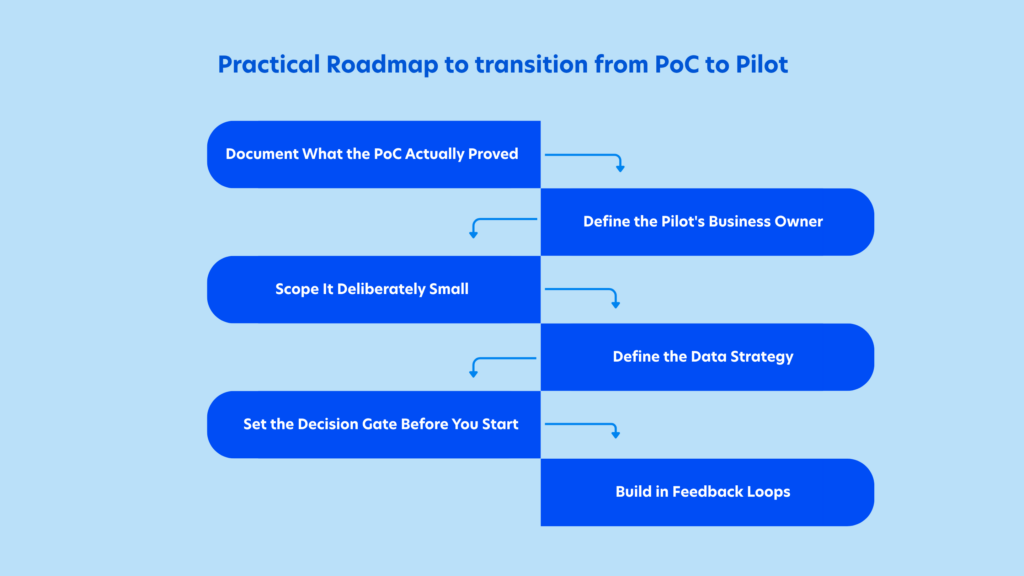
Step 1 - Document what the PoC actually proved
Write a clean PoC closure report. An honest record of what was tested, what the results were, what edge cases emerged, and what questions remain unanswered. The unanswered questions become the pilot’s scope.
Step 2 - Define the pilot's business owner
A PoC can be owned by IT or an innovation team. A Pilot cannot. There must be a named business leader accountable for the pilot’s KPIs, not just its technical delivery. If no business owner will put their name to the outcome, the idea isn’t ready to pilot.
Step 3 - Scope it deliberately small
The temptation after a strong PoC is to run an ambitious pilot across multiple locations and teams. Resist in this. A pilot scoped too wide loses the ability to learn. Start with one business unit, one region, or one process. Prove the model before expanding.
Step 4 - Define the data strategy
In the next step, make sure that the data used in the pilot is representative of production conditions. If it isn’t, you’re still in a sandbox – just a more expensive one.
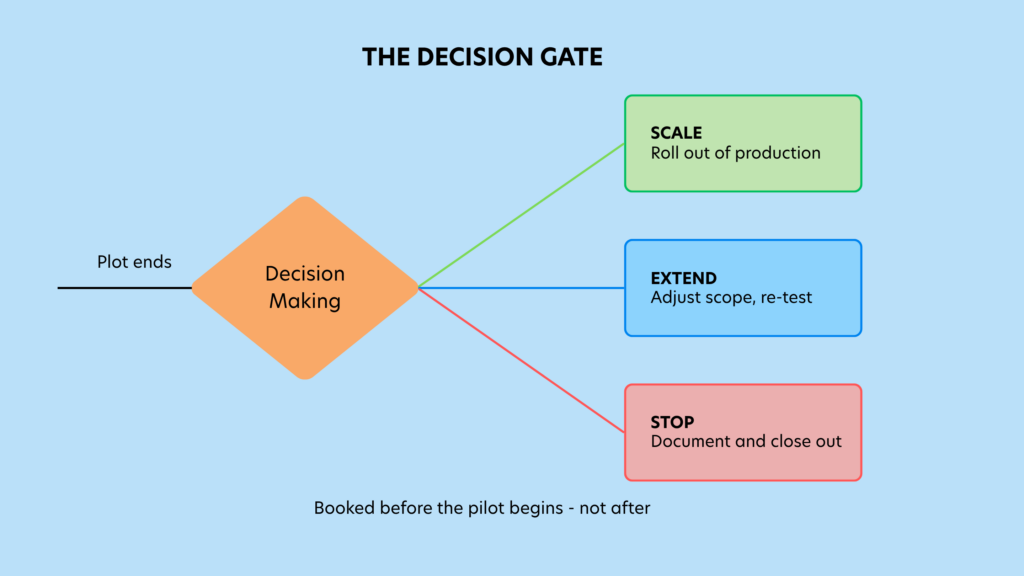
Step 5 - Set the decision gate before you start
Book the decision meeting before the pilot begins – six weeks out, ten weeks out, whatever fits the timeline. The meeting exists to make one of three decisions: scale to production, extend the pilot with adjusted scope, or stop. Having this meeting scheduled upfront changes the behavior of everyone involved. It creates accountability.
Step 6 - Build in feedback loops
Establish weekly or bi-weekly touchpoints with pilot participants – not to chase metrics, but to hear what’s actually happening on the ground. The qualitative signal from real users in a live environment is often more valuable than the quantitative data, especially in the first weeks of a pilot.
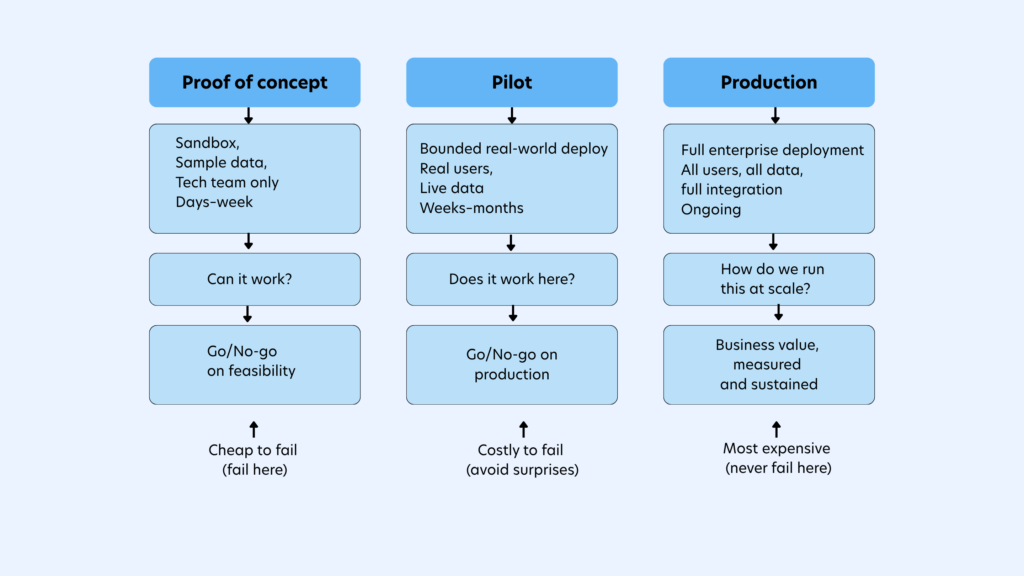
The PoC → Pilot → Production Framework at a Glance
Ready to Pilot? Prove It in 5 Checkboxes
Before greenlighting a pilot, an honest “yes” to all five of these should be non-negotiable:
- We have a PoC closure report with documented results and open questions
- A named business leader – not IT – owns the pilot’s success metrics
- Written exit criteria exist and are signed off before day one
- The decision-gate meeting is already on the calendar
- A change management plan (training, communication, feedback loops) is built into the pilot design, not bolted on afterward
If any box is unchecked, the honest move is to fix that first – not to start the clock anyway and hope it resolves itself mid-pilot.
What This Means for Enterprise Leaders
If you are sponsoring a technology initiative right now, ask yourself three questions:
1. Do we know which stage we’re in? If your team can’t immediately tell you whether the current initiative is a PoC or a Pilot – and name the specific question it’s designed to answer – you are in neither. You are in drift.
2. Do we have exit criteria? Written, agreed, signed off before the work started? If not, every result will be interpreted to justify continuation rather than to drive a decision.
3. Is there a business owner, not just a technical owner? If the only person accountable for the initiative’s outcomes is an engineer or a project manager, it will likely never make it to production. Someone in the business needs to own the outcome – not just the execution.
Most Insightful Guide: The Next-Gen Testing Blueprint: Shift SMART with Intelligent Quality (IQ)
Test automation is only as valuable as its ability to stay current. In rapidly evolving applications, brittle test scripts that break with every UI change create a maintenance overhead that can quickly consume more engineering time than the automation saves. This is one of the most common reasons QA automation programmes stall or regress.
Self-healing automation uses AI to detect when a UI element or application behaviour has changed and automatically updates the affected test case – without manual intervention. This keeps the test suite current at the pace of development, maintains coverage without a growing maintenance backlog, and preserves the ROI case for automation investment over time.
For enterprises managing large, complex application estates, self-healing capability is not a nice-to-have — it’s a prerequisite for sustainable automation at scale.
Wrap Up
Getting enterprise AI right isn’t about moving fast – it’s about placing the right bet at the right stage: a PoC to settle technical feasibility, a Pilot to prove operational fit, and Production to turn a validated idea into sustained business value.
At Everforth Quinnox, we accelerate this journey with Everforth AI Studio (EAI) -our AI innovation hub, built to help enterprises test ideas faster, scope pilots smarter, and move from validated concept to production without stalling in the middle.
Whether you’re settling a technical feasibility question or scoping a pilot that needs to earn its way to production, our stage-gated, business-KPI-first approach ensures every experiment is built to answer the question that’s actually holding you back – backed by data, driven by outcomes.
Why guess when you can validate? Connect with our experts today.
Meanwhile, schedule a call with us to discuss a customized AI PoC or Pilot roadmap tailored to your specific business needs.

Lead, Marketing, Everforth Quinnox
FAQ’s Related to QA Software Testing Services
No. A PoC tests whether a technology can technically work, in a sandbox, with sample data and no real users. A pilot tests whether that already-proven technology works inside your real environment – real users, real data, real workflows. See PoC vs. MVP vs. Prototype for how the two also compare to an MVP.
A successful PoC earns the right to a structured conversation about a pilot – not an automatic green light. That means writing a PoC closure report, naming a business owner, and deliberately scoping a small, bounded pilot. Our AI PoC roadmap lays out the full path from PoC to production.
Typically, weeks to several months, depending on the process being tested and how long it takes to see a reliable read on adoption and business KPIs. The key isn’t hitting an exact duration – it’s setting up the decision-gate meeting before the pilot starts, so it ends in a scale/extend/stop decision rather than running indefinitely.
Yes, when the technology is already mature and proven at scale, or a credible vendor or peer has demonstrated feasibility in a comparable environment. In that case, your real uncertainty is operational (adoption, workflow fit, change management), not technical – so a PoC would just be answering a question you already know the answer to.
A pilot validates whether an already-built solution works inside your organization’s real processes and people. An MVP is a product-development approach — the smallest usable version of a product built to learn from real users and iterate. They can overlap, but a pilot is about validating fit for a specific enterprise, while an MVP is about learning what to build next.