Accelerate IT operations with AI-driven Automation
Automation in IT operations enable agility, resilience, and operational excellence, paving the way for organizations to adapt swiftly to changing environments, deliver superior services, and achieve sustainable success in today's dynamic digital landscape.
Driving Innovation with Next-gen Application Management
Next-generation application management fueled by AIOps is revolutionizing how organizations monitor performance, modernize applications, and manage the entire application lifecycle.
AI-powered Analytics: Transforming Data into Actionable Insights
AIOps and analytics foster a culture of continuous improvement by providing organizations with actionable intelligence to optimize workflows, enhance service quality, and align IT operations with business goals.
In 2025, the conversation around artificial intelligence in the enterprise has reached a tipping point. But it’s no longer generative AI chatbots or large language models that are stealing the spotlight – it’s about prototypes building themselves, systems troubleshoot without prompting, and ideas move from whiteboard to working model in hours – not months. This isn’t speculative fiction; it’s the real-time shift happening inside enterprises powered by autonomous AI agents.
Once considered experimental or confined to isolated R&D labs, agentic AI is now at the heart of enterprise innovation. These autonomous agents aren’t just running tasks – they’re designing, iterating, and orchestrating entire proof-of-concept cycles. And in doing so, they’re reshaping how enterprises prototype, validate, and scale ideas with unmatched speed and intelligence.
According to an industry report, 85% of enterprises will use artificial intelligence agents in 2025. This is because they are essential to business efficiency, cost savings, and improved customer interaction. That’s not just progress – it’s a reinvention of how businesses operate. From automating IT workflows and transforming customer support to streamlining logistics and minimizing financial exposure, these autonomous agents are proving their importance across every corner of the enterprise.
In this blog, we’ll walk you through a structured, rapid-prototyping approach to agentic AI – the one that takes you from bold ideas to fully functioning autonomous agents.
What is Agentic AI?
Agentic AI refers to a new class of artificial intelligence systems designed to operate autonomously with a sense of purpose, initiative, and adaptability. Unlike traditional AI models that wait for human prompts to act, agentic AI systems are proactive – they can sense their environment, make decisions, and take actions toward specific goals without constant supervision.
These agents act like intelligent digital coworkers – capable of handling multi-step tasks, prioritizing objectives, and responding to change as it happens.
Understanding Proof of Concept (PoC)
A Proof of Concept (PoC) is a focused, time-bound experiment designed to validate whether an idea or solution is technically feasible and capable of delivering value before investing in full-scale development. In the context of agentic AI, a PoC becomes a critical first step in turning ambition into action.
PoCs allow enterprise teams to explore use cases like autonomous process handling, multi-agent collaboration, or decision automation – without overhauling infrastructure. Most importantly, it builds stakeholder confidence, creates internal momentum, exposes practical integration points, and sets the stage for phased deployment.
How Agentic AI is Transforming Enterprise PoCs
The traditional approach to Proof of Concept often resembles a one-off sandbox experiment – constrained in scope, slow to execute, and disconnected from production reality. But with agentic AI, PoCs are evolving into dynamic, intelligent prototypes that can operate autonomously, learn from real-world interactions, and adapt on the go.
What makes agentic AI particularly transformative is its ability to simulate real enterprise conditions in a PoC environment. As a result, organizations can validate not just whether a solution works, but how it performs, scales, and collaborates in complex workflows. This shift reduces time-to-value, minimizes risk, and builds confidence needed to scale with purpose.
Step-by-Step Approach to Agentic AI–Driven PoCs
1. Identify a Narrow, High-Value Use Case
The best agentic PoCs don’t start with moonshot ideas; they begin with precise, manageable challenges that deliver meaningful outcomes. Enterprises should target areas where rules-based logic dominates, where human bottlenecks slow down decision-making, or where the volume of repetitive tasks is high.
For Instance, consider a banking process like pre-approval checks for credit cards. It follows a structured sequence – credit score verification, document validation, and eligibility rules. Yet, delays arise due to manual review cycles. This is a sweet spot for an agentic PoC: it’s bounded, measurable, and has clear business impact.
2. Define Agent Goals and Boundaries
Before deploying the agent, treat it like a new team member: what role is it meant to play? What tools does it need? What decisions can it make alone, and when should it escalate?
A well-scoped agent goal might sound like: “Process incoming insurance claims and triage them into three categories: approve, escalate, or reject – while reducing average handling time by 30%.”
But it doesn’t stop at defining success. You must also set boundaries:
- What data can the agent access (e.g., read-only database access)?
- What systems can it interface with (e.g., CRM sandbox, ticketing tools)?
- What is off-limits (e.g., modifying customer records in production)?
These constraints not only build trust in the pilot but ensure compliance with governance and privacy protocols, especially critical in regulated industries.
3. Integrate with Real Enterprise Systems
Unlike traditional PoCs that operate in isolation, agentic AI must be placed in an environment that mirrors production – otherwise, the agent’s performance won’t reflect reality.
This means exposing the agent to the same tools, APIs, workflows, and data structures it would encounter post-deployment. Enterprises often start with sandboxed versions of systems. The agent is granted credentials, limited permissions, and a clear context – just like a junior analyst or operator would receive.
For example, if the agent is tasked with generating monthly reports, it gives access to historical datasets, report templates, and data visualization libraries. If it’s handling service tickets, connect it to the ticketing system and simulate real user inquiries.
By interacting with enterprise systems early, the agent can surface unforeseen integration issues or data quality gaps before they become blockers at scale.
4. Observe Behavior and Adaptability
With the agent in action, the real test begins – not of whether it works perfectly, but of how well it responds when things don’t go as planned.
Monitor how the agent:
- Responds to incomplete data,
- Handles unfamiliar inputs or exceptions,
- Chooses among available tools,
- And self-corrects when its actions don’t yield expected results.
This is where agentic AI proves its worth. Instead of static scripts that fail on edge cases, a well-tuned agent will adapt – changing its strategy, asking clarifying questions, or escalating intelligently. These capabilities aren’t pre-programmed; they emerge from memory, feedback loops, and multi-step reasoning.
This phase should also include a continuous refinement cycle. Analyze logs, tweak prompts, adjust agent memory, and – if needed – expand toolkits. Over days or weeks, the agent evolves from a basic assistant into a context-aware operator, better equipped to handle real-world complexity.
5. Measure Outcomes with Precision
A successful PoC isn’t just a working demo – it’s a data-driven argument for scaling. That’s why outcome measurement must be deliberate and multidimensional.
Start by defining clear KPIs:
- Operational efficiency (e.g., cycle time reduction, error rates),
- Business impact (e.g., cost savings, revenue uplift),
- User experience (e.g., satisfaction scores, resolution times).
Collect this data both quantitatively and qualitatively. Business users interacting with or reviewing the agent’s output should provide structured feedback. Did the agent align with expectations? Was it reliable? Was the output useful or confusing?
Capturing these signals across several iterations provides a complete picture of value creation – and helps justify the investment in turning the PoC into a scaled solution.
6. Iterate Quickly and Scale
One of the greatest strengths of agentic AI is its ability to improve through iteration. Rather than building a new system from scratch each time, the agent evolves – learning from errors, adapting to new prompts, and integrating additional tools or datasets.
Once a single-agent PoC proves its value, enterprises can expand its scope:
- Deploy it to handle adjacent tasks (e.g., from claims triage to fraud screening),
- Introduce multi-agent orchestration, where several specialized agents collaborate,
- Or integrate it with upstream/downstream workflows to create a seamless business process.
To support this evolution, enterprises should start formalizing infrastructure:
- Versioning prompts and agent configurations,
- Creating reusable data pipelines,
- Embedding fail-safes, alerting, and monitoring tools,
- And documenting agent behavior for transparency and compliance.
By investing in these foundations during the PoC phase, enterprises ensure that what starts as an experiment can mature into a production-ready, enterprise-grade solution – complete with scalability, security, and resilience.
Read the Full blog: Why does PoC matter in software development
Real-World Use Cases by Industry
AI agent business use cases span across industries—from autonomous IT incident resolution in large enterprises to AI agents managing personalized customer support in e-commerce.
Banking
Agentic AI can evaluate loan applications, retrieve customer history, and flag incomplete data – reducing turnaround times from days to minutes. In fraud detection, agents continuously scan transactions across systems, escalating only when risk patterns are detected.
Insurance
Agents handle first notice of loss (FNOL) processing – automatically collecting incident details, categorizing claims, and initiating payouts or routing to human adjusters. They also help underwriters by pre-analyzing risk profiles.
Financial Services
Regulatory compliance is data-heavy and time-sensitive. Agents can reconcile internal data with external regulations, detect mismatches, and even draft reports for review. In wealth management, they assist advisors by generating personalized portfolio suggestions based on live market data.
Retail
AI agents optimize dynamic pricing, adjust discounts based on inventory levels, and generate product bundles tailored to local demands. On the customer side, they handle order tracking, service requests, and post-purchase engagement across channels.
Manufacturing
Production planning agents assess machine availability, raw material stock, and delivery schedules to update manufacturing timelines in real time. Predictive maintenance agents monitor sensor data and automatically schedule repairs before failures occur.
Supply Chain & Transportation
Logistics agents reroute shipments in response to weather or traffic delays, while others dynamically select the best carriers based on cost and performance data. In warehouse management, agents coordinate picking and packing to maximize throughput and accuracy.
Related Read: Top 30+ AI Agents Use Cases for Business Success
Framework to Build an Agentic AI PoC
To build a meaningful agentic AI PoC, enterprises need a clear evaluation framework that goes beyond technical feasibility. The decision to prototype an agent should be rooted in business value, control needs, and contextual complexity.
Here’s a five-dimensional lens to guide that decision:
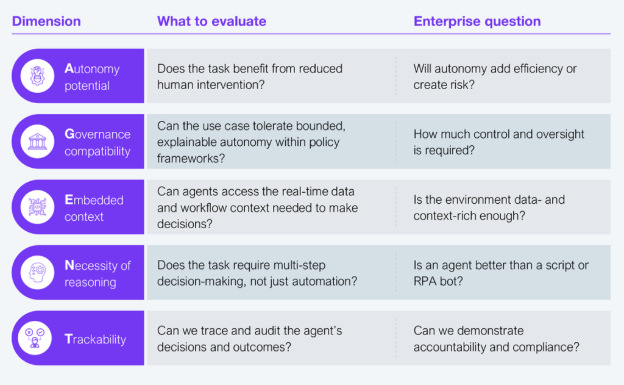
Source: HFS Research – Make the case for agentic AI in your enterprise, PoV by David Cushman
1. Autonomy Potential

Agentic AI thrives in use cases where manual involvement slows down throughput, introduces bottlenecks, or limits scalability. These include triage systems, form validations, approvals, and information routing – processes that are rules-heavy but context-sensitive.
Consider customer support: According to a Salesforce study, agents spend up to 25% of their time triaging tickets before solving them. A well-trained autonomous agent can handle this triage, classify intents, and assign priorities, freeing humans for resolution.
2. Governance Compatibility

Governance is often the deal-breaker in PoC deployment. In regulated environments like healthcare, finance, or government, full autonomy isn’t viable without explainability, logging, and escalation protocols.
Agentic AI, unlike black-box AI models, can be configured with guardrails, role-based permissions, and decision thresholds – creating bounded autonomy that allows for initiative but within tight compliance frameworks.
According to a industry study, 63% of enterprise AI leaders cite governance as their top concern when adopting autonomous systems. This is why governance compatibility must be evaluated before any PoC moves forward.
Processes that already operate within clearly defined policy boundaries (e.g., fraud detection rules, SLA-driven workflows, or compliance-based document reviews) are often better suited for agentic experimentation because the “rules of engagement” are already encoded.
3. Embedded Context

Autonomous agents are only as smart as their situational awareness. Without rich, real-time access to contextual signals – such as database records, process states, customer history, or API access – they cannot reason effectively.
In fact, enterprises with real-time data integration pipelines saw 2.6x better performance from autonomous agents versus those relying on static datasets.
Let’s say you’re building an agent to assist with IT incident triage. If it can only see the ticket title and not the full event log, system state, or user profile, its decision-making will be constrained and error-prone. But if integrated with monitoring systems, configuration management databases (CMDB), and historical ticket outcomes, the agent can prioritize, respond, and even suggest resolutions more effectively.
4. Necessity of Reasoning

Not every task needs agentic intelligence. Many back-office processes (e.g., data entry, simple report generation) are better suited to RPA or BPM tools. But tasks that involve trade-offs, planning, sequencing, or context-switching are where agentic AI truly shines.
According to a report from McKinsey Global Institute, 60% of enterprise tasks involve at least some level of cognitive decision-making, and 20% involve multi-layered reasoning – making them unsuitable for rule-based automation.
Example: In supply chain management, an autonomous agent might not just reorder stock when inventory drops – it may check weather disruptions, supplier SLAs, transport availability, and current pricing trends before making a recommendation. This is reasoning in action, and it’s what sets agentic AI apart from deterministic scripts.
5. Trackability

Transparency is essential, especially in environments where AI-driven decisions affect financial, legal, or customer-facing outcomes. Enterprises must ensure that every action taken by an agent can be logged, audited, and explained in natural language or logical trace.
Framework in hand — now build the PoC that scales.
Download our step-by-step AI PoC Strategic Roadmap. Frameworks, success metrics, and real enterprise case studies, all built so your agentic AI PoC is designed to scale from day one.
Challenges and Considerations in Deploying Agentic AI PoCs
While agentic AI brings transformational potential, deploying it – even at the PoC stage – comes with its own set of complexities. These aren’t just technical challenges; they’re organizational, cultural, and strategic. If not addressed early, they can derail even the most promising prototypes.
Here are the most critical challenges enterprises should anticipate, and how to navigate them:
1. Over-scoping the PoC
Challenge: Teams often try too many things in a single PoC, expecting an agent to handle an entire process with all edge cases and logic paths upfront. This leads to complexity, delays, and unclear outcomes.
Why it matters: Agentic systems are powerful but still need iterative design. Stretching them too soon often results in failure, not because of the idea, but due to the unrealistic scope.
Solution: Start with one tightly scoped use case that’s measurable and operationally meaningful (e.g., triaging IT tickets, auto-filling KYC forms). Let the agent prove value in one focused area before you actually scale up.
2. Data and Contextual Blind Spots
Challenge: Agents make decisions based on the data and context available to them. If critical inputs like customer history, transaction metadata, or process states are missing or fragmented, the agent’s reasoning will be flawed.
Why it matters: Even a well-designed agent can fail if it’s working with incomplete or outdated information. It can misinterpret the task or make poor decisions, eroding trust in the system.
Solution: Before launching the PoC, map out all the data the agent will need and ensure API or database access. Use staged environments or synthetic data only when real data isn’t available and simulate production signals closer to the realistic environment.
3. Lack of Guardrails and Oversight
Challenge: Non-defining of agent boundaries leading to incorrect actions, compliance violations, or even system outages.
Why it matters: To better control autonomy, enterprises need to ensure the agent doesn’t operate outside acceptable bounds, especially when it interacts with customers, finances, or sensitive data.
Solution: Define what the agent must and must never do, and the escalation paths asking for human help. Use audit logs to track every decision and enable override mechanisms from the initial stage.
In the world of app development and AI, testing with real user data can create major privacy concerns. Tech firms now use synthetic data to simulate real user behavior, build demo environments for sales pitches, and train ML models safely. Innovation hub like Everforth Quinnox AI (QAI) Studio exemplify how big players are making it easier for businesses to deploy AI faster and more affordably using synthetic datasets in just days and not months.
4. Poor Change Management and Stakeholder Buy-In
Challenge: A technically sound PoC can still fail if business users don’t understand the purpose, value, or trustworthiness of the agent.
Why it matters: Since Agentic AI directly affects how people work, any resistance or skepticism from end-users can stall adoption, especially if they feel displaced or excluded.
Solution: Bring stakeholders into the design phase and explain what the agent will and won’t be able to do. Share early wins and feedback often to build internal momentum.
5. Integration Fragility
Challenge: If the agent isn’t tested in a near-real environment, it may run smoothly in the design phase but fail in production due to integration issues – like inconsistent API behavior, latency, or authentication mismatches.
Why it matters: A PoC is only valuable if it reflects real-world complexity. Integration fragility leads to shallow insights and missed risks.
Solution: Prioritize integration in realistic environments over perfection. Connect the agent to at least one live system and observe how it handles real data flows, error conditions, and latency.
6. Short-Term Thinking on Long-Term Systems
Challenge: Some teams build PoCs with no forward-thinking – using brittle prompts, no documentation, and little version control. This creates friction when transitioning from PoC to pilot or production.
Why it matters: Agentic AI isn’t just a model; it’s an evolving software system. If your PoC has potential, you will definitely want to scale it. Starting from scratch wastes time and breaks continuity.
Solution: Build modularity, logs, and minimal design discipline even at PoC stage. Evaluate “If this works, can we reuse it in production?” If not, re-architect early.
7. Ethical and Compliance Risks
Challenge: Agents that make decisions, especially in regulated sectors like finance, healthcare, or insurance, must comply with policy, ethics, and legal frameworks. Many teams defer this consideration to later phases.
Why it matters: A PoC that leaks data, introduces bias, or violates rules can create liabilities and delay deployment indefinitely, even if technically successful.
Solution: Build ethics and compliance reviews into the PoC process. Use synthetic data when real data is sensitive. Log decisions, explain agent behavior, and create transparency dashboards from the early phase.
Conclusion
Agentic AI is becoming the new engine of enterprise prototyping and innovation. By enabling intelligent systems to observe, reason, and act independently, organizations can dramatically accelerate how they experiment, validate, and deploy transformative solutions. But turning agentic potential into enterprise-scale value demands more than scattered PoCs. It calls for a strategic, structured, and scalable approach.
That’s where Qinfinite, Everforth Quinnox’s intelligent application management platform, plays a defining role. Built on an agent-first architecture, Qinfinite empowers enterprises to move beyond fragmented automation—enabling autonomous agents to monitor, optimize, and adapt complex systems in real time through its digital twin foundation.
Complementing this, Everforth Quinnox AI (QAI) Studio serves as the launchpad for rapid, domain-specific agent innovation. Whether it’s automating compliance in financial services, enhancing supply chain visibility, or improving customer experience, QAI Studio equips teams to prototype fast and scale smart—with agents that are not just capable, but contextually intelligent.
Together, Qinfinite and QAI Studio turn agentic AI from possibility to enterprise reality – helping businesses shift from reactive operations to proactive, self-evolving ecosystems.
FAQs Related to Agentic AI PoC
Agentic AI is an advanced form of artificial intelligence that enables systems to reason, learn, and act independently – without continuous human instruction. These agents can assess goals, adapt to their environment, and make decisions dynamically, making them ideal for complex and evolving enterprise scenarios.
The key benefits include:
Faster iteration: Agents can self-improve and test multiple paths in parallel.
Contextual feedback: They adapt to real data and changing conditions, providing deeper validation.
Scalable insight: Prototypes powered by agents simulate real-world complexity more accurately, which accelerates stakeholder confidence.
Here’s how Agentic AI accelerates timelines:
Rapid experimentation: Agents explore multiple solutions in real time, speeding up discovery.
Reduced human effort: Less dependency on manual input means faster cycles and fewer bottlenecks.
Early validation: Agents generate performance insights continuously, helping teams quickly identify what works – and what doesn’t.
Autonomous Agents bring three major transformations:
From static to interactive prototypes: Agents interact with live systems, simulating real-world complexity far more effectively than scripted demos.
From manual testing to self-learning iterations: They experiment autonomously, learn from feedback loops, and improve performance continuously during the PoC.
From validation to simulation: Instead of testing one fixed outcome, agents explore multiple paths, uncovering what works best under different conditions.
Here are the core components:
Clear business outcome: Anchor the PoC to a measurable objective that solves a real enterprise problem.
Defined agent scope: Be precise about what the agent will do, what tools it can use, and where human oversight is needed.
Access to real-world context: Agents need quality data, system integrations, and process signals to function meaningfully. Governance and safety controls: Even in prototype mode, agents should have rules, escalation paths, and logging, for accountability and trust.
Continuous feedback loops: Plan for rapid testing, monitoring, and iteration. The ability to refine based on real outcomes is where agentic AI thrives.