A QA team has automated its regression suite. CI/CD is in place. Test execution can run across hundreds of scenarios.
Yet a release is still waiting.
The missing dependency is often test data.
A particular customer profile may be required. A transaction may need to exist in a specific state. Several records across different applications may need to remain connected. Production data may be too sensitive to use, while manually creating realistic alternatives can take hours.
This creates a growing enterprise paradox: testing is automated, but the data required to perform testing is not.
Test data management (TDM) is the process of creating, preparing, securing, provisioning, maintaining and retiring the data required for software testing. It helps QA teams obtain realistic, compliant and reusable datasets while reducing manual data preparation and enabling repeatable testing across environments.
Gartner’s 2024 research identified obtaining good-quality test datasets as one of the biggest challenges facing software development teams. In a separate 2025 study “3 Steps to Improve Test Data Management for Software Engineering”, Gartner found that inefficient test data management can increase development bottlenecks and regulatory noncompliance risks and outlined steps for software engineering leaders to improve delivery timelines and software quality.
For enterprises pursuing continuous testing, cloud modernization and faster release cycles, test data management is therefore moving from a supporting QA activity to an engineering and governance capability.
What Is Test Data Management?
Test Data Management (TDM) is the discipline of creating, discovering, preparing, protecting, provisioning and maintaining the data required for software testing.
Gartner describes TDM as the provisioning of data for development and testing in preproduction environments, with modern approaches combining capabilities such as synthetic data generation, data subsetting and masking.
The distinction is important.
TDM is not simply copying production data into a test environment. It is also not synonymous with synthetic data.
A mature TDM capability answers five questions:
- What data does the test require?
- Where can that data come from?
- How sensitive is it?
- How should it be prepared and provisioned?
- How can the same scenario be reproduced reliably?
The objective is data readiness: making the right data state available to the right test at the right time.
Why Test Data Management Matters in Enterprise QA
The importance of TDM increases as enterprise applications become more interconnected.
A single customer journey may span CRM, ERP, APIs, payment systems, identity platforms and downstream analytics. Testing that journey requires more than isolated records; it requires consistent relationships across systems.
There is also a privacy trade-off.
Production data provides realism, but Gartner notes that using production data for testing can create privacy, security and compliance risks. Gartner research (4 Techniques to Generate Synthetic Data for Software Testing” Published: March 12, 2024) highlights synthetic-data generation as one way to create realistic test conditions without exposing sensitive production information.
For enterprise QA leaders, the business case therefore extends beyond tester productivity:
- Faster release cycles
- More consistent regression testing
- Higher coverage of edge cases
- Reduced exposure of sensitive information
- Better test reproducibility
- Lower manual provisioning effort
Key Components of Test Data Management
An enterprise TDM capability typically brings together several complementary capabilities.
1.Data Discovery and Profiling – Identify where test data resides, what relationships exist and which datasets are actually required.
2.Data Classification – determine whether data contains personally identifiable, financial, healthcare or other sensitive information and apply the appropriate controls.
3.Data Masking and Anonymization – transform sensitive production-derived data while retaining enough realism for meaningful testing.
4.Data Subsetting and Cloning – create smaller, purpose-specific datasets rather than copying entire databases when full data volume is unnecessary.
5.Synthetic Data Generation – generate artificial datasets for scenarios where production data is unavailable, restricted or insufficient.
6.Provisioning and Refresh – deliver data into the required environment and restore it to a known state after testing.
7.Data Validation and Quality – Validate test data for completeness, accuracy, referential integrity and business-rule consistency before it is used for testing
8.Governance and Access Control – control who can access datasets, where they can be used, how long they are retained and how their use is audited.
The key insight is that no individual component is TDM by itself. Value comes from orchestrating these capabilities across the testing lifecycle.
How to Gather Test Data for Testing
Test data can be gathered from several sources, depending on the scenario.
- Production-derived data provides high realism for complex business scenarios, but requires strong privacy controls.
- Masked or anonymized data retains useful production characteristics while protecting sensitive attributes.
- Synthetic data is artificially generated and is particularly useful for edge cases, privacy-sensitive scenarios and high-volume testing.
- Subsetted data contains only the records required for a particular test or application flow.
- Boundary and negative-test data deliberately represents unusual, invalid or extreme conditions.
- Performance-test data is designed to reproduce the required volume and distribution for load and scalability testing.
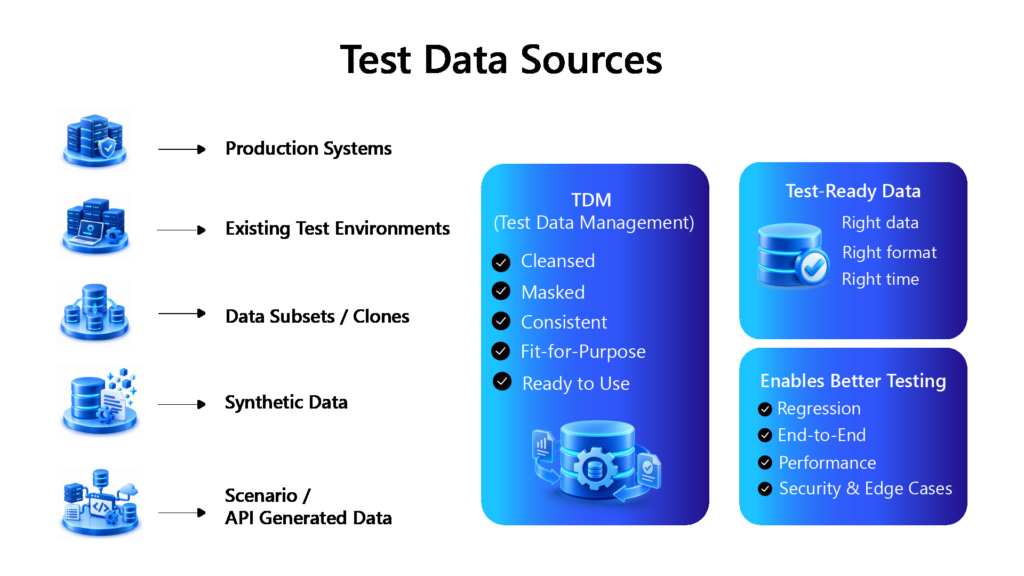
This distinction matters because the best TDM strategy is not necessarily the one with the most sophisticated generation technology.
Test Data Management Process: 7 Steps from Data Discovery to Retirement
A scalable TDM process can be structured around seven stages.
1.Identify the Test Scenario
Start with the business condition being tested rather than the database. Define the entities, states, relationships and edge cases required.
2.Discover and Classify the Data
Identify candidate sources and classify their sensitivity, ownership and regulatory requirements.
3.Select the Data Strategy
Determine whether the scenario requires production-derived, masked, subsetted, cloned or synthetic data.
4.Prepare and validate the Dataset
Apply masking, anonymization, subsetting or generation rules while preserving required relationships and business rules. Validate the dataset for completeness, referential integrity, consistency and required data states.
5.Provision the Data
Make the dataset available in the target environment through self-service or automated workflows.
6.Execute and Reset
Run the test and return the dataset to a known state so the scenario can be reproduced.
7.Govern and Retire
Track usage, refresh datasets when necessary and securely retire obsolete data. The goal is to move from ticket-driven data requests to repeatable data provisioning.
In simple terms, the test data management process moves from identifying what a test needs to making that data securely available, repeatable and reusable.
Best Practices for Effective Test Data Management
Design TDM Around Business Scenarios
Do not begin by asking which database tables to copy. Begin with the business journey and determine the data state required to validate it.
Automate Provisioning and Reset
If testers still need to submit tickets for every dataset, TDM remains a bottleneck. Provisioning, refresh and reset should increasingly be integrated into automated delivery workflows.
Preserve Referential Integrity
Customer, account, order, payment and transaction records must remain logically connected when the test requires those relationships.
Version Test Data
Teams should be able to identify which dataset version produced a particular result. This improves reproducibility and makes failures easier to investigate.
Apply Security by Design
Masking, access control, retention and auditability should be built into the TDM architecture rather than added after implementation.
Use the Minimum Necessary Dataset
Smaller, scenario-specific datasets can reduce provisioning time, storage requirements and unnecessary exposure of sensitive information.
These practices complement our existing guidance on test automation best practices, which identifies reliable test data as an important foundation for enterprise automation.
Test Data Management vs. Test Case Management
The two disciplines are related but serve different
| Test Data Management | Test Case Management |
|---|---|
| Manages the data required to execute tests | Manages the tests themselves |
| Creates, masks and provisions datasets | Defines, organizes and tracks test cases |
| Focuses on data readiness | Focuses on test coverage and execution |
| Maintains data states and relationships | Maintains test steps, results and traceability |
Put simply:
Test case management defines what should be tested. Test data management ensures the conditions required to test it actually exist.
Both need to work together for enterprise application testing to scale.
The Role of AI and Automation in Test Data Management
AI is expanding TDM from data provisioning toward scenario-aware data generation.
AI-assisted testing can interpret requirements, identify potential test conditions and generate data variations for positive, negative and edge-case scenarios.
But AI should not replace conventional TDM techniques.
How to Automate Test Data Management
Step 1 Define reusable data scenarios
Create reusable datasets for common business flows.
Step 2 Automate data generation
Use APIs, scripts or synthetic-data platforms to create required records.
Step 3 Automate masking
Apply data-protection rules whenever production-derived data is used.
Step 4 Integrate provisioning with CI/CD
Allow test pipelines to request and provision data automatically.
Step 5 Automate reset and refresh
Return datasets to known states after test execution.
Step 6 Add data validation
Check completeness, referential integrity and business-rule consistency before tests begin.
Choosing the Right Test Data Management Strategy
The right strategy depends on five factors:
- Required data fidelity – Determine how closely test data needs to mirror real-world or production conditions for the test to be meaningful.
- Data sensitivity – Assess whether the data contains PII, financial, health or other sensitive information that requires masking, anonymization or synthetic generation.
- Test volume – Consider how much data the test requires, particularly for performance, load and scalability testing.
- Scenario complexity – Evaluate the number of systems, records, relationships and business conditions that the dataset must reproduce.
- Provisioning frequency – Consider how often data needs to be created, refreshed or reset. Frequent testing typically calls for automated, on-demand provisioning.
A practical decision framework looks like this:
| Testing requirement | Suitable approach |
|---|---|
| High production fidelity | Masked production-derived data |
| Privacy-sensitive scenarios | Synthetic or anonymized data |
| Large-volume performance testing | Synthetic generation |
| Repeatable regression | Subsets, clones or versioned datasets |
| Rare business conditions | Synthetic edge-case data |
| Continuous testing | Automated provisioning |
| Complex multi-system flows | Relationship-aware datasets |
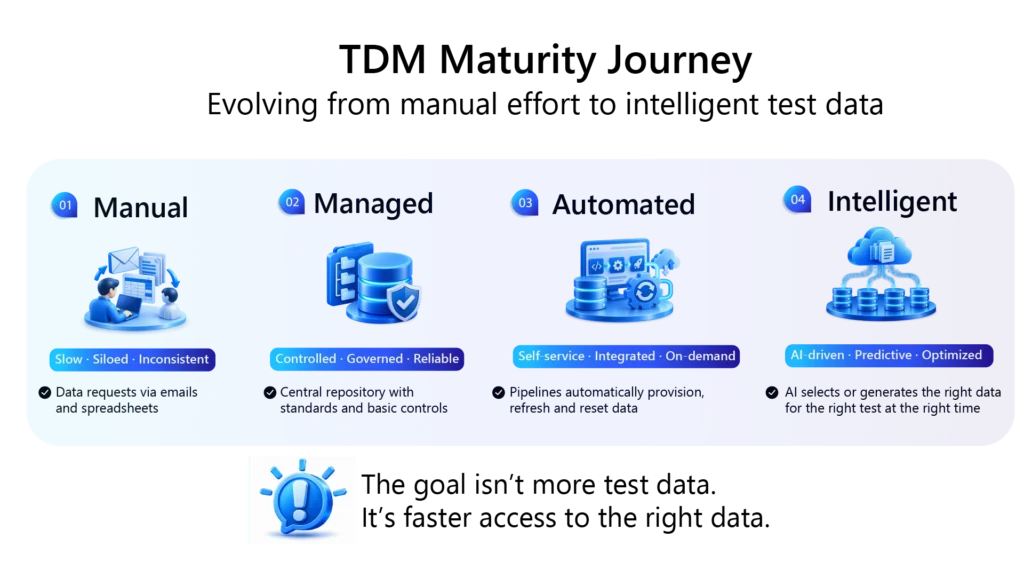
The strategic mistake is choosing a TDM tool first and determining the operating model later.
Enterprises should instead define their data requirements first, then select the combination of technologies that meets them.
Enterprise Use Cases of Test Data Management
Regression Testing
Reusable and resettable datasets allow regression suites to run consistently across releases.
End-to-End Testing
Relationship-aware datasets help reproduce customer journeys spanning multiple enterprise applications.
Integration Testing
Consistent test data helps validate data exchange, APIs, workflows, and dependencies between interconnected applications and services.
Performance Testing
Synthetic data can generate the volume and variation needed to test application scalability without exposing production records.
Security and Compliance Testing
Masked and synthetic datasets allow teams to test realistic workflows while limiting exposure of sensitive information.
CI/CD and Continuous Testing
Automated data provisioning allows test pipelines to obtain the data they require without manual intervention.
Edge-Case Testing
Synthetic generation can create rare or unusual business conditions that may not exist in sufficient quantity in production.
Our recent AI-driven Quality Engineering case study demonstrates this broader model. The engagement combined synthetic test-data generation with AI-driven requirements validation, autonomous test generation, impact analysis and service virtualization, and it reported a 40% reduction in post-production defects.
Another case study on our Application Testing as Software approach also incorporates a Test Data Generator for synthetic datasets alongside AI agents for test generation and automation. The engagement reports desktop testing running 13× faster, web testing 6× faster and mobile testing 3× faster.
Everforth Quinnox POV: Make Test Data a Delivery Capability
Our perspective is that test data should not remain an isolated QA responsibility.
It belongs within the broader quality-engineering fabric connecting:
Test automation + TDM + environment provisioning + service virtualization + CI/CD + governance
This is consistent with our broader quality philosophy.

“We’re also focused on building Quality into our processes and culture to deliver value to our customers continuously.”
Bighneswar Parida,
Director – Quality Engineering, Everforth Quinnox
That principle is particularly relevant to TDM. If quality is expected to be continuous, the data required to validate quality cannot remain dependent on slow, manual provisioning processes.
Everforth Quinnox’s AI-powered testing capabilities also combine CI/CD integration, service virtualization and synthetic test data to reduce dependencies that can delay testing.
Conclusion
The future of enterprise test data management is not about choosing between production data and synthetic data.
It is about building a fit-for-purpose data ecosystem.
Production-derived data, masking, subsetting, cloning, synthetic generation and AI-assisted creation each have a role. The differentiator will be how intelligently an enterprise orchestrates them around its testing objectives.
For CIOs, CTOs and quality-engineering leaders, the critical question is no longer simply:
“Do we have enough test data?”
It is:
“Can we provision the right, compliant and reproducible data at the same speed as our software delivery pipeline?”
Organizations that solve that problem can turn test data from a recurring release dependency into an engineering capability that supports faster delivery, stronger governance and more reliable software quality.
Analyst References
- Gartner – Use Synthetic Data to Improve Software Quality (2024)
- Gartner – 3 Steps to Improve Test Data Management for Software Engineering (2025):
- Gartner – 4 Techniques to Generate Synthetic Data for Software Testing (2024)
- Forrester – Agile Test Data Management: The New Must-Have

Head – Digital Marketing, Everforth Quinnox
FAQs
Test data management is the process of creating, preparing, securing, provisioning and maintaining the datasets required for software development and testing.
It helps QA teams access realistic and compliant data faster, improve test coverage, reproduce results and reduce manual dependencies that can delay software releases.
Common types include production-derived, masked, anonymized, synthetic, subsetted, boundary, negative-test and performance-test data.
TDM manages the data required to execute tests. Test case management manages the tests, including test steps, coverage, execution and results.
AI can help interpret requirements, identify data conditions and generate synthetic variations for positive, negative and edge-case scenarios. It should complement rather than replace established TDM techniques.
Not always. Gartner notes that different testing requirements need different data characteristics, so enterprises should select synthetic, masked, subsetted or production-derived data according to the use case.
There is no universal strategy. The right approach depends on data sensitivity, required realism, test volume, application complexity and provisioning frequency. Most mature enterprises use a combination of masking, subsetting, synthetic data and automated provisioning.