When generative AI (Gen AI) first entered the enterprise landscape, success was measured by the capabilities of the model. Organizations debated which large language model was the smartest, fastest, or most cost-effective. As adoption accelerated, attention shifted to another metric: token consumption. AI investments were often evaluated based on the cost of prompts, API calls, and compute.
Today, that mindset is becoming outdated.
Foundation models are rapidly becoming more powerful while inference costs continue to decline. Gartner predicts that by 2030, the cost of performing inference on trillion-parameter large language models will fall by more than 90% compared to 2025, driven by advances in hardware, model architectures, and inference optimization.
Yet despite declining model costs, enterprise AI spending continues to increase. Why?
Because the biggest expense is no longer generating intelligence – it’s turning that intelligence into measurable business value.
As enterprises move beyond AI pilots to deploying autonomous agents across customer service, procurement, finance, IT, and operations, the economics of AI are changing. A single business outcome may involve multiple AI agents, dozens of model calls, enterprise data retrieval, workflow orchestration, policy checks, and system integrations. In this new reality, focusing solely on token costs is like measuring the cost of electricity while ignoring the value produced by the factory.
The conversation is no longer about how many tokens an AI system consumes. It is about what those tokens accomplish.
Forward-looking organizations are beginning to ask a different set of questions:
- How many customer issues were resolved end-to-end?
- How many invoices were processed without human intervention?
- How much revenue was accelerated or operational cost eliminated?
- What was the cost of delivering each business outcome?
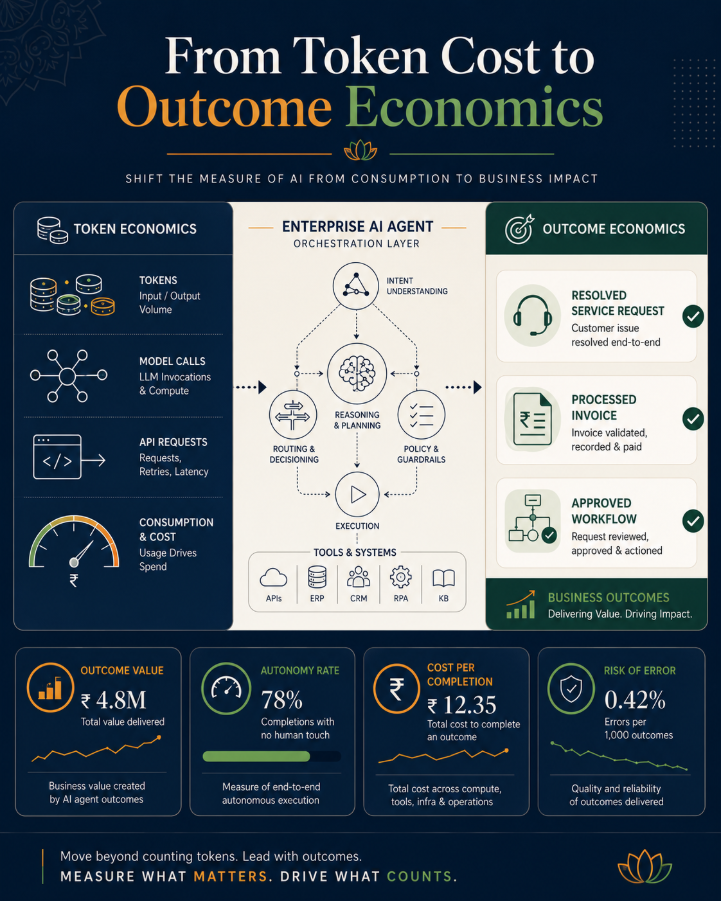
This marks a fundamental shift – from Token Economics, where success is measured by AI consumption, to Outcome Economics, where success is measured by the business value AI creates.
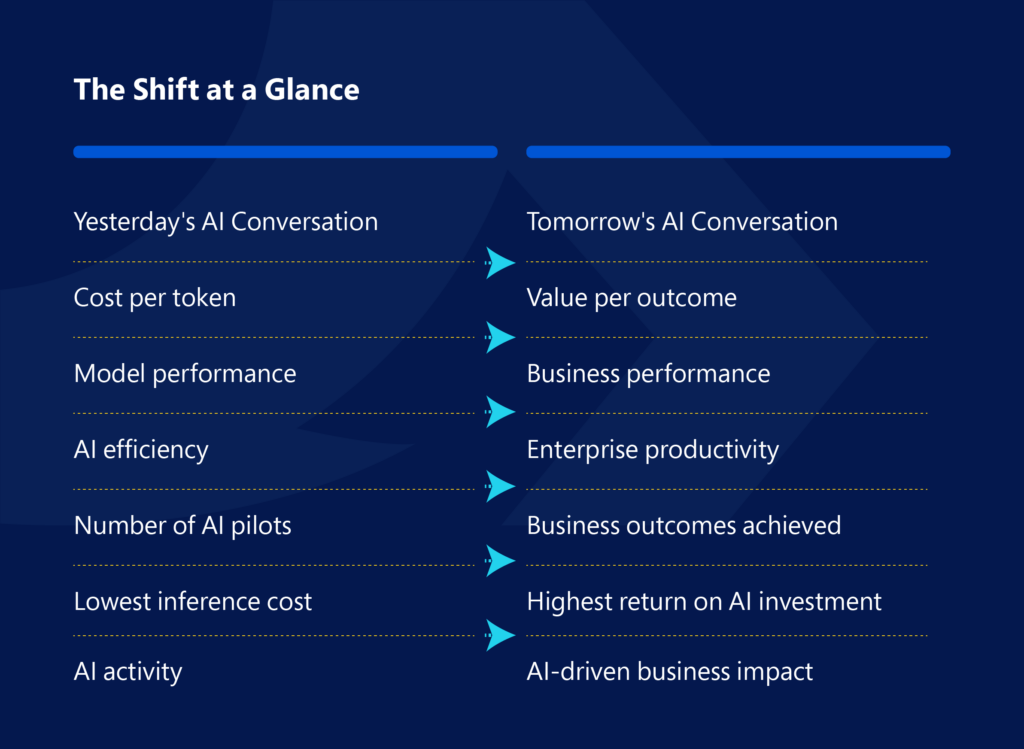
And organizations that embrace this shift will be better positioned to scale AI with confidence, maximize business value, and unlock the full potential of autonomous enterprises.
Ready to Move Beyond AI Pilots?
Understanding Outcome Economics is only the first step. The next challenge is building AI initiatives that deliver measurable business value from the outset.
Download our guide: How to Build an AI Proof of Concept (PoC): A Step-by-Step Strategic Roadmap to learn a practical framework for selecting use cases, defining success metrics, managing risks, and scaling AI with confidence.
Beyond Tokens: Measuring the Value AI Creates
For the past two years, enterprises have measured AI success through operational metrics such as:
- Token consumption
- API requests
- GPU utilization
- Latency
- Cost per prompt
- Number of model calls
These metrics are essential for engineers responsible for building and operating AI systems. But they reveal very little about the value AI creates for the business.
Imagine assessing a manufacturing plant based on the electricity it consumes rather than the number of products it delivers. Or evaluating a sales team by the number of calls they make instead of the revenue they generate. Activity may indicate effort, but it doesn’t measure outcomes.
Many organizations are making the same mistake with AI.
Consider two AI customer service agents. One processes ten times more tokens than the other. At first glance, it appears significantly more expensive. But if it resolves customer issues in a single interaction, reduces repeat contacts, shortens resolution times, and improves customer satisfaction, has it actually cost the business more?
Quite the opposite.
While the AI consumed more tokens, it reduced operational effort, improved service quality, and lowered the overall cost of serving the customer.
This is where Token Economics begins to fall short.
A lower token bill does not necessarily mean a lower cost of doing business. Likewise, a higher AI spend does not automatically indicate poor ROI if it delivers faster decisions, higher productivity, fewer errors, and measurable business outcomes.
As enterprise AI evolves from answering questions to executing complex workflows, organizations need a new way to measure success. The focus must shift from what AI consumes to what AI delivers.
That is the essence of Outcome Economics measuring AI not by the cost of computation, but by the value of the business outcomes it creates.
Token Economics vs. Outcome Economics: How Enterprise AI Success Is Being Redefined
| Dimension | Token Economics (AI 1.0 Thinking) | Outcome Economics (AI 2.0 Thinking) |
|---|---|---|
| Primary Question | How much does AI cost to run? | How much business value does AI create? |
| Success Metric | Cost per token, inference cost, API spend | Revenue growth, cost savings, productivity, customer satisfaction, risk reduction |
| Optimization Focus | Reduce compute and model costs | Maximize business outcomes and ROI |
| Decision Driver | Infrastructure efficiency | Business impact |
| What is Measured? | Token usage, latency, model accuracy, GPU utilization | Time saved, tasks automated, cycle time reduction, revenue generated, operational savings |
| View of AI | A technology expense | A business capability and value generator |
| Human Role | Minimize human involvement | Apply human oversight where it improves outcomes, trust, and compliance |
| Investment Decisions | Choose the cheapest model or lowest token cost | Choose the solution that delivers the highest business return—even if it costs more to run |
| Typical Question | "Can we reduce token consumption?" | "Does this AI agent improve business performance enough to justify its cost?" |
| Executive KPI | Lower AI operating cost | Higher ROI from AI-powered business processes |
Enterprise AI Is No Longer Just Technology—It's an Economic System
The first generation of enterprise AI was relatively simple. A chatbot answered questions, generated content, or summarized documents. The cost of using AI was largely tied to the number of prompts and tokens consumed.
That is no longer the reality.
Today’s enterprise AI systems are built around intelligent agents that do far more than generate responses. They reason through complex problems, access enterprise data, interact with ERP and CRM systems, collaborate with other AI agents, execute business workflows, and involve humans only when approvals or exceptions are required.
In many cases, a single customer request can trigger dozens of AI interactions behind the scenes—retrieving information, selecting the right model, validating outputs, invoking business applications, and coordinating actions across multiple systems.
As AI capabilities expand, so does the complexity and the cost of delivering a single business outcome.
McKinsey highlights that while the cost of model inference has fallen dramatically, enterprise AI spending continues to rise because organizations are deploying increasingly sophisticated multi-agent systems. Simply put, AI usage is growing faster than the cost of running individual models is falling.
This marks a fundamental shift in how enterprises should think about AI investments.
The challenge is no longer paying for intelligence. Intelligence is becoming increasingly affordable.
The real challenge is ensuring that every AI interaction contributes to a meaningful business outcome.
The Missing Layer: Enterprise AI Orchestration
One of the biggest misconceptions in AI adoption is believing that the model creates business value.
It doesn’t.
The orchestration layer does.
Between a user request and a business outcome lies an increasingly sophisticated decision engine that determines:
- What is the user’s intent?
- Which model should handle the request?
- Does additional enterprise context need to be retrieved?
- Should another specialized AI agent participate?
- Are policy guardrails satisfied?
- Is human approval required?
- Which enterprise systems should execute the action?
This orchestration layer determines not only response quality but also cost.
An inefficient orchestration strategy can generate multiple unnecessary model calls, duplicate reasoning, repeatedly retrieve the same context, or invoke expensive frontier models for routine tasks.
McKinsey highlights that orchestration choices how work is decomposed across agents, tools and models can change AI operating costs by an order of magnitude without improving the final business outcome.
In other words: The model is rarely the bottleneck. The workflow is.
Measuring What Actually Matters
As AI becomes embedded in enterprise operations, organizations need a new scorecard.
Instead of optimizing for infrastructure metrics alone, leaders should evaluate AI through business performance metrics.
1. Outcome Value
The first question should always be:
What measurable business value did the AI create?
Examples include:
- revenue generated
- working capital improved
- invoices processed
- procurement savings
- customer issues resolved
- operational hours saved
- compliance risks avoided
Every AI interaction should ultimately map to a business KPI.
2. Cost per Completion
Token cost measures consumption.
Cost per completion measures productivity.
If an AI agent completes an entire procurement workflow for $12 instead of requiring 40 minutes of human effort, the relevant question is not whether the model used 50,000 tokens.
The relevant question is whether the enterprise received a completed business outcome at a lower total cost.
Gartner increasingly recommends evaluating AI agents using total cost and business value frameworks rather than isolated technical metrics. (Gartner)
3. Autonomy Rate
Another emerging KPI is the percentage of work completed without human intervention.
High autonomy does not simply reduce labor costs.
It increases:
- scalability
- responsiveness
- operational consistency
- 24×7 execution capacity
Organizations moving toward agentic operations should measure how often AI completes workflows independently and where human intervention still creates friction.
4. Risk per Outcome
Every autonomous system introduces operational risk.
The objective is not maximum automation.
It is trusted automation.
Outcome Economics therefore measures:
- decision accuracy
- compliance adherence
- governance exceptions
- error frequency
- rollback rates
- audit readiness
AI becomes valuable only when enterprises can trust its outputs at scale.
The New CFO Question
Historically, CIOs asked: “How many AI licenses do we need?”
Today’s CFO asks a different question: “Which AI investments are actually producing measurable business returns?”
This shift explains why Gartner is increasingly discussing cost-per-result, value modeling and new pricing approaches for agentic AI instead of traditional consumption metrics. (Gartner)
Boards are becoming less interested in AI adoption rates.
They are becoming more interested in:
- margin improvement
- operating efficiency
- productivity gains
- customer retention
- revenue acceleration
AI is moving from an innovation budget to a business performance budget.
Why Governance Is Becoming an Economic Capability
Most discussions about AI governance focus on ethics and compliance.
Those remain essential.
But governance is also becoming an economic discipline.
Effective governance determines:
- which model should execute each task
- when reasoning depth should increase
- when smaller models are sufficient
- which tools can be invoked
- where human approval is mandatory
- how enterprise knowledge is reused instead of regenerated
Every governance decision influences cost.
Every routing decision influences value.
Every unnecessary model call compounds enterprise AI expenditure.
Governance therefore becomes a lever for improving both trust and financial performance.
Outcome Economics Will Separate AI Leaders from AI Adopters
As AI adoption accelerates, simply having AI will no longer be a competitive advantage—it will be the baseline. The real differentiator will be how effectively organizations convert AI investments into measurable business outcomes.
Over the next three years, AI will become as commonplace in enterprises as cloud computing and automation are today. Organizations across industries will deploy AI copilots, intelligent agents, multimodal models, and autonomous workflows at an unprecedented scale.
The organizations creating disproportionate value from AI will not necessarily be those with the largest models, the most AI pilots, or the highest token volumes. Instead, they will be the ones that embed economic discipline into every AI initiative and continuously optimize how AI delivers business impact.
They will know:
- which AI agents consistently generate measurable business outcomes and deliver positive ROI
- which workflows consume excessive compute and orchestration costs without creating meaningful value
- where multiple AI agents should collaborate to reduce cycle time and operating costs
- where autonomous execution creates speed, scalability, and competitive differentiation
- where human expertise remains essential to ensure governance, compliance, trust, and high-quality decision-making
Rather than asking, “How much AI are we using?”, these organizations will ask, “How much business value does every AI interaction create?”
This shift represents a significant evolution in enterprise AI strategy. Success will no longer be measured by the sophistication of a model or the number of AI applications deployed. It will be measured by how efficiently AI converts technology investment into tangible business outcomes.
In the emerging era of agentic AI, every workflow carries an economic footprint. Every autonomous decision has a cost, a risk, and a measurable return. Enterprises that understand these trade-offs—and continuously optimize for them will build AI systems that become increasingly valuable over time.
Those that continue to optimize only for model performance or token efficiency may achieve technical excellence, but they risk missing the larger opportunity: transforming AI into a sustainable engine of business value.
The Everforth Quinnox Perspective
Enterprise AI is entering its next phase.
The conversation is no longer about deploying another chatbot or experimenting with another foundation model.
It is about designing AI systems that continuously deliver measurable business value.
That requires an architecture where intelligent orchestration, governance, enterprise integrations and autonomous execution work together to transform business processes not just automate isolated tasks.
At Everforth Quinnox, we believe the future belongs to organizations that shift their AI operating model from consumption-centric to outcome-centric. Success will increasingly be measured not by the number of prompts executed or tokens consumed, but by outcomes delivered: customer issues resolved end-to-end, invoices processed accurately, workflows completed autonomously, risks reduced and measurable business value created.
The next generation of enterprise AI leaders will not win because they purchased the smartest models.
They will win because they built the smartest economics around them.

VP, AI & Data, Everforth Quinnox
FAQs
Outcome Economics is an approach to measuring AI success based on the business value AI delivers such as revenue growth, cost savings, productivity gains, customer satisfaction, and operational efficiency rather than operational metrics like token consumption or API calls.
Token Economics focuses on the cost of AI consumption, including tokens, model calls, GPU usage, and inference costs. Outcome Economics evaluates whether that AI investment generates meaningful business outcomes, making it a more effective measure of enterprise AI ROI.
Token costs indicate the operational expense of running AI models but don’t reveal whether AI is reducing costs, improving customer experiences, accelerating business processes, or increasing revenue. An AI application with higher token usage can still deliver significantly greater business value if it improves outcomes.
Organizations should track outcome-focused KPIs such as:
– End-to-end task completion rates
– Customer resolution rates
– Revenue generated or accelerated
– Operational cost savings
– Productivity improvements
– Cycle-time reduction
– Customer satisfaction (CSAT) and Net Promoter Score (NPS)
– Cost per business outcome
Agentic AI goes beyond generating responses by autonomously executing multi-step business processes across enterprise systems. Because these AI agents directly influence business outcomes, organizations must measure their value based on completed workflows, productivity gains, and operational impact rather than AI consumption alone.
Organizations should begin by aligning AI initiatives with measurable business objectives, defining outcome-based KPIs, integrating AI performance with business dashboards, and continuously tracking business impact alongside operational metrics such as cost, latency, and model performance.
Outcome Economics is particularly valuable for AI deployments in customer service, IT operations, finance, procurement, HR, supply chain, sales, and software engineering, where AI can directly improve productivity, automate workflows, and generate measurable business outcomes.