There is a metric that has quietly governed enterprise technology decisions in recent years: speed to build. How fast can we ship? How quickly can the AI generate the code? How soon can we get to production?
These are not bad questions. But they are increasingly incomplete ones. As AI-driven architecture tools become more powerful – capable of generating entire systems, recommending infrastructure stacks, and scaffolding microservices at a keystroke – the gap between what these tools optimize for and what enterprises actually need is growing wider.
The tools know how to build fast. What they don’t know is what it will cost to keep the lights on – or what it will cost the planet.
According to BCG analysis, cloud cost overruns – driven largely by architectural inefficiency – have become the number one unplanned expense in enterprise IT budgets, with organizations estimated to waste over $26 billion annually on unused or over-provisioned cloud resources.
The Architecture Decision No One Is Fully Making
When an engineering team adopts an AI-assisted architecture tool today, the conversation typically centers on two things: capability and speed. Can it generate the right patterns? Can it accelerate delivery? These are legitimate concerns – but they represent only a slice of the decision an enterprise is actually making.
Every architecture choice is also a long-term financial commitment. The infrastructure you select today will have compute costs that compound over months and years. The patterns you embed will determine the amount of human effort required to maintain, extend, and support the system over its lifetime. The cloud resources you provision will draw energy – and that energy has a carbon cost that is increasingly visible to regulators, investors, and boards.
None of the leading AI architecture and code generation tools are telling you this. They are optimizing for the moment of creation, not the years of operation. The result is that organizations are making billion-dollar infrastructure bets with only a fraction of the relevant information in hand.
The measure of a great architecture is not how quickly it was created – it’s how well it serves the organization and the world, over time. AI platforms that ignore cost and sustainability are giving enterprises an incomplete picture.
The Hidden Costs AI Tools Don't Show You
Consider what a typical AI-generated architecture recommendation leaves out:
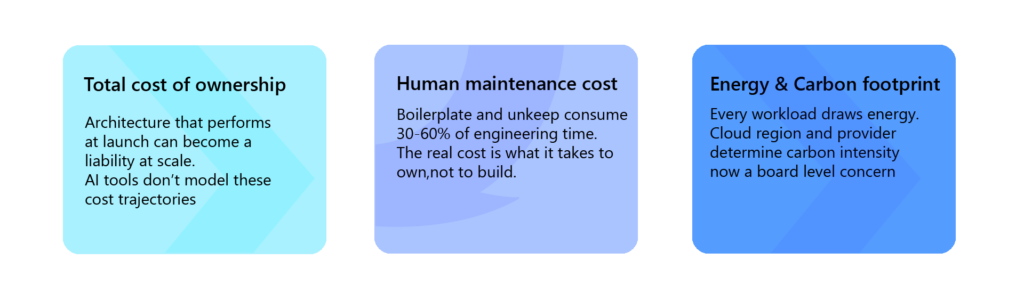
1. Total Cost of Ownership over time: Generating a working microservices architecture is not the same as generating a cost-efficient one. An architecture that performs beautifully at launch can become a financial liability at scale – through unnecessary compute provisioning, redundant services, inefficient data transfer patterns, or infrastructure choices that made sense at a certain traffic level and become expensive as the system grows. AI tools that optimize for correctness and speed are not modelling these trajectories.
2. Human maintenance cost: Architecture is not just infrastructure – it is the ongoing burden placed on the engineers who will live with the system. A complex, over-engineered solution may generate quickly but demand disproportionate maintenance effort over its lifetime. The real cost of an architecture is not what it takes to build; it is what it takes to own.
3. Energy consumption and carbon footprint: Every compute workload has an energy cost. Where workloads run – which cloud region, which data center, which provider – determines how carbon-intensive that energy is. As organizations publish sustainability reports and face growing pressure from ESG frameworks, the carbon profile of their technology infrastructure is no longer a back-office concern. It is a board-level one. Most enterprise architecture tools today are blind to all three of these dimensions. They are generated based on functional requirements and produce no signal on financial sustainability or environmental impact.
Industry Insight: A study by International Energy Agency, found that global data center energy consumption grew by over 20% between 2020 and 2023 – and AI-driven workloads are expected to accelerate that growth significantly through 2030.
Why CTOs Are Now Answerable to ESG Goals
Ten years ago, a Chief Technology Officer’s primary accountability was uptime and delivery. Five years ago, it expanded to include security and compliance. Today, a new dimension has entered the conversation: sustainability.
This is not a soft trend. Major institutional investors now score companies on ESG performance as a core criterion for investment decisions. Regulatory frameworks in the EU and increasingly across other markets require large organizations to report on Scope 3 emissions, which include the energy consumed by technology infrastructure. Several of the world’s largest enterprises have made public commitments to carbon neutrality, and technology leadership is directly accountable for delivering against those commitments.
The implication for architecture decisions is significant. When a CTO approves a new platform architecture, they are implicitly approving a carbon budget — whether or not that budget has ever been calculated. When an engineering team selects a cloud region, they are making a sustainability choice — whether or not anyone in the room is thinking about it that way.
The organizations that will lead this shift are those that start treating sustainability as a design constraint today, rather than a reporting obligation tomorrow.
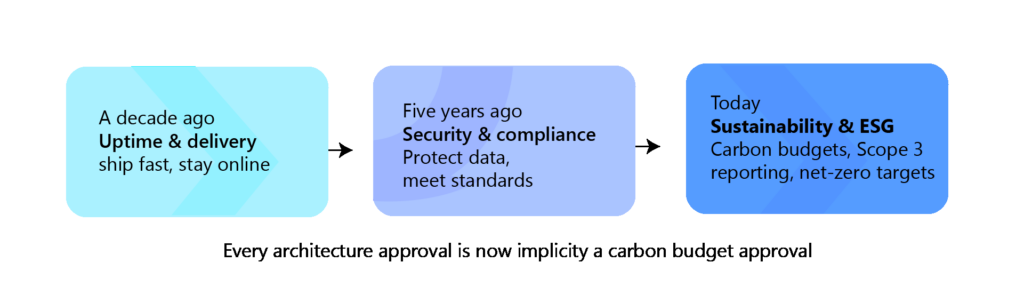
Every architecture approval is now implicity a carbon budget approval
Comparing Architectures the Way Enterprises Actually Need To
Here is what a more complete architecture evaluation looks like – and what AI tools of the next generation need to enable.
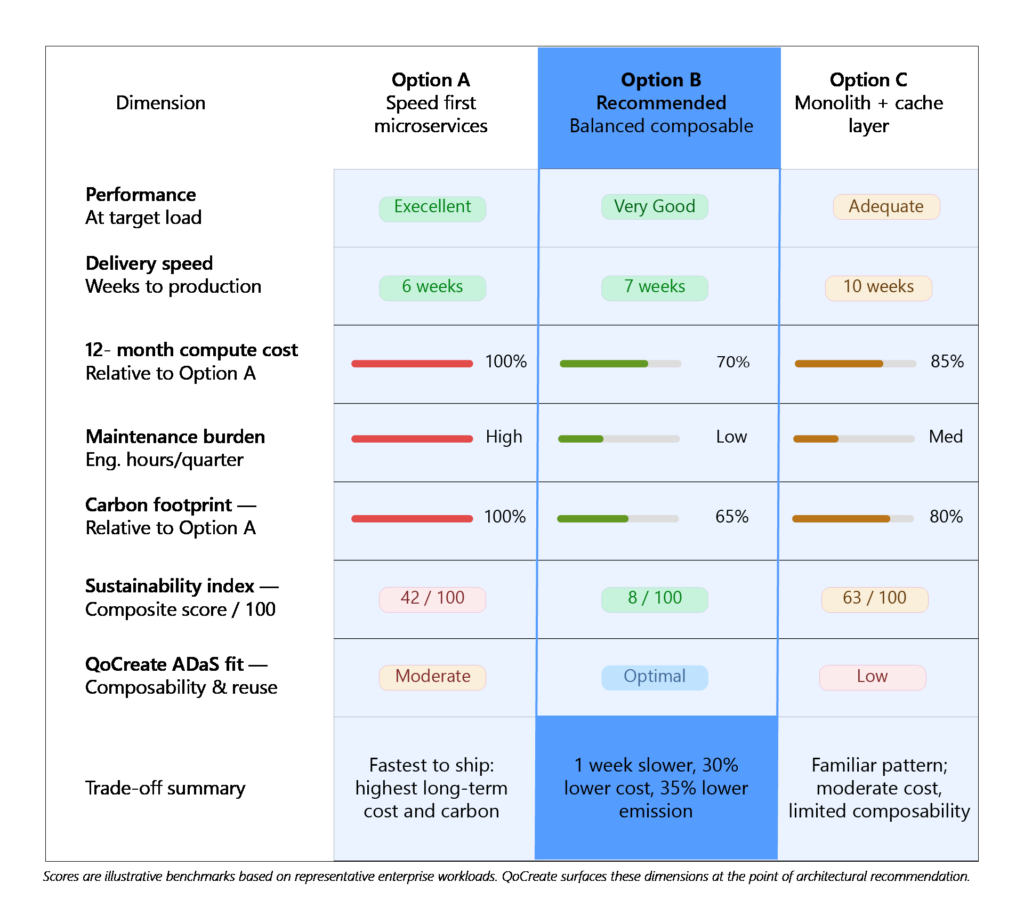
This is the conversation that enterprise leaders need to be having. And it is not happening yet – because the tools that generate architectures were never designed to model what those architectures cost to run.
How Everforth Quinnox’s QoCreate Addresses This Gap
At Everforth Quinnox, this is precisely the gap that QoCreate is built to close – and it does so at multiple levels of the architecture and delivery lifecycle.
At the platform level, QoCreate’s ADaS (Application Development as Software) framework treats the SDLC itself as a governed, versionable product. Every pipeline, configuration, agent behavior, and infrastructure template becomes a reusable, auditable artifact. This means architecture decisions are no longer one-off judgments – they become versioned choices with traceable outcomes, enabling organizations to measure cost and sustainability performance across their architectural decisions over time, and to learn from them.
At the recommendation level, QoCreate is designed to incorporate cost modeling and sustainability scoring directly into the architectural recommendation flow. When QoCreate surfaces an architecture option, the goal is for it to do so alongside a projection of its long-term cost profile and carbon impact – so that teams can make an informed choice:
- Option A ships faster;
- Option B costs 30% less to run and produces significantly lower emissions over its lifetime.
That is a decision worth making deliberately, with full information.
At the operational level, QoCreate’s Observability and Feedback Loops capability provides real-time visibility into how architectural choices are performing against cost and sustainability targets after deployment – not just at design time. This closes the loop between architectural intention and operational reality, creating the continuous improvement cycle that sustainability-conscious enterprises need.
This reflects QoCreate’s core conviction: that AI in the enterprise must be outcome-driven, not output-driven. Speed to ship is an output metric. Total cost of ownership and sustainability impact are outcome metrics. The next generation of AI development platforms – of which QoCreate is the leading example – will be judged on the latter.
Curious how QoCreate turns software development into a governed, self-orchestrating system? Grab the full guide: Reengineering Software with Agentic AI – The QoCreate Approach
The Business Case Is Already There
For organizations wondering whether this is a “nice to have” or a genuine business priority, the calculus is clearer than it might appear.
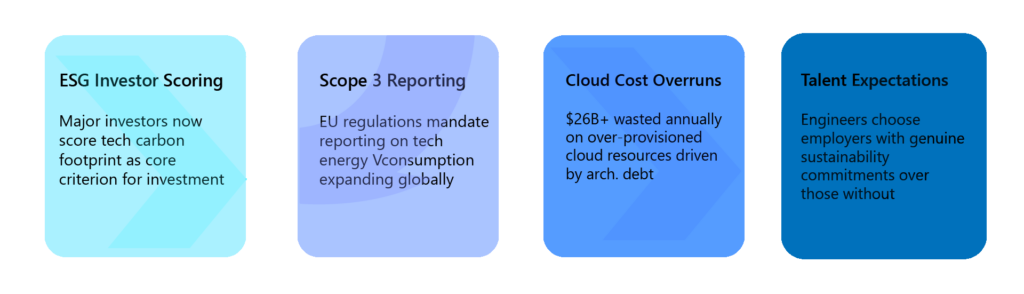
Cloud costs have become one of the fastest-growing line items in enterprise technology budgets, and a significant portion of that growth is driven by architectural inefficiency – systems built for speed, not sustainability at scale.
QoCreate’s composable architecture approach directly addresses this: by assembling applications from modular, reusable components rather than building redundant systems from scratch, organizations reduce both the upfront cost and the long-term compute burden of their architectures.
On the sustainability side, the cost of not tracking carbon impact is rising. Companies that cannot quantify or reduce the environmental footprint of their technology operations face growing exposure – to regulatory risk, to reputational risk with sustainability-conscious customers and partners, and to the credibility risk of making public commitments they cannot measure.
QoCreate’s continuous security and compliance pipelines – designed to automate policy enforcement and compliance validation – provide the operational foundation for tracking and reporting sustainability metrics with the same rigor applied to security or uptime. Organizations that build cost and sustainability intelligence into their architecture decisions now are not just doing the right thing environmentally. They are making a financially sound choice.
Industry Insight: PwC’s Future of Work Report projects that digital sustainability skills –including the ability to evaluate technology decisions through an ESG lens – will be among the highest-demand capabilities in technology leadership by 2028.
What Needs to Change
The shift requires movement on two fronts:
Platform evolution: AI architecture tools need to expand what they optimize for. The goal should not be the fastest path to a working system – it should be the best path to a sustainable, cost-efficient, maintainable system. That means modelling cost trajectories, estimating energy consumption, and surfacing sustainability trade-offs as first-class outputs. QoCreate’s ADaS framework and pluggable model registries – designed to evolve as AI advances without forcing large-scale rewrites – are built exactly for this kind of long-horizon thinking.
Decision-making culture: Organizations need to bring cost and sustainability into architecture reviews with the same rigor applied to security and performance. This means establishing baselines, setting targets, and holding teams accountable for the long-term profile of the systems they ship. QoCreate supports this through shared KPIs and dashboards that link engineering activity to business outcome metrics – moving the conversation from “what did we build” to “what value did we enable, and at what cost to the organization and the world.”
Neither shift is simple. But both are inevitable. The question is whether organizations lead this transition or are dragged into it by regulatory pressure and ballooning cloud bills.
Building for the Long Term
The best architecture decisions have always been the ones that consider the full lifetime of a system – not just the sprint to launch. What AI tools have given us is an extraordinary ability to build faster. What they have not yet given us is the wisdom to build better.
Cost intelligence and sustainability are not constraints on innovation. They are the conditions under which innovation can be sustained.
QoCreate is Everforth Quinnox’s answer to this challenge – an AI-powered operating system for enterprise development that treats architecture not as a one-time creation act, but as a living, observable, continuously improving system. Because technology strategies that succeed over a decade are built for change, not stability – and the organizations that build with full cost and sustainability awareness today are the ones that will lead tomorrow.
At Everforth Quinnox, we help enterprises build smarter with QoCreate – AI-driven architecture that accounts for what matters most: performance, cost, and planet. From discovery to institutionalization, we partner with COOs and CTOs to shift from reactive, project-by-project execution to predictable, scalable, intelligence-driven delivery aligned with business outcomes.
Are you ready to architect for the long term? Sponsor a 4–6-week QoCreate discovery engagement. Connect with our experts today.

Executive Vice President & Global Head - Service Lines, Everforth Quinnox
FAQ’s Related to AI-Driven Architecture
It’s the use of AI tools to generate, recommend, or scaffold technology systems – including infrastructure choices, microservices, and code often optimized for speed of delivery.
Many organizations provision more cloud infrastructure than they need, or choose architectures that seemed efficient at launch but become expensive as systems scale. This is largely a result of decisions made without visibility into long-term cost trajectories.
TCO refers to the full cost of a system over its lifetime – not just what it costs to build, but what it costs to run, scale, and maintain over months and years.
– Data collection and preparation
– Model training
– Testing and validation
– Bias reduction
– Privacy compliance
– Continuous model improvement
It enables faster experimentation and more resilient AI systems.
Every compute workload consumes energy, and the carbon intensity of that energy depends on factors like cloud region and data center provider. Cumulatively, infrastructure choices directly shape an organization’s environmental impact.
Investors increasingly use ESG performance as an investment criterion, and regulations in markets like the EU require large companies to report Scope 3 emissions, which include technology infrastructure energy use. This makes sustainability a board-level concern, not just an engineering one.
QoCreate surfaces cost projections and sustainability scoring alongside architecture recommendations – so teams choose with full information, not just speed in mind.
Its Observability and Feedback Loops capability monitors architecture performance against cost and carbon targets in real time, closing the loop between design intent and operational reality.
Yes, but only if speed and efficiency are evaluated together. A system generated quickly isn’t automatically expensive to run — but without deliberate cost modeling, speed-first decisions often lead to unplanned expenses later.