Artificial Intelligence (AI) has become the centerpiece of enterprise transformation. Pilot programs are launched, vendors are onboarded, innovation hubs are funded, and “AI-first” strategies are announced.
Across industries—from banking to healthcare, manufacturing to retail – organizations are investing heavily in AI technologies, driven by the promise of efficiency, personalization, and competitive advantage. Yet, despite the hype, many AI initiatives fail to deliver meaningful business results.
The gap between AI promise and AI reality is not about algorithms. It is about economics, talent and change management.
AI becomes real only when it is financially feasible, operationally scalable, and measurably valuable. This article explores how enterprises can close that gap by selecting the right use cases, running disciplined Proof of Concepts (PoCs), measuring what truly matters, and embedding change management at the core of transformation.
The Gap Between AI Promise and AI Reality
The AI narrative is promising: automation at scale, hyper-personalized experiences, predictive decision-making, and autonomous operations. Yet, when enterprises implement AI at scale, several challenges emerge:
- Fragmented Use Cases: Many organizations treat AI as an isolated solution for a single task say, chatbot automation or predictive maintenance. While these PoCs may succeed technically, their impact across the business remains limited.
- Complexity and Integration Issues: Integrating AI into existing IT systems, data pipelines, and business processes is often harder than anticipated. Legacy systems, data silos, and inconsistent data quality can derail even the most sophisticated AI models.
- Cost and ROI Uncertainty: AI implementation is expensive. Enterprises struggle to balance the investment in infrastructure, model development, and talent with the unclear financial returns, leading to stalled initiatives.
- Skill Gaps and Organizational Readiness: AI demands specialized talent in data science, machine learning, and AI operations. Many organizations face shortages in these skills, and the lack of senior management understanding can further hinder adoption.
- Change Management and Cultural Resistance: Fear of job displacement, lack of trust in AI-driven decisions, and resistance to changing entrenched processes are non-trivial barriers. Without addressing organizational change, AI initiatives can fail despite technical success.
The reality is stark: hype alone does not create value. Without a structured approach, AI projects risk becoming expensive experiments rather than strategic business enablers.
Bridging Expectation and Reality: Everforth Quinnox Recommendations
Everforth Quinnox believes that AI can deliver measurable business value but only when approached strategically. The path to financial feasibility, operational efficiency, and enhanced user experience lies in three core principles:
1. Financial Feasibility as the Foundation
AI is not a technology showcase. It is a strategic business investment.
When organizations treat AI as experimentation without economic discipline, projects become cost centers rather than value drivers. Hence, before launching an initiative, leaders must answer:
- What is the expected economic impact?
- How will value be quantified?
- What is the cost of implementation, integration, and maintenance?
- How long until break-even?
If these questions remain vague, the initiative is likely driven by hype rather than strategy.
Key Enterprise Value Drivers
AI creates value in three primary ways:
1. Cost Reduction
Cost reduction is often the most immediate and measurable AI outcome.
- Automation of repetitive manual processes
- Reduction in human error and rework
- Lower compliance penalties through improved accuracy
- Optimized workforce allocation
However, cost reduction is not about eliminating people. It is about reallocating human capacity to higher-value activities.
2. Improved User Experience
AI can transform both customer and employee experiences.
- Faster response times through intelligent automation
- Personalized and contextual interactions
- Reduced friction across digital and operational journeys
Better experiences often translate into higher retention, increased conversion, and stronger brand trust. But these must be measured not assumed.
3. Operational Efficiency
AI’s deeper impact lies in improving how organizations function.
- Streamlined workflows across departments
- Predictive insights enabling proactive decisions
- Real-time visibility into performance metrics
Operational efficiency compounds over time. Small cycle-time reductions across multiple steps can create significant P&L impact.
The critical principle: every AI initiative must be directly linked to business KPIs and financial outcomes. If the connection to revenue, cost, or risk reduction is unclear, the initiative should be reconsidered.
2. Selecting the Right AI Use Case: Focus on the Process, Not the Point
One of the most common enterprise mistakes is deploying AI as a “point solution.”
A chatbot here. A predictive model there. A document classifier somewhere else.
These isolated deployments often deliver incremental improvements but fail to create transformational value.
Why AI Must Target End-to-End Processes
Business value rarely resides in a single task. It lives in processes.
Consider order-to-cash, claims processing, loan origination, supply chain planning, or customer onboarding. Each of these spans multiple steps, teams, and systems. Optimizing one step while leaving others untouched limits impact.
A process-centric AI approach delivers:
- Higher cumulative value
- Stronger cross-functional adoption
- Better scalability
- Reusable data assets and models
When AI addresses the entire workflow including intake, validation, decision-making, exception handling, and feedback loops, the impact becomes structural rather than superficial.
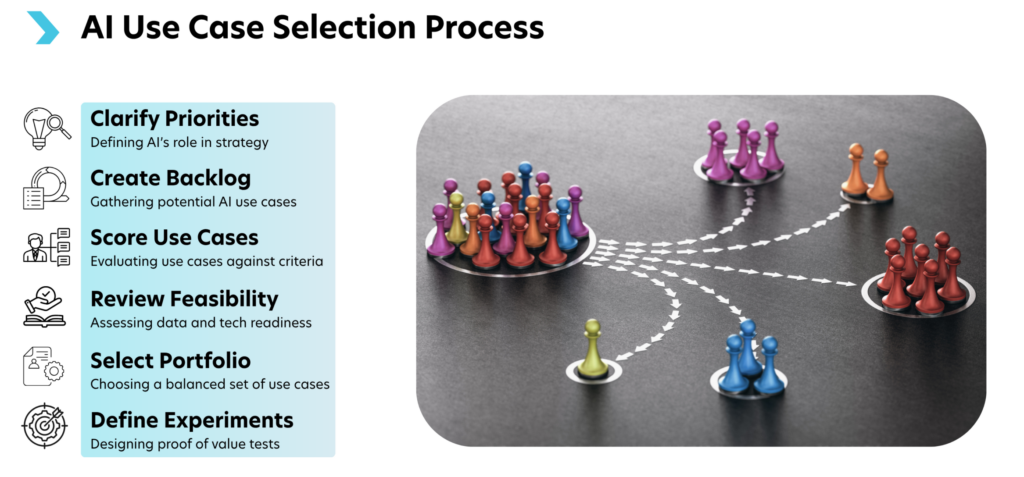
Guiding Principles for Use Case Selection
- Clear Business Ownership
Every AI initiative must have a business leader accountable for outcomes not just an IT sponsor. - Data Readiness Across the Process
High-quality, accessible data is non-negotiable. Fragmented or poor-quality data will undermine results. - Measurable Impact
The use case must clearly affect cost, experience, or efficiency. - Strategic Alignment
AI initiatives should directly support the organization’s broader business priorities and not operate in isolation.
Choosing the right use case is less about technological sophistication and more about economic relevance.
Read more: How to Choose the Right Use Case for an AI
3. Building AI Proof of Concept (PoC)
A Proof of Concept is not a marketing exercise. It is a controlled experiment designed to reduce uncertainty.
Yet many organizations jump straight into full-scale AI deployments without first evaluating feasibility, potential business impact, or whether the technology will perform effectively in their specific environment or not which is why even a RAND research report states that 80% of AI projects never advance beyond the prototype stage. This is precisely where an AI Proof of Concept (PoC) becomes essential.
Done correctly, a PoC helps organizations:
- Validate business value and feasibility
- Assess data quality and readiness
- Evaluate model performance
- Understand integration complexity
- Build stakeholder confidence
The objective is not perfection. It is learning.
A well-designed PoC answers the question: “Should we scale this?”
A poorly designed PoC merely proves that the technology works in isolation.
The difference is profound.
Successful PoCs are:
- Limited in scope but tied to real business metrics
- Designed with clear success criteria
- Structured with predefined decision gates
When enterprises skip disciplined PoCs, they either scale prematurely or abandon initiatives prematurely. Both are costly.

An AI PoC is more than just a technical experiment—it’s a strategic investment.
At EAI Studio, we align every PoC with clear business goals to ensure meaningful outcomes.
Krishna Kumar
VP, Data & AI, Everforth Quinnox
Read More: AI Proof of Concept (PoC) Guide
4. Measuring Success: Metrics That Matter
Many AI programs fail not because they do not create value but because that value is not clearly defined or tracked.
Measurement must begin before development starts. Here are the metrics that every business must measure for AI success:
1. Financial Metrics
- Cost savings achieved
- Productivity gains
- Revenue uplift
- ROI and payback period
Financial metrics anchor AI initiatives in business reality.
2. Operational Metrics
- Cycle time reduction
- Throughput improvement
- Accuracy improvements
- Error rate reduction
These metrics reveal whether AI is genuinely improving process performance.
3. Experience Metrics
- User adoption rates
- Customer satisfaction scores
- Net Promoter Score (NPS)
- Ease-of-use ratings
Technology that is not adopted does not create value.
Most importantly, measurement must continue beyond the PoC. Continuous monitoring ensures that models remain accurate, relevant, and aligned with evolving business conditions.
AI value erodes without governance and ongoing optimization.
5. Change Management: The Real Enabler of AI at Scale
Even the most technically sound AI initiative can fail due to:
- Skills gaps across teams
- Lack of executive sponsorship
- Organizational silos
- Fear of job displacement
- Resistance to new workflows
AI introduces uncertainty. Uncertainty creates resistance.
Without structured change management, AI initiatives stall during scaling—even if the PoC was successful.
What Effective Change Management Looks Like
1. Leadership Commitment
Senior leaders must articulate a clear vision: Why AI? Why now? What does success look like?
Visible sponsorship reduces skepticism.
2. Upskilling and Reskilling
AI adoption requires new competencies:
- Data literacy
- Process redesign thinking
- Model interpretation skills
Investing in people signals that AI is an enabler not a threat.
3. Transparent Communication
Fear thrives in silence. Organizations must:
- Clarify how roles will evolve
- Highlight opportunities for growth
- Share early wins and lessons learned
Trust accelerates adoption.
The future of AI in enterprises will not be determined by model sophistication. It will be determined by how effectively organizations bring their people along.
Turning AI from Hype into Sustainable Advantage with Everforth AI (EAI) Studio

VP, AI & Data, Everforth Quinnox