Accelerate IT operations with AI-driven Automation
Automation in IT operations enable agility, resilience, and operational excellence, paving the way for organizations to adapt swiftly to changing environments, deliver superior services, and achieve sustainable success in today's dynamic digital landscape.
Driving Innovation with Next-gen Application Management
Next-generation application management fueled by AIOps is revolutionizing how organizations monitor performance, modernize applications, and manage the entire application lifecycle.
AI-powered Analytics: Transforming Data into Actionable Insights
AIOps and analytics foster a culture of continuous improvement by providing organizations with actionable intelligence to optimize workflows, enhance service quality, and align IT operations with business goals.
Enterprise IT organizations are under pressure to deliver faster, more reliable, and more intuitive services while managing increasing complexity. Integrating AI with ITIL-aligned ITSM frameworks enables organizations to transition from reactive service delivery to proactive, intelligent operations. By embedding AI into core ITSM processes, enterprises can reduce disruption, improve employee experience, and scale service management without compromising governance.
This growing gap between business expectations and IT service delivery capability is why AI Itsm has moved from experimentation to necessity. Gartner says that by 2026, more than 80 percent of enterprises will have used generative AI APIs or deployed generative AI enabled applications in production environments. Instead, it strengthens them by embedding intelligence, automation, and predictive insights directly into ITSM workflows.
For enterprises seeking operational efficiency, improved user satisfaction, and scalable service management, integrating AI with ITIL-aligned ITSM is now a strategic priority rather than an optional enhancement.
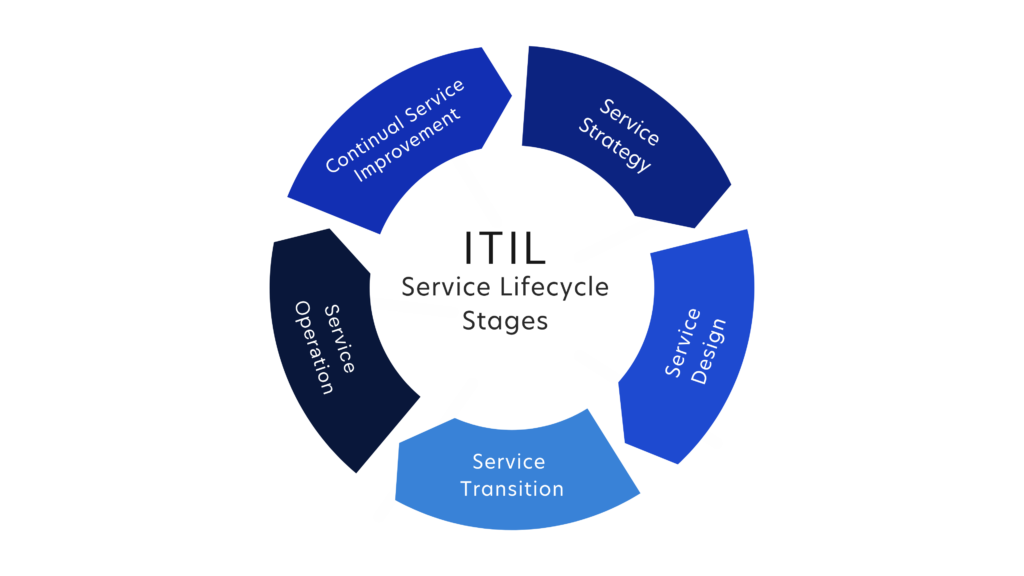
ITIL Service Lifecycle: An Overview
The ITIL service lifecycle provides a structured approach to designing, delivering, and improving IT services across their entire lifespan. It ensures consistency, accountability, and alignment with business objectives. However, as enterprise environments grow more dynamic, executing this lifecycle manually becomes increasingly difficult. AI enhances each stage of the lifecycle by accelerating decision–making, automating execution, and enabling continuous feedback loops. This allows organizations to preserve ITIL discipline while operating at modern enterprise speed.
Why ITIL and ITSM Frameworks Need AI
ITIL has long provided structure, consistency, and governance for IT service delivery. However, modern enterprise environments now operate at a scale and level of complexity that traditional manual execution cannot efficiently support. Hybrid infrastructure, cloud platforms, SaaS ecosystems, and remote work models have significantly increased service dependencies, ticket volumes, and operational noise.
1. Rising service complexity and volume
As digital services expand, IT teams are required to support more applications, integrations, and users than ever before. Industry research shows that IT service teams spend a large portion of their time on repetitive operational work, limiting their ability to focus on improvement and innovation. Recent findings show that many IT support desks spend over five hours per week per agent on these low-value activities. Without intelligence and automation, ITIL processes struggle to keep pace with this demand.
2. The limits of reactive service management
Traditional ITSM models respond after disruption occurs. Incidents are logged, prioritized, and resolved only once users are already impacted. While this approach aligns with process discipline, it places IT teams in a constant state of reaction. Modern enterprises require a model that reduces disruption rather than simply managing it.
3. Rising expectations for instant, digital support
Employees now expect fast, intuitive, and always available support experiences similar to consumer digital services. Meeting these expectations within ITIL frameworks requires more than additional headcount. It requires intelligence embedded directly into service workflows. AI becomes essential at this point, not as a replacement for ITIL, but as the capability that allows ITIL practices to operate at enterprise scale with speed and consistency.

How AI Brings ITIL Frameworks to Life
AI does not replace ITIL or weaken governance. It enhances execution. ITIL defines what needs to be done through structured practices such as incident management, request fulfillment, and continual improvement. AI strengthens how those practices are delivered by enabling faster decisions, predictive insights, and automation across workflows.
1. Moving from reactive support to proactive operations
ITIL based service models have traditionally been reactive. Issues occur, tickets are raised, and teams respond after impact. AI enables a fundamental shift. By analyzing historical incidents alongside real time monitoring data, AI identifies patterns and predicts potential disruptions before they escalate. This supports ITIL’s Continual Improvement practice by preventing incidents at a scale and speed that manual operations cannot achieve.
For example, organizations using GenAI reduce average time to resolution from over 32 hours to around 22.5 hours – nearly a 30% improvement
2. Automating routine service work at scale
A significant portion of IT service effort is consumed by repetitive requests such as password resets, access provisioning, and ticket status inquiries. Research indicates that 58 percent of IT teams spend between five and twenty hours each week on these low value activities. AI is ideally suited to handle this workload.
AI driven automation resolves common Tier one requests instantly and continuously without human intervention. This reduces ticket volumes, improves response times, and allows service professionals to focus on complex, high impact issues that require human judgment.
3. Building an intelligent and unified knowledge ecosystem
Knowledge management is one of the most challenging aspects of ITIL adoption. Documentation often becomes outdated, fragmented, and difficult to maintain. AI transforms this challenge into an advantage.
By connecting to existing knowledge sources such as collaboration platforms, document repositories, and historical support tickets, AI surfaces relevant answers in real time. Advanced systems can also generate new knowledge articles automatically from resolved incidents, ensuring documentation remains current and aligned with real operational outcomes. This strengthens self service adoption, accelerates resolution, and improves overall service consistency.
4. Watching Closely and Learning Intelligently
As chaos unfolds, Qinfinite’s AI watches closely, analyzing how dependencies respond under pressure. Which components fail immediately? Which ones recover automatically? Which require a human touch? This learning phase is crucial as it transforms raw data into actionable insights, building a deeper understanding of your system’s resilience and weaknesses.
Stat to Note: According to SolarWinds Research, organizations using generative AI in ITSM reduce average incident resolution times by nearly 30.5% – saving significant work hours and unlocking productivity gains that were previously unattainable.
Mapping AI Capabilities to Core ITSM Processes
AI capabilities deliver the most value when mapped intentionally to specific ITSM processes rather than applied generically.
1. Incident Management
Machine learning models classify incidents, assess urgency, and route tickets to the right resolver groups. This reduces mean time to resolution and improves first contact resolution. Forrester highlights that AI driven ticket triage can reduce incident handling time by up to 35 percent.
2. Problem Management
AI analyzes historical incident data to detect recurring patterns and hidden relationships. This enables faster root cause analysis and supports ITIL objectives of preventing repeat incidents.
3. Change Management
Predictive analytics assess the risk and potential impact of changes by analyzing previous deployments. AI can recommend optimal change windows and highlight dependencies, improving success rates without compromising governance.
4. Service Request Management
Natural language processing allows AI systems to understand user intent and automatically fulfill standard requests such as access provisioning and software installation. This capability is foundational to ai service desk automation strategies.
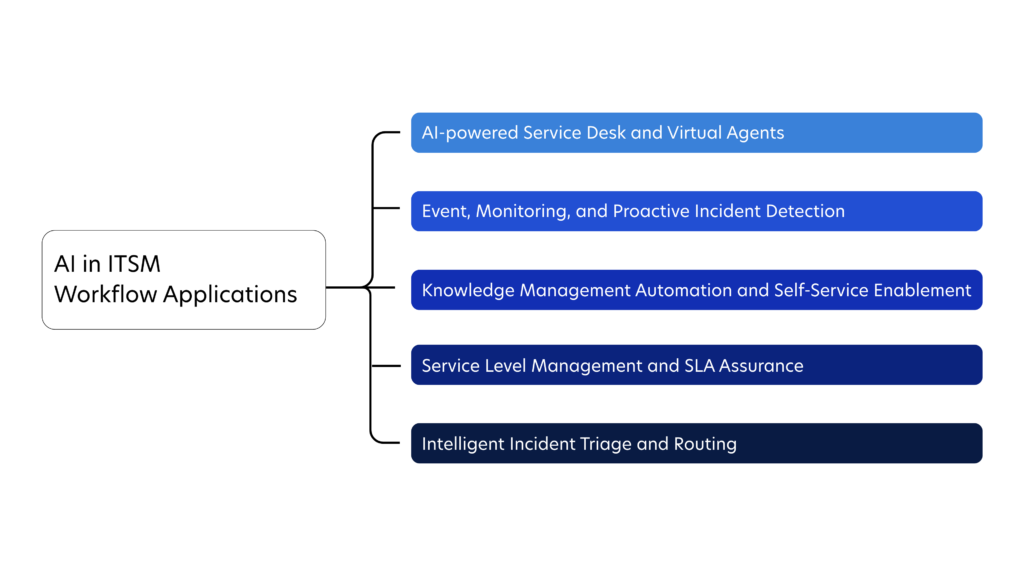
Where Enterprises Apply AI in ITSM Workflows
Enterprises typically begin AI adoption in high volume workflows where efficiency gains are immediately measurable.
1. AI- Powered Service Desk and Virtual Agents
The service desk is typically the first and most visible entry point for AI in ITSM. Virtual agents powered by natural language processing and machine learning handle routine, high-frequency requests such as password resets, access provisioning, ticket status checks, and software installation guidance.
Unlike traditional chatbots, modern AI service desks understand user intent, ask clarifying questions, and resolve issues end-to-end without human intervention. When requests fall outside predefined scenarios, AI seamlessly escalates them to human agents with full context, reducing back-and-forth and improving first-contact resolution.
For enterprises, this results in round-the-clock support availability, lower ticket backlog, and faster response times, while freeing service desk teams to focus on complex, business-critical issues.
2. Event, Monitoring and Proactive Incident Detection
In complex hybrid and cloud environments, infrastructure generates massive volumes of telemetry data – logs, metrics, alerts, and events. Human teams cannot manually analyze this noise at scale.
AI models continuously analyze real-time telemetry to detect anomalies, correlate related events, and identify early indicators of service degradation. Instead of reacting after failures occur, AI enables predictive incident creation, automated remediation, or proactive alerts before users experience impact.
This application directly improves system availability, reduces unplanned downtime, and shifts IT operations from reactive firefighting to preventive, stability-driven service management, aligning strongly with ITIL’s Continual Improvement objectives.
3. Knowledge Management Automation and Self-Service Enbalement
Knowledge management is often the weakest link in ITIL adoption due to outdated documentation and low self-service adoption. AI fundamentally changes this dynamic.
AI systems continuously analyze resolved incidents, service requests, and user interactions to identify knowledge gaps. They can automatically generate or update knowledge articles, recommend improvements, and surface the most relevant content in real time to both users and agents.
For end users, this translates into faster self-service resolution. For IT teams, it reduces repeat incidents and dependency on tribal knowledge. Over time, enterprises build a living knowledge ecosystem that evolves with real operational outcomes rather than static documentation.
4. Service Level Management and SLA Assurance
Meeting SLAs in dynamic environments requires more than static reporting. AI continuously monitors performance metrics across services, users, and infrastructure to detect early warning signs of SLA breaches.
By identifying trends and anomalies in real time, AI can recommend corrective actions such as workload rebalancing, priority adjustments, or proactive remediation. This enables IT teams to address issues before SLAs are violated rather than explaining breaches after the fact.
As a result, organizations achieve more consistent service delivery, improved compliance, and higher stakeholder confidence in IT’s ability to meet business commitments.
5. Intelligent Incident Triage and Routing
Incident triage is one of the most time-consuming and error-prone activities in ITSM. AI dramatically improves this process by automatically classifying incidents based on historical data, assessing urgency and business impact, and routing tickets to the most appropriate resolver group.
By learning from past resolution patterns, AI reduces misrouted tickets, unnecessary escalations, and manual reassignment. This leads to faster mean time to resolution (MTTR) and improved service consistency across teams and geographies.
At enterprise scale, intelligent incident triage alone can deliver significant productivity gains by eliminating thousands of manual routing decisions each month.
Practical Enterprise Strategies for Integrating AI with ITIL and ITSM Frameworks
To maximize value from AI and ITSM synergy, enterprises should adopt intentional strategies rather than point solutions:
1. Anchor AI initiatives to ITIL practices, not tools
A common mistake enterprises make is starting AI adoption with tools rather than processes. Successful organizations begin by mapping AI capabilities to ITIL practices such as incident management, request fulfillment, problem management, and continual improvement.
Instead of asking what AI tool to buy, leaders ask which ITIL process is creating the most friction, cost, or delay. AI is then introduced to enhance execution while preserving governance and accountability defined by ITIL.
2. Start with high volume, low risk use cases
Enterprises achieve faster ROI by applying AI first to repetitive and predictable workloads. Service desk automation, ticket categorization, password resets, and access requests are ideal starting points.
These use cases deliver measurable improvements in response time and ticket reduction without introducing operational risk. Early success builds trust across IT teams and stakeholders, creating momentum for broader AI adoption.
3. Use AI to shift from reactive to preventive operations
One of the most valuable strategies is using AI to reduce incidents rather than just resolve them faster. By analyzing historical incident data, monitoring signals, and configuration changes, AI can predict potential disruptions before users are affected.
This aligns directly with ITIL’s Continual Improvement practice and allows enterprises to move from firefighting to service stability. Prevention at scale is where AI delivers its greatest long-term value.
4. Integrate AI deeply into existing ITSM platforms
AI should not operate as a standalone layer disconnected from ITSM workflows. Enterprises see the most success when AI is embedded directly into their existing ITSM platforms, service catalogs, and monitoring tools.
Deep integration ensures AI driven insights trigger real actions such as ticket creation, workflow automation, and remediation, rather than remaining passive recommendations.
5. Treat AI as an augmentation of human expertise
Leading organizations position AI as a digital assistant for IT teams, not a replacement. AI handles noise, repetition, and pattern recognition, while humans focus on judgment, exception handling, and strategic decisions.
This strategy improves adoption, reduces resistance, and preserves accountability for critical activities such as major incident response and change approvals.
6. Build a strong data foundation before scaling AI
AI effectiveness depends on data quality. Enterprises that succeed invest early in cleaning ticket data, standardizing categories, improving CMDB accuracy, and consolidating knowledge sources.
Without this foundation, AI models produce inconsistent results. With it, AI becomes increasingly accurate and valuable over time.
7. Modernize knowledge management with AI
Rather than relying on manual documentation efforts, enterprises use AI to continuously improve knowledge quality. AI surfaces relevant answers in real time, recommends updates, and automatically generates knowledge from resolved incidents.
This strategy increases self service adoption, reduces repeat incidents, and ensures knowledge reflects real operational outcomes rather than outdated documentation.
8. Apply phased implementation with clear success metrics
AI integration should follow a phased roadmap. Enterprises define success metrics upfront such as reduction in ticket volume, improvement in mean time to resolution, SLA compliance, or user satisfaction.
Each phase is evaluated before expanding to more complex use cases such as predictive analytics or autonomous remediation.
9. Maintain strong governance and human oversight
Even with advanced automation, enterprises retain human control over high impact decisions. AI recommendations are reviewed, audited, and refined to ensure compliance with ITIL controls, security policies, and regulatory requirements.
This balance between automation and oversight builds trust and ensures long term sustainability.
10. Align AI driven ITSM outcomes to business value
The most mature strategy connects AI enabled ITSM improvements to business outcomes such as productivity, employee experience, cost optimization, and service resilience.
When AI in ITSM is framed as a business enabler rather than a technology upgrade, executive sponsorship and long term investment follow naturally.
For a deeper look at how organizations are applying intelligence across service workflows, explore this detailed guide on ai service management.
Conclusion
Integrating AI with ITIL aligned ITSM frameworks allows enterprises to modernize service delivery without losing control or governance. AI enhances speed, foresight, and consistency across ITSM processes, enabling organizations to prevent disruption, improve employee experience, and scale operations intelligently. When applied through a structured, phased strategy, AI transforms ITSM from a reactive support function into a proactive business enabler.
In this transformation journey, platforms such as Qinfinite, delivered in partnership with Quinnox, help enterprises operationalize AI across ITIL-aligned service workflows. By embedding intelligence into incident management, service automation, knowledge management, and monitoring processes, Qinfinite enables organizations to move beyond manual, reactive operations toward intelligent application management at scale, while maintaining governance and control.
Ready to move from reactive IT support to intelligent service delivery. Connect with Everforth Quinnox experts to explore how Qinfinite-powered ITSM strategies can accelerate your transformation and deliver measurable business impact.

Assistant Manager – Marketing (Analyst Relations), Everforth Quinnox
FAQs Related to AI with ITIL and ITSM Frameworks
Incident management, service request management, problem management, and monitoring processes see the highest impact due to high volumes and data driven decision requirements.
AI service management focuses on intelligent service delivery across IT and business functions, while AI enabled ITSM applies AI specifically within ITIL aligned ITSM processes.
Enterprises should begin with clear business use cases, strong data foundations, and low risk automation opportunities such as service desk automation.
Most enterprises can implement an AI service desk within three to six months, with pilot deployments often launched sooner depending on platform readiness.