Organizations today generate more data than ever before. Customer interactions, ERP systems, CRM platforms, cloud applications, IoT devices, third-party software, and AI-powered tools all contribute to an ever-expanding data ecosystem. Yet despite this abundance of information, many organizations still struggle to transform raw data into meaningful business intelligence. The reason is simple: bringing data together is often much more difficult than collecting it.
Data integration challenges have become one of the biggest obstacles preventing organizations from becoming truly data-driven. While digital transformation initiatives encourage businesses to adopt new technologies rapidly, they also create increasingly complex IT environments where data exists across multiple platforms, formats, and ownership boundaries. As a result, organizations face persistent data integration issues that impact reporting accuracy, operational efficiency, customer experiences, and strategic decision-making.
Successful integration is no longer just an IT initiative—it has become a business imperative. Leaders expect real-time insights, customers demand personalized experiences, regulators require strict compliance, and AI applications depend on high-quality, connected data. Without an effective integration strategy, even the most advanced analytics or AI investments fail to deliver their full value.
In this article, we’ll explore the seven most common data integration problems, understand why the challenges of data integration continue to grow, examine their business impact, and discuss practical strategies organizations can adopt to overcome them.
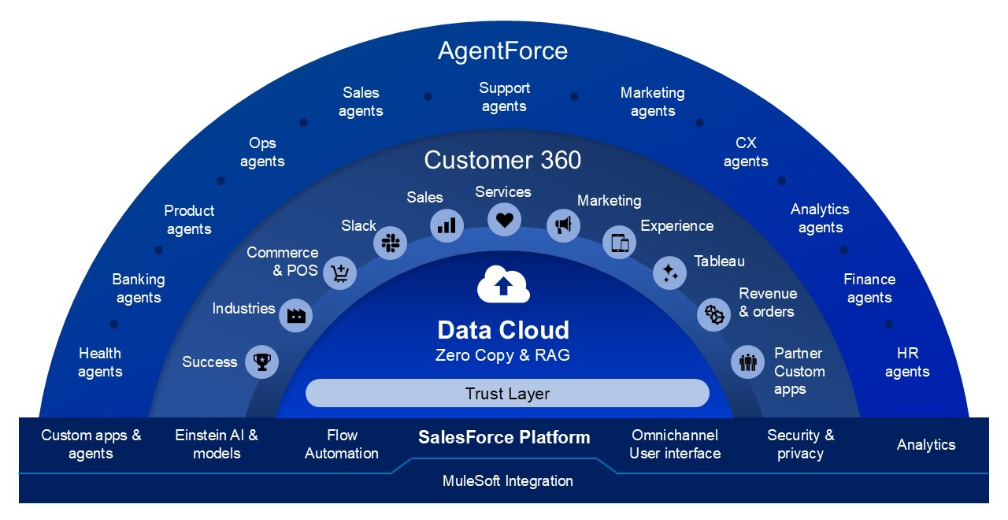
Image Source: Salesforce
As enterprises race to adopt autonomous AI, Agentforce implementation has become a strategic priority. However, deploying enterprise AI isn’t as simple as turning on a new feature. Success depends on the right data foundation, seamless integrations, governance, security, and a well-defined implementation strategy. Understanding what it takes to implement Agentforce effectively is the difference between a successful AI transformation and an expensive proof of concept that never scales.
Why Data Integration Is So Challenging
Data integration appears straightforward in theory: combine data from multiple sources into one unified system. In practice, however, modern enterprises operate in environments where technology landscapes have evolved over decades.

“Most organizations don’t struggle because they lack data—they struggle because their data is fragmented, inconsistent, and difficult to access when it matters most. Solving data integration challenges requires a shift from simply moving data between systems to building a connected data ecosystem where information is accurate, secure, and available at the right time.”
Krishna Kumar Chakirala,
VP – AI & Data Engineering, Everforth Quinnox
A single organization may simultaneously use cloud-native applications, legacy ERP systems, SaaS platforms, on-premises databases, APIs, spreadsheets, partner systems, and data lakes. Each system stores information differently, follows unique business rules, and updates data at different intervals.
Several trends have made integration increasingly difficult which includes:
- Hybrid and multi-cloud environments
- Growing SaaS adoption across departments
- Increasing regulatory requirements
- Real-time analytics expectations
- Rapid business expansion through mergers and acquisitions
- Explosion of IoT and machine-generated data
- AI and machine learning initiatives requiring clean, unified datasets
Instead of one centralized database, enterprises now manage hundreds or even thousands of interconnected applications. Every new application introduces another integration point, increasing complexity exponentially.
The result is an environment where integration is no longer a one-time project but an ongoing capability that requires continuous monitoring, governance, and modernization.
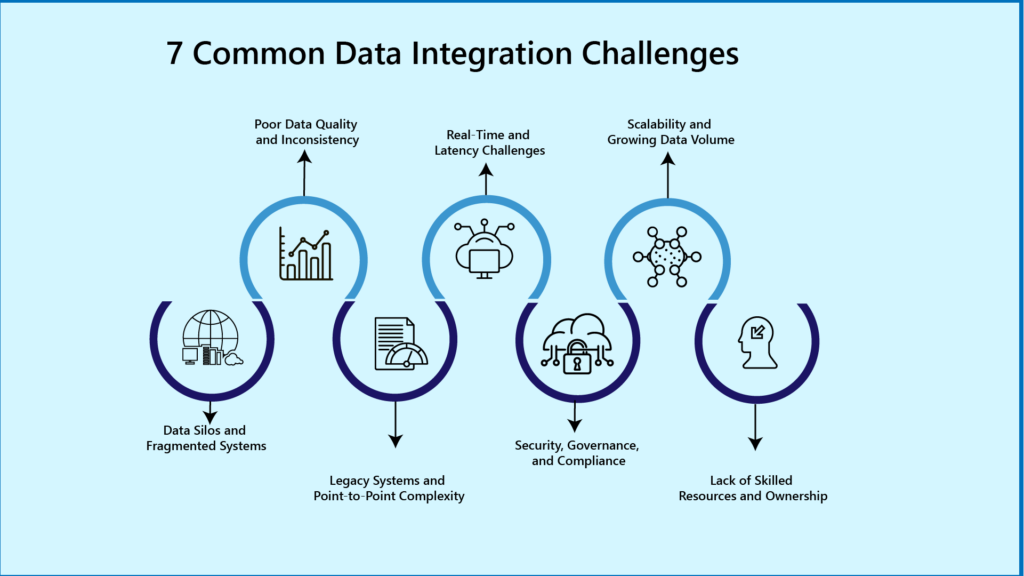
7 Common Data Integration Challenges
Understanding the most common data integration challenges is the first step toward building a resilient integration strategy. From fragmented data silos and data quality challenges to legacy systems and governance concerns, these issues can significantly hinder operational efficiency and business agility if left unresolved. Below are seven of the most common data integration problems organizations encounter and the practical approaches that can help overcome them:
| Industries | Agentforce Use Cases |
|---|---|
| Logistics | AI Shipment Orchestrator Agent |
| Manufacturing | Smart Lead-to-Order Conversion (Dealer / Distributor Network) |
| Banking | Intelligent Loan Pre-Approval & Offer Personalization |
| Recycling / Green Energy | Intelligent Renewable Energy Demand–Supply Optimization & Sales Acceleration |
| Healthcare | Intelligent Patient Care Coordination & Proactive Intervention |
| Real Estate & Property Management | AI-Powered Property Sales, Tenant Management & Maintenance Automation |
| Travel, Hospitality & Tourism | AI Concierge & Personalized Travel Experience Automation |
1. Data Silos and Fragmented Systems
Perhaps the most common of all is the existence of isolated data silos.
Departments often purchase software independently to solve immediate business needs. Sales uses one CRM, marketing relies on automation platforms, finance operates ERP systems, HR manages employee data separately, while operations use entirely different applications.
Although each system performs its intended function effectively, they rarely communicate seamlessly. This fragmentation creates multiple versions of the same customer, supplier, or product information. Teams spend valuable time reconciling reports instead of making decisions.
For example:
- Sales reports one revenue number.
- Finance reports another.
- Operations works with outdated inventory figures.
- Customer support cannot access recent purchase history.
Without integrated systems, organizations struggle to establish a “single source of truth.”
How to Solve It
Organizations should move beyond isolated application integrations toward an enterprise-wide integration architecture.
Best practices include:
- Implementing centralized integration platforms
- Building standardized APIs
- Creating master data management (MDM) strategies
- Establishing common business definitions
- Maintaining centralized metadata repositories
Rather than connecting systems individually, businesses should design integration around shared enterprise data models.
2. Poor Data Quality and Inconsistency
According to Gartner, poor data quality and integration challenges cost organizations an average of $12.9 million annually through operational inefficiencies, delayed decision-making, and missed business opportunities. Even the best integration platform cannot compensate for poor-quality data. One system may record customers using full names, another may use abbreviations, while a third may contain duplicate records. Even there are scenarios where formats may vary across applications, product identifiers may not match, and date conventions can differ from one system to another. These inconsistencies create significant data quality challenges that impact the reliability of integrated data and the insights derived from it.
Here are few common issues that often result lead to poor data quality:
- Duplicate records
- Missing information
- Invalid values
- Outdated customer data
- Conflicting business rules
- Inconsistent formatting
How to Solve It
Improving quality requires governance, not just technology.
Quality checks should occur before, during, and after integration rather than being treated as an afterthought. And to do that, organizations should establish:
- Data validation rules
- Automated cleansing processes
- Standardized data formats
- Deduplication workflows
- Data stewardship roles
- Continuous monitoring dashboards
3. Legacy Systems and Point-to-Point Complexity
Many enterprises still rely on mission-critical legacy systems developed years or even decades ago.
Replacing these systems is often expensive, risky, and operationally disruptive. As a result, businesses build temporary integrations whenever new applications are introduced.
Over time, these point-to-point integrations become increasingly difficult to maintain.
Instead of a manageable architecture, organizations end up with hundreds of custom connections that create:
- Higher maintenance costs
- Greater security risks
- Longer deployment cycles
- Increased downtime
- Complex troubleshooting
How to Solve It
Rather than replacing everything immediately, organizations should modernize incrementally.
Here is what organizations need to ensure:
- API-led connectivity
- Middleware platforms
- Integration Platform as a Service (iPaaS)
- Event-driven architectures
- Legacy system encapsulation through APIs
This enables businesses to preserve existing investments while improving interoperability and reducing long-term technical debt.
4. Real-Time and Latency Challenges
Businesses today operate in an environment where timely access to accurate information can directly influence decisions, customer experiences, and operational outcomes. As a result, organizations increasingly expect data to be available in real time rather than relying on traditional batch processing methods that may introduce hours or even days of delay.
For many industries, delayed data synchronization is no longer just an inconvenience – it can impact critical business processes. For example:
- Banks depend on real-time data processing to identify and prevent fraudulent transactions before financial losses occur.
- Manufacturers use continuous data streams from connected equipment to monitor performance, predict failures, and optimize production efficiency.
- Healthcare providers require immediate access to patient information across systems to support faster diagnosis, coordinated care, and better clinical decisions.
However, enabling real-time integration is not without its challenges. Organizations must address complex technical considerations such as event streaming, message queues, API limitations, data processing volumes, system concurrency, network reliability, and fault tolerance.
How to Solve It
Organizations should evaluate which business processes genuinely require real-time integration.
Effective approaches that they should follow include:
- Event-driven integration
- Streaming platforms
- Message brokers
- API-first architectures
- Change Data Capture (CDC)
- Intelligent caching mechanisms
Rather than forcing every workload into real time, businesses should align integration speed with operational requirements to balance performance and cost.
5. Scalability and Growing Data Volume
As organizations grow, the scale and complexity of their data environments grow with them. The volume, variety, and speed at which data is generated continue to increase as businesses adopt more applications, expand operations, and embrace digital technologies.
What may begin as a simple integration between a few business systems can quickly evolve into a highly interconnected ecosystem involving hundreds of applications, databases, cloud platforms, and external data sources—each processing millions of transactions and data exchanges every day.
At this scale, integration environments often encounter challenges such as:
- Performance degradation
- Long processing times
- Infrastructure bottlenecks
- Data pipeline failures
- Increasing storage costs
- Complex orchestration
While cloud technologies have made it easier for organizations to scale infrastructure on demand, building data integration architectures that can handle continuous growth remains a complex engineering challenge
How to Solve It
A scalable data integration strategy should support business growth without requiring major architectural redesigns every few years. And for that to happen, scalability should be prioritized right from the beginning. Here is what organizations can do for it:
- Cloud-native integration platforms
- Distributed processing
- Elastic infrastructure
- Microservices-based architectures
- Intelligent workload balancing
- Automated pipeline monitoring
6. Security, Governance, and Compliance
As data flows across applications, cloud platforms, partners, and geographies, security becomes far more complex than protecting individual systems. Every integration creates another pathway through which sensitive information travels, making robust governance an essential component of any integration strategy.
Organizations today manage a wide range of sensitive data—from personally identifiable information (PII) and financial records to intellectual property and confidential business information. Regulations such as GDPR, HIPAA, PCI DSS, and various regional privacy laws require organizations to know exactly where data resides, who can access it, and how it is processed throughout its lifecycle.
Without proper governance, businesses risk:
- Unauthorized access to sensitive information
- Data leakage across integrated applications
- Inconsistent access controls
- Regulatory non-compliance
- Audit failures
- Increased cybersecurity vulnerabilities
The challenge becomes even greater in hybrid and multi-cloud environments, where data moves between on-premises systems, SaaS applications, public clouds, and third-party platforms. Maintaining consistent security policies across these environments requires careful planning and continuous oversight.
A good example is data integration challenges in healthcare, where hospitals often integrate electronic health records, laboratory systems, imaging platforms, insurance providers, and patient portals. Every data exchange must comply with strict healthcare regulations while ensuring clinicians have timely access to accurate patient information. Even a small integration gap can affect patient care, operational efficiency, and regulatory compliance.
How to Solve It
Security and governance should never be treated as add-ons after integrations have been built. Instead, they must be embedded into the integration architecture from the outset.
Organizations should adopt practices such as:
- End-to-end encryption for data in transit and at rest
- Role-based and attribute-based access controls
- API authentication and authorization standards
- Centralized identity and access management
- Data lineage and metadata management
- Automated audit logging and monitoring
- Enterprise-wide governance policies
- Regular compliance assessments
By integrating governance into every stage of the data lifecycle, businesses can improve trust in their data while reducing operational and regulatory risk.
7. Lack of Skilled Resources and Ownership
Technology is only one part of successful integration. People and processes are equally important.
Many organizations struggle because data integration responsibilities are spread across multiple teams with unclear ownership. IT manages infrastructure, business units define requirements, security teams oversee compliance, and external vendors maintain individual applications. Without a unified governance model, integration initiatives often become fragmented.
At the same time, modern integration technologies require expertise in APIs, cloud platforms, data engineering, event-driven architectures, DevOps, data governance, security, and analytics. Finding professionals who possess expertise across all these disciplines can be challenging.
Common organizational issues include:
- Limited in-house integration expertise
- Inconsistent documentation
- Siloed project ownership
- Poor collaboration between business and IT teams
- Slow decision-making
- Knowledge loss when experienced employees leave
Even technically sound integration projects can fail when ownership is unclear or when organizations lack the skills needed to maintain evolving integration environments.
How to Solve It
Building integration maturity requires a combination of the right technology, governance practices, skilled teams, and clearly defined processes. Organizations that take a proactive approach can reduce complexity, improve reliability, and create a scalable foundation for future innovation.
Key recommendations include:
- Establishing a dedicated integration Center of Excellence (CoE)
- Defining clear ownership for enterprise data assets
- Investing in employee upskilling and certifications
- Standardizing integration frameworks and documentation
- Encouraging cross-functional collaboration
- Leveraging experienced technology partners where appropriate
Building organizational maturity around integration helps ensure that technology investments continue delivering value long after implementation.
Also Read: Data Integration Solutions: The Complete Guide 2026
The Business Impact of Unresolved Integration Challenges
While many organizations view integration as a technical concern, its consequences are felt across every aspect of the business. Unresolved data integration challenges directly affect operational performance, customer satisfaction, financial outcomes, and long-term competitiveness.
One of the most immediate impacts is poor decision-making. When leaders receive conflicting reports from different systems, confidence in business intelligence declines. Instead of making proactive decisions, teams spend valuable time validating data, reconciling discrepancies, and questioning the accuracy of reports.
Operational efficiency also suffers. Employees often perform repetitive manual tasks such as copying data between systems, updating spreadsheets, or correcting synchronization errors. These manual processes increase costs, reduce productivity, and introduce additional opportunities for human error.
Customer experience is another area heavily affected by data integration issues. Customers increasingly expect organizations to recognize them across every touchpoint, whether they interact through websites, mobile apps, contact centers, or retail locations. Fragmented customer data leads to inconsistent communication, delayed service, and missed personalization opportunities.
Innovation can also slow significantly. Emerging technologies such as artificial intelligence, predictive analytics, intelligent automation, and digital twins all depend on integrated, high-quality data. Organizations struggling with data integration problems often find it difficult to scale these initiatives because their underlying data foundation is fragmented.
From a financial perspective, unresolved integration challenges contribute to:
- Higher operational costs
- Increased infrastructure maintenance
- Longer project timelines
- Reduced return on digital transformation investments
- Higher compliance and security risks
- Lost revenue due to delayed decision-making
Perhaps most importantly, organizations lose business agility. When introducing a new application or acquiring another company requires months of integration work, the business becomes less responsive to market opportunities.
Ultimately, data integration is no longer just an IT concern—it has become a strategic capability that influences every major business outcome.
How to Solve Data Integration Challenges
Although every organization’s technology landscape is unique, the most successful integration strategies share several common characteristics. Rather than addressing individual issues in isolation, they establish a scalable integration foundation that supports future growth.
Here are the data integration techniques to follow:
Adopt an Integration-First Mindset
Instead of viewing integration as a task performed after new systems are deployed, organizations should make it a core part of technology planning. Every new application, platform, or digital initiative should be evaluated based on how it will exchange data with the broader enterprise ecosystem.
Modernize Through APIs
API-led connectivity has become the backbone of modern integration. Standardized APIs simplify communication between applications, reduce custom development, improve scalability, and make future integrations significantly easier to manage.
Build Strong Data Governance
Technology alone cannot guarantee reliable data. Organizations should establish enterprise-wide governance frameworks that define data ownership, quality standards, metadata management, security policies, and lifecycle management.
Prioritize Data Quality
Addressing data quality challenges requires continuous monitoring rather than periodic clean-up initiatives. Automated validation, profiling, standardization, and enrichment processes help maintain consistent data across systems.
Move Toward Intelligent Automation
Automation reduces manual intervention throughout the integration lifecycle. Modern integration platforms can automatically monitor workflows, detect anomalies, trigger alerts, and recover from failures, improving reliability while reducing operational overhead.
Design for Scalability
Organizations should build architectures capable of accommodating increasing transaction volumes, additional applications, and future technologies without requiring major redesigns. Cloud-native platforms, microservices, and event-driven architectures provide the flexibility needed to support evolving business requirements.
Establish Cross-Functional Ownership
Integration succeeds when business leaders, IT teams, data engineers, security specialists, and governance teams work toward shared objectives. Clear accountability ensures integration initiatives continue delivering long-term business value rather than becoming isolated technical projects.
When these practices are implemented together, organizations move beyond simply connecting systems—they create a connected enterprise where data becomes a trusted strategic asset.
| Component | When to Use | Skills Required | Additional License Required? |
|---|---|---|---|
| Prompt Template | To invoke an LLM to generate a response. Prompt template actions are one way an agent uses RAG. | Low-code | Yes |
| Flow | To run low-code rules-based automation and record retrieval | Low-code | No |
| Apex code | To run pro-code rules-based automation and record retrieval | Pro-code | No |
| MuleSoft API | To retrieve data from legacy systems and other external applications in a complex enterprise environment | Pro-code | Yes |
| External Service | To retrieve data from REST APIs that support OpenAPI specs | Low-code | Yes |
| Predictive Model | To use predictive AI with your agent | Low-code | Yes |
How Everforth Quinnox Helps Solve Data Integration Challenges
Modern enterprises require more than isolated integration projects—they need a strategic partner capable of designing, implementing, and continuously optimizing enterprise-wide data ecosystems. This is where Everforth Quinnox brings together technology expertise, industry knowledge, and AI-powered capabilities to help organizations ensure successful data integration initiatives.
With a team of 250+ AI and Data experts, we bring specialized knowledge across data engineering, cloud integration, analytics, automation, and intelligent technologies to help organizations build scalable and future-ready data ecosystems. Through AI-powered integration capabilities, we enable businesses to automate data workflows, improve data quality, identify integration inefficiencies, and create smarter, more adaptive integration environments.
Rather than relying on one-size-fits-all frameworks, we design integration solutions aligned with each organization’s technology landscape, regulatory requirements, and long-term business goals.
Conclusion
From fragmented data silos and poor data quality to legacy infrastructure, security concerns, scalability limitations, and organizational gaps, the challenges of data integration extend far beyond technology. They directly impact how organizations innovate, serve customers, maintain compliance, and compete in an increasingly data-driven business landscape.
The good news is that these challenges are solvable. By combining modern integration architectures, strong data governance, continuous data quality management, scalable cloud technologies, and clear organizational ownership, businesses can transform fragmented information into a unified, trusted, and actionable source of insight.
Organizations that address today’s data integration issues are not simply improving IT operations—they are building the digital foundation required to support AI initiatives, real-time analytics, operational agility, and sustainable business growth.
To successfully navigate complex data environments and unlock the full potential of enterprise data, organizations need the right strategy, expertise, and technology foundation. This is where advanced data integration solutions from Everforth Quinnox can help build a connected, intelligent, and future-ready data ecosystem designed for continuous innovation.

Deputy Manager, Marketing, Everforth Quinnox
FAQs Related to Data Integration Challenges
The most common data integration challenges include disconnected data silos, inconsistent data formats, poor data quality, legacy system limitations, real-time data processing requirements, scalability issues, security concerns, and lack of clear ownership.
Addressing these challenges requires more than just implementing an integration tool. Organizations need a well-defined integration strategy, strong data governance practices, modern architecture, and continuous monitoring to ensure data remains accurate, accessible, and secure.
Although closely connected, data integration issues and data quality issues refer to different problems.
Data integration issues occur when systems struggle to exchange, synchronize, or consolidate information effectively. These problems are usually related to disconnected applications, incompatible technologies, outdated integration methods, or inefficient data workflows.
Data quality issues, on the other hand, relate to the accuracy, completeness, consistency, and reliability of the data itself. For example, duplicate customer records, missing information, outdated details, or inconsistent formats are all examples of data quality problems.
The biggest data integration challenges in healthcare come from the complexity, sensitivity, and regulatory requirements surrounding patient information.
Healthcare organizations typically manage data across electronic health record (EHR) systems, laboratory platforms, imaging solutions, pharmacy systems, insurance applications, and patient engagement platforms. Connecting these systems while maintaining accuracy, privacy, and compliance can be extremely challenging.
Solving data integration problems starts with understanding the organization’s existing data landscape and identifying where gaps, redundancies, and inefficiencies exist.
Organizations can address integration challenges by:
– Creating a clear enterprise integration strategy
– Replacing fragile point-to-point connections with scalable integration architectures
– Using APIs and modern integration platforms for seamless connectivity
– Improving data quality through validation, cleansing, and standardization
– Establishing data governance policies and ownership
– Automating data workflows and monitoring integration performance
– Designing systems that can scale as business requirements evolve
Data integration failures usually happen because organizations focus only on technology and overlook the broader business, process, and governance factors involved.
Common causes include:
– Lack of a clear integration strategy
– Poor understanding of existing data sources and dependencies
– Inconsistent or low-quality data
– Overreliance on complex custom integrations
– Insufficient security and governance controls
– Limited technical expertise
– Lack of collaboration between business and IT teams
– Failure to plan for future scalability