Accelerate IT operations with AI-driven Automation
Automation in IT operations enable agility, resilience, and operational excellence, paving the way for organizations to adapt swiftly to changing environments, deliver superior services, and achieve sustainable success in today's dynamic digital landscape.
Driving Innovation with Next-gen Application Management
Next-generation application management fueled by AIOps is revolutionizing how organizations monitor performance, modernize applications, and manage the entire application lifecycle.
AI-powered Analytics: Transforming Data into Actionable Insights
AIOps and analytics foster a culture of continuous improvement by providing organizations with actionable intelligence to optimize workflows, enhance service quality, and align IT operations with business goals.
Why are data integration solutions now a boardroom priority? Most organizations are awash in data but starved of usable insight. Forbes estimates that global data creation will exceed 180 zettabytes, yet less than 30% of that data is ever analyzed. That gap between data generated and data used is not a technology problem alone. It is a data integration problem, and the right data integration solution is what closes it.
As organizations digitize core operations, adopt cloud platforms, and invest in AI-driven decision-making, the ability to connect data across systems has become a strategic differentiator.
According to Gartner, poor data quality and integration cost organizations an average of $12.9 million annually through operational inefficiencies, delayed decisions, and missed opportunities. McKinsey adds that data-driven organizations are 23 times more likely to acquire customers and 19 times more likely to be profitable, but only when data flows freely across the business.
Despite heavy investment in analytics, cloud, and AI, many organizations remain held back by fragmented data. Legacy systems, siloed SaaS applications, and brittle point-to-point connections block real-time visibility and slow innovation. A modern data integration solution is no longer a backend IT concern. It is a foundational capability for agility, resilience, and AI readiness.
This guide explains what modern data integration solutions are, how cloud and hybrid integration architectures work, the data integration challenges they solve, and how to choose a scalable, real-time solution built for long-term success.
Common Data Integration Challenges (and Why They Happen)
Most data integration problems are not caused by a single broken system. They build up over time as the data estate grows. These are the data integration challenges organizations run into most often.
- Data silos: Business units adopt SaaS platforms, analytics tools, and niche applications independently to solve local problems. Over time this creates fragmented data domains with inconsistent schemas, duplicate records, and conflicting definitions of core entities such as customers, products, and suppliers. The result is delayed reporting, manual reconciliation, and low trust in the numbers.
- Legacy, point-to-point connections: Many organizations still rely on batch ETL jobs and tightly coupled, hand-built integrations designed for predictable workloads. These struggle to support real-time analytics, event-driven processing, and AI pipelines that need continuous, low-latency data.
3. Growing volume and velocity: As data sources multiply, pipelines get harder to manage, monitor, and troubleshoot. Every new application adds dependencies, drives up maintenance, and creates long-term integration debt.
4. Governance, security, and compliance: Organizations must enforce data privacy rules, prove lineage and auditability, and hold data quality steady across regions and platforms, all without slowing delivery. Without a scalable integration approach, governance stays reactive instead of built in.
For a deeper look at the methods used to solve these problems, see data integration techniques and methodologies explained.
Modern Data Integration Solution Architecture
A scalable data integration strategy starts with the right architecture. Modern data integration solutions favor flexibility, decoupling, and automation over rigid pipelines.
At the core is a centralized integration layer – often a data integration platform or iPaaS – that connects source systems to downstream consumers. Instead of hard-coded point integrations, the solution uses reusable connectors, APIs, and event streams.
Key architectural components include:
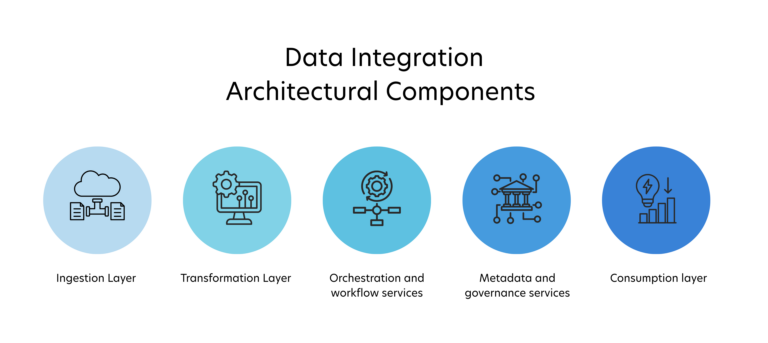
- Ingestion layer: Supports diverse sources, including transactional databases, SaaS platforms, streaming sources, IoT devices, and external partner feeds. Native connectors and change data capture (CDC) reduce latency and remove manual extraction.
- Transformation layer: Sstandardizes and enriches data using business rules. This includes schema normalization, data quality checks, validation, and enrichment with reference data ensuring downstream systems receive trusted, analytics-ready data.
- Orchestration and workflow services: Manages dependencies between integration jobs, handle retries and error recovery, and provide visibility into pipeline health. Automated, self-monitoring orchestration is what keeps operational overhead low as you scale, and it is the foundation of automated data integration.
- Metadata and Governance: Pprovides visibility into data lineage, usage, and quality. These capabilities are essential for compliance, impact analysis, and confidence in reporting.
- Consumption layer: Delivers data to analytics platforms, operational systems, and AI models. Modern solutions support ELT, data virtualization, and event-driven streaming to meet diverse consumption patterns and performance requirements.
Modern architectures also embrace data virtualization, event-driven streaming, and ELT patterns, allowing data to move at the speed required by the business. A well-designed integration framework reduces long-term cost and makes each new source faster to onboard. As AI moves deeper into operations, see how AI-driven data integration is reshaping these pipelines.
This architectural pattern is the same one that underpins enterprise data integration at scale.
Check out on this read: Data Integration Techniques and Methodologies Explained
Cloud, Hybrid, and On-Premise Data Integration Solutions
As organizations adopt multi-cloud and hybrid strategies, integration complexity increases. Data now lives across public clouds, private data centers, and SaaS ecosystems, –each with different performance, security, and cost profiles.
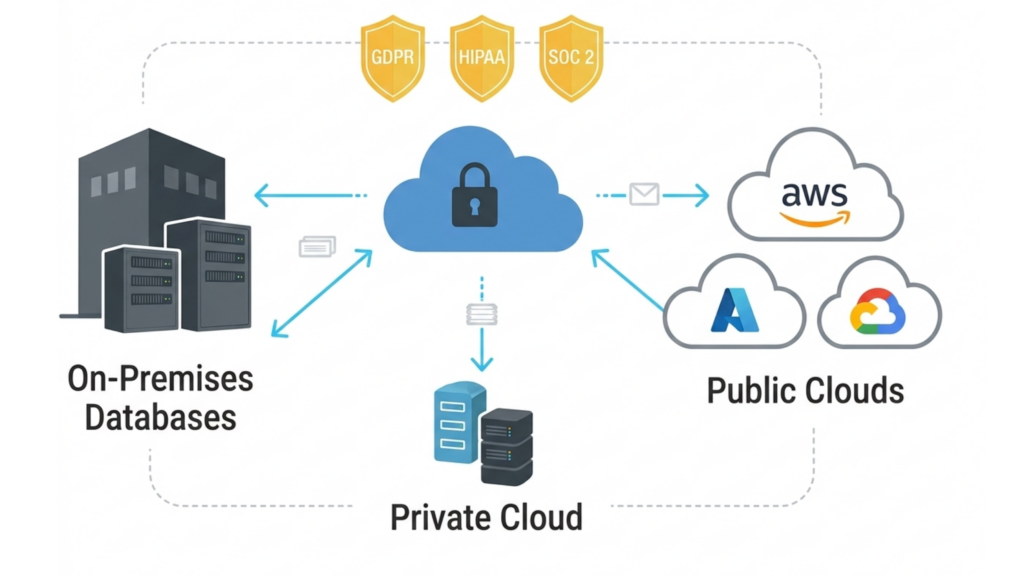
Modern data integration solutions are designed to be cloud-native and environment-agnostic. Cloud data integration moves and synchronizes data across SaaS, cloud, and on-premise systems without forcing everything into one location. Strong solutions support:
- Hybrid connectivity, so data flows cleanly between on-premise systems and cloud platforms. This is what most organizations actually need, since few are fully in the cloud.
- Real-time streaming, using event-based architectures for low-latency use cases. Real-time data integration is what powers live dashboards, fraud detection, and operational decisions that cannot wait for a nightly batch.
- Elastic scalability, so integration workloads scale automatically with demand and can handle distributed, high-volume event flows.
- API-first and microservices integration, aligning with modern application development and keeping each connection reusable.
Cloud-native integration also improves resilience and speed. You can run integration services closer to data sources, cut latency, and support global operations more effectively, whether the data sits in one cloud, several, or a mix of cloud and on-premise.
Types of Data Integration Solutions
There is no single right approach. Most organizations use a combination, matched to the systems they have and the outcomes they need.
- Cloud data integration solutions connect SaaS and cloud-hosted systems and are the default for organizations standardizing on the cloud.
- On-premise data integration solutions keep data movement inside the data center, which matters where latency, control, or compliance rules out the public cloud.
- Hybrid data integration solutions combine both, which is the most common real-world pattern.
- Real-time and streaming solutions move data continuously for low-latency use cases, instead of in scheduled batches.
- Custom data integration solutions are built around a specific system landscape when off-the-shelf connectors do not fit, often where industry-specific or legacy systems are involved.
Choosing among these is less about features and more about fit, which is where a solution partner earns its keep.
Related Success Story in Action: Everforth Quinnox’s data integration improves application performance for world’s largest non-alcoholic bottler
How to Choose the Right Data Integration Solution
Selecting the right solution requires more than comparing feature lists. Evaluate solutions on strategic fit, not just technical capability.
Key considerations include:
- Scalability and performance: Test under real conditions. The solution should handle growing data volumes, real-time workloads, and distributed deployments without degrading or becoming expensive.
- Cloud and hybrid readiness: The solution should natively support on-premise, cloud, and SaaS environments while enabling seamless data movement across them.
- Ease of use and automation: Low-code interfaces, reusable templates, and automated monitoring shorten time-to-value and reduce reliance on scarce specialists. A low-code integration platform lets both technical and business teams build and manage integrations with less friction.
- Governance and security: Build these in from the start, including data quality management, lineage tracking, access controls, encryption, and compliance with regulatory standards.
- Alignment with your core systems: The solution should support ERP, CRM, analytics, and custom platforms without heavy customization, so you get end-to-end visibility and efficiency.
The right solution ultimately enables agility. It lets you onboard new data sources quickly, adapt as requirements change, and support advanced analytics and AI without constant re-engineering. This is where the right partner matters as much as the right technology. Everforth Quinnox delivers digital integration solutions and enterprise application integration services that connect data and processes across your systems.
See how this works in practice: Everforth Quinnox’s data integration improved application performance for the world’s largest non-alcoholic bottler.
Conclusion
Data is one of the most valuable enterprise assets, but only if it can move freely, securely, and at scale. As digital ecosystems grow more complex, integration becomes a foundational capability rather than a technical afterthought.
Modern data integration solutions break down silos, modernize legacy architectures, and operate confidently across cloud and hybrid environments. When done right, integration transforms raw, fragmented data into a true enterprise asset.
This is where the choice of partner matters. Everforth Quinnox helps organizations move from fragmented integration efforts to scalable, future-ready data ecosystems. By combining deep domain expertise, AI-driven integration, and modern, cloud-native platforms, Everforth Quinnox helps you modernize legacy systems, support real-time analytics, and accelerate digital transformation with confidence.
As AI-powered integration, event-driven architectures, and intelligent automation keep advancing, the organizations that win are the ones that connect their data now, reduce complexity at scale, and build a lasting competitive edge.

Dinesh Panchbhai is a Deputy Manager at Everforth Quinnox, driving marketing, ABM and AI-driven automation leveraging emerging tech solutions. His writing reflects expert perspectives on integrating technology to foster meaningful connections and accelerate business growth. Outside of Everforth Quinnox, Dinesh enjoys exploring his creative side through music and poetry.
FAQs on Data Integration Solutions
Data integration solutions are the platforms, methods, and services that connect, transform, and deliver data across different systems, applications, and environments in a consistent, reliable way, so the business works from one trusted view of its data.
Cloud data integration is the practice of moving and synchronizing data across cloud platforms, SaaS applications, and on-premise systems. It uses connectors, APIs, and cloud-native services to keep data consistent and available across environments without forcing everything into a single location.
Cloud data integration solutions connect cloud and SaaS systems and scale elastically with demand. On-premise data integration solutions keep data movement inside your own data center, which suits low-latency, high-control, or compliance-driven needs. Most organizations use a hybrid mix of both.
Real-time data integration moves data continuously between systems using event-driven or streaming architectures, instead of scheduled batch jobs. It powers low-latency use cases such as live dashboards, fraud detection, and operational decisions that cannot wait.
Automated data integration uses orchestration, monitoring, and self-healing pipelines to move and reconcile data with minimal manual effort. It reduces operational overhead, lowers error rates, and keeps integrations stable as data volumes grow.
A custom data integration solution makes sense when off-the-shelf connectors do not fit your system landscape, typically where legacy, industry-specific, or heavily tailored systems are involved and standard tooling cannot model the required data flows.
Look for prebuilt connectors, reusable templates, visual workflow design, automated monitoring, built-in governance and security, and support for both cloud and on-premise systems. The goal is to let technical and business users build and manage integrations with less specialist effort.
Start with a clear integration strategy and target architecture, standardize and validate data quality early, favor reusable connectors and APIs over point-to-point links, build governance and lineage in from the start, and design for real-time and scale rather than retrofitting them later.