Every enterprise today is generating more data than ever before – from CRM platforms and ERP systems to IoT devices, SaaS applications, customer portals, and AI-powered tools. Yet for many organizations, this data remains fragmented across dozens of disconnected systems. Sales teams rely on one source of truth, finance on another, and operations on yet another, making it difficult to generate accurate insights or make timely business decisions.
Cloud data integration addresses this challenge by creating a seamless flow of information across applications, databases, and cloud environments. Rather than treating data as isolated assets, organizations can unify, transform, and deliver trusted information wherever it’s needed – whether for analytics, AI, compliance, or customer experiences.
The need has never been greater. According to Goldman Sachs Research, only around 30% of enterprise workloads have actually migrated to the cloud so far, leaving decades of modernization and integration work ahead. At the same time, Grand View Research estimates the global data integration market will grow from USD $15.18 billion in 2024 to $30.27 billion by 2030, highlighting how critical connected data has become for digital transformation. This guide covers what cloud data integration is, how it works under the hood, where it fits across cloud, hybrid, and multi-cloud environments, the benefits and challenges organizations actually run into, and the practices that separate integration programs that scale from the ones that quietly collapse under their own complexity.
What Is Cloud Data Integration?
Cloud data integration is the process of combining data from multiple sources (applications, databases, SaaS platforms, on-premises systems, IoT devices) into a unified, consistent view, using cloud infrastructure and cloud-native tools to do the connecting, transforming, and delivering.
In practical terms, instead of data sitting locked inside individual systems, cloud data integration moves, reshapes, and reconciles it so the rest of the business can use it, whether that’s a BI dashboard, a machine learning model, or a customer-facing application.
Think of cloud data integration as the digital nervous system of an enterprise. Every application generates valuable business information, but unless these systems communicate effectively, organizations struggle with duplicate records, inconsistent reporting, delayed analytics, and fragmented customer experiences. Cloud integration eliminates these silos by enabling information to move securely and intelligently across the enterprise.
The “cloud” aspect extends beyond simply hosting integration software online. Modern cloud integration platforms are built to scale elastically, support hundreds of pre-built connectors, automate complex workflows, and process data in near real time. Unlike traditional on-premises integration tools that often relied on scheduled overnight jobs and significant hardware investments, cloud-native platforms can respond dynamically to changing workloads while significantly reducing infrastructure overhead.
It’s worth being precise about a distinction that trips a lot of teams up. Data integration is the broader discipline: combining data from disparate sources into a unified view, cloud or not. Cloud data integration specifically refers to doing that work using cloud infrastructure and cloud-native services, whether the source systems themselves are in the cloud, on-premises, or both. You don’t need an all-cloud environment to benefit from cloud data integration. Most enterprises are integrating a mix.

As organizations accelerate AI and cloud adoption, cloud data integration becomes the backbone that ensures trusted, real-time data is available where and when it’s needed.
Akshai Rathore,
Director – Service Delivery, Everforth Quinnox
How Cloud Data Integration Works
Cloud data integration involves collecting data from multiple systems, transforming it into a standardized format, and delivering it to the appropriate destination while maintaining quality, security, and governance throughout the process.
Although every organization has unique requirements, most integration architectures rely on several core approaches.
- ETL (Extract, Transform, Load): Data is extracted from source systems, transformed into the target format or schema, then loaded into the destination (typically a cloud data warehouse or lake). This remains the dominant pattern for structured, governed reporting use cases.
- ELT (Extract, Load, Transform): Data is loaded into the cloud destination first, then transformed there, taking advantage of the scalable compute of cloud data warehouses (Snowflake, BigQuery, Redshift) to do heavier transformation work after the fact. ELT has grown fast because it front-loads data availability and pushes transformation flexibility downstream.
- iPaaS (Integration Platform as a Service): A cloud-hosted platform that connects applications and data sources through pre-built connectors and low-code workflows, commonly used for real-time, event-driven, or API-based integration between SaaS applications.
- Data virtualization: Instead of physically moving and copying data, a virtualization layer creates a unified query interface across source systems, useful when data residency or duplication constraints make physical movement impractical.
- Change Data Capture (CDC): Captures and streams incremental changes from source systems in near-real time, feeding downstream systems continuously rather than in scheduled batches. This is increasingly the backbone of “real-time” integration claims.
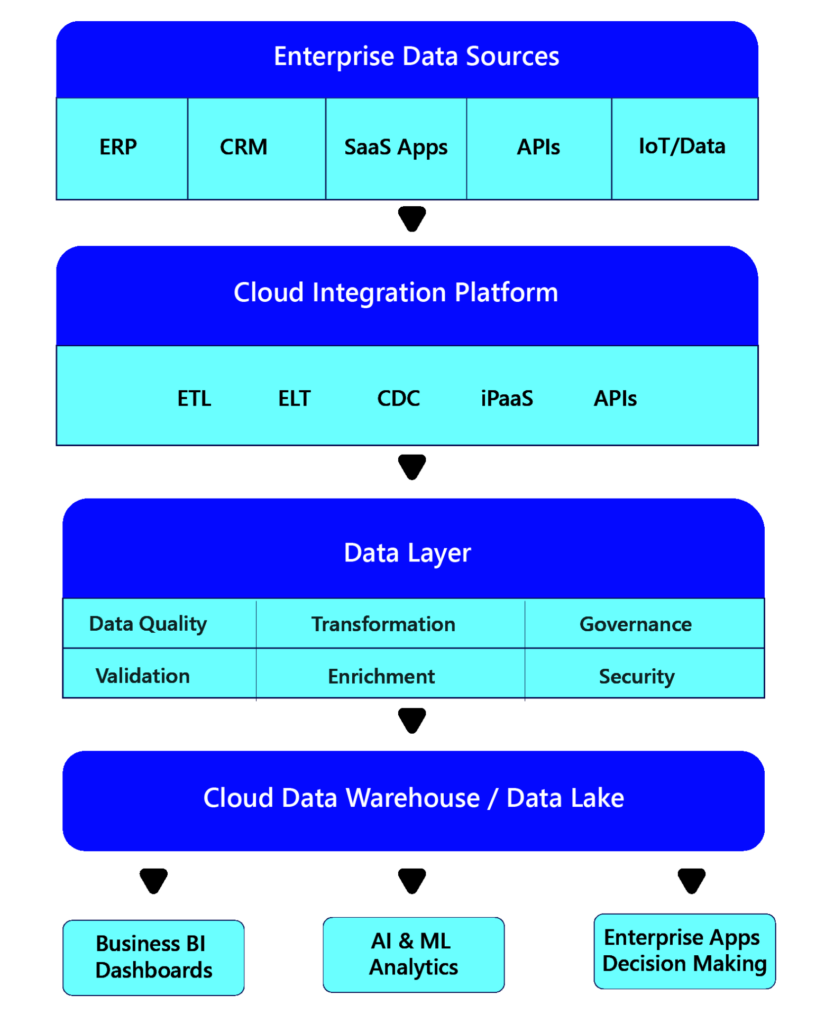
For a deeper technical walkthrough of these approaches and how to choose between them for a specific use case, see this breakdown of data integration techniques.
The Cloud Data Integration Pipeline
Regardless of the integration pattern, most cloud data integration workflows follow four fundamental stages.
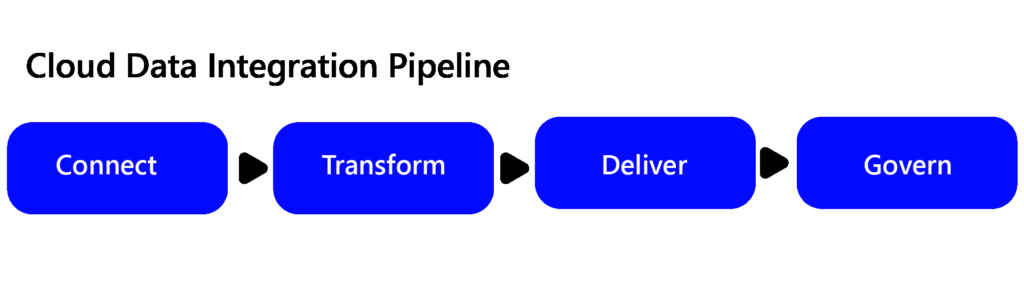
Connect
The integration platform securely connects to source systems such as enterprise applications, cloud databases, APIs, legacy systems, or IoT devices. Modern platforms typically provide hundreds of pre-built connectors that simplify this process while reducing custom development.
Transform
Raw data is rarely analytics-ready. During transformation, organizations cleanse inaccurate information, standardize formats, remove duplicate records, enrich datasets, reconcile inconsistencies, and apply business rules that improve data quality.
This stage is essential because integrating poor-quality data simply spreads inaccuracies across the enterprise.
Deliver
Once transformed, data is delivered to its destination. Depending on business requirements, this may include cloud data warehouses, data lakes, business intelligence platforms, operational applications, AI models, customer portals, or downstream enterprise systems.
Delivery can occur in real time, near real time, or scheduled batches depending on the use case.
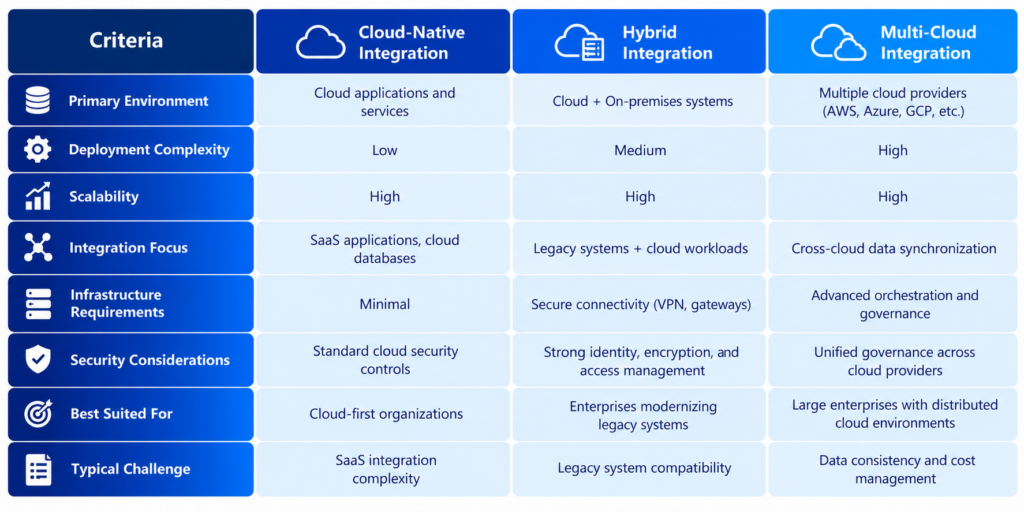
Cloud, Hybrid, and Multi-Cloud Integration Models
Very few enterprises are integrating data in a single, clean, all-cloud environment, and the model an organization chooses shapes almost every downstream architectural decision.
1.Cloud-native integration connects data sources and destinations that are already cloud-based: SaaS applications, cloud data warehouses, cloud databases. This is the simplest model to operate and typically the fastest to deploy, but it assumes the source systems have already made the move to the cloud.
For example, an e-commerce company may integrate Shopify, Salesforce CRM, Stripe payments, and Snowflake to create a centralized customer analytics platform. Customer purchases, payment information, support tickets, and marketing interactions flow seamlessly between systems, providing a unified customer profile without extensive custom coding.
2.Hybrid integration connects on-premises systems (legacy ERPs, mainframes, on-prem databases) with cloud destinations. Hybrid integration typically requires a secure connectivity layer (VPN, dedicated interconnect, or a hybrid integration platform with on-prem agents) to bridge the two environments without exposing data unnecessarily.
Consider a financial institution running its core banking platform on-premises while adopting cloud-based analytics and AI services. Hybrid integration enables transaction data to flow securely into cloud environments for fraud detection, customer insights, and reporting without replacing the mission-critical banking platform itself. This approach allows enterprises to modernize incrementally instead of undertaking costly “rip-and-replace” transformation projects.
3.Multi-cloud integration connects data across more than one public cloud provider (AWS, Azure, Google Cloud), often because different business units, acquisitions, or historical vendor decisions have left data distributed across providers. Multi-cloud integration adds real complexity: each provider has its own native services, security models, and data egress costs, and moving data between them isn’t free, technically or financially. The choice between these models is rarely a clean.
For guidance on structuring the underlying architecture for each model, including where data virtualization, hub-and-spoke, and mesh patterns fit, see this overview of data integration architecture.
Key Benefits of Cloud Data Integration
Cloud data integration delivers value far beyond simply connecting systems. It enables organizations to unlock better insights, improve operational efficiency, support AI initiatives, and create more agile digital businesses. Here are the most significant benefits
- Unified, trustworthy data – Instead of separate, conflicting versions of customer or operational data sitting in disconnected systems, cloud data integration produces a single, reconciled view. That’s the actual prerequisite for reliable analytics, reporting, and AI, not the AI model itself.
- Scalability without infrastructure overhead – Cloud-based integration platforms scale compute and storage elastically. An organization doesn’t need to provision (and pay for) peak-capacity hardware year-round to handle month-end reporting spikes or seasonal demand.
- Faster time-to-value – Pre-built connectors, low-code transformation tools, and managed infrastructure mean integration projects that used to take months of custom development can often be stood up in weeks.
- Real-time decision-making – Change Data Capture and event-driven integration patterns mean decisions (fraud detection, inventory rebalancing, personalization) can run against current data rather than yesterday’s batch load.
- Lower total cost of ownership – No hardware refresh cycles, consumption-based pricing, and reduced need for specialized on-premises infrastructure teams typically make cloud integration more cost-efficient over a multi-year horizon than maintaining equivalent on-premises ETL infrastructure, though this depends heavily on data volume and egress patterns.
- Better cross-functional collaboration – When finance, operations, and customer-facing teams work from the same integrated data instead of exporting spreadsheets from five different systems, the quality of business decisions improves in ways that are easy to state and genuinely hard to overstate.
Cloud Data Integration Challenges
While cloud data integration offers significant advantages, implementing it successfully is far from straightforward. Many organizations underestimate the complexity of integrating hundreds of applications, legacy systems, cloud platforms, and business processes into a single connected ecosystem.
Without careful planning, integration initiatives can quickly become difficult to manage, expensive to maintain, and vulnerable to security and compliance risks. Understanding these challenges and proactively addressing them – helps organizations build resilient integration architectures that continue delivering value as the business grows.
- Data quality and consistency – Integration doesn’t fix bad data. It just moves faster and further. Mismatched formats, duplicate records, and inconsistent identifiers across source systems surface immediately once integration exposes them.
Fix: Build data quality and validation rules into the transformation layer itself, not as a downstream cleanup step, and assign clear data ownership per source system, so quality issues have an accountable owner, not just a shared inbox.
- Data quality and consistency – Integration doesn’t fix bad data. It just moves faster and further. Mismatched formats, duplicate records, and inconsistent identifiers across source systems surface immediately once integration exposes them.
- Security and compliance across environments – Moving data across cloud boundaries, especially across hybrid and multi-cloud environments, multiplies the number of places sensitive data can be exposed, misconfigured, or non-compliant with data residency requirements
Fix: Apply encryption in transit and at rest as a baseline, not an afterthought, and map data residency and regulatory requirements (GDPR, industry-specific regimes) before designing the pipeline, not after it’s built.
- Security and compliance across environments – Moving data across cloud boundaries, especially across hybrid and multi-cloud environments, multiplies the number of places sensitive data can be exposed, misconfigured, or non-compliant with data residency requirements
- Security and compliance across environments – Moving data across cloud boundaries, especially across hybrid and multi-cloud environments, multiplies the number of places sensitive data can be exposed, misconfigured, or non-compliant with data residency requirements.
Fix: Apply encryption in transit and at rest as a baseline, not an afterthought, and map data residency and regulatory requirements (GDPR, industry-specific regimes) before designing the pipeline, not after it’s built.
- Security and compliance across environments – Moving data across cloud boundaries, especially across hybrid and multi-cloud environments, multiplies the number of places sensitive data can be exposed, misconfigured, or non-compliant with data residency requirements.
- Integration sprawl – As organizations adopt more point-to-point connectors and one-off integrations, the resulting web of dependencies becomes its own maintenance burden; the opposite of the simplicity integration was supposed to deliver.
Fix: Consolidate around a smaller number of well-governed integration platforms rather than accumulating ad hoc scripts and connectors and maintaining a living inventory of what’s connected to what.
- Integration sprawl – As organizations adopt more point-to-point connectors and one-off integrations, the resulting web of dependencies becomes its own maintenance burden; the opposite of the simplicity integration was supposed to deliver.
- Legacy system connectivity – Older on-premises systems, mainframes and aging ERPs among them, often weren’t built with modern APIs in mind, making them the hardest and most expensive systems to integrate cleanly.
Fix: Use a hybrid integration layer purpose-built for legacy connectivity rather than forcing legacy systems into cloud-native integration patterns they weren’t designed for.
- Legacy system connectivity – Older on-premises systems, mainframes and aging ERPs among them, often weren’t built with modern APIs in mind, making them the hardest and most expensive systems to integrate cleanly.
- Cost visibility – Cloud data movement isn’t free. Egress charges, compute for transformation, and storage all accumulate, and without monitoring, integration costs can grow faster than the value they’re delivering.
Fix: Monitor data volume and transformation compute against business value delivered, not just uptime, and revisit architecture choices (like ELT vs. ETL) when costs start climbing disproportionately to data growth.
- Cost visibility – Cloud data movement isn’t free. Egress charges, compute for transformation, and storage all accumulate, and without monitoring, integration costs can grow faster than the value they’re delivering.
- API reliability and versioning– Cloud API integration depends on external endpoints staying stable. Rate limits, breaking changes to a third-party API, and inconsistent error handling can silently break a pipeline that was working fine the week before.
Fix: Build retry logic and rate-limit handling into every API connection, monitor upstream API version changes proactively, and avoid tightly coupling business logic to a single vendor’s API contract.
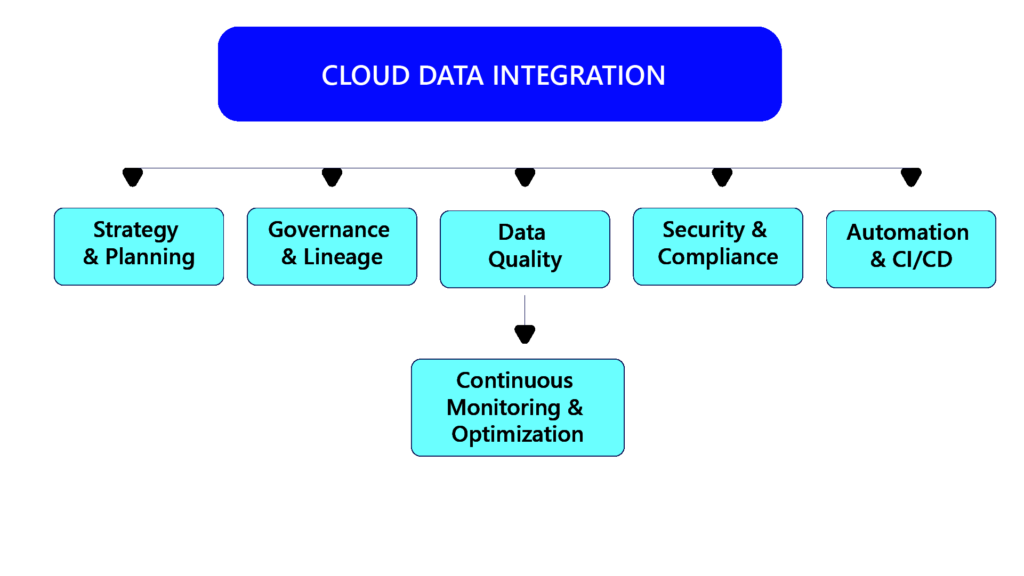
Cloud Data Integration Best Practices
Technology alone doesn’t determine the success of a cloud integration initiative. Organizations that consistently achieve long-term success combine modern integration platforms with strong governance, thoughtful architecture, and business-driven implementation strategies.
The following best practices help enterprises build scalable integration ecosystems capable of supporting future growth.
1. Start with a clear data integration strategy, not a tool selection
The most common failure mode is choosing a platform before defining what needs to connect to what, at what latency, and under what governance model. Strategy should drive tooling, not the reverse. See this framework for building a data integration strategy before committing to a platform.
2. Design for governance from day one
Access controls, data lineage, and audit trails are far cheaper to build into the architecture up front than to retrofit once dozens of pipelines are already in production.
3. Prioritize by business value, not technical convenience
Integrate the data sources that unblock the highest-value use cases first, not simply the easiest systems to connect.
4. Choose the right pattern for the use case, not a single one-size-fits-all approach
Batch ETL still makes sense for month-end financial consolidation. CDC and streaming make sense for fraud detection or real-time personalization. Most mature integration programs run several patterns in parallel.
5. Monitor data quality continuously, not just at pipeline build time
Source systems change, schemas drift, and upstream teams make changes without always notifying downstream consumers. Automated data quality monitoring catches this before it reaches a dashboard or a decision.
6. Plan for hybrid and multi-cloud realities even if you're "all-in" on one cloud today
M&A activity, shadow IT, and vendor negotiations mean most enterprises end up managing more than one environment eventually. An architecture that assumes permanent single-cloud simplicity tends to need costly rework later.
7. Treat integration as a program, not a project
Data sources, business requirements, and compliance regimes keep changing. Integration architecture needs an ongoing operating model and owner, not a one-time implementation and handoff.
For a broader view of how these practices fit into a complete integration program, platforms, connectors, and managed services together, see this overview of data integration solutions.
How Everforth Quinnox Approaches Cloud Data Integration
Everforth Quinnox‘s data and cloud engineering teams work with enterprises across BFSI, retail, manufacturing, and logistics to design and implement cloud data integration architectures that connect legacy and cloud-native systems without forcing a disruptive, all-at-once migration. That typically includes:
- Assessing the existing data landscape and integration sprawl before recommending a target architecture
- Designing hybrid and multi-cloud integration patterns suited to regulatory and legacy-system constraints specific to the client’s industry
- Implementing governance, data quality, and security controls as part of the integration build, not as a separate workstream
Conclusion
Cloud data integration has become a strategic enabler for modern enterprises, helping organizations break down data silos, improve decision-making, and accelerate digital transformation. However, success depends on more than just connecting systems – it requires the right integration strategy, governance, security, and scalable architecture.
Whether you’re modernizing legacy infrastructure, adopting a hybrid cloud model, or building a multi-cloud ecosystem, investing in a robust cloud data integration approach today will help your organization unlock greater agility, innovation, and long-term business value.

Deputy Manager, Marketing, Everforth Quinnox
FAQs Related to Cloud Data Integration
Cloud-based data integration differs from traditional, on-premises methods mainly in flexibility, scalability, and accessibility. Traditional integration relies on fixed hardware and custom point-to-point connections that are slow to scale and expensive to maintain. Cloud-based services run on elastic infrastructure, connect to a much broader range of applications through pre-built connectors, and support real-time data movement rather than only scheduled batch jobs.
No. Most enterprises run hybrid environments, integrating on-premises legacy systems with cloud destinations using a cloud-based integration platform. The value comes from the integration approach and tooling, not from every source system being cloud-native.
Cloud data integration services are managed offerings, from platform implementation to ongoing pipeline management, that help organizations design, build, and operate their integration architecture without building that capability entirely in-house. They’re typically worth considering when internal teams lack bandwidth or specialized expertise for a complex hybrid or multi-cloud integration effort, or when time-to-value matters more than building in-house capability from scratch.
The main advantages are flexibility, scalability, and cost efficiency. A cloud-based integration platform scales compute and storage on demand instead of requiring fixed hardware capacity, connects to a much wider range of applications and data sources out of the box, and typically reduces total cost of ownership compared to maintaining equivalent on-premises middleware.
The recurring issues are reliability, security, and scalability: unstable third-party endpoints, inconsistent authentication and error handling, and pipelines that break under load. These are best addressed with retry and rate-limit handling built into every connection, monitoring upstream API changes, and designing integrations, so business logic isn’t tightly coupled to any single vendor’s API contract.