Collateral was once viewed largely as an operational obligation: calculating the requirement, identifying an eligible asset, moving the collateral, and reconcile the transaction. That model is no longer sufficient.
As derivatives portfolios become more complex, clearing arrangements expand, and regulatory requirements become more demanding, financial institutions need to answer much more strategic questions: How much collateral do we need? Which assets are eligible? What collateral is actually available? Where is it currently deployed? What should we use for each obligation – and what should we preserve for future liquidity or funding needs?
The scale of the derivatives market makes these questions increasingly important. According to the Bank for International Settlements (BIS), the notional amount of outstanding OTC derivatives reached $846 trillion at the end of December 2025, underscoring the scale of exposures for which margin and collateral processes are critical. While notional value is not the same as the amount of collateral required, the figure illustrates the enormous scale of the market infrastructure in which margin and collateral processes operate.
This is particularly important for firms managing collateral across bilateral OTC derivatives, centrally cleared transactions, and tri-party arrangements. The introduction of Uncleared Margin Rules (UMR) has added another layer of complexity by increasing the importance of accurate margin calculation, eligible collateral, segregation, and timely collateral movements.
This is where Calypso collateral management can provide an integrated technology foundation for managing collateral throughout its lifecycle.
The objective is not simply to automate collateral movements. It is to determine how available collateral can be allocated most efficiently while satisfying regulatory, contractual, liquidity, and risk constraints.
This blog examines how collateral optimization works within a Calypso-based environment, the core collateral functions involved, the role of UMR, common implementation challenges, and how firms can continue improving their collateral operations after go-live.
What Is Collateral Optimization?
Before looking at how Calypso supports collateral management, it is important to distinguish collateral management from collateral optimization.
Collateral management covers the broader lifecycle of collateral, including:
- Determining collateral requirements
- Issuing and receiving margin calls
- Checking collateral eligibility
- Valuing collateral and applying haircuts
- Allocating collateral
- Processing substitutions
- Moving collateral through settlement channels
- Reconciling collateral positions
- Managing disputes and exceptions
- Supporting reporting and operational controls
- Collateral optimization goes one step further.
It asks: Given all the assets available to us, which asset should we use to satisfy this particular obligation?
That decision can depend on much more than eligibility. For example, a financial institution may have cash, government securities, corporate bonds, and other eligible assets available. Several of these assets may satisfy the same collateral requirement. However, using cash may have a higher liquidity or funding cost, while using a particular security may consume an asset that Treasury has reserved for another purpose.
Therefore, the cheapest eligible asset for one margin call may not necessarily be the best asset from an enterprise-wide perspective.
A well-designed collateral optimization process considers factors such as:
- Eligibility
- Haircuts
- Liquidity
- Funding cost
- Asset availability
- Concentration limits
- Counterparty preferences
- Currency
- Maturity
- Internal reserves
- Existing collateral allocations
- Settlement constraints
The goal is to satisfy the obligation without unnecessarily consuming scarce or strategically important collateral.
What Calypso Collateral Management Does
Collateral management sits across several areas of the capital markets operating model, including trading, risk, treasury, operations, settlement, and regulatory compliance.
A modern collateral management system therefore needs to do more than maintain a record of pledged assets. It needs to connect the information and processes that determine:
- What collateral is required
- Why it is required
- Which assets are eligible
- Which assets are available
- How much value each asset provides after applicable haircuts
- Where the collateral should be allocated
- When it needs to move
- Whether the movement was completed successfully
Calypso can support these processes through capabilities for collateral and margin processing, eligibility management, inventory, allocation, substitutions, workflows, and related operational controls. The exact functionality available to a financial institution depends on its Calypso version, configuration, modules, integrations, and operating model.
A simplified collateral management workflow can be viewed as:
Trade and exposure data → Margin requirement → Collateral call → Eligibility assessment → Inventory assessment → Optimization and allocation → Settlement → Reconciliation → Reporting
Each stage influences the next.
For example, a collateral manager may receive a margin requirement but cannot immediately determine the best asset to use. The decision depends on the applicable collateral agreement, eligible asset types, haircut schedules, concentration limits, inventory availability, funding considerations, and settlement constraints.
This is why collateral management technology is increasingly being treated as part of the broader capital markets infrastructure rather than as a standalone back-office process.
For financial institutions looking to modernize or extend their broader Calypso environment, Calypso services can support implementation, integration, modernization, testing, and ongoing platform optimization.
Why Collateral Optimization Matters More Under Uncleared Margin Rules (UMR)
The introduction of Uncleared Margin Rules (UMR) has made disciplined collateral processes increasingly important for in-scope market participants. UMR requires applicable counterparties to exchange margin for certain uncleared derivatives transactions. Initial margin (IM) and variation margin (VM) create collateral requirements, while initial margin may also involve segregation requirements.
This changes how firms need to think about their collateral portfolios. Collateral is no longer simply something that needs to be available when a margin call arrives. It can also represent a significant liquidity and funding resource.
Consider a financial institution with several counterparties and multiple collateral agreements. One counterparty may accept cash and government securities. Another may accept a broader range of securities but apply different haircuts. A third may impose tighter concentration restrictions. At the same time, the institution may have only a limited amount of high-quality liquid assets available.
If each margin call is handled independently, the firm could satisfy every individual obligation while still producing a poor overall collateral outcome.
For example, it might:
- Use cash when securities would have been more efficient
- Consume highly liquid securities needed for future obligations
- Increase concentration in a particular issuer
- Leave less flexible collateral available for another counterparty
- Create unnecessary collateral movements
- Increase funding costs.
- This is why collateral optimization needs to consider the portfolio rather than only the individual margin call.
How Collateral Optimization Works Inside Calypso
At its core, the process of collateral optimization involves selecting collateral from an available inventory to satisfy an obligation while balancing multiple constraints and objectives.
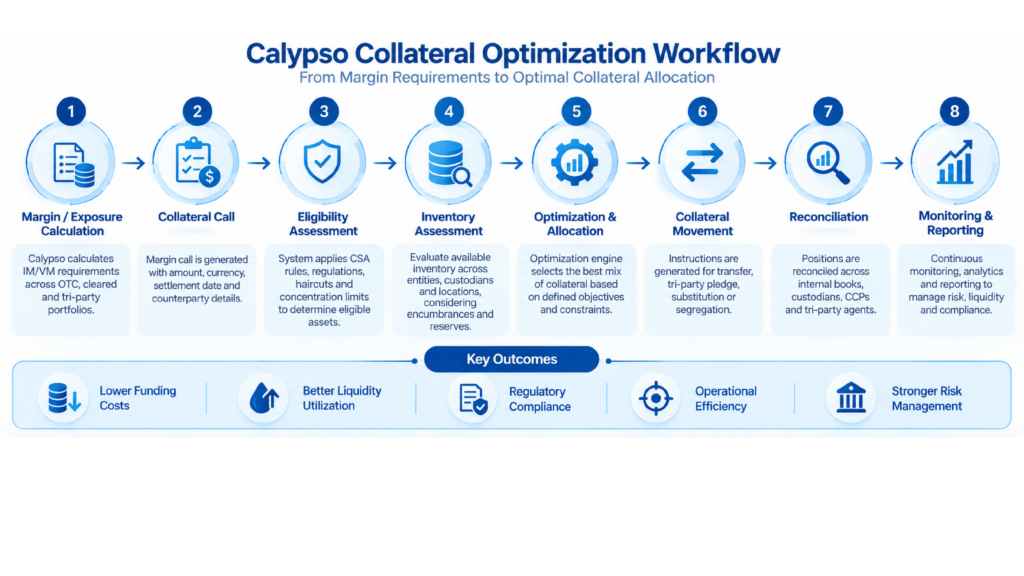
It can be broken down into several connected stages.
1. Establish the collateral requirement
The process begins with a margin or collateral requirement.
Depending on the transaction and operating model, this could relate to:
- Variation margin
- Initial margin
- Independent amounts
- Other contractual collateral requirements
The requirement determines the amount, currency, timing, and settlement conditions that need to be satisfied.
A collateral call therefore becomes more than a simple request for an amount. It becomes an input into the allocation decision.
2. Determine collateral eligibility
The next question is: Which assets are eligible for this specific obligation.
Eligibility criteria can include:
- Asset class
- Issuer
- Credit quality
- Currency
- Maturity
- Jurisdiction
- Counterparty
- Clearing arrangement
- Concentration limits
- Haircuts
Eligibility can vary significantly between counterparties and agreements.
An asset that is acceptable for one obligation may be ineligible for another. This makes centralized and accurately maintained eligibility rules an important part of collateral management software.
For example, a government security may qualify under one agreement but fail another agreement’s maturity, currency, issuer, or concentration requirements.
Eligibility is therefore one of the foundations of collateral optimization.
If eligibility rules are outdated or incorrectly configured, the institution can face two undesirable outcomes:
1.Invalid collateral allocation, or
2.An unnecessarily restricted collateral pool
Both can increase operational risk and potentially increase funding costs.
3. Assess available collateral inventory
The institution then needs to determine which eligible assets are actually available.
A security may appear in an institution’s portfolio but still be unavailable for a particular collateral requirement because it is:
- Already pledged
- Encumbered
- Reserved
- Allocated to another counterparty
- Pending settlement
- Required for another business purpose
This makes real-time or near-real-time inventory visibility important to optimization.
Held → Eligible → Available → Deployable
A large collateral portfolio does not automatically translate into a large optimization opportunity if the institution cannot accurately distinguish between held, eligible, available, and deployable assets.
4. Apply optimization objectives
After identifying eligible and available assets, the system can apply the institution’s optimization logic.
Depending on the operating model, objectives can include:
- Minimizing funding cost
- Preserving cash
- Minimizing opportunity cost
- Reducing concentration
- Maximizing liquidity
- Prioritizing certain securities
- Minimizing collateral movements
- Meeting counterparty preferences
This is where collateral optimization differs from basic collateral management.
Collateral management asks: “What assets can satisfy this requirement?”
Optimization asks: “Which eligible assets should satisfy this requirement given all the applicable constraints?”
This distinction becomes increasingly important when an institution has a large and diverse inventory.
As Vaishali Redij, Senior Manager – Calypso at Everforth Quinnox, explains:
“The effectiveness of collateral optimization is ultimately dependent on the quality and timeliness of the data feeding the process. Even a well-configured Calypso implementation can struggle to deliver optimal outcomes when inventory, eligibility, market data, settlement, or counterparty information is fragmented across systems.”
The point is critical: optimization is only as good as the data and rules supporting it.
5. Execute the collateral movement
An optimization decision is only useful if it can be operationalized.
Once collateral has been selected, the process may involve:
- Generating settlement instructions
- Communicating with custodians
- Connecting to CCPs
- Interacting with tri-party agents
- Confirming movements
- Updating positions
- Reconciling records
- Managing exceptions
Therefore, effective collateral management tools need to connect decision-making with execution rather than treating optimization as an isolated calculation.
The Three Core Pillars: Eligibility, Allocation, and Substitution
A collateral management platform typically brings several related functions together. Three are particularly important to optimization: eligibility, allocation, and substitution.
Collateral eligibility
Eligibility establishes the universe of assets that can be considered for a specific obligation.
For example, a collateral agreement may allow certain government securities but exclude particular issuers, currencies, maturities, or asset categories. The rules may also include concentration limits, minimum ratings, or other contractual requirements.
Because these rules can vary by counterparty, agreement, and market structure, maintaining them accurately is critical.
An eligibility rule that is outdated can lead to either:
- An invalid collateral allocation, or
- An unnecessarily narrow collateral pool
Eligibility should also be treated as an ongoing governance process rather than a one-time implementation activity.
Collateral allocation
Allocation determines which eligible assets are actually assigned to an obligation.
Consider an institution with $100 million of eligible securities but several simultaneous collateral requirements. It cannot evaluate each margin call independently if doing so could result in the same scarce asset being used – or effectively reserved -for competing obligations.
Allocation needs to consider the broader inventory position and applicable constraints.
This is one reason collateral optimization can become an enterprise-level problem rather than a transaction-level task.
Collateral substitution
Collateral requirements can change after an initial allocation.
A counter party may request a substitution, an asset may cease to meet eligibility requirements, or an institution may determine that the asset currently posted has become more valuable for another purpose.
Substitution enables one eligible asset to be replaced with another while maintaining the required collateral value. A robust substitution process should preserve the same eligibility, valuation, policy, and settlement controls used during the original allocation.
Otherwise, an institution could make an efficient initial allocation only to lose that efficiency through subsequent manual substitutions.
Managing Margin and Collateral Across OTC, Cleared, and Tri-Party
Collateral becomes more operationally complex when an institution manages multiple market structures.
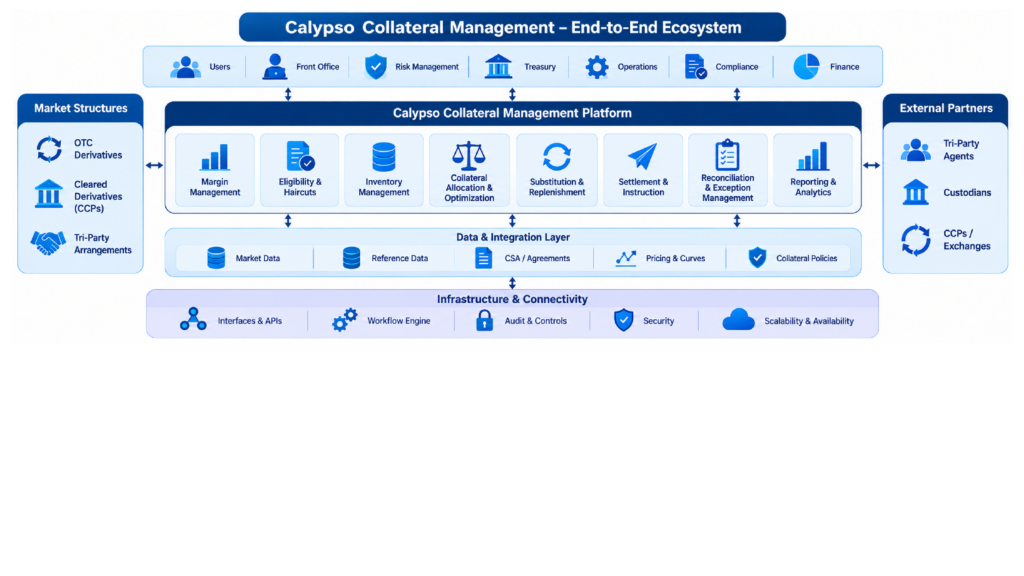
OTC collateral management
Bilateral OTC derivatives involve collateral arrangements directly between counterparties.
Processes can include:
- Margin calculation
- Collateral calls
- Eligibility checks
- Collateral allocation
- Dispute handling
- Substitutions
- Settlement
- Reconciliation
Different agreements may have different rules, creating a significant configuration and operational burden.
A centralized collateral process can help apply these rules consistently while providing greater visibility into obligations and inventory.
Cleared collateral management
Central clearing introduces another layer of requirements.
CCPs calculate margin according to their methodologies and require clearing participants or members to meet those obligations within specified timeframes.
The collateral process therefore needs to connect:
Margin Requirement → Eligible Collateral → Available Inventory → Allocation → Settlement → Confirmation
The challenge is not simply calculating the amount due. The institution must also ensure that the right collateral is available and delivered through the correct infrastructure within the required timeframe.
Tri-party collateral management
Tri-party collateral arrangements involve a third-party agent, typically a custodian, that facilitates collateral administration between the parties.
Depending on the arrangement, the tri-party agent may support:
- Collateral custody
- Valuation
- Eligibility checks
- Allocation
- Substitution
- Reporting
This introduces additional connectivity and data dependencies into the collateral management workflow. The institution therefore needs its internal collateral processes and external tri-party processes to remain synchronized.
Reserve and Policy Management in Calypso
One of the most important principles of collateral optimization is that the most efficient allocation is not necessarily the allocation that uses the cheapest eligible asset.
In practice, financial institutions often need to preserve particular assets for specific purposes. This is where reserves and collateral policies become important.
A reserve can prevent certain assets or collateral capacity from being used for lower-priority obligations.
For example, an institution may want to reserve highly liquid securities for:
- Liquidity management
- Funding requirements
- Specific counterparties
- Contingency requirements
- Regulatory considerations
- Strategic transactions
Policies determine how collateral should be allocated within those boundaries.
They may establish preferences or restrictions based on:
- Asset class
- Issuer
- Currency
- Counterparty
- Concentration
- Liquidity
- Haircut
- Availability
Consider a situation where the optimization process identifies a highly liquid government bond as the most efficient asset for satisfying a margin requirement.
From a narrow collateral perspective, that might be the correct decision. However, if Treasury has reserved the same security for another liquidity requirement, using it may create an undesirable enterprise-level outcome.
This leads to a broader principle:
The optimal collateral allocation is not necessarily the cheapest allocation in isolation. It is the allocation that balances collateral efficiency with liquidity, funding, risk, policy, and operational constraints.
That is why collateral optimization should operate in coordination with broader collateral risk and liquidity management.
Where Collateral Optimization Can Break Down
Even a sophisticated collateral management platform cannot compensate for poor data, incomplete configuration, or disconnected processes.
In many implementations, optimization challenges arise not because the required functionality is missing, but because the ecosystem supporting it is fragmented.
Data quality
Collateral optimization relies on accurate information about:
- Securities
- Positions
- Prices
- Haircuts
- Eligibility
- Counterparties
- Agreements
- Encumbrances
- Settlement status
If any of these inputs are inaccurate or delayed, the resulting allocation can be unsuitable even when the underlying system is functioning correctly.
Eligibility configuration
Collateral eligibility is not static.
Counterparty agreements, market conditions, clearing requirements, and internal policies can change. If those changes are not reflected in the system promptly, the optimization process can operate using outdated rules.
Regular configuration governance is therefore as important as the initial configuration.
Fragmented collateral management systems
Many institutions have accumulated multiple systems over time.
One application may hold securities inventory, another may manage margin, another may support settlement, and spreadsheets may still be used for exception handling or manual calculations.
This creates problems such as:
- Duplicate data
- Reconciliation effort
- Delayed information
- Manual intervention
- Inconsistent views of collateral availability
Consolidating or integrating these processes can create a more reliable foundation for optimization.
Integration gaps
A collateral platform may need to exchange information with:
- Trading systems
- Risk platforms
- Market data providers
- Custodians
- CCPs
- Tri-party agents
- Settlement systems
- Treasury applications
- Reporting platforms
A failure in any critical integration can affect the downstream collateral process.
Integration therefore needs to be treated as part of the collateral operating model – not simply as a technical implementation task.
Limited inventory visibility
Optimization cannot be effective without knowing what is actually available.
Collateral may be distributed across legal entities, accounts, custodians, currencies, and business units.
A central view of inventory should distinguish between assets that are:
Held → Eligible → Available → Reserved → Encumbered → Allocated
That distinction can materially improve allocation decisions and reduce the risk of double-counting available collateral.
Excessive customization
Customization may be necessary for institution-specific requirements, but excessive customization can increase the cost and complexity of maintaining a Calypso environment.
It can also make:
- Upgrades
- Regression testing
- Maintenance
- Troubleshooting
- Regulatory changes
A disciplined Calypso migration strategy can help organizations move toward a more maintainable architecture while preserving necessary business capabilities.
Manual exception handling
Automation often receives attention during the standard workflow, while exceptions receive less consideration.
Yet recurring exceptions can consume a substantial amount of operational capacity.
Institutions should identify recurring breaks and determine whether they can be addressed through:
- Better data
- Improved configuration
- Workflow changes
- Additional integrations
- Automation
- Process redesign
The objective should be to make exceptions genuinely exceptional.
Getting Calypso Collateral Management Right: Implementation and Optimization
A successful Calypso collateral implementation begins with the business process rather than the technology configuration.
Before implementing or redesigning collateral functionality, institutions should understand how collateral moves through the organization today and where the highest-value improvements exist.
Map the end-to-end collateral workflow
Start with the complete lifecycle:
Exposure → Margin calculation → Collateral call → Eligibility → Inventory → Allocation → Settlement → Reconciliation → Reporting
Document:
- Systems involved
- Data sources
- Manual decisions
- Business rules
- Exception points
- Settlement dependencies
- Ownership across teams
This creates a practical blueprint for implementation.
Define what “optimization” means
Optimization needs measurable objectives.
Possible KPIs include:
- Reduction in collateral funding costs
- Reduction in excess cash usage
- Improvement in eligible collateral utilization
- Reduction in manual interventions
- Lower settlement failure rates
- Faster margin-call processing
- Reduction in collateral disputes
- Better intraday collateral visibility
- Reduced concentration
Without defined objectives, it becomes difficult to determine whether a new collateral management technology is actually delivering better outcomes.
Build a reliable collateral data foundation
Data ownership should be explicitly established for:
- Security master data
- Counterparty data
- Collateral agreements
- Eligibility rules
- Haircuts
- Market prices
- Inventory
- Settlement instructions
The optimization engine can only make decisions based on the information it receives.
Configure before customizing
A strong implementation approach should use configurable business rules wherever practical.
Unnecessary customization can make future:
- Upgrades
- Testing
- Maintenance
- Troubleshooting
- Regulatory changes
more difficult.
Where customization is required, it should have clear ownership, documentation, and testing coverage.
Integrate the complete process
Collateral management should not be designed as an isolated application.
Integration architecture should account for both incoming information- such as margin requirements, positions, prices, and eligibility data – and outgoing processes such as settlement instructions, confirmations, reconciliation, and reporting.
This creates continuity from the initial collateral requirement through final settlement and reconciliation.
Testing Calypso Collateral Workflows: Beyond the Happy Path
Collateral processes are particularly sensitive to configuration changes because a seemingly small rule change can affect eligibility, allocation, settlement, or downstream reconciliation.
Testing should go beyond the standard happy path.
Important scenarios include:
- Different collateral types
- Multiple currencies
- Haircut changes
- Eligibility changes
- Substitution requests
- Margin disputes
- Insufficient inventory
- Concentration breaches
- Settlement failures
- Partial collateral movements
- Intraday changes
- Multiple legal entities
- CCP workflows
- Tri-party workflows
Regression testing becomes particularly important as collateral rules, integrations, and configurations evolve.
For organizations managing complex Calypso environments, a Calypso automated testing tool can help improve regression coverage and reduce the risk associated with configuration changes, upgrades, and integrations.
Continuously Improving Collateral Operations After Go-Live
The implementation of a collateral management system is not the end of the optimization journey.
Collateral requirements change. Portfolios change. Counterparties change their agreements. Funding costs fluctuate. Regulatory expectations evolve. Internal liquidity priorities can also shift.
A collateral operating model therefore needs a mechanism for continuous improvement.
Monitor collateral performance
Useful metrics can include:
- Collateral utilization
- Excess collateral
- Cash versus securities usage
- Funding cost
- Collateral movement volumes
- Settlement failure rates
- Margin disputes
- Manual intervention rates
- Substitution frequency
- Concentration
- Optimization savings
These indicators provide a more complete view of whether the collateral function is becoming more efficient.
Review optimization rules periodically
A rule that was optimal under one set of market conditions may not remain optimal indefinitely.
For example, changes in funding costs can alter the relative attractiveness of cash and securities. A change in a counterparty agreement can also expand or restrict the eligible collateral universe.
Optimization rules should therefore be reviewed as part of ongoing collateral governance.
Use operational data to identify improvement opportunities
The collateral function generates valuable operational data.
Recurring exceptions can reveal:
- Poorly maintained reference data
- Incomplete integrations
- Incorrect eligibility rules
- Inefficient workflows
- Manual bottlenecks
Rather than treating these events as isolated operational problems, firms can analyze them as indicators of where the underlying process needs improvement.
The Next Step: Connecting Collateral Optimization with Liquidity Management
The evolution of collateral management is moving beyond simply answering:
“How do we satisfy this margin call?”
The more strategic question is:
“How do we satisfy this obligation while preserving liquidity, minimizing funding costs, managing risk, and retaining flexibility for future obligations?”
That shift changes collateral from a largely operational function into a strategic component of liquidity and funding management.
The future of collateral optimization is therefore likely to depend not only on better allocation algorithms or more automation, but on the ability to connect collateral decisions with the institution’s broader financial position.
This is where data integration, inventory visibility, policy management, analytics, workflow automation, and continuous testing become increasingly important.
Conclusion
Collateral optimization is increasingly becoming a strategic capability for capital markets institutions.
Regulatory requirements such as UMR, increasingly complex derivatives portfolios, multiple collateral agreements, and tighter liquidity considerations have made it more important for firms to understand not only how much collateral they need, but how they can deploy their collateral portfolios most efficiently.
Calypso can provide the technology foundation for this process by connecting margin requirements, collateral calls, eligibility, inventory, allocation, substitution, policy management, settlement, and reconciliation.
However, realizing the full value of Calypso collateral management requires more than platform functionality. The quality of the outcome depends on the interaction between data, configuration, integration, business rules, inventory visibility, risk policies, and operating processes.
This is where the right implementation and modernization partner can make a difference.
At Everforth Quinnox, we help financial institutions maximize the value of their Calypso investments by bringing together Calypso expertise, implementation and modernization capabilities, integration, testing, and ongoing platform optimization. Our approach focuses not only on configuring the platform, but on aligning Calypso with the institution’s broader collateral, risk, liquidity, and operational objectives.
Ultimately, the goal is not simply to automate collateral processing. It is to build a collateral operating model that can make informed allocation decisions, reduce unnecessary funding and operational costs, protect liquidity, manage collateral risk, and adapt as market and regulatory requirements change.
With the right Calypso strategy, technology foundation, and continuous optimization approach, collateral can move from being an operational obligation to becoming a more efficiently managed strategic resource.

Deputy Manager, Marketing, Everforth Quinnox
Frequently Asked Questions
Collateral optimization is the process of selecting and allocating eligible collateral to satisfy margin or other collateral obligations while considering factors such as funding cost, liquidity, haircuts, concentration limits, eligibility, and asset availability. The objective is to meet the obligation efficiently without unnecessarily consuming scarce or high-value collateral.
Calypso can support collateral management through capabilities for margin and collateral processing, eligibility, inventory, allocation, substitution, policy controls, workflows, and collateral movements. The effectiveness of the implementation depends on the institution’s Calypso configuration, data quality, integrations, and optimization rules.
Collateral management covers the broader lifecycle of managing collateral, including determining requirements, issuing collateral calls, validating eligible assets, moving collateral, and reconciling positions. Collateral optimization focuses specifically on determining how available collateral should be allocated to satisfy those obligations as efficiently as possible.
Tri-party collateral management is an arrangement in which a third-party agent, generally a custodian, facilitates collateral administration between two counterparties. Depending on the arrangement, the agent may support custody, valuation, eligibility checks, allocation, substitution, and reporting.
Uncleared Margin Rules increase the importance of effective collateral processes by requiring applicable counterparties to exchange margin for certain uncleared derivatives transactions. Initial and variation margin requirements can create significant collateral and liquidity demands, making efficient inventory management, eligibility, allocation, and optimization increasingly important.