As the global capital market transitions toward cloud-native standards, modern middleware frameworks, and higher execution velocity, upgrading your core treasury and capital markets platform is a strategic mandate. Calypso V18 plays a pivotal role in this transformation, moving away from legacy Java specifications to a modern technology foundation powered by JDK 17 and Spring Boot 3.1.x.
While Calypso V18 maintains the foundational core architecture of V17, it introduces key infrastructure streamlining, enforces the migration from javax to jakarta, and completely replaces 400+ legacy raw SQL remote calls with a structured Query DTO Framework.
However, moving to V18 is not just about implementing new technologies. Organizations also need to understand what these architectural changes mean for their existing environment, how they impact customizations and integrations, and how to approach the upgrade with minimal business disruption.
In this blog, we’ll break down the key changes introduced in Calypso V18, explain why they matter, and share a practical roadmap to help you plan and execute a successful upgrade with confidence.
Download our 5-Point Executive Checklist for Calypso Migration Success – a practical roadmap used by leading financial institutions to minimize risk, accelerate validation, and future-proof their Calypso estate.
Calypso V17 vs. Calypso V18 - Core Architectural & Functional Delta
The operational and technical differences between Calypso V17 and V18 center around platform modernization, database footprint, and data access patterns:
| Dimension | Calypso V17 | Calypso V18 | Operational Impact |
|---|---|---|---|
| Java Runtime | Java 8 / 11 runtime baseline | JDK 17 Strictly (Compile & Runtime) | Upgrades compiler & runtime execution; unlocks modern garbage collection & security updates. |
| Framework Ecosystem | Legacy Spring / Java EE (javax.*) | Spring Boot 3.1.x (jakarta.*) | Forces package rename across custom extensions, Web APIs, and JMS messaging modules. |
| Data Access Layer | Direct SQL WHERE clause strings in Remote Calls | Query DTO Framework (400+ legacy calls deprecated/removed) | Refactors data querying into a strongly typed, object-oriented, and secure abstraction layer. |
| Database Support | Oracle, PostgreSQL, Sybase | Sybase Support Removed | Sybase environments must execute a database migration prior to upgrading to V18. |
| Server Footprint | KPI Server, Limit Server, engines active | KPI & Limit Servers Removed | Simplifies deployment topology; reduces memory footprints and server orchestration overhead. |
| Core Architecture | Distributed Service Architecture | Unchanged Core Architecture | Domain models and underlying service topographies remain intact, keeping integration patterns familiar. |
Deep Dive: What Has Changed & System Impact
A. The Java 17 & Spring Boot 3.1.x Shift (javax to jakarta)
The underlying framework upgrade to Spring Boot 3.1.x mandates a transition from legacy javax. packages to the modern jakarta.* namespace.
- Custom Code Compilation: The majority of initial compilation breakages during upgrade stem from javax package dependencies (e.g., javax.jms, javax.servlet). Custom extensions, handlers, and engines must be updated to target Jakarta specifications.
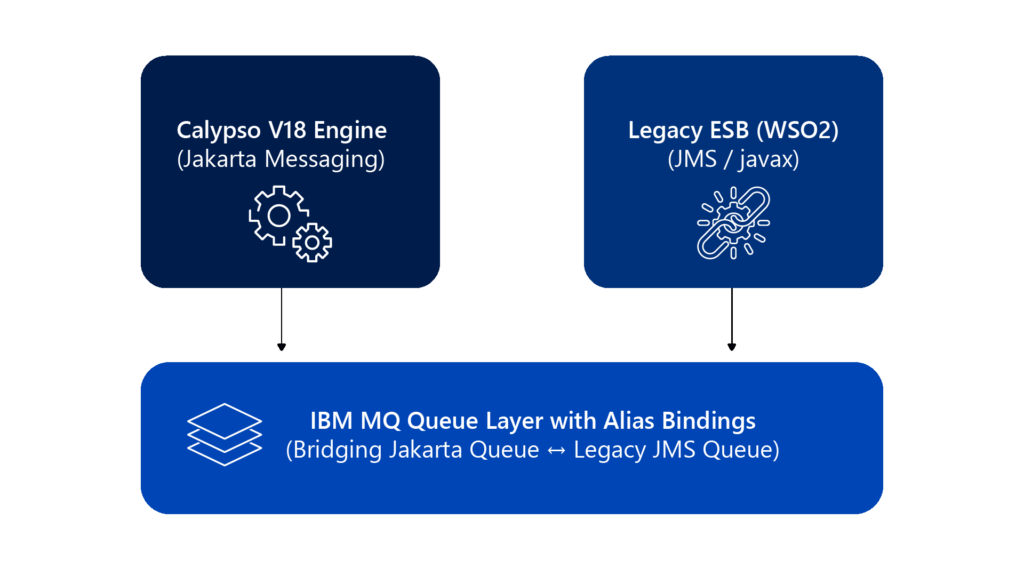
- Middleware & Integration Queues (e.g., IBM MQ & WSO2): Upgrading messaging dependencies impacts downstream integration points such as trade upload engines (UploadImportMessageEngine) and ESB layers (e.g., WSO2, APEX/CADIS).
Key Insight: When transitioning enterprise messaging (like IBM MQ) to Jakarta Messaging, queue connection factories and bindings must be recreated under the jakarta namespace. For legacy middleware components that cannot immediately migrate from JMS to Jakarta, dual queue aliases or separate connection factories must be established to preserve trade processing flows (e.g., FPML trade status transitions like AUTHORIZED/VERIFIED).
B. Transition to the Query DTO Framework
Calypso V18 completely decommissions over 400 legacy remote APIs that relied on inline SQL WHERE clauses. These are replaced by the Query DTO Framework.
- Flexible Abstraction: The Query DTO Framework provides a strongly typed, flexible way to construct queries across standard and custom Calypso business objects, supporting complex filtering, logical operators, paging, and sorting.
- Early Adoption Path: Query Framework APIs were made available in late Calypso V17 Maintenance Releases (from Dec 2023 onward). While optional in V17, they become mandatory in V18.
- Manual Refactoring Required: There is no automated conversion tool provided by the vendor for transitioning legacy SQL queries to Query DTOs. Engineering teams must refactor these calls manually based on standard architectural guidelines.
C. Infrastructure & Topology Simplification
- Sybase Removal: Sybase is no longer supported in V18. Organizations still running on Sybase must complete a database migration prior to cutover.
- Server Consolidation: The KPI Server and Limit Server have been removed, streamlining system startup sequences and reducing hardware/container footprints.
Strategic Business and Technical Benefits of Upgrading to V18
Upgrading to Calypso V18 delivers long-term technical and operational returns across three core areas:
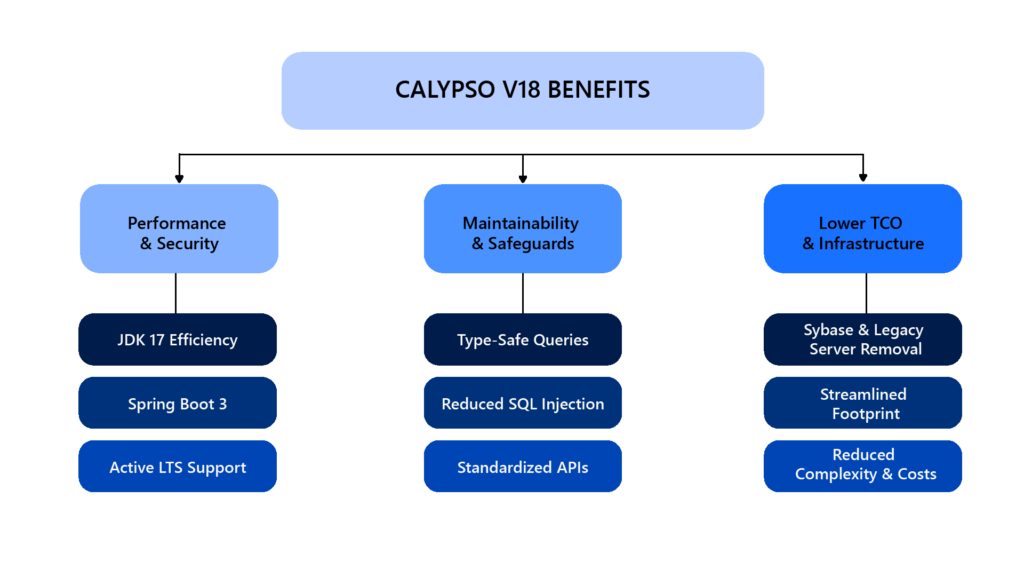
1. Performance, Security, and Modernized Stack
- JDK 17 Runtime Efficiencies: Modern garbage collectors (such as ZGC and Shenandoah) in JDK 17 reduce pause times during high-volume trading hours, enhancing throughput across core processing engines.
- Updated Security Posture: Transitioning to Spring Boot 3.1.x and Jakarta eliminates critical vulnerabilities found in end-of-life Java EE libraries, satisfying institutional IT compliance requirements.
2. Enterprise Code Governance & Query Protection
- Elimination of SQL Injection Risks: Legacy raw SQL string building in remote calls posed security and maintainability risks. Query DTOs parameterize and validate query structure, preventing malicious code injection and ill-formed queries.
- Standardized Extension Development: Object-specific query definitions allow developers to build scalable custom modules without deep DB schema coupling, reducing code rot and simplifying future upgrades.
3. Reduced Infrastructure Complexity & TCO
- Server Footprint Rationalization: Removing the KPI and Limit Servers reduces active background processes, lowering JVM memory overhead and container resource requirements across non-production and production environments.
- Database Modernization: Dropping legacy Sybase support helps financial institutions consolidate database maintenance onto strategic enterprise engines like Oracle or PostgreSQL.
Phase-by-Phase Adoption Strategy & Recommended Roadmap
To ensure a smooth transition with minimal disruption to trading and back-office operations, organizations should follow a structured 5-phase migration strategy:
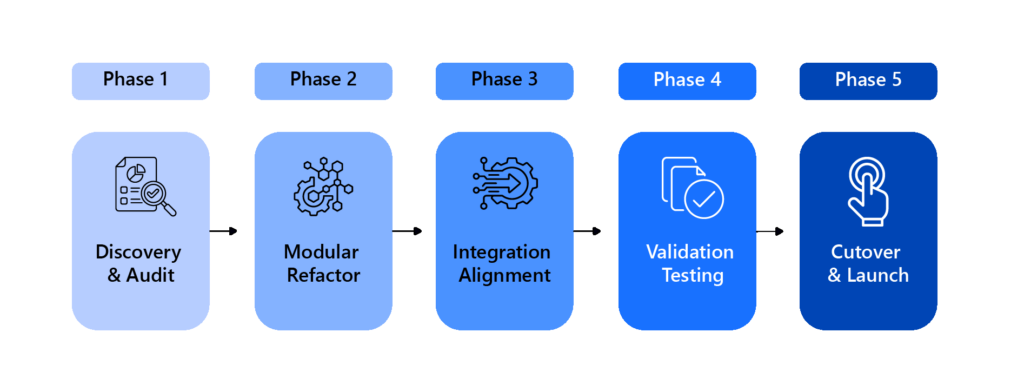
Phase 1: Preparation & Early Sandbox (V17 MRs)
- Leverage post-Dec 2023 Calypso V17 Maintenance Releases to introduce and test Query DTO APIs early in your current environment.
- Conduct a full static code analysis on custom repositories to identify all occurrences of javax.* references and deprecated remote SQL calls.
Phase 2: Custom Code Refactoring
- Update project dependencies to JDK 17 and Spring Boot 3.1.x.
- Refactor custom modules from javax to jakarta (especially messaging and servlet dependencies).
- Systematically convert legacy remote SQL calls to Query DTO definitions according to object-specific query standards.
Phase 3: Middleware & Integration Realignment
- Update messaging providers (IBM MQ, JMS bridges) to support Jakarta bindings.
- Define queue aliases and connection factories to bridge communications between Jakarta-native Calypso V18 and legacy integration tools (e.g., WSO2 ESB, reporting engines).
Phase 4: Non-Functional & Integration Testing
- Perform end-to-end testing across trade capture, messaging lifecycle (e.g., DU XML/CSV uploads), and downstream STP flows.
- Conduct performance testing on high-volume queries translated to the Query DTO framework to verify indexing and response times.
Phase 5: Production Deployment & Monitoring
- Execute cutover scripts, ensuring database baseline compatibility and server configuration updates (decommissioning KPI/Limit server definitions).
Conclusion: De-Risking Your Calypso V18 Upgrade with Everforth Quinnox
Upgrading to Calypso V18 is more than a routine application patch; it is a foundational architecture migration that touches custom codebases, data query layers, and integration topologies. Without a structured, automation-led strategy, organizations risk extended development cycles, integration bottlenecks, and costly downtime.
This is where Everforth Quinnox serves as an indispensable execution partner. As an AI-first digital enterprise and trusted Calypso services partner with over 15 years of platform experience, Everforth Quinnox transforms complex upgrades into predictable, zero-defect transformations.
The Everforth Quinnox Advantage for Calypso V18:
- The ACT (Assured Calypso Transformation) Framework: Combines upgrade readiness assessments, automated code remediation, and environment validation to de-risk V18 migrations and accelerate delivery timelines.
- Proven Integration & Middleware Solutions: Leveraging deep engineering expertise, Everforth Quinnox quickly resolves integration hurdles – such as IBM MQ Jakarta queue creation and WSO2 alias bindings – ensuring upstream and downstream trade messaging flows without disruption.
- Automation-Led Validation: By pairing deep domain knowledge with propriety DevOps accelerators (including QFrame and SmartCompare), Everforth Quinnox enables financial institutions to achieve up to 54% higher test coverage while reducing overall execution time by 25% to 30%.
- Proven Financial Track Record: From saving major tier-1 institutions over $1M+ in operational costs to cutting upgrade execution times by four months, Everforth Quinnox ensures your Calypso V18 upgrade delivers rapid time-to-value with zero production impact.
Ready to accelerate your Calypso V18 journey? Partner with Everforth Quinnox’s Calypso Center of Excellence to turn technical debt into a modernized, resilient, and high-performance capital markets engine.

Senior Manager - Calypso at Everforth Quinnox
FAQ’s Related to Calypso V18
Calypso V18 introduces several significant upgrades over V17, including mandatory support for JDK 17, Spring Boot 3.1.x, migration from javax to jakarta, adoption of the Query DTO Framework, removal of Sybase database support, and elimination of KPI and Limit Servers. These changes improve security, performance, and maintainability while modernizing the platform architecture.
Upgrading to Calypso V18 enables financial institutions to leverage a modern technology stack, strengthen security, improve application performance, reduce infrastructure complexity, and ensure long-term vendor support. It also prepares organizations for future innovation while minimizing technical debt.
Common challenges include refactoring custom code from javax to jakarta, manually converting legacy SQL queries to the Query DTO Framework, updating middleware integrations such as IBM MQ and WSO2, validating custom extensions, and conducting comprehensive regression and integration testing.
Everforth Quinnox offers the ACT (Assured Calypso Transformation) Framework, automation-led validation, integration expertise, and proprietary accelerators to simplify complex Calypso upgrades. Their approach helps reduce migration risks, accelerate testing, streamline middleware transitions, and minimize production downtime.
Beyond technical modernization, Calypso V18 helps organizations improve operational efficiency, strengthen security, lower infrastructure costs, simplify maintenance, accelerate future upgrades, and build a more resilient and scalable capital markets platform.