In today’s fast-moving digital economy, software quality directly influences customer loyalty, revenue, and reputation. Yet, 41% of enterprises still depend primarily on manual testing – that slows release cycles, increases costs, and introduces greater risk.
Test automation changes that equation. It accelerates product delivery, ensures consistency, and reduces operational expenses. Yet, one question often stands between decision-makers and automation investment: Is automation truly worth it?
While the benefits of automation are well known, the real differentiator lies in understanding its measurable impact. Business leaders and technology executives want to see tangible results – how automation directly contributes to efficiency, quality, and profitability.
This is where Test Automation ROI becomes essential. It transforms automation from a technical initiative into a quantifiable business case. Measuring ROI helps organizations understand which areas of automation deliver the most value, how quickly the investment pays off, and how it strengthens long-term competitiveness.
In this blog, we will explore what Test Automation ROI means, why it matters, the key factors influencing it, and how to calculate it accurately. You will also learn how to interpret results, avoid common pitfalls, and apply proven strategies to maximize automation returns. Whether you are launching automation for the first time or scaling an enterprise-wide framework, this guide will help you turn testing automation into a measurable engine for business growth.
What is Test Automation ROI?
Test Automation ROI represents the financial return a company gains from automating its software testing processes compared with the investment made to implement and maintain that automation. It quantifies the cost savings, efficiency improvements, and quality enhancements achieved by replacing repetitive manual testing with automated scripts and frameworks.
The standard formula for calculating ROI is:
ROI = (Net Gain from Automation / Cost of Automation) × 100
Where:
- Net Gain from Automation = (Manual Testing Cost – Automated Testing Cost)
- Cost of Automation includes expenses such as tools, licenses, infrastructure, training, and maintenance.
For example, if a company invests $40,000 in automation but saves $100,000 annually through reduced manual testing, the ROI equals:
ROI = ((100,000 – 40,000) / 40,000) × 100 = 150%
A 150 percent ROI means every dollar spent returns one and a half dollars in value. However, beyond financial figures, test automation drives non-tangible benefits-such as faster release cycles, improved reliability, and better collaboration between teams – that further enhance long-term value.
Don’t Miss on this Read: How to Maximize the ROI of your Test Automation Platform
Top 3 Reasons to Calculate Your Automated Testing ROI
Calculating ROI in automation testing ensures that automation efforts align with business goals rather than existing as isolated technical initiatives. Below are key reasons why ROI calculation should be an essential part of every test automation strategy:
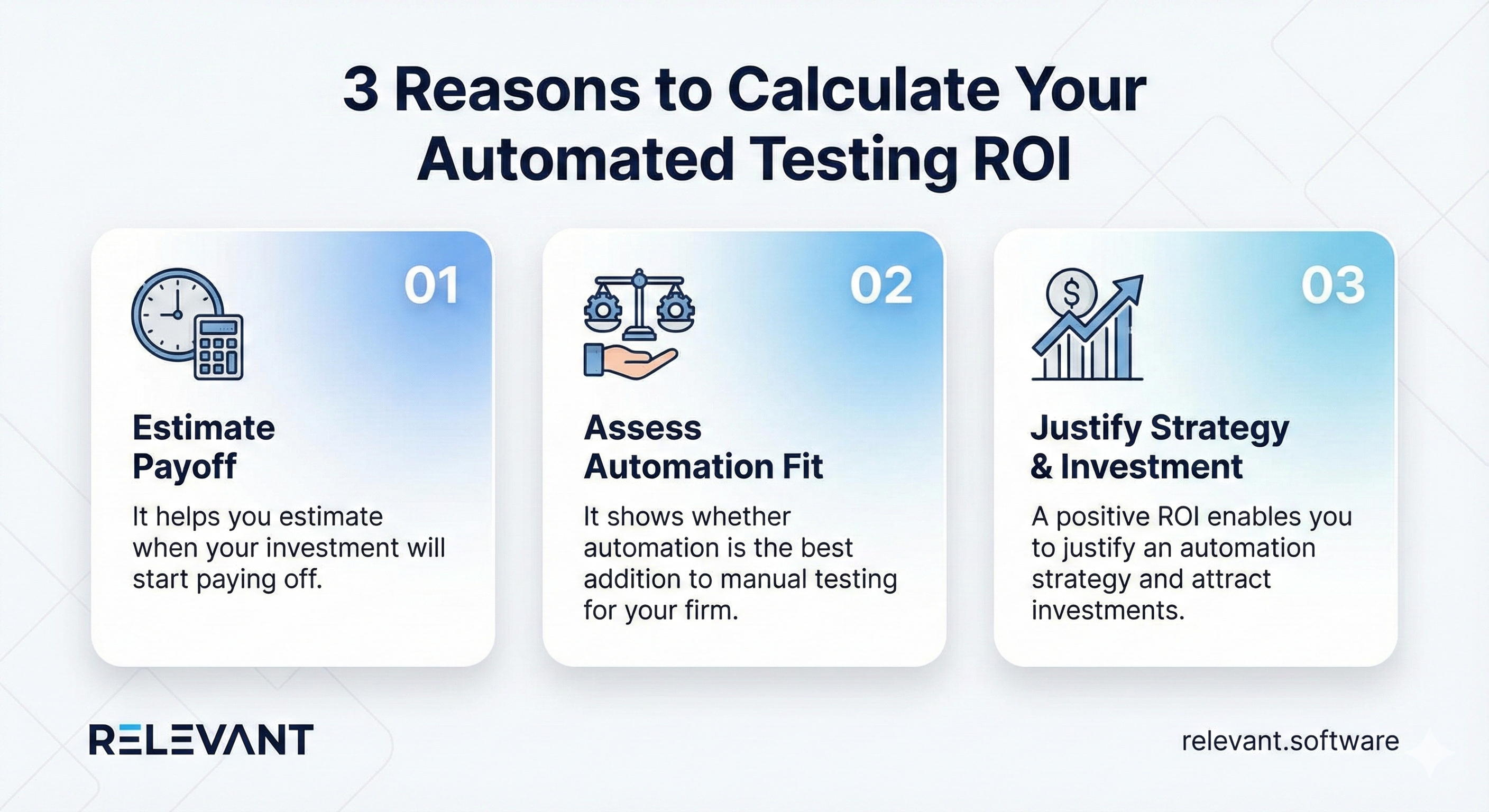
1. Estimate When Your Investment Starts Paying Off
ROI analysis helps determine the payback period – when automation begins to generate savings greater than the initial investment.
For example, if your setup cost is $30,000 and your annual labor savings reach $45,000, the break-even point occurs within the first year.
This clarity helps leaders:
- Forecast cost recovery and long-term value creation
- Justify phased automation rollouts based on financial impact
- Align budgets with expected ROI timeline.
In essence, ROI converts testing metrics into financial visibility, showing when automation moves from cost center to value driver.
2. Evaluate Whether Automation Is the Right Addition to Manual Testing
Not every test process needs automation. ROI helps identify where automation adds measurable advantage and where manual testing remains more efficient.
For instance:
- Repetitive regression suites and smoke tests yield ROI above 100% within months.
- Complex UI or ad hoc tests, on the other hand, may not justify automation costs.
By comparing manual versus automated effort and maintenance overhead, organizations can prioritize high-impact areas – ensuring maximum returns for every automation dollar spent.
3. Strengthen Your Business Case and Drive Investment Confidence
A positive ROI is the most persuasive metric for executives evaluating automation expansion. It helps transform quality assurance from an operational expense into a strategic enabler of digital growth.
Clear ROI metrics empower teams to:
- Secure funding for tool upgrades, training, or infrastructure expansion
- Demonstrate quantifiable returns to stakeholders and clients
- Position automation as a competitive differentiator rather than a support function.
For example, a sustained ROI above 100 percent year-over-year signals a mature, efficient automation ecosystem – one capable of delivering faster releases, lower defect rates, and stronger business outcomes.
Factors Affecting Test Automation ROI
Multiple components shape how much value organizations extract from test automation. Understanding these factors ensures that ROI calculations remain accurate and actionable.
| Factor | Description | Impact on ROI |
|---|---|---|
| Initial Investment | Includes cost of tools, setup, and training | High upfront costs reduce short-term ROI |
| Test Case Complexity | Simpler repetitive tests yield faster automation benefits | Complex tests require higher maintenance |
| Maintenance Effort | Frequency of updates to scripts and data | Increased maintenance reduces ROI |
| Test Coverage | Extent of application areas tested | Broader coverage improves ROI |
| Tool Selection | Right tools improve speed and accuracy | Poor tools reduce effectiveness |
| Team Expertise | Skilled engineers create robust automation | Skill gaps add cost and rework |
| Execution Frequency | Frequent test runs amplify returns | Rarely executed tests deliver minimal value |
| Framework Scalability | Scalable frameworks such as Everforth Quinnox Test Automation Framework (QTAF) support long-term growth | Scalability improves efficiency and ROI |
Understanding Automation Costs
Test automation can significantly enhance productivity and reliability, but understanding the total cost of ownership (TCO) is crucial to assessing true ROI. A complete view of automation costs must account for all dimensions- people, processes, and technology- rather than focusing solely on tool expenses. Many organizations underestimate these hidden costs, which can distort ROI calculations.
Automation investments typically fall into four key cost areas.
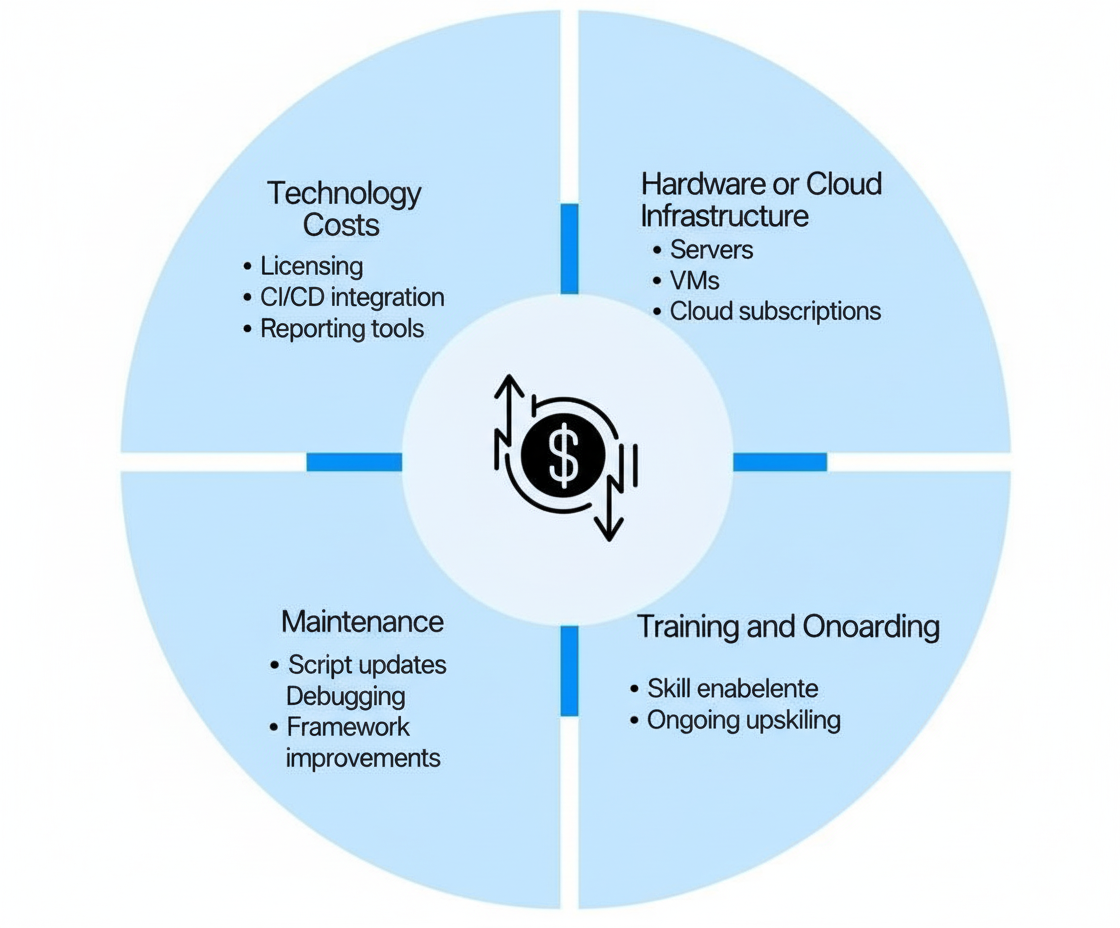
1. Technology Costs
Licensing fees are often the largest portion of technology expenses, especially when using commercial automation frameworks. Costs depend on the number of user licenses, automation agents, and hardware configurations. In addition to licensing, setup-related expenses – installation, initial configuration, and user enablement – should also be considered.
Technology costs may also include supporting solutions such as code repositories for managing automation scripts, CI/CD integrations for continuous test execution, and reporting tools that deliver testing insights. Neglecting these related expenditures often results in an incomplete understanding of total investment.
2. Hardware Costs
Hardware costs primarily apply to on-premises environments that require dedicated servers or infrastructure. These include acquisition, configuration, and ongoing maintenance. Cloud-based automation tools generally, bundle infrastructure within their subscription fees, effectively eliminating separate hardware spending.
3. Training Expenses
Training ensures teams can effectively use automation tools and frameworks. The cost depends on the complexity of the technology, existing skill levels, and the quality of vendor or community support. Advanced tools often demand deeper learning and periodic retraining, while low-code or intuitive platforms can reduce these costs considerably.
4. Implementation and Maintenance Expenses
One of the most underestimated cost components involves integrating and maintaining automation platforms. As applications evolve, test scripts must be updated to reflect changes in functionality and design. Maintenance costs rise in proportion to the number and complexity of automated assets. Continuous refinement and monitoring are essential to keep automation efficient and relevant.
Factors Influencing Automation ROI
A more granular look reveals deeper variables that influence how quickly and effectively automation investments deliver value.
Key Drivers of Automation ROI
- Initial Investment
Covers licensing, infrastructure, and training costs. Larger investments require longer payback periods but can yield higher future returns. - Test Case Selection
Automating stable, high-frequency, and business-critical tests maximizes ROI. Unstable or rarely executed tests usually add overhead rather than savings. - Maintenance Effort
Tests that frequently fail due to UI or functional changes drive up costs. Modular and reusable designs reduce this burden significantly. - Test Execution Speed and Frequency
The faster and more frequently tests run, particularly within CI/CD pipelines, the higher the overall time savings. - Team Skill and Productivity
Skilled QA engineers build efficient automation, while unoptimized scripts lead to debugging delays and lower returns. - Time Saved
Reducing manual testing hours directly lowers costs and accelerates release cycles, increasing productivity. - Defect Detection and Quality Gains
Early bug detection prevents expensive rework, enhances product stability, and improves customer satisfaction. - Integration with CI/CD and DevOps
Embedding automated tests into continuous delivery processes provides immediate feedback and enhances stability. - Reusability and Scalability
Tests that can be reused across releases or platforms increase ROI as initial investments spread over multiple cycles. - Project Lifecycle Duration
Longer projects benefit more from automation because costs are amortized over time. For short-term initiatives, the return may be lower.
How to Calculate Test Automation ROI (Step-by-Step)
Let’s run a realistic case example.
Scenario: A QA team executes 600 manual test cases per release, each taking 15 minutes. There are 12 releases per year, and the average tester hourly rate is $50.
1. Manual Testing Cost
600×0.25 (hours)×50×12=$90,000600
2. Automation Cost
- Tool license and setup: $30,000
- Annual maintenance and updates: $10,000
- Automated test execution time: 1 minute per test
Execution cost:
600×0.016 (hours)×50×12=$5,760600
Total automation cost (first year):
30,000+10,000+5,760=$45,760
3. ROI Calculation
ROI = (90,000−45,760)/ 45,760×100 = 96.6%
That’s nearly a full return within the first year, with greater compounding benefits in subsequent years as setup costs drop.
How to Interpret the Results
| ROI Range | Interpretation |
|---|---|
| Negative ROI | Overinvestment or unstable test areas |
| 0–50% | Early phase ROI, expect ramp-up |
| 50–150% | Healthy return with scalable framework |
| 150%+ | Mature, optimized automation delivering business-level impact |
If ROI is below 50%, revisit automation scope, test case selection, and maintenance approach.
Improving ROI: Enhance returns by focusing on scalable frameworks, AI-assisted platforms like Qyrus, and following Test Automation Best Practices. Regular monitoring and refinement ensure continuous improvement.
Example ROI Improvement Over Time
| Year | Automation Cost ($) | Savings ($) | ROI (%) |
|---|---|---|---|
| Year 1 | 45,000 | 90,000 | 100% |
| Year 2 | 25,000 | 90,000 | 260% |
| Year 3 | 20,000 | 100,000 | 400% |
Once setup costs are absorbed, ROI compounds rapidly – proving automation is a long-term value engine, not a one-time efficiency fix.

Common Pitfalls When Calculating Automation ROI
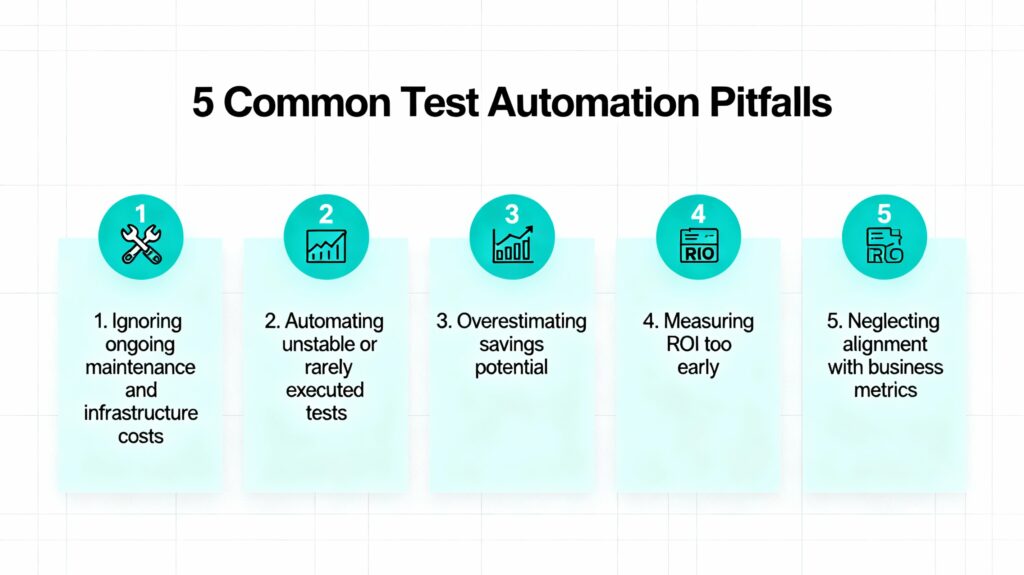
Avoiding these pitfalls ensures a clear and accurate understanding of automation’s true value.
Best Practices to Improve Automation Testing ROI
Maximizing ROI requires both strategic planning and disciplined execution. Below are proven methods to enhance automation outcomes.
- Focus on High-Value Test Cases
Prioritize automating regression, smoke, and data-driven tests for immediate impact. - Select the Right Tools and Frameworks
Align tool choice with your technology stack and team capability. Frameworks like Everforth Quinnox Test Automation Framework (QTAF), Quinnox’s AI-powered Intelligent Quality (IQ) testing framework or AI-driven platforms such as Qyrus can streamline testing and analytics. - Design Maintainable Scripts
Adopt modular, reusable, and parameterized test designs to minimize upkeep. - Integrate with CI/CD Pipelines
Running tests automatically within build processes ensures faster and more reliable feedback loops. - Reduce Test Flakiness
Use stable identifiers and appropriate waits to improve consistency and reduce wasted effort. - Perform Routine Maintenance
Regularly update or retire outdated scripts to keep test suites efficient. - Track and Measure ROI Continuously
Monitor metrics such as time saved, coverage, and defect rates to refine strategy. - Invest in Training and Upskilling
Skilled teams can leverage automation tools more effectively and adapt to new technologies faster. - Start Small and Scale Gradually
Begin with one area, validate ROI, then expand systematically to reduce risk. - Use Parallel and Cross-Platform Testing
Run tests simultaneously across browsers or devices to shorten execution time. - Align Automation Goals with Business Objectives
Ensure testing focuses on features that directly impact customer experience and organizational goals. - Leverage Analytics for Continuous Improvement
Analyze test performance data to uncover inefficiencies and optimize execution cycles.
Conclusion
Test Automation ROI is more than a number – it is a reflection of how effectively your testing strategy supports business growth, agility, and quality. By understanding influencing factors, addressing measurement gaps, and applying proven best practices, organizations can ensure that every dollar invested in automation delivers measurable results.
Enterprises using solutions like Everforth Quinnox Test Automation Framework (QTAF) and intelligent platforms such as Qyrus consistently achieve higher ROI – through reusable scripts, predictive maintenance, and intelligent orchestration
Automation delivers measurable returns when built with strategy, discipline, and data. The right approach doesn’t just cut testing time – it powers faster innovation, better products, and sustainable business value.
To further explore practical strategies and success stories, visit Testing Test Automation and Test Automation Best Practices.
FAQs on Test Automation ROI
Test Automation ROI measures the financial and operational value gained from automating testing compared to the total investment. It helps organizations evaluate how efficiently automation reduces costs, accelerates delivery, and improves software quality.
Use the formula – ROI = ((Savings from Automation – Cost of Automation) / Cost of Automation) × 100. It shows how much value your automation efforts generate per dollar invested, enabling teams to quantify real business impact.
ROI depends on factors such as which test cases are automated, how often they are executed, the level of script maintenance required, and the skill maturity of the QA team. The right tool and test design approach can significantly boost returns.
A healthy ROI for automation typically starts around 50–100% in the first year and can rise to 200–300% as frameworks mature and reusability increases. Sustained ROI growth indicates strong efficiency and process optimization.