Introduction
Every bank today faces the same uncomfortable choice.
AI models need vast amounts of data to become useful. Customer data is exactly the kind of data that banks are least free to use. Privacy regulations, Basel III capital and risk requirements, and internal model risk policies all exist to protect that data, and rightly so.
But they also slow down the very AI initiatives banks are under pressure to deliver.
Synthetic data is emerging as the way through this standoff. Not as a shortcut around governance, but as a way to build AI systems that are trained, tested, and validated without ever touching a real customer record.
If done well, it lets banks move faster. If done carelessly, it introduces a new category of risk that many institutions are not yet equipped to manage.
This piece looks at what synthetic data actually means for a bank specifically, how to govern it responsibly, where it delivers the most value, and what can go wrong if it is treated as a shortcut rather than a discipline.
Download Now: The Synthetic Data Master Guide: The 2026 Strategic Roadmap to Limitless, Safe, and Scalable Data
Get pragmatic frameworks, actionable strategies, and decision-making criteria for integrating synthetic data into your bank’s AI and data ecosystem.
Why Banks Face a Harder Data Problem Than Most Industries
Every industry dealing with AI adoption talks about data constraints. Banks face a version of the problem that is structurally harder to solve.
Core banking systems were often built decades before anyone thought about training machine learning models on transaction histories. Data sits fragmented across mainframes, product-specific platforms, and layers of acquired systems, each with its own schema and its own quirks. Before a bank can even think about training an AI model, it usually has to reconcile years of inconsistent data architecture.
Then there is model risk management. In most industries, a data science team can build a model, test it, and ship it. In banking, every model that touches a customer decision, whether it is a credit score, a fraud alert, or a pricing recommendation, typically has to pass through a model risk sign-off process before it goes anywhere near production. That process exists for good reason. It also means the fastest path to AI value is not writing better code. It is having data and documentation ready enough to clear governance without months of back and forth.
This is the specific bottleneck synthetic data is well positioned to address, because it can be built, from the outset, to satisfy exactly these constraints.
What "Safe" Synthetic Data Actually Means for a Bank
Synthetic data is artificially generated information that mirrors the statistical patterns of real data without containing any actual customer records. It can be produced through several methods, ranging from straightforward statistical modeling to more advanced generative techniques such as GANs and, increasingly, diffusion-based approaches.
For a bank, the generation method matters less than most vendors would have you believe. What actually matters is whether the resulting data is governed, validated, and demonstrably fit for the specific regulated use case it is being applied to. A synthetic dataset that statistically resembles real transactions but has never been checked for privacy leakage or bias inheritance is not safe. It is simply untested.
That distinction, between synthetic data as a technique and synthetic data as a governed capability, is the difference this article is really about.
Governance and Model Risk Management
This is where the “safely” in AI adoption actually gets decided.
Gartner predicts that by 2027, 60% of data and analytics leaders will face critical failures in managing synthetic data, putting AI governance, model accuracy, and regulatory compliance at risk. That is not a caution against using synthetic data. It is a caution against using it without a governance structure built to handle it.
Treating Synthetic Data as a Governed Model Input, Not a Shortcut
The single biggest mistake banks make with synthetic data is treating it as a workaround for governance rather than an input to it. Synthetic data still needs lineage tracking, documented assumptions, and periodic revalidation, exactly like any other data feeding a regulated model. Skipping that step because the data is “not real” defeats the purpose.
Frameworks Banks Can Draw On
Regulators and industry bodies working specifically on synthetic data in financial services, such as the UK Financial Conduct Authority’s Synthetic Data Expert Group, have converged on a similar set of governance principles. Distilled for a bank building an internal framework, they come down to a few practical commitments:
| Principle | What it means in practice |
|---|---|
| Accountability | A named owner for every synthetic dataset, not just every model |
| Transparency | Documented assumptions about what the data does and does not represent |
| Explainability | Traceable lineage from source data to synthetic output |
| Security and Privacy | Technical safeguards proven to resist re-identification |
| Fairness | Active checks for inherited bias, not an assumption of neutrality |
| Human Oversight | A person accountable for sign-off, not just an automated check |
| Suitability | Justification for why synthetic data fits this specific use case |
| Continuous Monitoring | Ongoing checks for drift as market and customer behavior evolve |
In the US, banks already operating under the Federal Reserve, OCC, and FDIC’s revised model risk management guidance, which superseded the original SR 11-7 letter in April 2026, have a natural home for these principles. Synthetic data does not need a parallel governance track. It needs to be pulled into the model risk framework banks already run, as a documented, validated input like any other.
What Can Go Wrong
Synthetic data is not risk-free simply because it contains no real customer information. A few failure modes are specific to how synthetic data behaves at scale, and worth understanding before an institution leans on it heavily.
Model collapse. When synthetic data is generated repeatedly from prior synthetic outputs rather than refreshed against real-world data, rare but critical events, like a sudden fraud spike or an unusual market move, tend to get smoothed out of existence. The data starts to look cleaner and more convenient than reality, which is precisely the problem.
Bias inheritance. Synthetic data is not automatically neutral. If the source data reflects historical patterns of discrimination in lending or underwriting, a synthetic version built from that data will faithfully reproduce those patterns, often while looking more “objective” because it is artificially generated. Assuming synthetic data is inherently fair is one of the more dangerous shortcuts a bank can take.
Recursive contamination. As more of the data ecosystem becomes AI-generated, there is a growing risk of models training on data that was itself produced by an earlier AI model, compounding small errors into larger ones over successive generations. Banks generating synthetic data at scale need a clear line back to verified real-world sources.
Drift. A synthetic dataset built to reflect last year’s transaction patterns will not reflect this year’s interest rate environment or fraud typologies. Synthetic data needs the same refresh discipline as any other model input, not a one-time build.
How to Know Synthetic Data Is Trustworthy
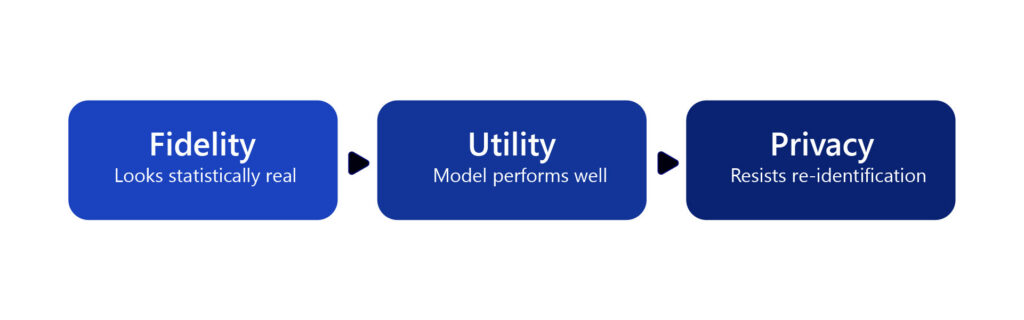
Before synthetic data is used in anything customer-facing or regulator-facing, it is worth checking it against three simple questions.
Does it look real? This is a statistical fidelity check, whether the synthetic dataset actually preserves the patterns and relationships of the real data it is standing in for, rather than just superficially resembling it.
Is it useful? A model trained on synthetic data should perform comparably when validated against a holdout set of real data. If it does not, the synthetic data is not yet good enough to trust.
Is it actually private? This is the check most often skipped. Good synthetic data should resist attempts to re-identify individuals or infer sensitive attributes from it, and that resistance should be tested, not assumed.
A bank that can answer yes to all three, with evidence, has synthetic data it can actually build on.
Key Use Cases for Banks
This is where synthetic data moves from theory to daily operations. A few use cases stand out for how directly they map to problems banks already have.
Fraud Detection and AML
Fraudulent transactions are, by design, rare. That scarcity makes it genuinely difficult to train a fraud detection model on real data alone, since the model simply does not see enough examples of the patterns it is meant to catch. Synthetic data lets banks generate realistic fraud and money laundering typologies, including rare “roundtripping” patterns, at the volume needed to train a model properly, without exposing a single real transaction in the process.
Credit Scoring and Reject Inference
One of the persistent problems in credit modeling is that banks only have outcome data for applicants they approved. What would have happened with the applicants who were rejected is unknown, which biases every model trained on that history. Synthetic data offers a way to estimate the likely performance of previously rejected applicants, helping banks build fairer, better-calibrated credit models without waiting years to collect that missing outcome data organically.
Open Banking and Secure Data Sharing
Open banking initiatives depend on banks and fintech partners being able to test integrations against realistic data before going live. Synthetic data makes it possible to build virtual sandboxes for these partnerships, letting a bank and a fintech run a proof of concept in weeks instead of the months it typically takes to get real data-sharing agreements and privacy reviews approved.
Stress Testing and Scenario Simulation
Regulatory stress testing already requires banks to simulate how portfolios respond to shocks, a sharp rate move, a market downturn, an unusual claims pattern. Synthetic data extends what is possible here by allowing banks to construct scenarios for which no historical precedent exists, testing resilience against situations that have not happened yet rather than only the ones already on record.
Making Adoption Work Operationally
None of this works as a purely technical exercise. Forrester research on AI adoption in lending points to more than 80% of financial services AI decision-makers planning to increase investment in both predictive and generative AI, which means the pressure to move fast is real. But moving fast on synthetic data specifically requires the same cross-functional discipline banks already apply to model risk: data science, legal, compliance, and the relevant business domain experts working from one governance charter, not four separate ones.
In practice, that means synthetic data initiatives should not sit solely inside a data science or innovation team. The compliance and model risk functions need a seat at the table from the first pilot, not a review gate bolted on at the end. Banks that build this collaboration in from the start tend to move through model risk sign-off faster, not slower, because the documentation governance will eventually ask for has already been built alongside the model itself.
Conclusion: Real Data Is Still the Strategic Moat
Synthetic data is not a substitute for a bank’s real data, and it should not be sold to any institution as a cost-saving shortcut. It is best understood as a risk-bearing asset. Used with rigorous governance, it removes one of the biggest obstacles standing between a bank’s AI ambitions and production deployment, letting institutions test, train, and validate models without exposing the customer data they exist to protect.
The banks that get the most value from synthetic data will not be the ones that generate the most of it. They will be the ones that govern it with the same discipline they already apply to every other input into a regulated model. That discipline, more than the underlying technology, is what actually makes AI adoption safe.
Everforth Quinnox works with banking and financial services clients on exactly this intersection, AI governance, compliance, and data strategy, drawing on more than a decade of domain experience in the sector. If your organization is evaluating how synthetic data fits into your AI risk management framework, reach out to our AI and data experts.

Executive Vice President (EVP), Everforth Quinnox
FAQs Related to SAP Managed Services
Synthetic data is artificially generated information designed to replicate the statistical patterns of real-world data without containing any actual records. In banking, it is used to train, test, and validate AI models while reducing dependence on sensitive customer data.
Banks use synthetic data for fraud and AML model training, credit scoring and reject inference, open banking sandboxes for testing fintech integrations, and stress testing portfolios against scenarios that have no historical precedent.
It can be, but only when it is generated, validated, and governed as part of an existing model risk management framework. Synthetic data that is not checked for privacy leakage, bias inheritance, or drift is not inherently safer than real data.
By checking it against three criteria: statistical fidelity to real data, comparable model performance when validated against real holdout data, and demonstrated resistance to re-identification or attribute inference.
No. Synthetic data should complement real data, particularly for training, testing, and simulating rare scenarios, while real data remains essential for final validation and ongoing model monitoring.