Over the last few years of working with global retailers, one reality has become increasingly clear: the true competitive battleground in retail is no longer the storefront – it’s the supply chain.
Retailers have traditionally focused on price, product assortment, and promotions to drive growth. However, when disruption hits – whether it’s demand spikes during peak seasons, geopolitical trade tensions, logistics bottlenecks, or sudden shifts in consumer behavior – those strategies quickly lose impact if the supply chain cannot respond with speed and intelligence.
As we move toward 2026, retail leaders are confronting an operating environment defined by constant volatility. Demand patterns shift in real time, fulfillment expectations continue to accelerate, and cost pressures remain relentless. In this environment, the question is no longer whether supply chains should transform digitally. The real question is how quickly retailers can evolve from reactive logistics networks into intelligent, adaptive supply ecosystems.
The past few years have reinforced an important lesson: disruptions are no longer rare events. From pandemic-era shortages and port congestion to labor constraints and geopolitical tensions, instability has become a permanent feature of global commerce. Retailers that rely on fragmented systems, manual planning, and limited visibility simply cannot respond fast enough.
In my experience, the retailers that navigate volatility successfully are those that treat supply chains not as operational backbones but as strategic intelligence systems – networks capable of sensing demand shifts, predicting disruption, and orchestrating fulfillment dynamically.
In this article, we’ll explore why digital transformation in retail has become a strategic necessity, what defines a digitally mature supply network, the technologies reshaping operations, and how forward-looking retailers are preparing for the next phase of supply chain evolution.
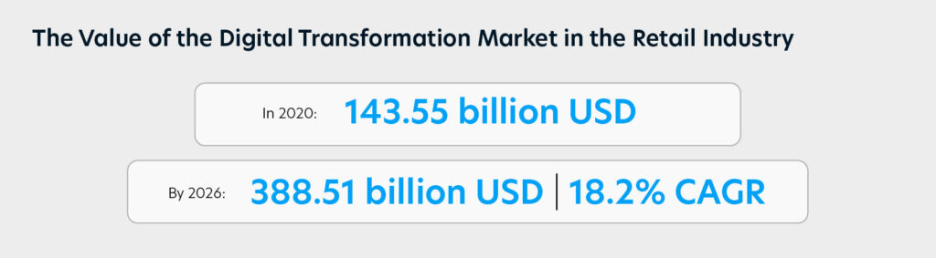
The Three Phases of Retail Supply Chain Evolution
Across the retail industry today, supply chains are evolving through three distinct stages of maturity. Understanding these phases helps organizations evaluate where they stand and what transformation truly requires.
1. Reactive Supply Chains (Legacy Model)
Traditional supply chains were designed primarily for efficiency and scale. Planning decisions relied on historical data, spreadsheets, and manual coordination between procurement, logistics, and merchandising teams.
While this model worked in relatively stable markets, it struggles in today’s volatile environment. Forecasting inaccuracies, limited visibility, and slow decision cycles often lead to stockouts, excess inventory, and rising operational costs.
2. Digitally Enabled Supply Chains (Current Industry Phase)
Many retailers are currently transitioning into this stage. Cloud-based ERP platforms, integrated analytics tools, and improved data visibility allow organizations to monitor operations more effectively.
These systems provide better insights into inventory levels, supplier performance, and logistics operations. However, decision-making is still largely human-driven, with technology acting as a support system rather than an autonomous operator.
3. Intelligent Autonomous Supply Networks (Emerging Future)
The next phase – and where the industry is rapidly heading – is the intelligent supply network.
In this model, AI-driven systems continuously analyze demand signals, supplier performance, logistics constraints, and market conditions. These systems not only generate insights but can also execute operational adjustments automatically within defined governance rules.
Inventory allocation, replenishment strategies, and logistics routing increasingly become self-optimizing processes rather than manual decisions.
Most retailers today sit somewhere between stage two and stage three. Those that accelerate toward intelligent supply networks will gain a significant competitive advantage.
Related Read: Data Integration Techniques and Methodologies Explained
Why Retail Supply Chain Digital Transformation Is a Strategic Imperative
Retail margins have always been thin. But in 2026, volatility compounds pressure on profitability. Freight rate swings, fluctuating fuel costs, unpredictable consumer demand, supplier instability, and growing omnichannel expectations create systemic operational risk.
Research from McKinsey suggests that inaccurate demand forecasting contributes to nearly $1 trillion in inventory waste annually across industries. This highlights a critical problem: traditional planning methods cannot keep up with real-time demand shifts.
From what I see across the industry, three forces are accelerating the need for supply chain transformation.
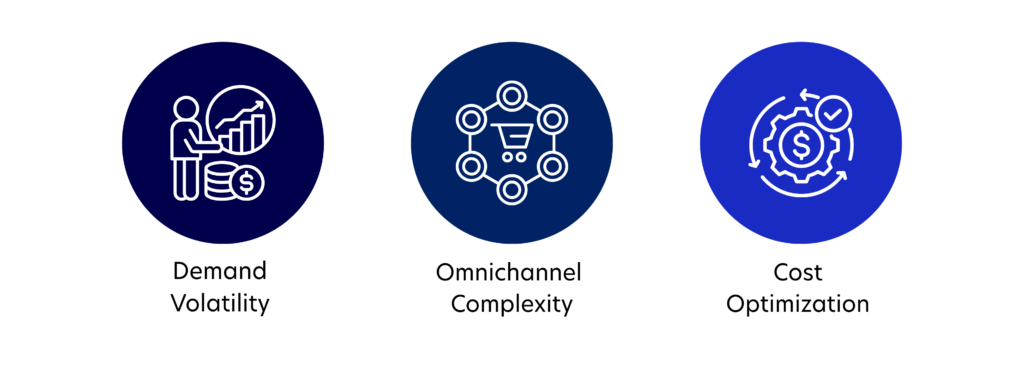
1. Demand Volatility is Intensifying
Consumer behavior now shifts in near real-time, influenced by social commerce, rapid trend cycles, and macroeconomic sentiment. Static forecasting models fail under these conditions. Retailers require AI-driven demand sensing that incorporates point-of-sale data, social signals, weather patterns, and macroeconomic indicators. Advanced analytics can reduce forecasting errors by 20–30 percent, significantly improving inventory planning and reducing operational waste.
2. Omnichannel Complexity Has Exploded
The blending of e-commerce, in-store, curbside pickup, marketplace fulfillment, and “buy online, pick up in store” (BOPIS) channels – all requiring synchronized inventory visibility. Customers expect two-day or even same-day delivery regardless of channel. Without real-time inventory orchestration, fulfillment costs escalate, and customer satisfaction erodes.
3. Cost Optimization Must Coexist with Resilience
Historically, lean supply chains optimized for cost. Today, retailers must balance cost efficiency with redundancy, multi-sourcing strategies, and nearshoring initiatives. Digital tools enable scenario modeling, supplier risk scoring, and predictive logistics planning that make this balancing act feasible.
According to a recent Deloitte retail outlook, around 95% of retail executives expect rising supply chain costs due to global trade dynamics, and 66% plan to restructure their supply chains through nearshoring and diversification.
Retailers that treat supply chain modernization as a cost center will struggle. Those who view it as a strategic enabler will gain a measurable competitive advantage.
What Defines a Digitally Mature Retail Supply Chain in 2026
A digitally mature retail supply chain is not defined by isolated technology deployments – it’s about how tech is integrated into decision-making, execution, and resilience planning.
By 2026, mature supply chains will exhibit five defining characteristics.
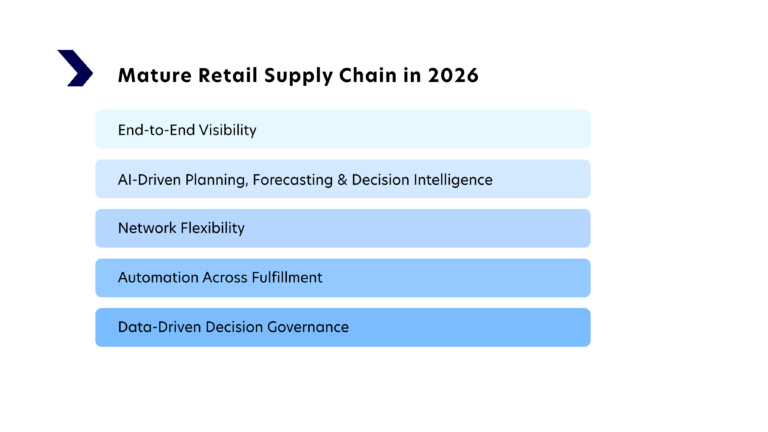
1. End-to-End Real-Time Visibility
Tomorrow’s supply chains will operate with full transparency – from raw material sourcing to last-mile delivery – using IoT sensors, cloud platforms, and unified data views. Gartner-style visibility hubs enable anomaly detection, exception management, and rapid response.
Already, major retailers are deploying real-time tracking at scale. For example, Walmart plans to attach IoT sensors to 90 million pallets across 4,600 stores by the end of 2026 to track location, condition, and temperature data in real time – improving both fulfillment accuracy and operational efficiency. (Source: CNBC)
2. AI-Driven Planning, Forecasting & Decision Intelligence
Traditional forecast models based purely on historical data no longer suffice. Advanced machine learning models now integrate broad signal sets – point-of-sale data, promotions, social trends, weather patterns, and macroeconomic factors – to forecast demand with far greater accuracy.
Industry statistics suggest that AI-enabled forecasting can reduce forecast errors by 20–30% and lift forecast accuracy into the 80–90% range for top performers.
3. Agile, Flexible Networks
Digital maturity means designing supply networks that adapt, not just react. This includes:
- Nearshoring & dual sourcing to reduce geopolitical risk.
- Dynamic rebalancing of inventory across regions based on real-time demand signals.
- Collaborative supplier platforms feeding standardized performance data back to planning systems.
4. Smart Fulfillment & Automation
Warehouse robotics, automated guided vehicles, AI-based picking optimization, and smart sorting systems will reduce labor dependency and improve order accuracy. Automation not only improves speed but also mitigates labor shortages and wage pressures.
Recent projections show that warehouse automation, including robotics and AI will drive transformative efficiency gains as facilities integrate modular automation across operations.
5. Data-Driven Risk Governance
Decision-making will be guided by predictive analytics and scenario modeling rather than intuition. Retailers will run simulations for demand shocks, supplier disruptions, and transportation bottlenecks before they occur, strengthening resilience. A control tower isn’t a dashboard; it’s a neural system that senses, predicts, and prescribes action.
Digital maturity in supply chains is less about adopting a single transformative platform and more about integrating data across silos to create an intelligent ecosystem.
Key Forces & Technologies Reshaping Retail Supply Chains in 2026
In 2026, retail supply chains are no longer linear pipelines; they are intelligent, adaptive ecosystems powered by Agentic AI, intelligent automation, and real-time IoT data streams. The shift underway is structural: operations are becoming autonomous, predictive, and increasingly sustainable by design.
Retailers are responding to a new operating reality shaped by extreme omnichannel convenience, geopolitical volatility, climate disruptions, labor constraints, and accelerating circular economy mandates.
| Key Technologies | Key Forces Driving Transformation |
|---|---|
| Agentic AI & Decision Intelligence | Geopolitical & Climate Disruptions |
| IT/OT Convergence & IoT | Extreme Omnichannel Expectations |
| Warehouse Robotics & Automation | Sustainability & Circular Economy |
| Blockchain for Traceability | Labor Shortages & Workforce Reskilling |
| Generative Search & Context Engineering |
Key Technologies Reshaping 2026 Supply Chains
1. Agentic AI & Decision Intelligence
AI now moves beyond dashboards to execution. It autonomously adjusts inventory policies, refines demand plans, optimizes pricing, and even supports supplier negotiations within governance rules. Industry research says that decision intelligence is shifting retail from reactive planning to continuous optimization.
Strategic impact: Faster decisions, reduced manual intervention, adaptive supply networks.
2. IT/OT Convergence & IoT
Integrating ERP systems with operational technology and IoT sensors delivers real-time visibility into inventory, shipments, and asset health. Retailers gain instant exception alerts and condition monitoring across the network.
Strategic impact: Proactive disruption management and improved service levels.
3. Warehouse Robotics & Automation
Autonomous mobile robots, AI picking systems, and smart sortation reduce errors and offset labor shortages. Automation ensures consistent fulfillment speed during demand spikes.
Strategic impact: Higher throughput, lower dependency on manual labor, improved accuracy.
4. Blockchain for Traceability
Blockchain enables secure, end-to-end product tracking – ensuring authenticity, faster recalls, and ESG compliance.
Strategic impact: Greater transparency and stronger consumer trust.
5. Generative Search & Context Engineering
AI-driven contextual analysis interprets consumer intent beyond keywords, improving regional assortment and inventory placement decisions.
Strategic impact: Higher sell-through rates and reduced markdown risk.
Key Forces Driving Transformation
- Geopolitical & Climate Disruptions:Trade conflicts, sanctions, and climate events are forcing diversified sourcing and flexible logistics strategies.
- Extreme Omnichannel Expectations:Customers demand instant, seamless fulfillment. Retailers are blurring the lines between stores and warehouses to meet speed expectations.
- Sustainability & Circular Economy:Eco-conscious consumers and regulatory pressure are pushing retailers toward carbon tracking, sustainable sourcing, and reverse logistics models.
- Labor Shortages & Workforce Reskilling:Automation is reshaping roles and to respond to this change; future supply chain teams must manage AI systems and collaborate with robotics rather than perform repetitive tasks.
- In 2026, competitive advantage will not come from isolated technologies but from integrating these forces into a cohesive, intelligent, and resilient supply chain strategy.
Real-World Retail Supply Chain Use Cases
Let’s move from theory to execution. These real-world examples show how leading retailers are embedding intelligence and resilience into their supply chains.
1. AI-Powered Demand Forecasting
Retailers are using advanced analytics and machine learning to predict demand at a granular SKU and store level. By integrating POS data, promotions, seasonality, and local demand signals, AI-driven forecasting reduces stockouts, minimizes overstock situations, and improves working capital efficiency. This enables more accurate replenishment and faster response to shifting consumer trends.
2. Real-Time Inventory Visibility with IoT
IoT-enabled sensors and smart tracking systems provide end-to-end visibility across warehouses, transit routes, and retail stores. Real-time monitoring of product location and condition improves accuracy, reduces shrinkage, and strengthens cold-chain compliance. This transparency enables faster exception handling and better operational decision-making.
For example, Walmart is deploying ambient IoT sensors at scale across its supply chain to track pallets (location, condition, temperature) and feed data into AI systems for improved visibility and inventory accuracy.
3. Blockchain-Based Product Traceability
Blockchain technology is being applied to create transparent, tamper-proof product tracking from origin to shelf. This strengthens compliance, enables faster product recalls, and improves authenticity verification – particularly important in food, luxury, and regulated goods sectors.
4. AI-Driven Route Optimization
AI-powered transportation systems dynamically optimize delivery routes based on traffic patterns, fuel costs, and delivery windows. This reduces transportation expenses, lowers emissions, and improves on-time delivery performance, strengthening overall logistics resilience.
5. Warehouse Robotics & Intelligent Automation
Automated picking systems, robotic sorting, and AI-coordinated fulfillment processes are transforming distribution centers. These technologies increase throughput, reduce human error, and enable scalable operations during peak demand periods. Automation also addresses labor shortages while improving speed and efficiency.
For example, Ocado’s automated fulfillment centers use grid-based robotics and AI to pick and move grocery orders efficiently, showcasing one of the most advanced real-world automation systems in retail logistics.
6. Digital Supply Chain Control Towers
Centralized digital control towers integrate ERP, supplier, and logistics data into a unified dashboard. With predictive analytics and real-time alerts, retailers can identify disruptions early, simulate scenarios, and make faster, data-driven decisions across their supply network.
Critical Challenges Retailers Must Address to Enable Supply Chain Transformation
While the vision is compelling, transformation is not without hurdles:
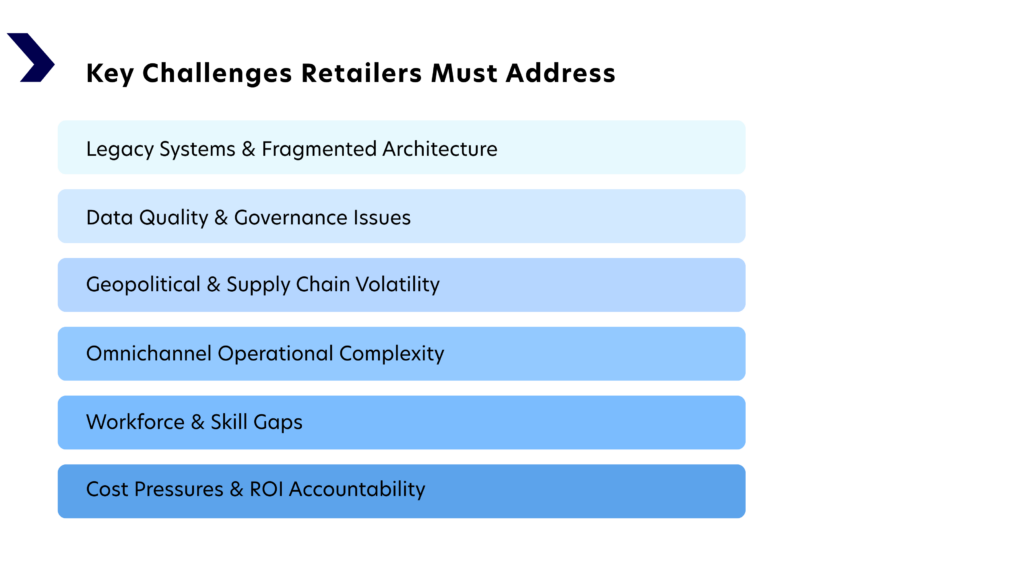
1. Legacy Systems & Fragmented Architecture
Many retailers still operate on disconnected legacy systems across procurement, warehousing, merchandising, and logistics. These silos restrict real-time visibility and make it difficult to implement AI, automation, or unified control towers effectively. Without modernization and integration, digital transformation efforts remain limited in impact.
2. Data Quality & Governance Issues
Advanced analytics and predictive planning depend on clean, standardized, and real-time data. Inaccurate inventory records, inconsistent product information, and limited supplier transparency can compromise forecasting accuracy and operational decisions. Strong data governance frameworks are essential to unlock digital value.
3. Geopolitical & Supply Chain Volatility
Trade disruptions, climate risks, and global sourcing dependencies continue to expose retailers to unexpected shocks. Building resilience requires supplier diversification, regionalization strategies, and improved risk monitoring to prevent operational breakdowns.
4. Omnichannel Operational Complexity
Managing inventory seamlessly across physical stores, fulfillment centers, and digital platforms adds layers of operational complexity. Without unified commerce systems and synchronized inventory management, retailers risk stock discrepancies and poor customer experience.
5. Workforce & Skill Gaps
As supply chains become more automated and data-driven, retailers must invest in upskilling employees to manage AI systems, analytics tools, and automation technologies. Digital transformation demands both technological and cultural change.
6. Cost Pressures & ROI Accountability
Retail operates on tight margins. Investments in robotics, IoT, and advanced analytics must clearly demonstrate measurable returns in efficiency, service levels, and margin protection. Strategic prioritization is critical to sustainable transformation.
Overcoming these challenges is fundamental for retailers aiming to build intelligent, resilient supply chains capable of thriving in 2026 and beyond.
What’s Next Beyond 2026? Emerging Retail Supply Chain Trends
We can’t look ahead to 2026 without glancing back at what led to the trends we’re seeing today. Many of the forces that defined last year are still echoing through today’s supply chains. Volatility, margin pressure, rising customer expectations, and sustainability mandates did not disappear – they evolved.
Beyond 2026, retail supply chains will not simply become faster; they will become more autonomous, predictive, and ecosystem-driven.
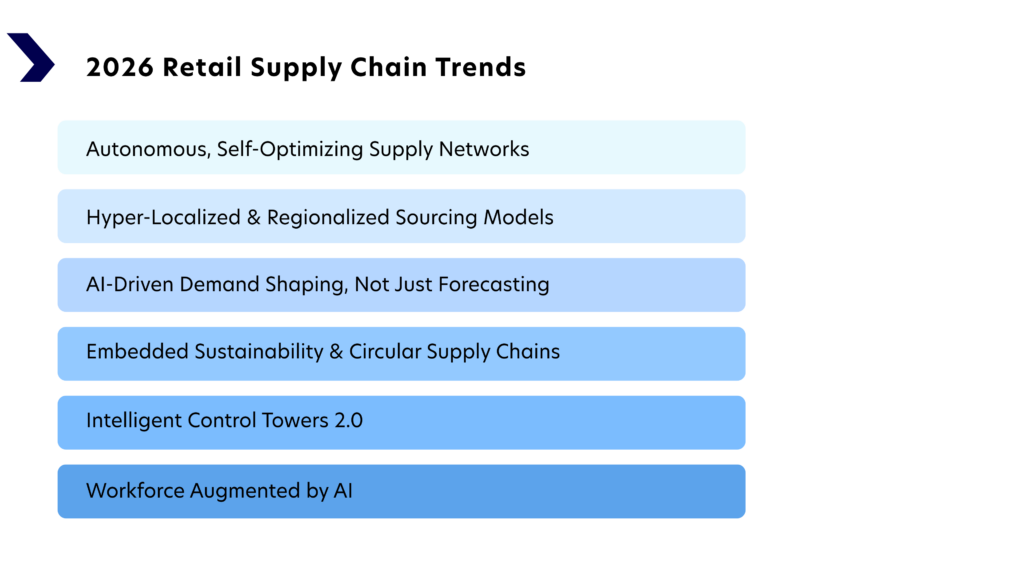
1. Autonomous, Self-Optimizing Supply Networks:
The next phase of transformation will move beyond decision support toward decision execution. AI systems will increasingly automate replenishment adjustments, supplier negotiations, and logistics re-routing in real time. Instead of reactive firefighting, supply chains will continuously self-correct based on live data signals.
2. Hyper-Localized & Regionalized Sourcing Models:
Globalization is giving way to balanced regionalization. Retailers will adopt multi-sourcing strategies, nearshoring, and micro-distribution networks to reduce exposure to geopolitical and climate risks. Flexibility will become more valuable than lowest-cost sourcing.
3. AI-Driven Demand Shaping, Not Just Forecasting:
Retailers will move from predicting demand to actively influencing it. Advanced analytics will align promotions, pricing, and inventory positioning dynamically to steer consumer purchasing behavior and protect margins.
4. Embedded Sustainability & Circular Supply Chains:
Sustainability will shift from reporting compliance to operational design. Carbon-aware routing, recyclable packaging, reverse logistics optimization, and resale ecosystems will become embedded into core supply chain strategies rather than standalone ESG initiatives.
5. Intelligent Control Towers 2.0:
Future control towers will integrate supplier risk intelligence, geopolitical alerts, weather modeling, and financial impact simulations into unified platforms. Scenario planning will become real-time and automated, allowing leadership teams to act before disruptions escalate.
6. Workforce Augmented by AI:
Rather than replacing human roles entirely, AI will augment planners, warehouse managers, and logistics coordinators. Decision-making will become faster, but human oversight will remain critical for governance, ethics, and strategic prioritization.
Build the Intelligent Retail Supply Chain of Tomorrow with Everforth Quinnox
Retail supply chain digital transformation is no longer a modernization initiative; it is a strategic imperative. As 2026 approaches, retailers must move beyond incremental improvements and re-architect their supply networks to be predictive, automated, and disruption-ready.
Retailers that invest in unified data ecosystems, AI-driven planning, automation, and resilient sourcing strategies will protect margins while delivering faster, more reliable customer experiences. The competitive edge will belong to organizations that can anticipate disruption, respond dynamically, and continuously optimize operations across both physical and digital channels.
This is where Quinnox brings strategic value. By combining deep retail domain expertise with AI-led engineering, cloud modernization, and intelligent automation capabilities, Quinnox helps retailers modernize legacy systems, implement real-time visibility frameworks, and design resilient supply chain architectures. From demand forecasting and control towers to omnichannel fulfillment enablement, Quinnox partners with retail leaders to translate digital ambition into measurable business outcomes.
Connect with Us Today to redefine what’s possible in retail excellence.

Akshai Rathore
FAQ’s Related to Retail Supply Chain Digital Transformation
Retail supply chain digital transformation is the integration of digital technologies across planning, sourcing, warehousing, logistics, and fulfillment to create a connected, real-time, and data-driven supply network. It enables better visibility, faster decision-making, and improved customer fulfillment.
Key technologies include AI and machine learning for forecasting, IoT for real-time tracking, cloud platforms for scalability, advanced analytics for insights, robotics for warehouse automation, and blockchain for traceability. Companies like Amazon leverage many of these to optimize fulfillment operations.
Major challenges include legacy systems, data silos, high implementation costs, cybersecurity risks, and resistance to change. Aligning technology upgrades with business strategy is often the most complex part.
Retailers should begin with a digital maturity assessment, define clear business goals, prioritize high-impact use cases (like demand forecasting), modernize core systems, and invest in data governance and workforce upskilling.
AI shifts supply chains from reactive to predictive. It improves demand forecasting, optimizes inventory, enhances route planning, and identifies risks early – enabling faster, data-driven decisions at scale.