Software defects don’t just break code – they break trust. In a world where users abandon an app within seconds of a glitch, quality has become the ultimate differentiator. According to the CISQ Report, companies lose an average of $2.41 million annually due to software failures and production defects. Every missed bug can mean lost revenue, disrupted operations, and damage that ripples across customer experience and brand reputation.
Today’s QA leaders face a new challenge – not merely finding defects faster but preventing them entirely. The shift from reactive testing to proactive quality engineering is transforming how software teams deliver value. By combining defect analytics, automation, and smarter collaboration, forward-thinking enterprises have achieved up to 45% fewer defects, faster release cycles, and measurable gains in reliability.
This guide explores practical approaches to achieving such a reduction. You’ll discover practical defect reduction strategies, the lifecycle behind effective defect management, and highlight real-world case studies that demonstrate measurable improvement.
What is a Defect? (and Why It Matters More Than You Think)
A defect, often referred to as a bug or error, occurs when software does not perform as expected. It represents a deviation from requirements or specifications, often resulting from incorrect logic, data handling errors, or system integration issues. Defects may arise during design, development, or testing phases. Whatever the cause, every defect represents a break in trust between what was promised and what’s delivered.
Early identification of defects is crucial, as the cost of fixing them increases significantly when discovered later in production. Industry research shows that fixing a defect discovered after release can cost up to 100 times more than addressing it during the design phase.
Why is Defect Management Important in Software Testing?
Defect management is the structured approach of identifying, analyzing, prioritizing, and resolving defects during the software development life cycle. It ensures that every issue is logged, tracked, and closed through a standardized workflow.
Poor defect management can derail everything: delayed launches, bloated maintenance budgets, unhappy users. By contrast, teams with mature defect-processes can:
- Reduce rework & bug-fix time
- Improve QA ↔ dev collaboration
- Bring predictability to release timelines
- Boost product quality & performance
According to a recent survey conducted by Gartner, companies that adopt advanced QA metrics saw a 30 % reduction in defects by being data-driven.
At its core, the process focuses on visibility and accountability. By maintaining a central repository for defects, teams can monitor trends, identify recurring issues, and evaluate the effectiveness of quality assurance efforts.
To understand how AI further streamlines this process, explore AI in Software Testing.
The Defect Management Life Cycle in Software Testing
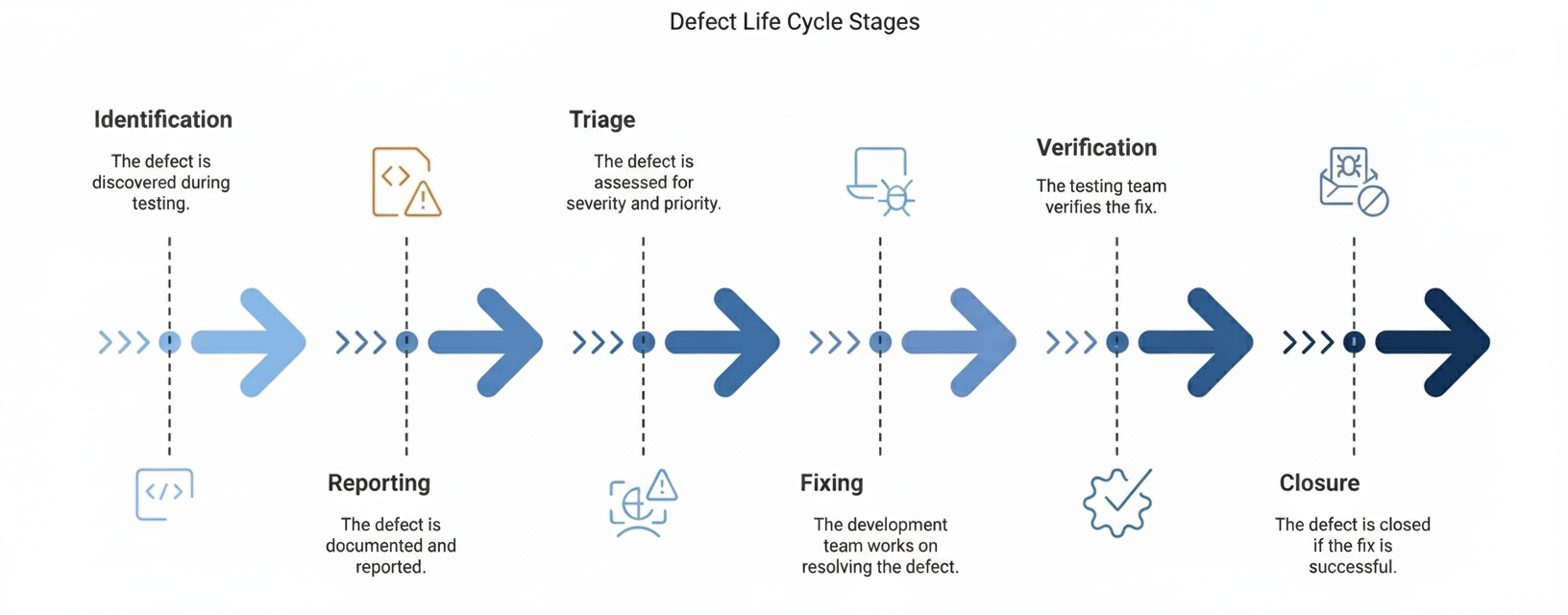
The defect management life cycle in software testing defines the journey of a defect from discovery to closure. It typically follows these key stages:
1. Defect Identification:
This is the discovery point – where testers or automation tools detect an anomaly in the system’s behavior. Clear evidence such as screenshots, logs, or steps to reproduce should be captured to confirm it’s an actual defect, not a configuration or environment issue.
2. Defect Reporting:
Once identified, the defect is formally documented in a tracking tools. Testers provide all relevant details – including severity, test environment, build version, and reproduction steps – so developers can quickly understand and act on the issue.
3. Defect Triage:
The development team investigates the root cause, modifies the code, and validates the fix through unit testing. The focus is on solving the problem efficiently while preventing new issues from emerging in related areas. Proper version control and documentation are key to maintaining traceability.
4. Defect Verification:
Once the fix is implemented, the QA team re-tests the defect in the latest build to ensure the issue no longer occurs. Regression testing is often performed at this point to confirm that no new defects have been introduced by the fix. Successful verification moves the defect closer to closure.
5. Defect Closure:
After successful validation, the defect is marked as “Closed.” This status confirms that both QA and development teams agree the issue has been resolved, tested, and verified in the live environment or final build. However, if the issue resurfaces later, it can be reopened and re-enter the cycle for further action.
Reopen (if needed): If the issue persists, the defect is reopened for further investigation.
Maintaining discipline through these stages ensures that no defect slips through unnoticed and that the entire lifecycle is auditable for process improvement.
Key Phases of Defect Management
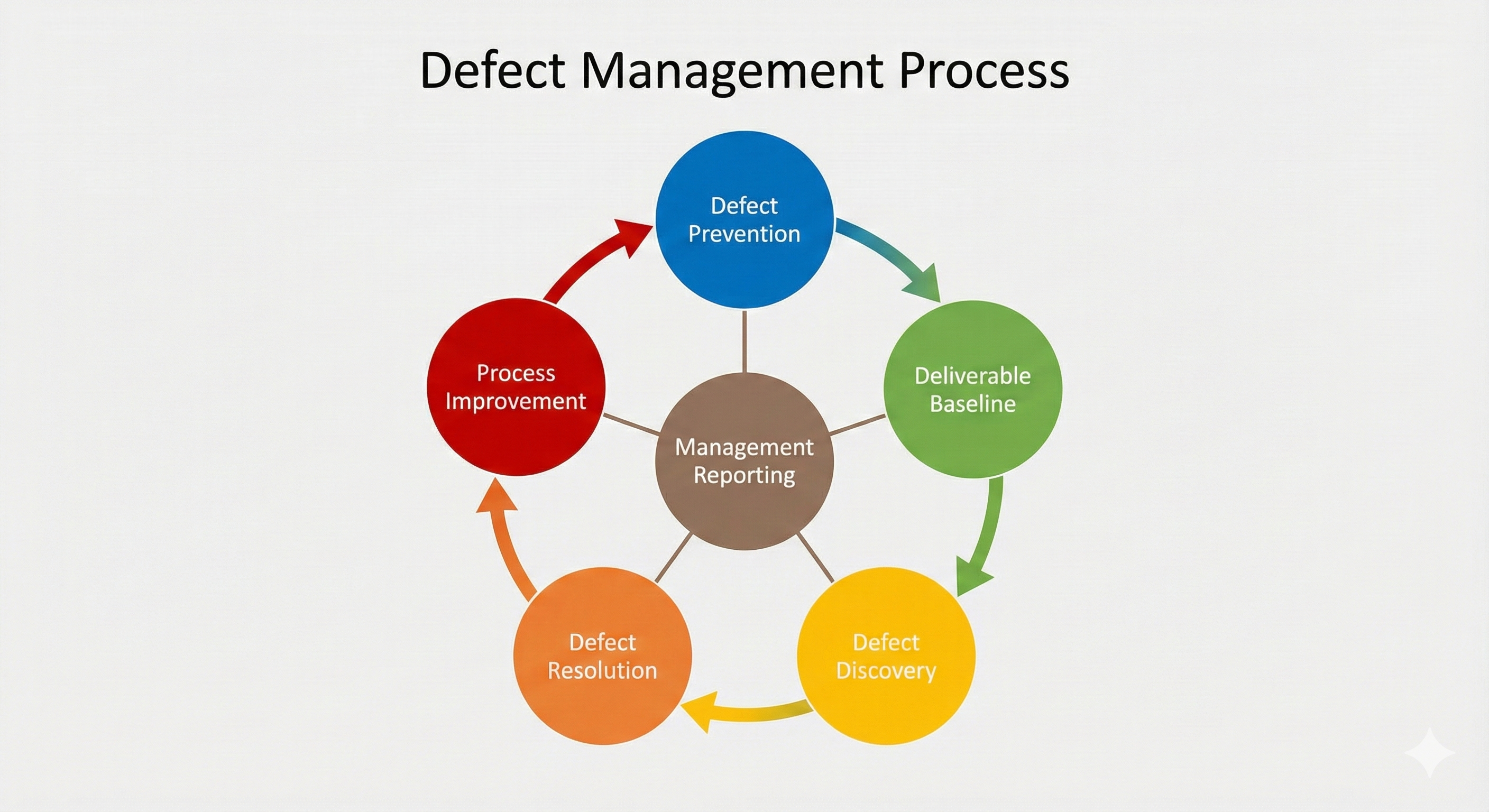
Each phase in this cycle plays a vital role in reducing risks, improving efficiency, and ensuring the final product meets both business goals and user expectations.
1. Defect Prevention
The best defects are the ones that never happen. Prevention begins with clear requirements, code reviews, and early-stage testing. By integrating static code analysis and automated quality gates, teams can identify potential issues before development even starts.
2. Deliverable Baseline
Before testing begins, a deliverable baseline sets the benchmark for functionality, performance, and quality. It acts as a reference point that helps QA teams measure deviations accurately and maintain consistency across builds.
3. Defect Discovery
This phase focuses on uncovering issues through systematic testing, monitoring, and user feedback. Whether it’s manual, automated, or exploratory testing, the goal is early and thorough detection to minimize cost and downstream impact.
4. Defect Resolution
Once identified, defects are analyzed for severity and business impact, then prioritized for fixing. Developers apply targeted code corrections, perform unit validation, and collaborate with QA to ensure the defect is resolved without introducing new issues.
5. Process Improvement
Every defect tells a story about where the process can get better. Root cause analysis and post-release reviews help teams identify recurring gaps in coding standards, testing coverage, or requirement clarity – leading to more resilient systems over time.
6. Defect Management and Reporting
This final phase involves ongoing tracking, reporting, and analysis of defect metrics such as defect density, leakage, and closure rates. The insights gained feed back into development and testing cycles, driving smarter decisions and measurable quality gains.
How to Reduce Defects by 45 Percent: Proven Strategies
Reducing defects requires a combination of prevention, automation, collaboration, and continuous improvement. Here are data-backed methods to achieve measurable reduction:
1. Shift-Left Testing Approach
Testing early in the development cycle catches issues before they spread across codebases. By integrating unit tests and static analysis during development, teams can prevent up to 30 percent of potential defects. Embedding QA from the design stage saves time, cost, and rework later.
2. Test Automation
Automating repetitive test cases improves coverage and consistency. According to research by industry leaders, automation can help detect 40% more defects in less time. Quinnox leverages intelligent automation frameworks that integrate seamlessly into CI/CD pipelines, ensuring continuous feedback.
3. Root Cause Analysis and Predictive Analytics
Analyzing defect trends enables teams to pinpoint systemic weaknesses. Using AI-driven predictive models, QA teams can anticipate where defects are likely to occur and focus efforts proactively.
4. Clear Requirement Analysis
Ambiguous requirements account for nearly 50% of software defects. Encouraging early collaboration between product owners, developers, and testers ensures clarity and alignment.
5. Continuous Integration and Continuous Deployment (CI/CD)
By embedding testing into Continuous Integration and Continuous Deployment pipelines, teams get instant feedback on code changes. This approach enables faster detection of integration issues and prevents late-stage surprises, improving release stability and developer confidence.
6. Cross-Functional Reviews
Regular peer reviews and code walkthroughs uncover logic flaws, design inconsistencies, and missed test cases early in the process. These collaborative reviews not only strengthen code quality but also build shared ownership for product excellence across QA, development, and product teams.
How Companies Reduced Defects by 45 Percent (Real Case Studies)
Case Study 1: Global Food and Beverages Leader
A major American food and beverage conglomerate, among the top privately held firms in the United States, faced mounting challenges in scaling its testing capabilities for a growing portfolio of web and mobile applications. Manual testing and fragmented QA processes created inefficiencies, long release cycles, and inconsistent quality.
By implementing the Qyrus, our codeless automation platform, the company achieved rapid improvement in application quality and time to market. The solution enabled reusable test automation, parameterized data-driven testing, and centralized reporting for Salesforce, SAP, and Android applications. Automation coverage reached 90 percent across all test scenarios, with testing execution times dropping to an average of three minutes per test.
The approach unified QA operations, empowered manual testers to build automated scripts, and ensured detailed visibility through step-by-step reporting and video execution logs. These advances allowed faster high-quality application releases and measurable boosts in consumer satisfaction and operational efficiency.
Case Study 2: A Neo-Bank’s Digital Transformation
A UK-based neo-bank serving mass affluent clients, sought to accelerate its software release cycles while maintaining high quality standards across complex savings and lending products. Burdened by manual testing and long regression cycles, the bank needed an agile testing partner to help evolve its delivery processes.
Through its partnership with Quinnox and adoption of the Qyrus AI-powered testing platform, the bank transformed its quality engineering framework. Over 550 test cases were automated, achieving full regression coverage across mobile and web applications. The release cycle shortened dramatically, with testing timelines reduced from 17 weeks to just 5 weeks, and defect leakage from QA to UAT dropping from 65 percent to 10 percent.
Daily automated test runs across environments enabled early defect detection and continuous integration. The shift to a monthly release cadence empowered Monument to deliver new digital products more quickly, supporting its rapid growth in the competitive banking sector. Qyrus provided end-to-end automation, real-device testing, and integrated analytics, aligning perfectly with the bank’s agile methodology and digital-first goals.
Case Study 3: Vital UAT Testing for an Investment Bank’s Transformation
A Mauritius-based investment bank embarked on an enterprise-wide IT transformation, known as Project Flamingo, aiming to enhance operations, risk management, and customer experience. Progress was delayed due to fragmented requirements, inadequate test planning, and over 20,000 existing defects. To move forward, the bank relied on Quinnox’s UAT expertise.
Quinnox designed a structured UAT framework covering 26 applications and 24 lines of business under a big-bang implementation model. The plan incorporated domain-led testing, a three-tier review of test ware, impact analysis, and cross-application performance validation.
The result was a successful UAT cycle completed ahead of schedule, giving the bank confidence to proceed with transformation. Over 20,000 defects were addressed and nearly 3,000 incidents managed during simulations. The process uncovered requirement gaps, optimized resources, improved reporting, and enhanced cross-functional coordination. Quinnox’s comprehensive approach not only delivered stable releases but also defined a long-term testing strategy that sustained the bank’s transformation roadmap and operational resilience.
Metrics to Measure Defect Reduction Success
To gauge defect management performance, organizations rely on quantifiable metrics such as:
- Defect Density: Number of defects per thousand lines of code or function points.
- Defect Leakage: Percentage of defects missed during testing and found after release.
- Defect Removal Efficiency (DRE): Ratio of defects detected before release to total defects found.
- Mean Time to Detect (MTTD): Average time taken to identify a defect after introduction.
- Mean Time to Repair (MTTR): Average time required to fix and validate a defect.
- Customer-Reported Defects: Indicator of post-release quality and user satisfaction.
Tracking these metrics helps QA leaders quantify progress and demonstrate the ROI of quality initiatives.
Common Challenges in Defect Management
Even with robust frameworks, organizations face several challenges, including:

1. Inconsistent Logging Practices
Defects often lack complete details or standardized reporting, making it difficult for developers to reproduce and fix them quickly. A consistent logging format reduces ambiguity and accelerates resolution.
2. QA ↔ Dev Communication Gaps
When testing and development teams operate in silos, critical context gets lost. Transparent communication channels, shared dashboards, and regular sync-ups are key to preventing misalignment.
3. No Shared Definition of Severity or Priority
Without clear criteria for severity and priority, teams waste time debating what to fix first. Standardized definitions ensure everyone evaluates impact consistently.
4. Weak Root Cause Analysis (RCA)
Teams sometimes focus on fixing the symptom rather than investigating why a defect occurred. Strong RCA practices eliminate repeat issues and improve long-term quality.
5. Limited Automation Adoption
Relying solely on manual testing can slow delivery and increase human error. Automation helps scale coverage, reduce regression time, and detect issues earlier.
6. Resistance to New Processes or Culture Change
Quality transformation often fails when teams resist process updates or new tools. Leadership support, training, and clear success metrics can help drive adoption.
Overcoming these challenges requires cultural transformation and leadership commitment to quality.
Best Practices to Maintain Low Defect Rates
Sustaining low defect rates is an ongoing effort that combines process discipline and technological innovation.
- Build a Quality-First Mindset Across Teams
Quality should be owned by everyone, not just QA. Encourage developers, product owners, and testers to share accountability for product excellence. - Use AI and Automation for Smarter Test Case Generation
AI-driven tools can predict defect-prone areas, create optimized test cases, and automate repetitive validation steps, improving both accuracy and coverage. - Maintain a Central Defect Repository with Analytics
A unified defect management dashboard helps track trends, root causes, and closure rates. Data visibility enables teams to make informed decisions and measure improvement. - Run Regular Retrospectives to Learn from Defects
Post-release reviews help uncover patterns, process gaps, and lessons learned, turning every defect into an opportunity for continuous improvement. - Align QA Metrics with Business Outcomes
Measuring only test coverage or execution rates misses the bigger picture. Link QA goals to metrics like user satisfaction, release velocity, and defect leakage to show business value. - Partner with Expert Quality Engineering Providers (like Quinnox)
Collaborating with specialized partners brings advanced tools, automation frameworks, and domain expertise that accelerate defect prevention and drive measurable quality gains.
- Build a Quality-First Mindset Across Teams
Together, these practices transform testing from a reactive process into a proactive, data-driven quality culture that sustains excellence release after release.
Building a Future of Zero-Defect Software with Everforth Quinnox
Reducing software defects by 45 percent is achievable with a structured defect management process, intelligent automation, and data-driven insights. The journey from reactive testing to proactive quality engineering demands more than tools. It requires a cultural shift toward accountability, collaboration, and continuous improvement.
At Quinnox, we help enterprises make that shift seamlessly. Our Intelligent Quality approach with Shift SMART framework combine predictive analytics, intelligent automation, and data-driven insights to prevent defects before they appear. Whether it’s through accelerated testing or integrated CI/CD enablement, we empower QA teams to deliver with confidence and consistency.
From optimizing test coverage to improving release velocity, Quinnox transforms quality from a checkpoint into a competitive advantage. The result is software that performs flawlessly, scales intelligently, and earns customer trust every time.
If your goal is to build defect-resilient systems and future-proof your testing strategy, Quinnox can help you turn that vision into measurable results.
Discover how we’re redefining quality engineering for the digital age – visit Everforth Quinnox AI in Software Testing.
FAQs on Defect Management in Software Testing
The goal is to identify, track, and resolve defects efficiently to enhance software quality and reduce rework.
Bug tracking is one component of defect management. The latter encompasses the full lifecycle, including prevention, analysis, and continuous improvement.
Functional errors, integration issues, performance bottlenecks, and UI inconsistencies are among the most frequent defect categories.
AI predicts defect-prone modules, automates triage, and improves test coverage through intelligent prioritization.
Popular tools include JIRA, Bugzilla, Azure DevOps, and customized AI-powered solutions from providers like Quinnox.