Across many enterprises, the application landscape has grown into a complex web of systems, platforms, tools, and shadow solutions. Years of organic growth, mergers and acquisitions, emergency projects, and technology upgrades have left leaders with a portfolio that is difficult to manage and even harder to modernize.
When the board asks a straightforward question such as “Which applications must we modernize in the next three years to deliver our business strategy?”, many organizations do not have a data backed answer. They may know their largest systems, their most visible platforms, or the latest digital initiatives. Yet there is limited visibility into how all the pieces fit together, what value each application delivers, and where money is being spent with little return.
At the same time, modernization is no longer optional. Business models are evolving, customer expectations are rising, and regulators are setting new standards for resilience, security, and transparency. Legacy applications restrict agility, make change slow, and trap data in silos. They also consume a growing share of technology budgets through maintenance, licensing, and specialist skills.
In this environment, application rationalization becomes a strategic discipline rather than a one-time clean up. It gives leaders an integrated view of their technology estate and a structured way to decide what to keep, what to retire, what to consolidate, and what to transform. Most importantly, it becomes the decision engine behind effective modernization.
This blog explores application rationalization through a leadership and business lens, examining what it truly involves, its connection to modernization, how to design a robust process, and what key metrics to measure. The focus throughout is on helping decision makers translate rationalization into tangible business outcomes rather than treating it as a pure technology exercise.
What Is Application Rationalization
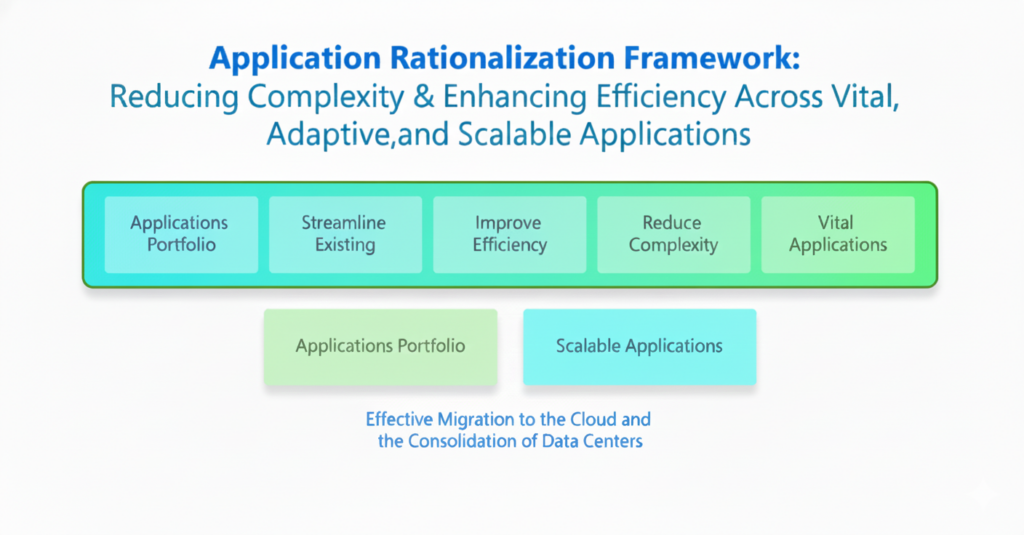
At its core, application rationalization is the structured evaluation and optimization of an organization wide application portfolio. Instead of viewing applications as isolated systems, it treats them as a portfolio of investments similar to a financial asset portfolio.
A well-designed application rationalization strategy defines the decision framework, the criteria, and the governance model so that these choices are consistent and transparent. This ensures that decisions about retaining, modernizing, replacing, or retiring applications are aligned with enterprise priorities and applied consistently across the organization.
The Link between Application Rationalization and IT Modernization
Many enterprises begin their modernization journey with a list of visible challenges. For example, a core product system that is difficult to change, an aging on-premises platform that needs to move to the cloud, or a set of customers facing applications that offer a poor experience. While these are valid triggers, they do not represent the whole picture.
Application rationalization provides the bridge between high-level modernization ambition and the detailed roadmap of initiatives that will deliver it. The link operates at several levels.
1. Strategic alignment
Modernization is successful only when it is clearly connected to business strategy. Rationalization maps applications to business capabilities and value streams. This allows leaders to see which parts of the portfolio support growth, which protect the license to operate, and which have become outdated.
For example, if a bank wants to grow digital onboarding, for retail customers, rationalization can highlight all applications that touch that customer journey. Leaders can then decide which ones must be modernized to support that strategic priority rather than simply upgrading technology for its own sake.
2. Technical feasibility and risk
Not all applications are equal in terms of modernization complexity. Some are modular and loosely coupled. Others are tightly integrated, heavily customized, and difficult to change. Rationalization assesses the technical health and dependency structure so that modernization plans are realistic and risk aware.
This is where collaboration between architecture teams, operations, and business owners becomes critical. Without rationalization, leaders may underestimate the true risk or cost of modernizing a deeply embedded legacy systems and over commit to timelines.
3. Financial optimization
Modernization is often constrained by budget. Rationalization shows where money is currently tied up in low value or redundant applications. By retiring or consolidating those systems organizations can release funds that can be redirected into modernization programs with clear business benefit.
Stat to Know: According to Gartner, organizations can reduce application portfolio costs by up to 30% through effective rationalization while improving agility and resilience.
Executives appreciate this aspect because it creates a direct connection between cost takeout and reinvestment. It also supports more robust business cases with measurable financial baselines.
4. Operating model and skills
Modernization changes how teams work, and it requires different skill sets. Rationalization helps leaders understand which applications depend on scarce skills, which rely on niche vendors, and where support models are fragmented. This insight informs the future operating model and sourcing strategy.
In short, application rationalization supplies the information, the prioritization, and the financial headroom that make modernization achievable rather than aspirational. Without it modernization turns into a series of isolated projects that may deliver local improvements but fail to transform the technology estate.
The Application Rationalization Process: Step by Step
While each organization will adapt the approach to its context, a robust application rationalization process typically follows a series of structured steps. The aim is to combine quantitative data with qualitative insight in a way that leadership can trust.
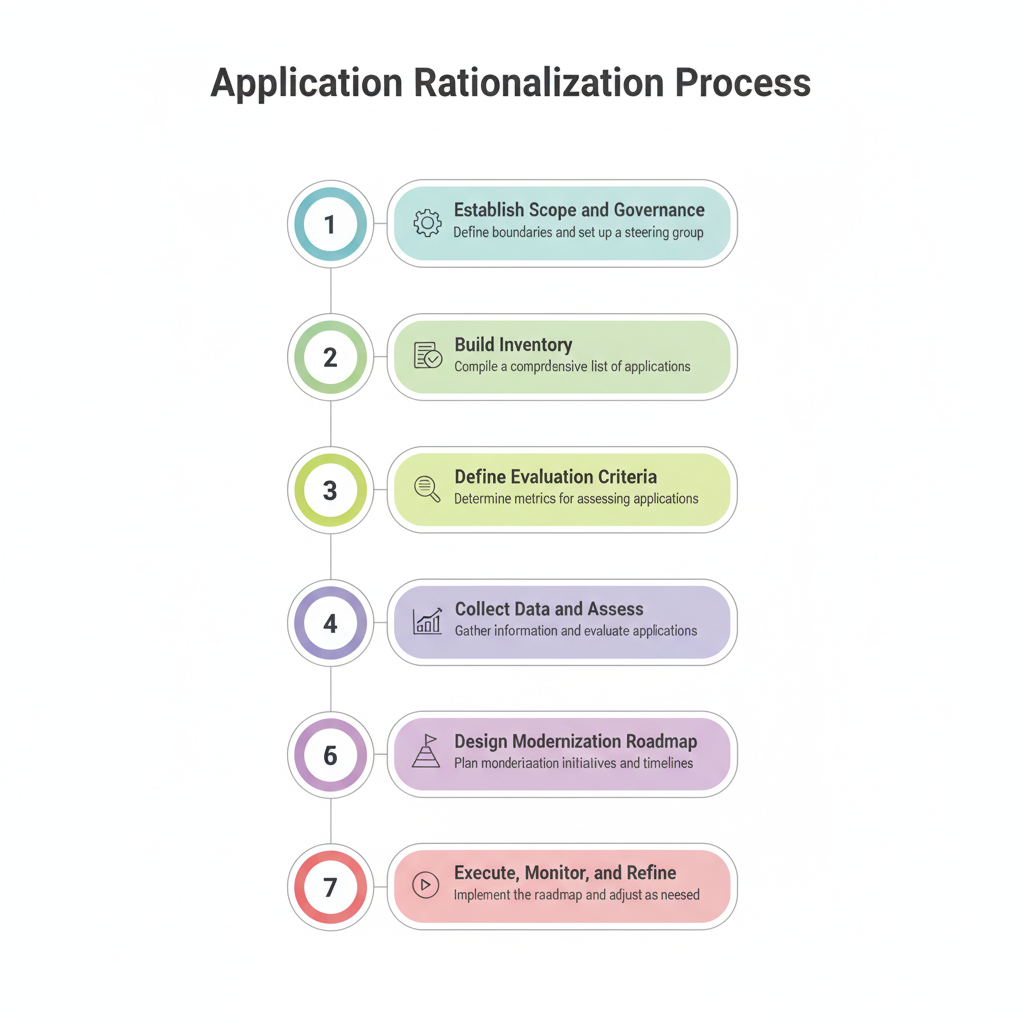
Step 1: Establish scope and governance
The first step is to define the scope of the rationalization. Will it cover the entire enterprise, a line of business, a region, or a specific platform domain? Executives need clarity on boundaries, objectives, timelines, and decision rights.
A cross-functional steering group is essential. It usually includes representation from business leadership, CIO or CTO functions, enterprise architecture, finance, security, and operations. This group sets the rules of engagement and ensures that outcomes are not driven solely by one perspective.
Step 2: Build a complete and reliable inventory
Many organizations discover early that there is no single definitive list of applications. Information is scattered across CMDB tools, spreadsheets, cloud reports, and team knowledge. Combining these into a trusted inventory is foundational work.
Step 3: Define evaluation criteria and scoring models
Once the inventory exists, the next task is to decide how each application will be evaluated. Effective criteria blend business, technology, cost, and risk considerations. Common dimensions include Business value, Functional fit, Cost, technical health and Compliance risk.
Scoring models are created for each dimension. The scores do not need to be perfect, but they must be consistent and transparent. This allows leaders to compare applications on a like for like basis.
Step 4: Collect data and perform assessments
Data is gathered from tools, documentation, financial records, and stakeholder interviews. Workshops add context that raw data cannot capture, surfacing operational dependencies and hidden constraints.
Step 5: Classify applications into future state options
Once applications have been evaluated, they are organized into clear future state categories:
Invest and modernize
- Retain and optimize
- Consolidate
- Replace
- Retire
Governance forums validate these classifications to ensure decisions reflect real-world conditions, not just numerical scores.
Step 6: Design the modernization roadmap
With classifications complete, the organization shifts from analysis to planning by creating a modernization roadmap. This roadmap groups initiatives into waves that fit business priorities, operational cycles, and risk tolerance. It also sequences activities by considering dependencies, such as modernizing a core platform before retiring connected downstream systems. Foundational enablers are identified during this step, including data platforms, integration standards, security frameworks, and cloud landing zones. These elements support all modernization initiatives and help the organization move toward a coherent target architecture. Estimates of cost, effort, and timelines are prepared to build a strong portfolio level business case. The roadmap balances quick wins, such as retiring unused applications, with larger transformational programs that require careful planning and long-term investment.
Step 7: Execute, monitor, and refine
Execution is governed through regular reviews, benefit tracking, and portfolio-level oversight. Rationalization becomes continuous, with new applications assessed using the same criteria to prevent future sprawl.
Don’t just rationalize, revolutionize with our exclusive guide on “2025 and Beyond: Redefining Business Intelligent Application Management (iAM)” to learn how IT leaders are transforming legacy applications navigating Complexity, Cost, and Change.
Key Considerations for Modernization through Rationalization
Rationalization is powerful, but its impact on modernization depends on several thoughtful choices and trade offs. From a business analyst standpoint the following considerations are particularly important for leadership.
1. Focus on business capabilities, not just systems
Modernization driven by technology alone can easily become a replacement of like for like systems. Instead, anchor rationalization in the language of business capabilities and value streams.
2. Combine top-down and bottom-up perspectives
A top-down approach clarifies strategic priorities and budget constraints. A bottom-up analysis reveals actual complexity, data issues, and integration challenges.
Rationalization should blend both. Leadership sets the direction and financial guardrails. Delivery and operations teams supply the practical insight on what is feasible, in what sequence, and with which risks. Ignoring either side leads to fragmented or unrealistic modernization plans.
3. Manage data as a first class concern
Many modernization initiatives stall because data is fragmented, duplicated, or tightly locked into legacy structures. When assessing applications, pay attention to:
- Data ownership and stewardship
- Data quality and completeness
- Master and reference data models
- Regulatory and privacy requirements
Modernization is the ideal opportunity to move toward shared data platforms, clear ownership, and stronger governance. Without explicit attention to data, rationalization might simplify applications but still leave the organization with inconsistent or unreliable information.
4. Think in terms of target architecture and patterns
Rationalization should not result in a random collection of modern technologies. Instead it should lead toward a coherent target architecture. This includes preferred patterns for integration, security, observability, cloud usage, and user experience.
When evaluating modernization options for each application, ask how well they fit into the target patterns. Solutions that align with them reduce future complexity and operating cost. Those that diverge should face higher scrutiny and stronger justification.
5. Do not underestimate change management
New applications and modernized platforms rarely succeed if users are not prepared. Rationalization can flag where change impact will be concentrated. For example:
- A large number of front line users reliant on a legacy interface
- Critical finance or risk processes with tight reporting deadlines
- Long running processes that span multiple applications
Leadership should treat change management as part of the modernization investment rather than an optional add on. Training, communication, process redesign, and support channels make the difference between adoption and resistance. Use rationalization to evolve the operating model
Modernization is also a chance to modernize how technology is delivered and operated. For instance, moving from siloed support teams to product-based squads, or from manual deployments to automated pipelines.
As rationalization identifies clusters of applications that support related capabilities, leaders can explore organising teams around these clusters. This increases accountability for outcomes and shortens feedback loops.
Challenges and How to Overcome Them
Even with a –well-designed approach application rationalization encounters real world challenges. Anticipating them helps leaders respond proactively.
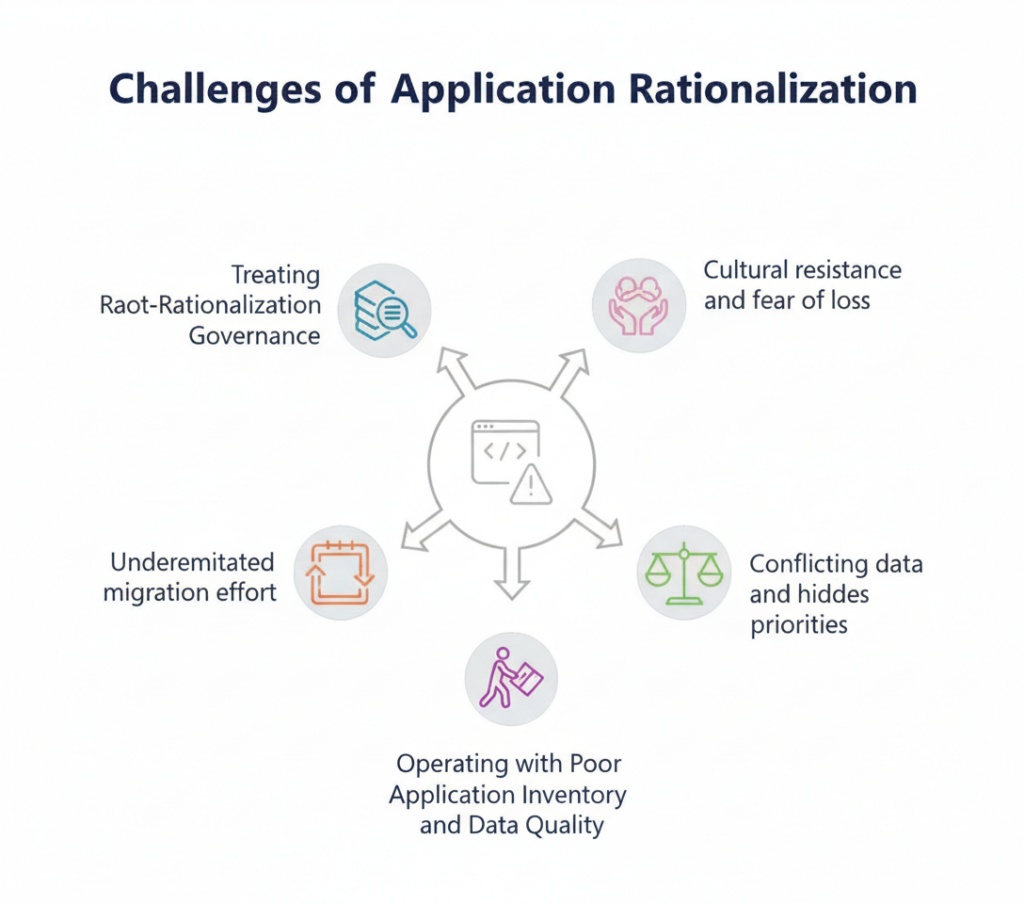
1. Cultural resistance and fear of loss
Business stakeholders sometimes fear that rationalization is primarily a cost cutting exercise that will remove tools they rely on. Technology teams may worry about losing platforms they have built careers around.
To overcome this, leaders need a clear narrative. The message should emphasize that rationalization is about creating capacity for modernization and innovation, not just reduction. Involvement of stakeholders in evaluation workshops also builds ownership of outcomes.
2. Incomplete data and hidden complexity
Few organizations start with perfect data about their applications. Information can be inconsistent, outdated, or missing. Shadow IT adds another layer of confusion.
Rather than waiting for perfect data, aim for “good enough to decide” thresholds. Document assumptions, highlight areas of uncertainty, and improve data quality iteratively. Early wins, such as retiring clearly unused applications, can fund better discovery efforts.
3. Conflicting priorities between business units
Different business units may have conflicting views on which applications are strategic or which should be modernized first. These conflicts can stall decision making.
The steering group should agree on a common evaluation framework with transparent scoring and weighting. When trade-offs are required, use enterprise-wide priorities, for example, risk reduction or customer experience to guide decisions rather than local preferences.
4. Underestimation of migration and integration effort
Rationalization sometimes focuses on the target state and underestimates the effort needed to get there. Integrations, data migration, and parallel run periods can consume significant time and cost.
To mitigate this, involve experienced architects and delivery leads in the planning stages. Use reference architectures and past project data to calibrate estimates. Build contingency into timelines and budgets for unknowns that will surface during execution.
5. Treating rationalization as aone-time project
If rationalization is viewed as a one off clean up, the organization is likely to drift back into complexity within a few years. New applications will be added without reference to the portfolio view, and modernization will again become reactive.
Instead, embed rationalization into governance processes. For example, require rationalization impact analysis for new solution proposals and major changes. Maintain the portfolio inventory as a living asset. This turns application rationalization into a continuous discipline.
For more detail on frequent missteps, leadership teams can explore this detailed perspective on application rationalization mistakes.
Metrics and Success Measurement
Leaders will rightly ask how to know whether application rationalization and modernization are succeeding. Metrics answer that question and provide the evidence needed to sustain sponsorship.
A balanced scorecard often works best, combining financial, technical, and business measures.
Financial and cost related metrics
- Reduction in total application portfolio spend over a defined period
- Percentage of spend shifted from run activities to change and innovation
- Savings from license consolidation and retirement of unused applications
- Reduction in infrastructure cost as applications move to standardized or cloud platforms
These metrics should be tracked at portfolio level and at program level. They feed directly into investment decisions for future modernization waves.
Portfolio complexity metrics
- Total number of applications in scope and trend over time
- Number of technologies and platforms used and their trend
- Ratio of strategic platforms to bespoke or niche solutions
- Number of high risk or unsupported applications remaining
These indicators tell leaders whether rationalization is truly simplifying the environment or merely reshuffling complexity.
Operational and risk metrics
- Incident volume and severity associated with legacy applications
- Average time to recover from critical incidents for modernized versus non modernized applications
- Compliance findings or audit issues related to obsolete platforms
- Security vulnerabilities identified in legacy components and their closure rate
Improvement in these measures demonstrates that rationalization driven modernization enhances resilience and risk posture.
Business and customer metrics
While many of these will be specific to each organization, typical examples include:
- Cycle times for key processes, such as onboarding, claims, order fulfillment, or product launch
- Customer satisfaction or net promoter scores for digital journeys that depend on modernized applications
- Employee productivity indicators where modernized tools reduce manual work or rekeying
These measures make the value of modernization visible beyond the technology function.
Execution and adoption metrics
Finally, leaders should track metrics that show how well the rationalization program itself is running:
- Percentage of applications assessed relative to total scope
- Progress against the modernization roadmap, such as applications migrated or retired
- Adoption of portfolio governance practices for new projects
- Stakeholder satisfaction with transparency and decision making
Together these metrics form a dashboard that the steering group can review regularly. They also provide data for refining strategy and communicating success to the broader organization.
Conclusion
Application rationalization has evolved from a housekeeping exercise into a core strategic capability for enterprises that want to modernize effectively. By treating applications as a portfolio of investments and evaluating them through a business, technical, risk, and cost lens, leaders gain the clarity they need to act with confidence.
Rationalization gives a fact-based view of where to invest, where to retire, and where to transform. It unblocks modernization by revealing dependencies, reducing technical debt, and freeing up budget. It ensures that modernization is aligned with business capabilities and target architectures rather than being guided by isolated technology decisions.
This is where Quinnox brings strategic depth to the journey. Through Qinfinite, Quinnox’s AI-powered Intelligent Application Management (iAM) organizations can operationalize application rationalization as a continuous, intelligence-led discipline. Qinfinite’s capabilities provide ongoing visibility into application usage, performance, technical readiness, and business relevance helping leaders govern their application portfolios with precision and foresight.
Enterprises that embed rationalization as an ongoing practice, supported by intelligent platforms like Qinfinite, create a self-correcting application portfolio. They are better equipped to respond to regulatory change, integrate acquisitions, adopt new platforms, and deliver digital experiences that meet rising customer expectations. In doing so, they transform modernization from a risky gamble into a managed, repeatable, and value-driven journey.
FAQs
It involves evaluating every application in the enterprise to understand business value, cost efficiency, functional relevance, technical condition, and modernization potential. The goal is to decide which applications to retain, retire, replace, consolidate, or modernize.
It identifies which applications should be modernized first, reduces technical debt, clarifies dependencies, and helps leaders create a realistic modernization roadmap. Without rationalization, modernization programs often become fragmented and costly.
Most enterprises benefit from conducting rationalization every one or two years. However, organizations undergoing major cloud migration, mergers, regulatory changes, or digital transformation may require more frequent reviews.
Typical benefits include reduced cost, lower operational risk, simpler architectures, faster modernization cycles, improved user experience, and better alignment between technology and business objectives.
Common mistakes include relying on incomplete data, skipping business stakeholder involvement, ignoring integration dependencies, focusing only on cost instead of value, or treating rationalization as a one-time activity rather than a continuous practice.