Accelerate IT operations with AI-driven Automation
Automation in IT operations enable agility, resilience, and operational excellence, paving the way for organizations to adapt swiftly to changing environments, deliver superior services, and achieve sustainable success in today's dynamic digital landscape.
Driving Innovation with Next-gen Application Management
Next-generation application management fueled by AIOps is revolutionizing how organizations monitor performance, modernize applications, and manage the entire application lifecycle.
AI-powered Analytics: Transforming Data into Actionable Insights
AIOps and analytics foster a culture of continuous improvement by providing organizations with actionable intelligence to optimize workflows, enhance service quality, and align IT operations with business goals.
As organizations accelerate digital transformation and modernization, data has become their most valuable strategic asset. Yet, with data flowing across multiple systems, formats, and platforms, ensuring accuracy and consistency becomes increasingly complex. When discrepancies arise, trust in reports, analytics, and operational decisions erodes.
This is where data reconciliation becomes critical. Data Reconciliation process ensures your business data remains accurate, complete and reliable, even as it moves across systems, migrations, and integrations.
For CIOs, CTOs, and business leaders, mastering data reconciliation is not a technical detail but a business imperative. Whether you are executing cloud migrations, merging data from acquisitions, or managing multi-source analytics, the ability to reconcile data accurately determines the success of your enterprise intelligence.
In this blog, we explore what data reconciliation is, how it works, and the best practices and real-world use cases that make it indispensable across industries.
What is Data Reconciliation?
At its core, data reconciliation is the process of comparing data from different sources to ensure consistency and accuracy. It identifies discrepancies, errors, or missing records that may have occurred during data transfer, integration, or transformation.
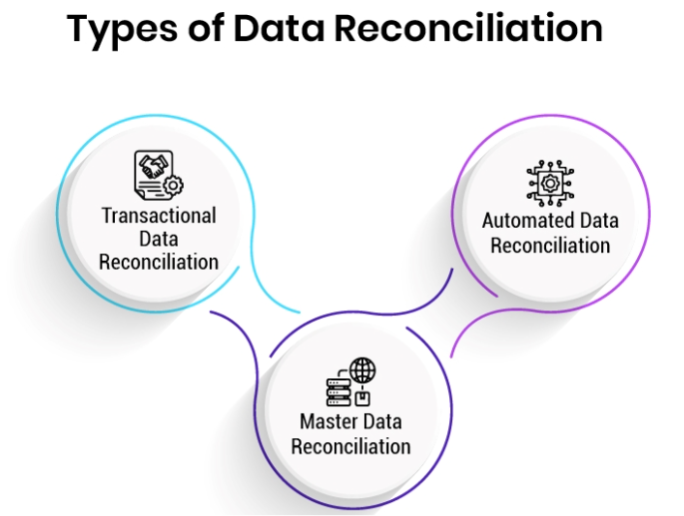
Think of it as a quality control mechanism for enterprise data pipelines. When your organization moves or synchronizes data between applications, databases, or systems. Data reconciliation confirms that what arrived is exactly what was intended.
In simpler terms, it answers one question:
“Is the data in the target system an accurate, complete reflection of the source system?”
In data migration contexts, reconciliation is especially critical. It verifies that every record from a legacy system has been accurately mapped, transformed, and loaded into the new environment. Without it, organizations risk operational disruptions, reporting inaccuracies, or even regulatory non-compliance.
For a deeper look into structured migration processes, explore Quinnox’s insights on Data migration strategies.
How Data Reconciliation Works
Whether it’s financial records, customer information, or inventory data, discrepancies inevitably arise when data flows through different systems. Data reconciliation works by identifying these mismatches, investigating their causes, and correcting them to create a single, reliable source of truth. This process is crucial for businesses aiming to make informed decisions, maintain compliance, and build trust in their data assets. Let’s take a closer look at how data reconciliation operates in practice and why it’s an indispensable step in effective data management.

The data reconciliation process typically involves four key stages:
1. Data Extraction
Data is pulled from both source and target systems. This could include databases, ERP systems, CRMs, or cloud applications. Extracted data is then standardized into a consistent format to facilitate comparison.
2. Data Comparison
Using automated reconciliation tools or scripts, the extracted datasets are then compared record by record. The process checks for-
- Missing or extra records
- Mismatched field values
- Inconsistent data types or formats
- Transformation or mapping errors
3. Error Identification and Resolution
Discrepancies are flagged and classified based on severity. Data engineers or business users review these anomalies and decide corrective actions, such as reprocessing, manual adjustments, or upstream fixes.
4. Validation and Reporting
Once issues are resolved, validation reports confirm that the data sets are now synchronized. These reports serve as audit evidence for compliance and provide confidence in the integrity of business data.
In modern environments, reconciliation is often automated using advanced ETL tools, scripts, and AI-driven validation engines. However, governance and human oversight remain essential to interpret results and approve resolutions.
Why is Data Reconciliation Important?
For modern enterprises, data reconciliation goes beyond error detection; it underpins trust, compliance, and decision-making.
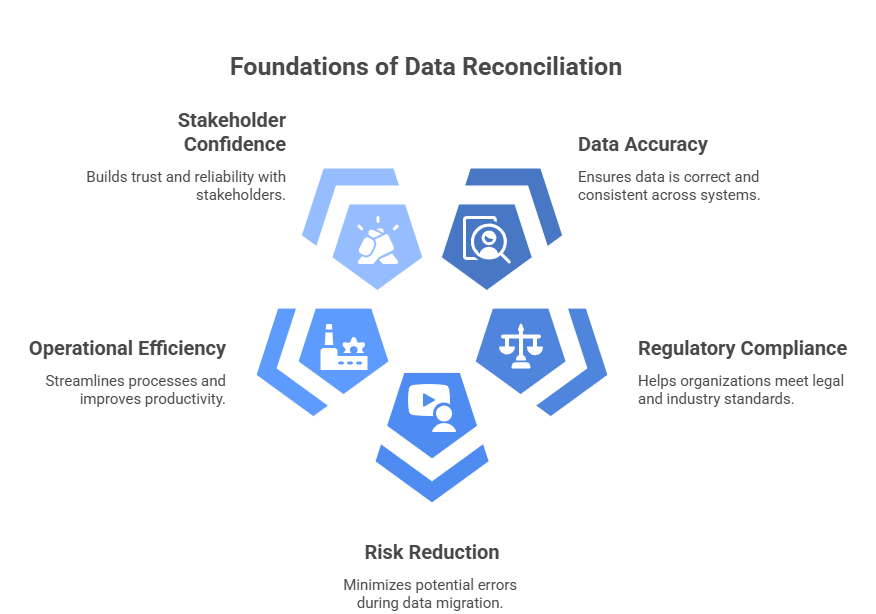
Here is why it matters:
1. Ensures Data Accuracy and Consistency
Reconciliation eliminates discrepancies between systems, ensuring that everyone across the organization is working from a single source of truth. This consistency drives confident decision-making and reduces costly rework.
2. Supports Regulatory Compliance
Industries such as banking, insurance, and healthcare face strict regulations regarding data accuracy. Reconciliation provides audit-ready proof that data integrity has been maintained across migrations or transformations.
3. Reduces Risk during Data Migration
When migrating to new systems, reconciliation acts as a safeguard against data loss or corruption. For detailed insights into migration controls, review Quinnox’s Data migration plan and Data migration checklist.
4. Improves Operational Efficiency
Automated reconciliation reduces manual verification efforts, freeing teams to focus on value-driven activities rather than error hunting.
5. Builds Stakeholder Confidence
Validated, reconciled data enhances trust among executives, regulators, and customers. It assures them that analytics, financial statements, and business insights are based on reliable data.
6. Ensures Data Accuracy and Consistency
Reconciliation eliminates discrepancies between systems, ensuring that everyone across the organization is working from a single source of truth. This consistency drives confident decision-making and reduces costly rework.
7. Supports Regulatory Compliance
Industries such as banking, insurance, and healthcare face strict regulations regarding data accuracy. Reconciliation provides audit-ready proof that data integrity has been maintained across migrations or transformations.
8. Reduces Risk during Data Migration
When migrating to new systems, reconciliation acts as a safeguard against data loss or corruption. For detailed insights into migration controls, review Quinnox’s Data migration plan and Data migration checklist.
9. Improves Operational Efficiency
Automated reconciliation reduces manual verification efforts, freeing teams to focus on value-driven activities rather than error hunting.
10. Builds Stakeholder Confidence
Validated, reconciled data enhances trust among executives, regulators, and customers. It assures them that analytics, financial statements, and business insights are based on reliable data.
Data Reconciliation Best Practices
Implementing data reconciliation best practices ensures reliability, scalability, and compliance throughout the process. Here are the key principles enterprises should follow:
1. Define Clear Data Governance Frameworks
Establish ownership for data quality and reconciliation. Assign roles for validation, approval, and exception management. Governance ensures accountability and consistency across departments.
2. Standardize Data across Systems
Standardization minimizes reconciliation errors caused by format or unit inconsistencies. Use consistent naming conventions, data types, and transformation logic.
3. Automate Wherever Possible
Automation tools can compare millions of records across multiple systems efficiently. Automating repetitive tasks like record matching or anomaly detection reduces human error and accelerates the reconciliation cycle.
4. Implement Incremental and Continuous Reconciliation
Instead of waiting for post-migration checks, adopt ongoing reconciliation to catch issues early. Continuous validation improves responsiveness and prevents large-scale data failures.
5. Maintain Detailed Audit Trails
Record every reconciliation activity, discrepancy, and resolution. Audit trails support compliance, improve traceability, and provide valuable learning for future projects.
6. Integrate Data Reconciliation with Migration Testing
Combine reconciliation with migration validation to confirm not only technical success but also business usability. Learn more from Quinnox’s Data migration validation best practices.
7. Prioritize Critical Data
Focus reconciliation efforts on business-critical datasets such as financial transactions, customer records, and compliance-related data.
8. Leverage AI and Machine Learning
Modern AI tools can detect subtle anomalies or outliers that manual or rule-based systems might miss. Intelligent reconciliation also helps predict recurring error patterns.
9. Review and Refine Regularly
Continuous improvement should be embedded into the reconciliation lifecycle. Post-project reviews uncover process gaps and feed improvements into future initiatives.
Following these best practices transforms reconciliation from a routine task into a strategic data quality discipline.
Data Reconciliation Use Cases Across Industries
The importance of data reconciliation spans across every industry that relies on data accuracy for compliance, operations, and decision-making. Whether the objective is regulatory adherence, financial integrity, or operational efficiency, reconciliation ensures that organizations maintain confidence in their data regardless of its source or volume.
Here are some of the most significant use cases across industries:
1. Banking and Financial Services
Financial institutions operate in an environment where even the smallest data discrepancy can translate into significant monetary loss or regulatory breach. Data reconciliation is central to maintaining integrity across core banking systems, transaction databases, and reporting tools.
Common applications include:
- Transaction Matching: Verifying that debits and credits match across systems like payment gateways, core banking, and general ledgers.
- Regulatory Reporting: Ensuring compliance data submitted to regulators (such as Basel III or SOX) matches internal financial records.
- Customer Account Balancing: Comparing customer balances across internal systems, mobile apps, and external partner integrations.
- Fraud Detection: Identifying anomalies in reconciled data that signal duplicate or unauthorized transactions.
See how Quinnox helped a global bank ensure 100% data integrity in our Data migration reconciliation case study.
2. Insurance
The insurance sector relies heavily on reconciled data to ensure policy accuracy, premium consistency, and timely claim settlements. Discrepancies in policy or claims data can directly impact customer satisfaction and compliance.
Common applications include:
- Policy and Claim Alignment: Ensuring data consistency between policy administration systems, CRM platforms, and claims databases.
- Regulatory Compliance: Validating that solvency and underwriting data meet standards like IFRS 17 or NAIC reporting.
- Broker and Agent Reconciliation: Matching commission, premium, and claims data across multiple intermediaries.
For insurers undergoing modernization, embedding reconciliation into their Data migration strategies helps maintain operational continuity during system upgrades.
3. Retail and eCommerce
Retailers and eCommerce enterprises depend on real-time, accurate data across supply chains, inventory systems, and digital platforms. Data reconciliation ensures that product, order, and customer information remains aligned across multiple touchpoints.
Common applications include:
- Inventory Management: Ensuring synchronization between warehouse management, POS, and ERP systems.
- Order Fulfilment Accuracy: Matching order data from online platforms to shipment and billing systems.
- Customer Data Consistency: Aligning customer profiles and preferences across loyalty programs and CRM systems.
- Revenue Assurance: Comparing sales and payment data across multiple channels to prevent revenue leakage.
By automating reconciliation, retailers can significantly improve order accuracy, forecasting, and customer experience, especially during high-volume periods such as holidays or promotions.
4. Healthcare
In healthcare, data accuracy can have life-or-death implications. Hospitals, insurers, and public health agencies use data reconciliation to ensure patient safety, regulatory compliance, and billing precision.
Common applications include:
- Patient Record Reconciliation: Matching data between EMRs (Electronic Medical Records), pharmacy systems, and insurance databases.
- Claims and Billing Validation: Ensuring that medical claims data aligns with services rendered and approved codes.
- Regulatory Compliance: Supporting audits for HIPAA, ICD-10, and other healthcare regulations through validated data trails.
By adopting reconciliation as a routine control, healthcare organizations can eliminate billing errors, prevent duplicate records, and enhance patient trust.
5. Manufacturing and Supply Chain
For manufacturers, especially those operating globally, reconciliation ensures alignment across production, logistics, procurement, and financial systems.
Common applications include:
- Production Data Validation: Reconciling machine-level IoT data with production planning systems to ensure accuracy in output reports.
- Supply Chain Transparency: Matching shipment, inventory, and procurement data across multiple suppliers and logistics partners.
- Quality Assurance: Reconciling test and inspection data against quality standards for audit readiness.
Manufacturers leveraging reconciliation as part of their digital transformation efforts gain better traceability, reduced waste, and improved operational efficiency.
6. Telecommunications
Telecom operators process millions of transactions daily i.e. calls, messages, data usage, and billing events. Discrepancies in these high-volume datasets can lead to revenue leakage or customer disputes.
Common applications include:
- Usage and Billing Reconciliation: Comparing usage data captured by network elements against customer billing systems.
- Revenue Assurance: Ensuring that all chargeable events are billed accurately and reflected in financial systems.
- Partner Settlement: Validating data exchanged with roaming partners, content providers, or resellers.
Automated reconciliation systems in telecoms can process billions of records quickly, preventing revenue loss and maintaining customer confidence.
Data Reconciliation Challenges
Despite its importance, organizations face several challenges when implementing data reconciliation:
1. Complex Data Landscapes
Enterprises operate across hybrid environments—cloud, on-premises, and SaaS—which complicates reconciliation. Managing different formats and volumes can overwhelm traditional systems.
2. Poor Data Quality
If source data is inconsistent or incomplete, reconciliation becomes harder and less reliable. Addressing data quality upstream is essential.
3. Manual Processes
Manual reconciliation is time-consuming and error-prone. It also struggles to scale for large data volumes, making automation a necessity.
4. Lack of Clear Ownership
Without defined accountability, discrepancies can go unresolved. Governance structures must designate clear data owners.
5. Inconsistent Transformation Rules
When data transformation logic varies across systems, reconciliation often fails due to mismatched mappings.
6. Limited Tooling
Not all reconciliation tools handle large-scale or real-time comparisons efficiently. Enterprises must choose platforms that align with their architecture and performance needs.
7. Regulatory Pressures
Compliance requirements continue to evolve. Keeping audit trails aligned with new standards requires constant vigilance.
Overcoming these challenges requires a mix of technology, process discipline, and cultural alignment around data integrity.
Conclusion
In the era of digital transformation, data reconciliation is the foundation of data trust. It ensures that as organizations modernize and integrate their decisions rest on reliable, validated information.
For CIOs and CTOs, investing in reconciliation is not just a technical safeguard -it is a strategic enabler of business agility and compliance.
When embedded within broader Data migration strategies, reconciliation becomes a core competency that protects enterprise value, mitigates risk, and strengthens stakeholder confidence.
Quinnox continues to help global enterprises build resilient data ecosystems through automation, validation, and governance frameworks designed for scale.
To start your data reconciliation journey, reach our experts today!
FAQs on Data Reconciliation
Data reconciliation ensures that data transferred or integrated between systems remains accurate, complete, and consistent. It is essential for maintaining business integrity, compliance, and trust in enterprise data.
The process includes extraction, comparison, discrepancy identification, resolution, and validation. Each step ensures the target dataset mirrors the source accurately.
Common techniques include record count validation, field-level comparison, checksum verification, sampling analysis, and automated exception reporting.
It validates that all data from the legacy system is correctly migrated, preventing loss or corruption. It also supports compliance and operational continuity.
Follow standardized frameworks, automate comparisons, maintain audit trails, and focus on continuous improvement. Integrating reconciliation into broader Data migration validation best practices ensures accuracy and efficiency.