Every enterprise today claims to be “data-driven.” Yet, behind the dashboards, AI models, and analytics platforms lies an uncomfortable truth – most organizations are still battling fragmented data landscapes. Customer data lives in CRMs, transactional data sits in ERPs, operational data flows through legacy systems, and digital signals pour in from cloud apps, IoT devices, and partner ecosystems. The result? Data everywhere, insight nowhere.
This is where data integration architecture quietly becomes one of the most strategic – and most underestimated – enterprise capabilities.
According to Gartner, poor data quality and fragmented integration cost organizations an average of $12.9 million per year. McKinsey reports that companies that effectively integrate data across silos are 1.5x more likely to outperform peers in revenue growth. Yet many enterprises still treat integration as a plumbing problem rather than a business-critical architecture decision.
Modern data integration is no longer about moving data from Point A to Point B. It is about designing a resilient, scalable, and intelligent fabric that enables real-time insights, supports AI and analytics, and evolves as the business changes. A well-designed integration architecture determines whether your AI initiatives succeed, whether analytics are trusted, and whether digital transformation actually delivers outcomes.
In this blog, we break down what data integration architecture really means today, explore its core components, examine common architectural patterns, and outline best practices, challenges, and the evolving role of the data integration architect.
Key Components of a Data Integration Architecture
A strong data integration architecture is not a single tool or platform. It is a layered ecosystem of capabilities working together to ensure data flows reliably, securely, and meaningfully across the enterprise.
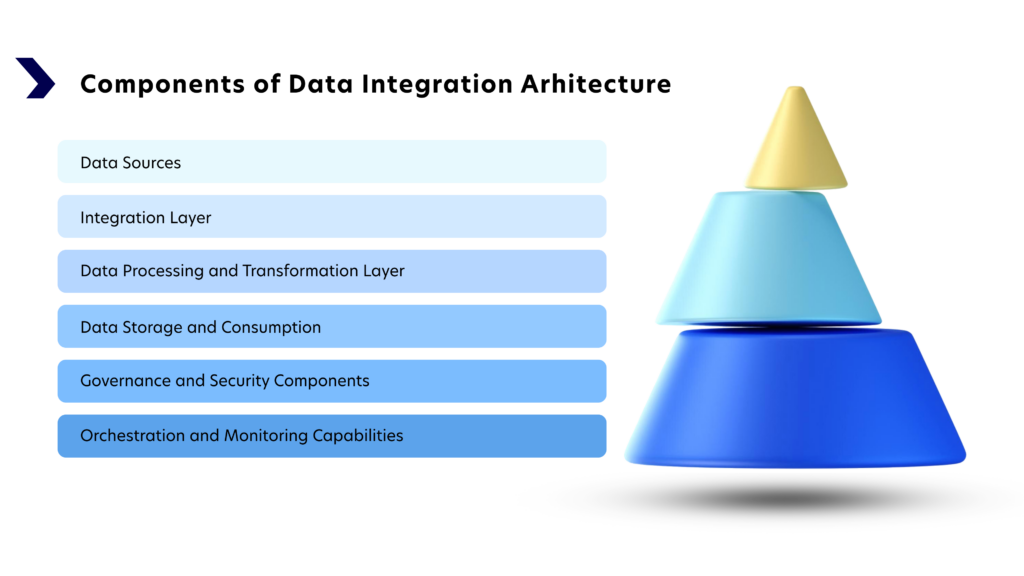
- Data sources: These include transactional systems like ERP and CRM, operational systems such as supply chain or manufacturing platforms, SaaS applications, data lakes, external APIs, and increasingly, streaming sources like IoT sensors or application logs. Modern architecture must assume heterogeneity from day one.
- Integration layer: It’s the heart of the architecture. This layer handles data ingestion, transformation, enrichment, and movement. It may include ETL/ELT tools, data pipelines, message brokers, API gateways, and event streaming platforms. The design choice here – batch vs real-time, centralized vs distributed – has far-reaching implications.
Related Read: Data Integration Techniques and Methodologies Explained
- Data processing and transformation layer: This ensures that raw data is cleansed, standardized, and shaped for downstream consumption. This includes schema mapping, data validation, deduplication, and business-rule enforcement. Increasingly, this layer also supports metadata-driven transformations and reusable logic.
- Data storage and consumption: Integrated data typically lands in data warehouses, data lakes, or lakehouses, where it becomes available for analytics, BI tools, AI/ML models, and operational applications. A well-designed architecture ensures data is discoverable and usable, not just stored.
- Governance and security components: These include metadata management, lineage tracking, data quality monitoring, access controls, encryption, and compliance frameworks. Without these, integration becomes a liability rather than an asset.
- Orchestration and monitoring capabilities: These ensure pipelines run reliably, failures are detected early, and performance bottlenecks are addressed proactively. Integration at scale is impossible without visibility and control.
Common Data Integration Architectures Explained
Enterprises typically adopt patterns based on scale, latency needs, data maturity, and business priorities. Understanding these models helps organizations avoid costly redesigns later.
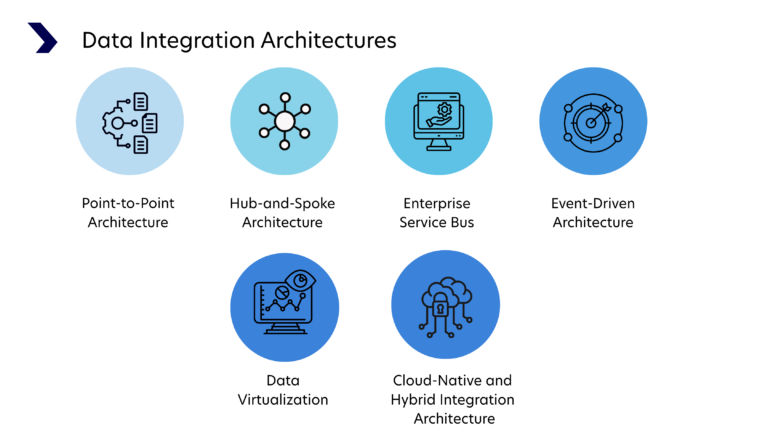
- The point-to-point architecture is the most basic and also the most problematic. Systems are directly connected through custom integrations. While simple to start, this approach quickly becomes brittle and unmanageable as systems grow. Changes in one system ripple across the network, increasing risk and cost.
- A step forward is the hub-and-spoke architecture, where a central integration hub manages data exchange between systems. This reduces complexity and improves governance but can create performance bottlenecks and single points of failure if not designed carefully.
- The enterprise service bus (ESB) architecture introduces standardized messaging, routing, and transformation capabilities. ESBs are well-suited for complex, transaction-heavy environments but often struggle with scalability and cloud-native requirements if implemented with legacy tooling.
- Modern enterprises increasingly adopt event-driven architectures, where systems publish and subscribe to events in real time. This model supports agility, scalability, and responsiveness, making it ideal for digital products, IoT, and real-time analytics.
- Another increasingly popular pattern is data virtualization, which allows consumers to access data across systems without physically moving it. While this reduces duplication and latency, it depends heavily on performance and governance maturity.
- Finally, many organizations are embracing cloud-native and hybrid integration architectures, combining iPaaS platforms, API-led connectivity, and streaming pipelines. These architectures prioritize flexibility, scalability, and faster time-to-value.
The key is not choosing the “best” architecture, but the right mix of patterns aligned with business goals and technical constraints.
Best Practices for Designing Data Integration Architecture
The most resilient data integration architectures follow a small set of repeatable, outcome-driven practices. The table below maps these practices to effort, impact, and real-world applicability.
| Integration Best Practice | Implementation Effort | Skill & Platform Needs | Business & Technical Impact | Where It Fits Best |
|---|---|---|---|---|
| Design Integration Around Business Domains | Medium | Domain knowledge, data modeling, integration tooling | Reduces data silos, improves ownership, accelerates change | Large enterprises with multiple business units and complex data ownership |
| Adopt Event-Driven & Real-Time Pipelines | High | Streaming platforms, message brokers, real-time processing skills | Enables real-time insights, faster decision-making, improved responsiveness | Digital products, IoT, customer experience and operational intelligence use cases |
| Decouple Systems Using APIs & Messaging | Medium | API management, asynchronous messaging platforms | Improves scalability, fault tolerance, and system agility | Enterprises modernizing legacy systems or moving to microservices |
| Standardize Data Models & Integration Contracts | Medium | Canonical data models, schema management, governance tools | Minimizes integration rework, improves data consistency | Organizations integrating multiple internal and third-party systems |
| Embed Data Quality & Validation in Pipelines | Medium | Data quality frameworks, observability tools | Increases trust in analytics and reporting, reduces downstream errors | Analytics-driven organizations and regulated industries |
| Design for Hybrid & Multi-Cloud Environments | High | Cloud platforms, networking, security, integration platforms | Avoids vendor lock-in, supports flexible deployment models | Enterprises with regulatory constraints or phased cloud adoption |
| Enable Metadata-Driven & Reusable Pipelines | Medium | Metadata management, orchestration tools | Faster onboarding of new sources, lower maintenance cost | Data platforms expected to scale rapidly |
| Implement End-to-End Observability & Monitoring | Low - Medium | Monitoring, logging, alerting platforms | Faster issue resolution, higher pipeline reliability | Mission-critical data flows and enterprise reporting systems |
| Shift Left on Security & Governance | Medium | IAM, encryption, data governance frameworks | Reduces compliance risk, strengthens data security posture | BFSI, healthcare, and compliance-heavy enterprises |
| Automate Testing & Deployment of Integrations | Medium | CI/CD pipelines, automated testing frameworks | Faster releases, fewer production failures | Agile teams managing frequent integration changes |
Top 7 Benefits of Data Integration Architecture
A well-designed data integration architecture is not just a technical enabler – it is a business force multiplier. When done right, it changes how quickly organizations can respond, how confidently they can decide, and how effectively they can scale digital initiatives.
Below are the seven most impactful benefits enterprises realize when integration is treated as architecture, not ad-hoc plumbing.
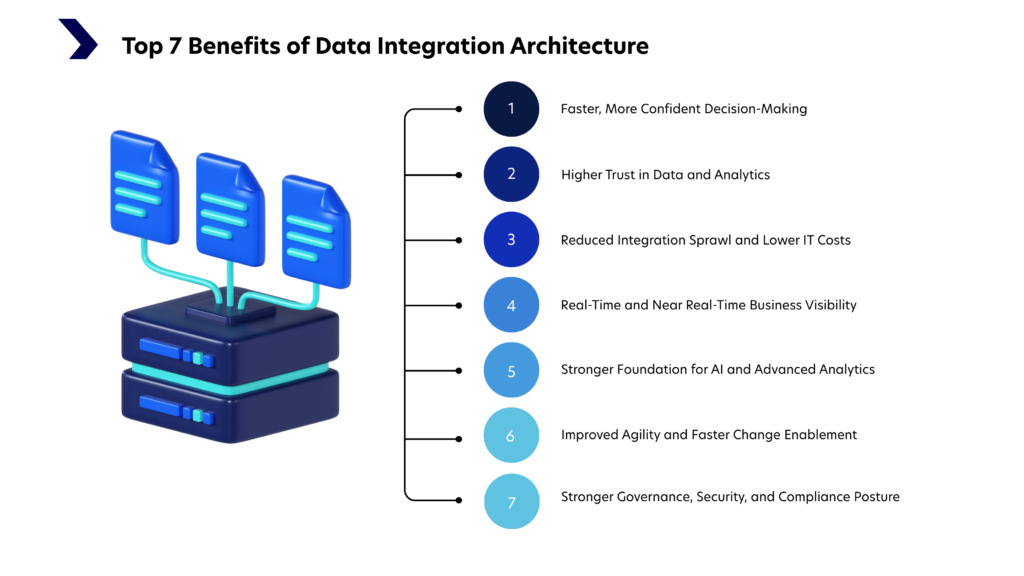
1. Faster, More Confident Decision-Making
The most immediate benefit of a solid data integration architecture is speed to insight. When data from core systems – ERP, CRM, digital channels, operations, and external sources – flows into a unified and governed layer, leaders no longer wait days or weeks for reconciled reports.
According to McKinsey, organizations that enable integrated data access across business units are 23% more likely to acquire customers and 19% more likely to be profitable. The reason is simple: decisions are based on current, trusted data rather than fragmented snapshots.
2. Higher Trust in Data and Analytics
Data distrust is one of the silent killers of analytics adoption. When different teams see different numbers for the same metric, confidence erodes quickly. A strong integration architecture embeds standardized data models, validation rules, lineage, and quality checks directly into data pipelines. This ensures that metrics are consistent, traceable, and explainable.
3. Reduced Integration Sprawl and Lower IT Costs
Without architectural discipline, integration of landscapes tends to grow organically – and chaotically. Point-to-point connections multiply; custom scripts pile up, and maintenance costs skyrocket. A centralized, well-governed integration architecture replaces brittle connections with reusable pipelines, APIs, and event streams, dramatically reducing technical debt.
Enterprises that standardize integration patterns often report 20–30% lower integration maintenance costs over time due to reduced duplication and simplified change management. (Source: World Journal of Advanced Engineering Technology and Services) Instead of building separate integrations for every downstream consumer, a standardized ingestion pipeline feeds multiple analytics and reporting use cases.
4. Real-Time and Near Real-Time Business Visibility
Traditional batch-based integration limits insight to what happened yesterday – or last week. Modern integration architectures support event-driven and streaming models, enabling real-time visibility into business operations. This capability is critical for use cases such as fraud detection, supply chain optimization, dynamic pricing, and customer experience personalization.
5. Stronger Foundation for AI and Advanced Analytics
AI initiatives fail more often due to data readiness issues than model complexity. Machine learning models require clean, timely, and well-integrated data across multiple domains. A robust data integration architecture ensures data is consistently ingested, enriched, and governed, making it suitable for advanced analytics and AI workloads.
According to the Pragmatic Institute, up to 80% of AI project time is spent on data preparation. Integrated architectures significantly reduce this overhead and accelerate time-to-value.
6. Improved Agility and Faster Change Enablement
Business priorities change constantly – new markets, new products, mergers, regulatory updates. Integration architectures designed for decoupling and reuse allow organizations to adapt without massive rework. API-led and event-driven integration models enable teams to add or modify systems without breaking existing data flows, improving overall agility.
7. Stronger Governance, Security, and Compliance Posture
As data volumes grow and regulations tighten, governance can no longer be an afterthought. A solid integration architecture embeds security controls, access policies, encryption, and auditability into the data flow itself. This reduces compliance risk while still enabling broad data access for analytics and innovation.
Highly regulated industries such as BFSI and healthcare increasingly rely on integration architecture to balance data democratization with compliance.
Common Challenges in Data Integration and How to Solve Them
Despite advances in integration technologies, many enterprises continue to face recurring challenges that slow down data initiatives and dilute business value. The most common ones include:
1. Persistent Data Silos Across Business Units
Data silos are often less about technology and more about organizational structure. When teams own systems independently, data becomes fragmented and inconsistent.
How to address it: Establish a standardized integration architecture supported by strong executive sponsorship. Define clear data ownership models and shared integration standards that cut across business units.
2. Latency Mismatch Between Use Cases and Pipelines
Many organizations still rely on batch-based integrations for use cases that demand near real-time or real-time insights – leading to delayed decisions and missed opportunities.
How to address it: Adopt event-driven and streaming architectures where real-time responsiveness matters. Invest in the right platforms and upskill teams to design and manage asynchronous data flows.
3. Poor Data Quality and Low Trust in Analytics
When integrated data lacks consistency, accuracy, or traceability, business users quickly lose confidence in reports and dashboards.
How to address it: Embed data quality checks, validation rules, and lineage tracking directly into integration pipelines. Treat observability and data quality as architectural requirements, not optional add-ons.
4. Integration Tool Sprawl and Growing Complexity
Over time, enterprises accumulate multiple ETL tools, custom scripts, APIs, and integration platforms – often solving similar problems in different ways.
How to address it: Define a clear integration strategy and reference architecture. Rationalize tools based on use cases, standardize patterns, and prioritize reusable, platform-based integrations.
5. Tight Coupling Between Systems
Point-to-point integrations create brittle dependencies, making even small changes risky and expensive.
How to address it: Decouple systems using APIs, messaging, and event-driven patterns. This allows systems to evolve independently without breaking downstream consumers.
6. Governance and Security Added Too Late
When governance is layered after integrations are built, compliance gaps and security risks quickly surface.
How to address it: Shift governance and security left. Embed access controls, encryption, metadata management, and auditability into the integration architecture from the outset.
7. Limited VisibilityIntoIntegration Health
Without proper monitoring, failures go unnoticed until business users report missing or incorrect data.
How to address it: Implement end-to-end observability across pipelines, including monitoring, logging, and alerting. Proactive visibility reduces downtime and improves reliability.
Conclusion
Data integration today is about enabling smarter, faster, and more confident decisions across the enterprise. The organizations that extract real value from their data are those that align integration strategy tightly with business objectives. By choosing the right architectural patterns, investing in scalable technologies, and adopting proven integration best practices, enterprises can transform fragmented data into a strategic, decision-ready asset. This alignment is what allows integration to support everything from day-to-day operations to long-term digital transformation initiatives.
Looking ahead, the rise of AI in data integration is set to redefine how data is discovered, prepared, governed, and consumed. Intelligent pipelines, automated data quality, and adaptive integration flows will enable faster insights with less manual intervention – making integration smarter, not just faster.
This is where Quinnox brings differentiated value. Our AI-powered data integration solutions combine deep architectural expertise with next-generation intelligence to help enterprises build future-ready, outcome-driven data ecosystems. From intelligent integration design to scalable execution, Quinnox enables organizations to unlock the full potential of their data – today and in the AI-driven future.
Ready to maximize your data’s potential? Quinnox helps you move beyond integration to intelligent, innovation-led data architectures that drive real business impact.

Lead, Marketing, Everforth Quinnox
FAQ’s Related to Data Integration Architecture
API-led and event-driven architectures are typically best for cloud systems because they support scalability, flexibility, and real-time data exchange. Many organizations also adopt hybrid models when on-prem systems are involved.
System integration connects applications so they can function together operationally. Data integration focuses on consolidating and transforming data from multiple sources to enable analytics, reporting, and informed decision-making.
Yes. Even small businesses use multiple SaaS tools and digital platforms. A structured integration approach prevents data silos, reduces manual effort, and supports future growth.
APIs enable secure, standardized communication between systems. They help decouple applications, support scalability, and make modern, cloud-based integration possible.