Accelerate IT operations with AI-driven Automation
Automation in IT operations enable agility, resilience, and operational excellence, paving the way for organizations to adapt swiftly to changing environments, deliver superior services, and achieve sustainable success in today's dynamic digital landscape.
Driving Innovation with Next-gen Application Management
Next-generation application management fueled by AIOps is revolutionizing how organizations monitor performance, modernize applications, and manage the entire application lifecycle.
AI-powered Analytics: Transforming Data into Actionable Insights
AIOps and analytics foster a culture of continuous improvement by providing organizations with actionable intelligence to optimize workflows, enhance service quality, and align IT operations with business goals.
Every unplanned outage, every buggy release, every regression that slips into production carries a price tag that leadership now recognises. And as enterprises accelerate their digital transformation journeys, the pressure on testing teams has reached a critical inflection point.
$2.41 Trillion
The estimated annual cost of poor software quality in the United States – encompassing failed IT projects, cybercrime losses, and technical debt.
Source: Consortium for Information & Software Quality (CISQ)
To put that number in perspective: it exceeds the GDP of most countries. Yet organisations continue to treat testing as a late-stage checkbox rather than a strategic capability. That is changing – fast.
The shift is structural. Application quality has become a board-level concern. Enterprises are releasing updates faster, integrating more systems, supporting more devices, and serving users who expect always-on digital experiences. In that environment, traditional QA delivery models are under pressure. What worked when releases were quarterly and applications were monolithic no longer works as effectively in a world of cloud-native platforms, APIs, microservices, DevOps, and continuous delivery.
This is one of the main reasons application testing services are evolving. Businesses no longer want testing to be a late-stage checkpoint. They want it to be scalable, integrated, data-driven, and aligned to business outcomes such as speed to market, resilience, compliance, and customer experience. As a result, many organizations are rethinking how testing is sourced, managed, and operationalized.
Traditional testing models typically relied on fixed teams, an environment-heavy setup, manual coordination, and significant internal overhead. Those models still have value in some contexts, especially for highly specialized or deeply regulated workloads. But they can become costly and slow when testing demand fluctuates, release cycles accelerate, or teams need broader coverage across applications, devices, geographies, and integrations.
“Quality is not an act; it is a habit.”
- Aristotle - and a truth that modern engineering teams are finally operationalising at scale
That shift is driving interest in application testing as a service (TaaS) – a model that gives enterprises access to testing capabilities on demand, often through cloud-enabled platforms, reusable frameworks, automation accelerators, and specialized expertise. Instead of building every testing capability in-house, organizations can consume testing more flexibly based on release needs, application complexity, and transformation priorities.
This evolution is not simply a sourcing change. It reflects a broader transformation in how quality engineering is delivered. As enterprise environments become more distributed and digital business becomes more dependent on software, leaders are moving from labor-heavy test execution toward platform-led, service-based, and increasingly intelligent testing models. That is where modern application testing, outcome-based delivery, and TaaS are beginning to converge.
What is Testing as a Service (TaaS)?
Testing as a Service, or TaaS, is a delivery model in which testing capabilities are provided as an on-demand managed service rather than being built and operated entirely by internal teams. It enables organizations to access testing tools, environments, frameworks, automation, governance, and domain expertise through a service partner or platform-based model.
At a practical level, application testing as a service allows enterprises to consume testing in a more elastic way. Instead of maintaining large permanent QA teams and infrastructure for every possible scenario, businesses can scale testing up or down based on release schedules, transformation programs, peak demand periods, or specific quality needs such as regression, performance, security, API, or user acceptance testing.
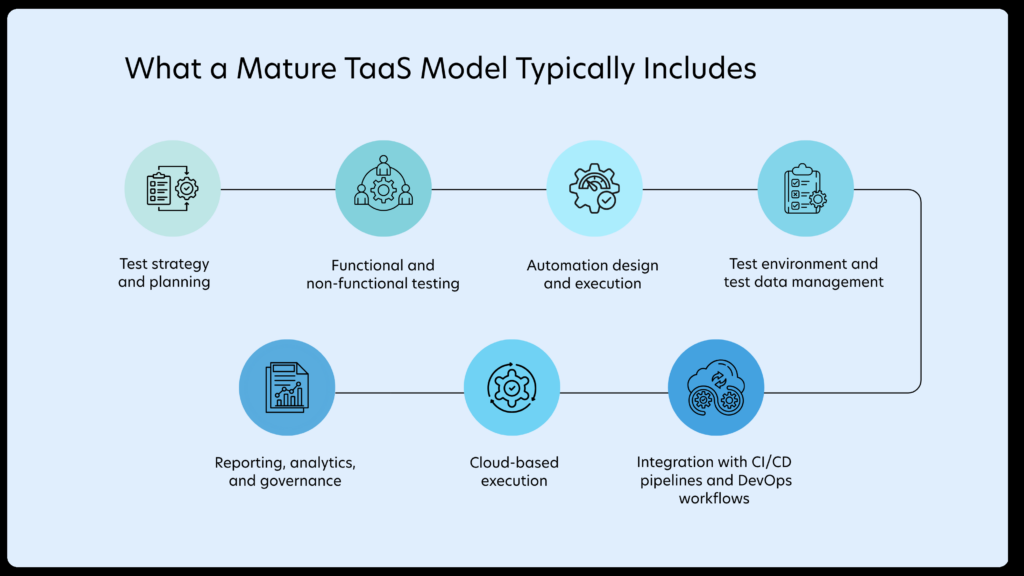
The key difference is that TaaS is not just outsourced testing in a traditional sense. Mature TaaS models are typically more platform-centric, more automated, and more integrated into modern engineering lifecycles. They are designed to deliver repeatability, transparency, and faster turnaround rather than simply provide additional manual testers.
For many enterprises, TaaS also creates access to broader expertise. A partner delivering application testing services across industries and platforms is often better positioned to bring reusable accelerators, domain knowledge, best practices, and specialized testing capabilities than an internal team that is stretched across day-to-day priorities.
This is especially relevant in complex environments that require enterprise application testing. Large organizations typically deal with ERP systems, CRM platforms, third-party integrations, data pipelines, legacy applications, customer-facing digital channels, and multiple business-critical workflows. A TaaS model can help standardize and industrialize testing across that landscape while still allowing flexibility for application-specific needs.
In short, TaaS turns testing from a fixed operational burden into a more scalable service layer that supports quality at the speed modern businesses require.
The Market Signal: TaaS is Growing Fast
The momentum behind TaaS is not anecdotal; it is reflected in market data. Organisations across industries are accelerating their shift from traditional QA delivery to service-based quality models.
- $11-14B
TaaS global market size by 2030-2032
- 30%
Organizations can achieve up to 30% cost savings compared to traditional testing methods.
Source: Grand View Research
The drivers behind this expansion are structural. Software complexity is increasing, release cycles are accelerating, and the shift to Agile and DevOps makes static, labour-heavy testing unsustainable. At the same time, the maturity of cloud infrastructure and AI-powered testing tools has made it viable to deliver testing as a true utility service.
A real-world example: Autonomous testing platform Functionize raised $41 million in Series B funding in January 2025 to accelerate its AI-driven QA solutions – a signal of where enterprise investment is flowing as organisations look to make quality engineering both smarter and more scalable.
TaaS vs Traditional Application Testing Services
To understand why TaaS is gaining traction, it helps to compare it with traditional application testing services.
Traditional testing models were built for a different era. In many organizations, testing was structured around dedicated in-house teams, long test cycles, static environments, and heavy manual effort. Test planning often began after development milestones were already defined. Scaling required hiring, onboarding, tool procurement, and environment setup. The model could work, but it was often slower and less responsive to rapid change.
TaaS emerged because those constraints became harder to justify. Modern engineering organizations need faster feedback, broader coverage, more automation, and more flexibility. A service-based model addresses those needs differently.
1. Delivery model
Traditional testing usually depends on fixed teams and predefined engagement structures. Capacity is tied to the size and skills of the internal QA function or long-term vendor team.
TaaS is more elastic. It allows organizations to provision testing capacity and capabilities as needed. That is useful when release intensity changes month to month or when major initiatives create short-term testing spikes.
2. Cost structure
Traditional models often involve significant fixed costs. Enterprises invest in people, tools, environments, licenses, maintenance, and governance overhead regardless of how intensively those assets are used.
With application testing as a service, the cost structure is often more variable and consumption-oriented. Businesses pay for the testing capabilities they actually use, which can improve utilization and reduce waste, especially in dynamic delivery environments.
3. Speed and scalability
One of the biggest constraints in traditional testing is time to scale. Adding new test environments, expanding coverage, or building automation often requires long lead times.
TaaS is designed for quicker scalability. Because the service model is usually backed by cloud infrastructure, reusable frameworks, and established delivery processes, organizations can respond faster to new applications, release cycles, and business priorities.
4. Tooling and platforms
Traditional testing models often suffer from fragmented tooling. Different teams use different frameworks, reporting standards, and execution processes, making governance more difficult.
A mature TaaS provider typically brings a more standardized and integrated toolchain. That can include automation frameworks, dashboards, orchestration capabilities, environment provisioning, and analytics. This is one reason businesses are increasingly exploring application testing services that combine consulting, execution, and platform support rather than only staffing.
5. Automation maturity
In traditional models, test automation may exist but is often unevenly adopted. Scripts can become brittle, coverage may be inconsistent, and maintenance may depend on a few key individuals.
TaaS models tend to be more automation-led by design. Since scalability and repeatability are central to service delivery, automation becomes an operational necessity rather than a side initiative. This supports better regression efficiency, faster feedback, and stronger alignment with CI/CD.
6. Business alignment
Traditional testing sometimes operates as a downstream QA function focused mainly on defect detection.
TaaS is better positioned to function as a strategic quality service. It can connect testing with release velocity, customer experience, resilience, regulatory compliance, and operational continuity. That shift is important because quality today is not just about finding bugs. It is about protecting business outcomes.
7. Best-fit scenarios
Traditional models may still be suitable when applications are highly stable, release cycles are predictable, and the organization has strong internal QA capability with deep application knowledge.
TaaS is especially attractive when organizations need to scale quickly, modernize testing, support multiple platforms, handle fluctuating release demand, or accelerate digital transformation without expanding permanent testing overhead.
Glance At a Direct Comparison of Traditional testing vs TaaS
| Dimension | Traditional Testing | Testing as a Service (TaaS) |
|---|---|---|
| Delivery Model | Fixed teams, predefined engagement structure | Elastic capacity provisioned to release demand |
| Cost Structure | High fixed costs regardless of utilisation | Variable, consumption-based spending |
| Speed to Scale | Long lead times for new apps/environments | Rapid onboarding via cloud and reusable frameworks |
| Tooling | Fragmented; team-by-team tooling decisions | Unified platform with automation, analytics, governance |
| Automation Maturity | Inconsistent; often brittle and siloed | Automation-led by design, CI/CD integrated |
| Business Alignment | Downstream QA, bug detection focus | Strategic quality service tied to business outcomes |
| Best Fit | Stable apps, predictable cycles, strong internal QA | Fluctuating demand, digital transformation, scale |
The broader takeaway is not that one model is universally better. It is that the evolution of application testing services reflects a changing business environment. Enterprises increasingly need a delivery model that is more flexible, platform-enabled, and outcome-driven than traditional structures were designed to provide.
Implementation Considerations & Integration
Moving to a TaaS model is not just a procurement decision. It requires thoughtful implementation. The organizations that get the most value from application testing as a service are the ones that treat it as an operating model shift rather than simply a vendor transition.
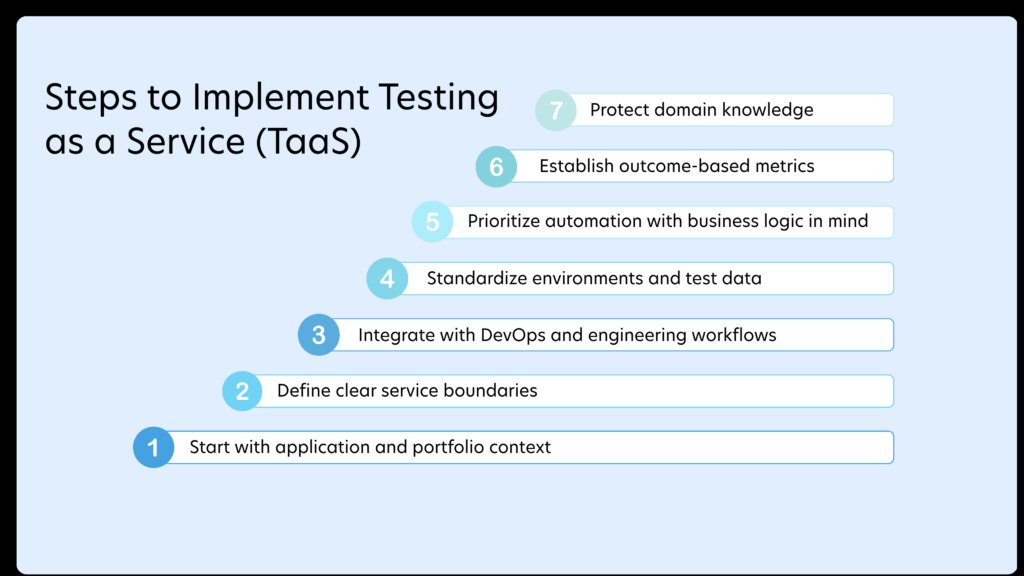
1. Start with application and portfolio context
Not every application needs the same testing model. Customer-facing platforms, ERP systems, mobile apps, internal productivity tools, and data-intensive applications all carry different risk profiles. The first step is understanding which applications are best suited for TaaS and which may still require strong internal ownership.
For example, an organization may decide to use TaaS for regression, performance, cross-browser, API, and integration testing across multiple product lines while retaining internal control over niche validation areas tied to proprietary business logic.
2. Define clear service boundaries
A successful TaaS engagement needs clarity on roles, responsibilities, and outcomes. That includes:
- What types of testing are included
- Who owns test strategy
- How environments and test data are managed
- How release decisions are made
- What SLAs, KPIs, and governance mechanisms apply
Without that clarity, even the best application testing services can become reactive instead of strategic.
3. Integrate with DevOps and engineering workflows
TaaS works best when it is embedded into delivery pipelines rather than operating as a disconnected external layer. Test planning, automation execution, defect reporting, and release feedback should align with the same tools and workflows used by development and operations teams.
That means integrating TaaS with source control, CI/CD pipelines, test management systems, observability platforms, and collaboration tools. Quality should become part of the engineering rhythm, not a separate handoff.
4. Standardize environments and test data
Many testing bottlenecks come not from execution itself but from environment instability and poor test data readiness. A strong TaaS model addresses both.
Cloud-based environments, service virtualization, synthetic data generation, and automated provisioning can significantly reduce delays. This is especially important for enterprise application testing, where applications often depend on multiple interconnected systems and realistic data scenarios.
5. Prioritize automation with business logic in mind
Automation should not be pursued only for volume. The real objective is faster, more reliable validation where automation provides measurable value. High-frequency regression suites, API validation, repetitive workflows, and multi-platform coverage are often strong candidates.
However, organizations should also be realistic about maintenance, data dependencies, and change frequency. The right TaaS partner will help decide what should be automated, what should remain exploratory, and where AI-assisted approaches can improve efficiency.
6. Establish outcome-based metrics
Traditional QA metrics often focus narrowly on execution counts and defect totals. TaaS should be measured more strategically. Good metrics may include:
- Reduction in regression cycle time
- Improvement in release confidence
- Defect leakage trends
- Automation coverage in business-critical flows
- Environment readiness metrics
- Test execution turnaround time
- Cost per release or per validated feature
55%
of organisations are now using AI tools for development and testing, with mature DevOps teams leading at 70% adoption – a clear signal of where modern quality engineering is heading.
Source: DevOps Digest
These indicators help leaders understand whether application testing as a service is improving quality delivery in practical business terms.
7. Protect domain knowledge
One concern with any service-based model is loss of business context. This can be mitigated through strong documentation, shared governance, product-based test ownership, and close collaboration between internal stakeholders and the service provider.
TaaS should not create distance from the application. It should create a more efficient structure for managing quality around it.
In essence, implementation success depends on integration, governance, and fit. TaaS is most effective when it becomes a connected part of the enterprise delivery ecosystem rather than a separate outsourced function.
The Future: TaaS + AI, Observability & Platformization
The next phase in the evolution of application testing services will be shaped by intelligence, visibility, and platform-led delivery.
TaaS is already changing how testing is consumed. But the future of the model will be defined by how effectively it incorporates AI, observability, and platformization to make quality engineering more predictive, more autonomous, and more business-aware.
AI-driven testing will make TaaS smarter
The adoption numbers tell a clear story: 72% of QA professionals now actively use AI for test generation and script optimisation, and 82% affirm AI will be critically important over the next three to five years. AI testing adoption has already grown from 7% in 2023 to 16% in 2025 – and the trajectory is accelerating.
AI in TaaS enables smarter test gaps, optimize regression scope, predict defect-prone areas, improve script resilience, and speed up root-cause analysis. A service provider supporting multiple applications and delivery patterns can build stronger intelligence into test design, maintenance, and reporting. That makes application testing as a service not only scalable, but increasingly adaptive.
Over time, AI will help shift testing from reactive validation toward risk-based quality decisions. Instead of running everything, teams will be able to run what matters most based on code changes, historical failures, production signals, and business impact.
“80% of software teams will use AI for testing in the near future - an adoption rate not seen since the smartphone revolution of the 2010s.”
Observability will connect testing with production reality
Traditional testing often ends at release. But modern quality engineering must learn from production behavior as well. Observability tools generate rich insight into system performance, user journeys, API behavior, failures, and anomalies in real environments.
As TaaS evolves, these signals will increasingly feed back into testing. That means test suites can be refined based on actual usage patterns, recurring incidents, integration failures, and performance bottlenecks. This strengthens the connection between test coverage and real business risk.
For enterprises, that creates a more closed-loop quality model where testing is informed by live operational behavior rather than only pre-release assumptions.
Platformization will industrialize quality delivery
Another major trend is platformization. Instead of delivering testing as a collection of disconnected services, providers are building unified platforms that combine automation, orchestration, reporting, analytics, environment access, and governance.
This matters because large organizations need consistency. Platform-led delivery reduces fragmentation, improves transparency, and makes it easier to apply common quality standards across portfolios. It also simplifies scaling across geographies, business units, and technology stacks.
For buyers of application testing services, platformization changes the value proposition. The conversation moves beyond team size and hourly effort toward reusable assets, speed of onboarding, intelligent reporting, and integrated quality operations.
TaaS will support broader engineering transformation
The future of TaaS is not limited to QA teams. It will increasingly support product engineering, SRE practices, release management, compliance programs, and digital transformation initiatives.
In other words, TaaS is becoming part of a broader quality engineering ecosystem. It will help enterprises manage complexity across applications, reduce release friction, improve resilience, and align software quality more directly with customer and business outcomes.
That is why the evolution from traditional testing to application testing as a service matters. It is not just a delivery innovation. It is a response to how software itself has changed. As digital businesses demand more speed, more intelligence, and more operational confidence, the testing model must evolve with them.
Conclusion: Quality Engineering as a Strategic Capability
The journey from traditional testing models to Testing as a Service reflects a larger shift in enterprise technology delivery. Applications are more complex, releases are more frequent, and quality expectations are higher than ever. In that reality, static, labor-heavy testing structures are increasingly difficult to scale.
Modern application testing services must be flexible, automation-led, integrated, and outcome-focused. That is what makes TaaS compelling. It gives organizations the ability to access testing capabilities on demand, improve efficiency, strengthen release confidence, and better align quality engineering with business priorities.
46%
of teams now report deploying code 50% or more faster than they did in 2024 – with AI-powered testing at the centre of that acceleration.
Source: DevOps Digest
At the same time, TaaS is not a one-size-fits-all replacement for every traditional model. The right approach depends on application complexity, regulatory needs, internal maturity, and transformation goals. For many organizations, the best path is a hybrid one: retaining strategic internal ownership while using application testing as a service to add scale, speed, expertise, and platform support.
Looking ahead, the most successful enterprises will be the ones that treat testing as a strategic capability rather than a downstream activity. As AI, observability, and platformization reshape the quality landscape, TaaS is poised to become a core enabler of faster delivery, stronger resilience, and better digital experiences.
For organizations evaluating how to modernize quality engineering, now is the right time to reassess the role of application testing, explore scalable application testing services(ATaS), and build a stronger foundation for enterprise application testing at scale.
At Everforth Quinnox, we have built our application testing practice around exactly this philosophy and taken it one step further with ATaS (Application Testing as a Service). ATaS is Everforth Quinnox’s purpose-built delivery model that goes beyond traditional testing. ATaS is application-centric by design. It is structured around the specific risk profile, business logic, integration complexity, and release patterns of each application not a one-size-fits-all testing catalogue.
Our ATaS model combines platform-led delivery, AI-assisted automation, and deep domain expertise across ERP, CRM, cloud-native, and digital channel applications, with outcome-based governance built in from day one. The result: your teams spend less time managing testing overhead and more time shipping with confidence. Whether you are modernising a legacy QA function, scaling testing for a major digital transformation programme, or looking to embed quality deeper into your DevOps delivery chains, Everforth Quinnox’s ATaS brings the methodology, the tooling, and the application-specific intelligence to make it work at enterprise scale.
Ready to move beyond generic testing to application-centric quality engineering with Everforth Quinnox ATaS? Connect with our experts today!

Executive Vice President & Head Global Marketing, Everforth Quinnox
FAQs Related to Testing as a Service
An organization should consider TaaS when testing demand is variable, release cycles are accelerating, internal QA capacity is limited, or specialized capabilities such as automation, performance, and cross-platform validation are needed quickly. It is especially useful when the business wants to scale quality without significantly increasing fixed overhead.
A TaaS model commonly includes functional testing, regression testing, integration testing, API testing, performance testing, security testing, mobile and cross-browser testing, user acceptance support, environment coordination, and test automation services. The exact scope depends on the service design and business requirements.
The main risks include weak domain understanding, unclear ownership, communication gaps, and poor integration with engineering workflows. These can be mitigated through strong governance, shared KPIs, clear service boundaries, embedded collaboration, documentation standards, and close alignment with development and business teams.
Yes. In fact, application testing as a service can be highly effective for enterprise-scale environments because it supports scalable execution, standardized governance, reusable automation, and access to specialized expertise. It is particularly valuable when applications involve multiple integrations, business-critical workflows, and frequent releases.
Yes. Modern TaaS models increasingly support automation-first and AI-assisted testing. That can include self-healing scripts, test optimization, defect prediction, smarter regression selection, and analytics-driven decision-making. These capabilities help organizations improve speed, coverage, and release confidence.
Traditional outsourcing often focuses on external manpower. TaaS is broader and more strategic. It usually combines managed services, automation frameworks, cloud-enabled execution, reporting, integration, and scalable delivery models. The goal is not only to add people, but to deliver testing as an optimized service.
Yes. Many organizations adopt TaaS in a hybrid model. Internal teams may retain product knowledge, release accountability, and test governance, while the TaaS provider handles scalable execution, automation, specialized test types, and platform support. This often delivers better flexibility without losing business context.
Built with reference to Quinnox content themes around enterprise testing evolution and quality transformation.