How many applications does your organization really need? For a large enterprise, the answer is rarely straightforward.
One application supports finance. Another supports sales. A legacy platform still runs a critical process. Several SaaS applications were adopted independently by different business units. An application inherited through an acquisition overlapwith an existing system. And somewhere in the environment sits an application that nobody is quite sure who owns – but nobody wants to switch off.
This is how an applicationion sprawl happens. The challenge isn’t simply having too many applications. It is the cost, complexity, risk and technical debt hidden across the portfolio.
McKinsey estimates that technical debt can represent 20% to 40% of the value of an organization’s entire technology estate. Its research also found that 10% to 20% of technology budgets intended for new products can be diverted toward resolving technology-debt issues.
That means the applications an enterprise chooses to keep – or retire can directly influence how much capacity it has for modernization and innovation.
This is where an Application Portfolio Management (APM) framework becomes critical. APM provides a structured way to answer five fundamental questions:
- What applications do we have?
- What value do they provide?
- What do they really cost?
- What risks do they create?
- What should happen to each application next?
Let’s explore how enterprises can build an effective APM framework and use it to make smarter portfolio decisions.
What Is an Application Portfolio Management Framework?
Application Portfolio Management is a structured discipline for discovering, assessing, governing and optimizing an organization’s applications throughout their lifecycle.
IBM defines APM as a framework for optimizing an organization’s technology stack and software-based services, including application inventory, business-capability mapping and lifecycle management.
Think of APM as portfolio management for enterprise software. Just as an investment portfolio is evaluated based on risk, return and strategic objectives, an application portfolio can be evaluated based on:
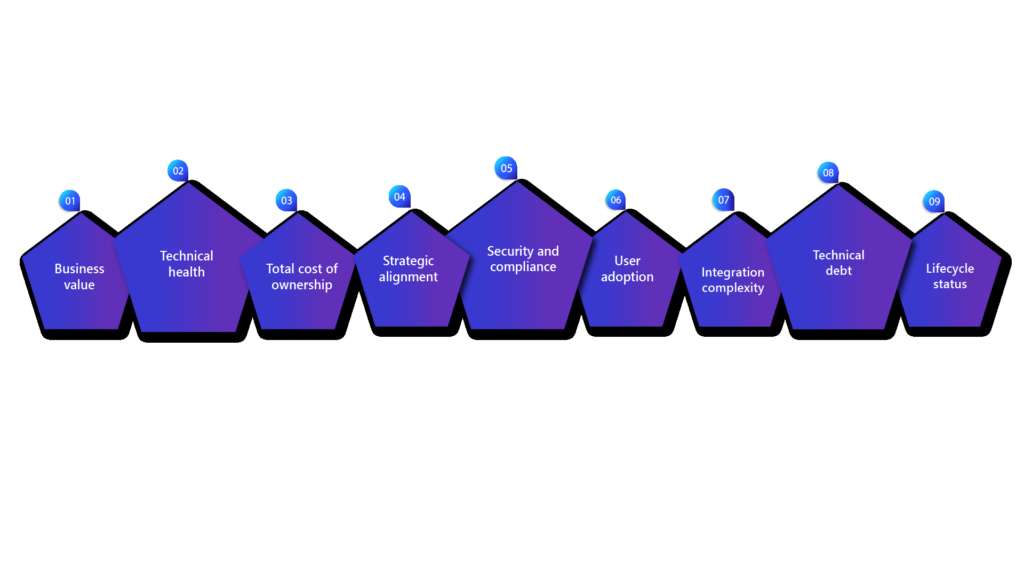
The important word is portfolio. An application should not be evaluated in isolation.
Consider an organization with three customer-service applications: Looking at App A alone could lead to the conclusion that its $1.5 million cost is too high. Looking at the portfolio tells a different story: App A may be strategically important, while Apps B and C could potentially be consolidated.
That is the power of portfolio thinking.
Why Enterprises Need an Application Portfolio Management Framework
Enterprise application environments are constantly changing. Applications are added through digital transformation programs, acquisitions, cloud migrations, SaaS adoption and departmental initiatives. Without a formal framework, the portfolio gradually becomes fragmented.
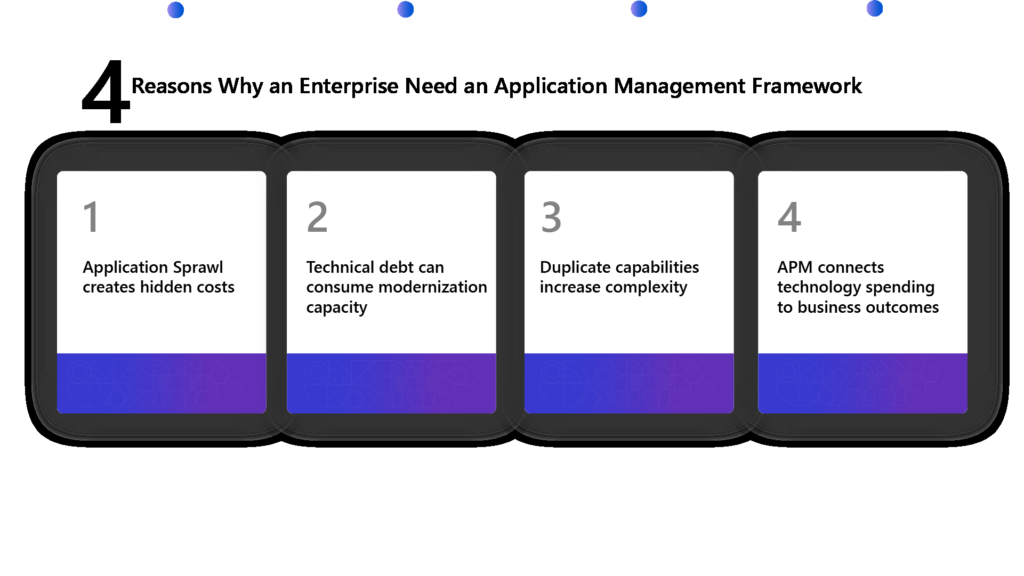
1. Application sprawl creates hidden costs
Organizations often know what they spend on individual applications but struggle to understand their aggregate application economics.
IBM’s application portfolio reporting capabilities, for example, emphasize analyzing total application spend, cost drivers, infrastructure costs, application usage and run-versus-development expenditure across the portfolio.
The question therefore becomes: Are we spending money because an application is strategically valuable or simply because nobody has decided to retire from it?
APM helps make that distinction visible.
2. Technical debt can consume modernization capacity
Technical debt is one of the strongest reasons to establish application-level visibility.
McKinsey’s research across 220 companies in five geographies and seven sectors found a significant relationship between technology-debt performance and business performance. It estimated technical debt at 20–40% of the technology estate’s value.
For an enterprise with a $500 million technology estate, that range would represent $100 million–$200 million in technology debt if the organization’s experience aligns with McKinsey’s estimate.
That illustrates why “we’ll modernize it later” can become an expensive strategy.
3. Duplicate capabilities increase complexity
Imagine five applications providing overlapping document management capabilities. Each may have:
- Separate licenses
- Separate vendors
- Separate support teams
- Separate integrations
- Separate security controls
- Separate upgrade cycles
APM helps identify these overlaps and determine whether consolidation makes sense.
4. APM connects technology spending to business outcomes
Instead of asking: “How much does this application cost?”
APM encourages leaders to ask: “What business capability does this application enable, what value does it create, and what is the cost of delivering that capability?”
That changes the conversation from IT cost management to technology value management.
Key Components of an Effective Application Portfolio Management Framework
A strong APM framework typically brings together six core dimensions.
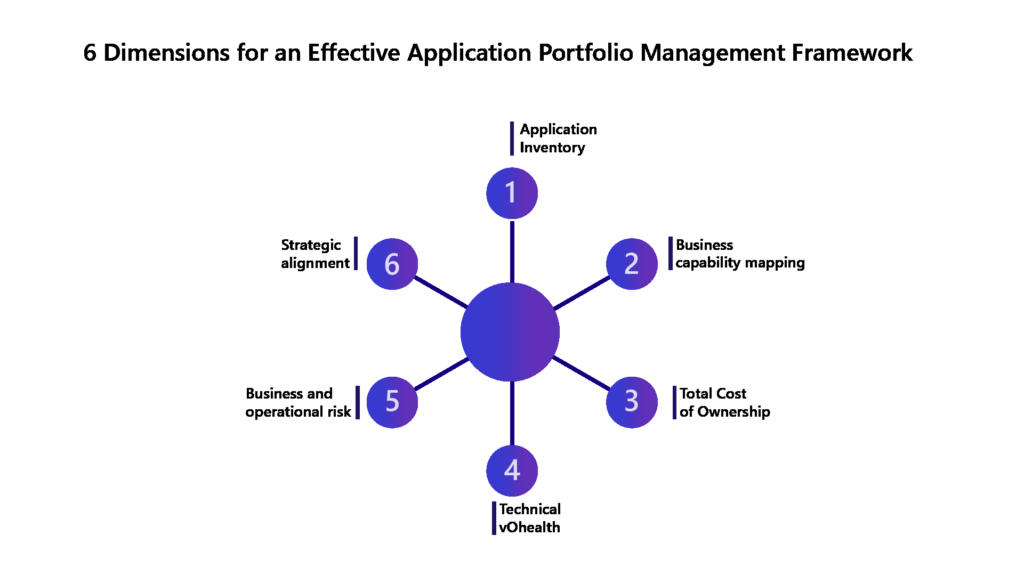
Each layer answers a different question and together they provide the intelligence needed to determine what happens to an application next.
1. Application inventory: Know What You Actually Have
The first challenge for many enterprises is surprisingly basic: Do we have a complete and accurate inventory of our applications?
In large organizations, the answer may be no. Applications can exist across data centers, public clouds, private clouds, SaaS environments, subsidiaries and individual business units. Some may be formally registered in a CMDB, while others may have been introduced independently by business teams.
An effective APM framework therefore starts with a centralized application inventory.
For every application, organizations should ideally capture:
- Application name
- Business owner
- IT owner
- Business capability
- Number of users
- Technology stack
- Hosting model
- Vendor
- Lifecycle stage
- Annual cost
- Integrations
- Criticality
- Security status
2. Business capability mapping: Understand Why Each Application Exists
Knowing that an enterprise has 800 applications tells leadership very little. Knowing that those 800 applications support 120 business capabilities, and that 15 applications perform essentially the same function – provides actionable insight.
This is where business capability mapping becomes important. Applications should be mapped to the business capabilities and processes they support.
For example:
Customer onboarding → CRM → Identity verification → Compliance screening → Document management → Customer servicing
Now consider an enterprise where three different applications support customer onboarding across different regions.
The organization may discover that:
- Application A supports North America
- Application B supports Europe
- Application C supports Asia-Pacific
At first glance, all three may appear necessary. A capability-based analysis could reveal that they perform 70–80% of the same functions, with regional differences accounting for the remaining functionality.
That creates a much more meaningful question: Should the organization continue funding three platforms or create a common capability with regional extensions?
This is the type of insight APM should generate.
3. Total Cost of Ownership: Look Beyond License Fee
The cost of an application can include License + Infrastructure + Cloud consumption + Development + Maintenance + Support + Security + Integration + Data management + Vendor management
For example, an application may have a $300,000 annual license but require another $700,000 in infrastructure, support and maintenance. Its real annual TCO is therefore closer to $1 million, not $300,000.
This distinction becomes particularly important when comparing applications that deliver similar capabilities.
Consider:
| Application A | Application B | |
|---|---|---|
| License | $300K | $450K |
| Infrastructure | $250K | $100K |
| Support | $300K | $150K |
| Integration | $100K | $50K |
| Security & compliance | $50K | $50K |
| Estimated TCO | $1M | $800K |
Looking only at licensing would make Application A appear cheaper. Looking at TCO changes the picture.
APM therefore allows organizations to shift from license management to technology economics.

“Every application consumes more than a license fee. It consumes infrastructure, talent, support, integrations and management attention. A mature APM strategy makes those hidden costs visible. That visibility is what allows technology leaders to invest with greater precision.”
Amith BalaChandran Nair,
Sr. Architect, Everforth Quinnox
4. Technical health: Identify the Applications Creating Future Risks
An application can deliver significant business value while simultaneously becoming a technical liability. That is why business value and technical health need to be evaluated separately.
Technical health can include:
- Architecture
- Scalability
- Maintainability
- Performance
- Technology currency
- Vendor support
- Security vulnerabilities
- Technical debt
- Integration complexity
Consider a claims-processing platform that has been running for 15 years. It may be highly valuable because thousands of employees depend on it and it supports a mission-critical business process.
But if it relies on outdated technology, requires specialist developers and is increasingly difficult to integrate with modern systems, the organization has a problem.
The right question isn’t “Should we retire it?”
It is: “How do we preserve the business capability while reducing the technical risk?”
The answer could involve replatforming, refactoring, replacing or gradually migrating the application. This is where APM connects directly with modernization strategy.
5. Business and operational risk: Measure What the Application Contributes
Technical metrics alone cannot determine an application’s future. A technically outdated application may still be supporting one of the organization’s most important revenue-generating processes.
Business value can therefore be assessed using factors such as:
- Business criticality
- Data sensitivity
- Regulatory requirements
- Security exposure
- Recovery requirements
- Vendor dependency
- Availability requirements
6. Strategic alignment: Is the Application Fit for the Future?
An application can be valuable today and still be poorly aligned with tomorrow’s technology strategy. This is increasingly important as enterprises move toward:
- Cloud-first architectures
- API-led integration
- Data modernization
- Generative AI
- Agentic AI
- Composable applications
- Platform engineering
- Automation
Strategic alignment asks: Does this application support the architecture and capabilities the organization is trying to build?
For example, an application that cannot expose APIs, scale effectively or integrate with modern data platforms may become increasingly difficult to incorporate into an AI-enabled enterprise architecture.
That does not automatically mean it must be replaced. But it does mean its future fit needs to be considered.
Application Portfolio Management Framework: A Step-by-Step Approach
A practical APM program can be structured into 7 steps.
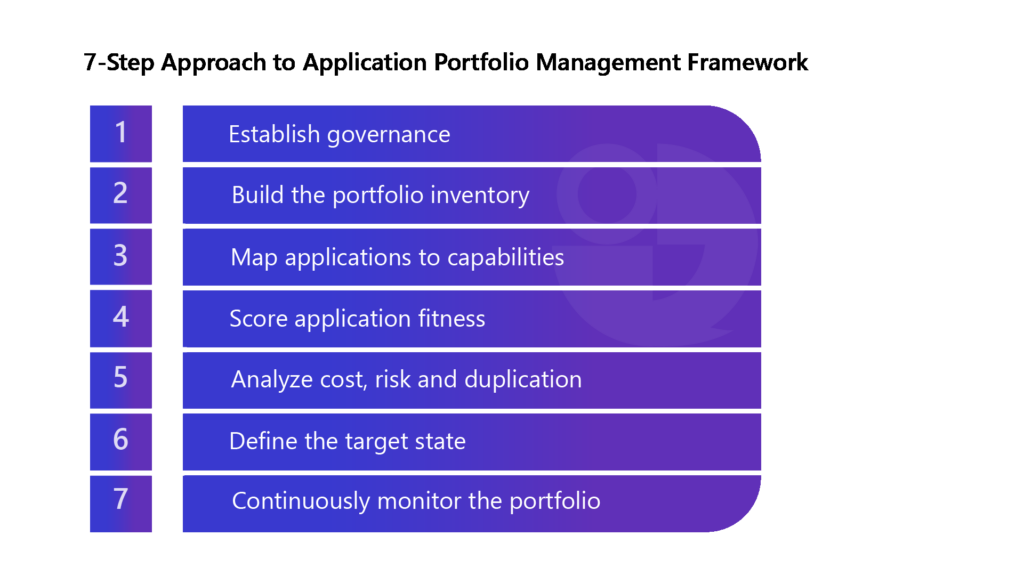
Step 1: Establish governance
Create a cross-functional governance team involving:
- CIO/CTO
- Enterprise architecture
- Application owners
- Business leaders
- Finance
- Cybersecurity
- Risk and compliance
Application decisions affect both technology and business operations, so governance cannot sit entirely within IT.
Step 2: Build the portfolio inventory
Create a single source of truth. Bring together information from:
- CMDB
- IT asset-management platforms
- Procurement
- Finance
- Cloud environments
- Architecture repositories
- Application owners
Step 3: Map applications to capabilities
Identify exactly what each application does and which business processes depend on it.
Step 4: Score application fitness
Evaluate each application using standardized criteria.
Step 5: Analyze cost, risk and duplication
Look for:
- High-cost/low-value applications
- Redundant applications
- Unsupported technology
- High-risk systems
- Low adoption
- Excessive integration complexity
Step 6: Define the target state
Determine whether applications should be:
Invested in → Modernized → Migrated → Consolidated → Retired
Step 7: Continuously monitor the portfolio
APM should not become a once-a-year spreadsheet exercise. Application portfolios change continuously.
How to Assess and Score Applications in Your Portfolio
A scoring framework turns subjective application discussions into more consistent decisions. A practical can use five dimensions, each scored from 1 to 5:
| Dimension | Weight |
|---|---|
| Business Value | 30% |
| Technical Health | 20% |
| Strategic Alignment | 20% |
| Cost Efficiency | 15% |
| Risk and Compliance | 15% |
For Example:
Suppose an application receives:
- Business Value = 5/5
- Technical Health = 2/5
- Strategic Alignment = 5/5
- Cost Efficiency = 2/5
- Risk = 2/5
Its weighted score would be:
(5 × 30%) + (2 × 20%) + (5 × 20%) + (2 × 15%) + (2 × 15%) = 3.5/5
But here’s the important part:
A score is not a decision. An application scoring 3.5/5 could represent a strategically important application with severe technical debt.
The appropriate response might therefore be modernization, not retirement. This is why portfolio scoring should combine quantitative scoring with business context.
How to Use the TIME Model for Application Portfolio Decisions
Once applications have been assessed, organizations need a mechanism to translate assessment into action. One widely used approach is the TIME model:
T — Tolerate
The application remains operational because its business value justifies keeping it, even if it is not strategically important to modernize immediately.
Typical action: Maintain and monitor.
I — Invest
The application is strategically important and has sufficient fitness to justify additional investment.
Typical action: Enhance, scale and innovate.
M — Migrate
The application has business value, but its technology, architecture or operating model creates constraints.
Typical action: Replatform, refactor, replace or move.
E — Eliminate
The application has limited value, duplicates another capability or creates disproportionate cost and risk.
Typical action: Retire and transition users/data.
The TIME model becomes especially useful when combined with the earlier scoring framework.
For example:
High business value + low technical health = Migrate/Modernize
High business value + high technical health = Invest
Low business value + high duplication = Eliminate
Moderate value + acceptable health = Tolerate
The goal is not to eliminate as many applications as possible. The goal is to align the portfolio with business priorities.
How Application Portfolio Management Supports Application Rationalization
Application rationalization is where APM can produce measurable business impact. The objective is to identify which applications should remain, consolidate, modernize, migrate or retire.
A real-world example demonstrates the potential.
In a case study involving a U.S. financial-services organization, Birlasoft assessed 400 business-process activities as part of an application rationalization initiative.
The analysis identified:
- 36% recommended reduction in the application portfolio
- 16% potential cost reduction
- 34% reduction in legacy application code
- 100% visibility into the corporate-action portfolio
The important lesson is that rationalization was not simply “delete old applications.” The organization assessed business processes and the technology supporting them to determine where the portfolio could be simplified.
How AI Is Transforming Application Portfolio Management
Traditional APM relies heavily on manual data collection. AI introduces the possibility of making portfolio management much more dynamic.
1. AI can accelerate application discovery
AI can analyze data from application repositories, infrastructure, codebases, cloud environments and other sources to identify technology assets and relationships.
2. AI can identify hidden dependencies
One of the biggest risks in application retirement is discovering dependencies too late.
AI-assisted analysis can help identify relationships between:
Applications → APIs → Databases → Infrastructure → Business Processes
This can make impact analysis more comprehensive.
3. AI can identify technical-debt hotspots
AI can analyze code, incidents, architecture patterns and technology versions to identify applications that may require disproportionate maintenance.
That matters when technical debt already represents a potentially significant share of enterprise technology value.
4. AI can improve application rationalization
Imagine asking: “Which applications could we retire without disrupting critical business capabilities?”
An AI-enabled APM platform could potentially analyze:
- Usage
- Business criticality
- Dependencies
- Cost
- Data
- Integrations
- Contracts
- Technology health
and surface candidate applications for further assessment.
The final decision should still involve accountable business and technology owners – but AI can dramatically accelerate the analysis.
5. AI can support modernization prioritization
AI can help organizations identify applications where modernization could have the greatest potential impact.
For example: This transforms APM from a static inventory into a decision-support mechanism.
The APM Metrics Every CIO Should Track
A mature APM program should measure more than just the application count. These 10 metrics provide a clearer view of portfolio health, cost, risk and strategic alignment.
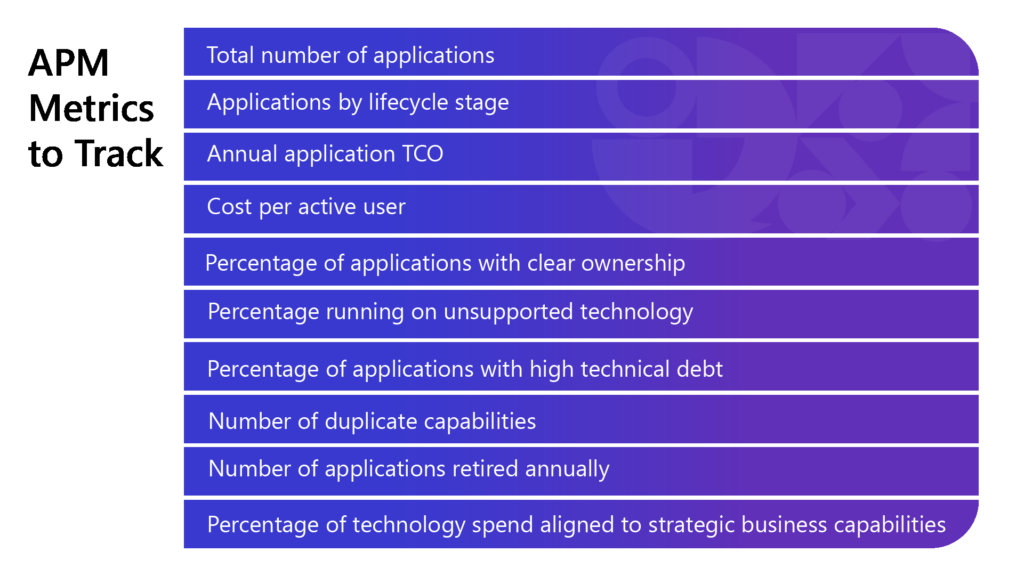
1.Total Application Count: Tracks the size of the application landscape and helps identify whether application sprawl is increasing or declining.
2.Application TCO: Measures the complete cost of running an application, including licensing, infrastructure, support, maintenance, security and integration.
3.Cost per Active User: Compares application spending with actual adoption to identify systems that may be disproportionately expensive to operate.
4.Business Value Score: Measures how strongly an application contributes to revenue, productivity, customer experience or critical business capabilities.
5.Technical Health Score: Evaluates architecture, maintainability, scalability, technology currency, performance and technical debt.
6.Technical Debt Exposure: Identifies applications carrying significant modernization requirements or outdated technology that could constrain future transformation.
7.Application Redundancy Rate: Highlights overlapping applications that provide similar business capabilities and may create opportunities for consolidation.
8.Unsupported Technology Percentage: Tracks applications running on outdated or unsupported technologies that may increase security, compliance and operational risks.
9.Application Retirement Rate: Measures the pace at which redundant, obsolete or low-value applications are successfully decommissioned.
10.Strategic Alignment: Measures how closely application investments support the organization’s current and future business and technology priorities.
The real value comes from looking at these metrics together. A high-cost application isn’t necessarily a problem if it delivers high strategic value, while a low-cost application may still be a rationalization candidate if it is redundant, risky or underutilized.
Conclusion: From Application Inventory to Strategic Advantage
Enterprise application portfolios don’t become complex overnight. They grow one system, one acquisition, one SaaS platform and one integration at a time – until organizations are left managing hundreds or even thousands of applications without a clear view of what each one costs, contributes or puts at risk.
Application Portfolio Management brings that complexity into focus. But APM should not be reduced to cost-cutting exercises. The real objective is to build an application landscape that is leaner, healthier, strategically aligned, and ready for what’s next.
For enterprises navigating legacy modernization, cloud transformation, and AI adoption, that requires more than an application of inventory. It requires the ability to continuously assess business value, technical health, cost, risk, dependencies, and modernization potential.
This is where Everforth Quinnox can help. By bringing together application assessment, rationalization, modernization, cloud transformation, integration and AI-powered intelligent application management platform, Everforth Quinnox helps enterprises move from understanding their application landscape to actively transforming it.
Because the question isn’t simply: “How many applications do we have?”
It is: “Which applications are creating value, which are holding us back and what should we do about them?”
The enterprises that can answer that question with data, clarity and speed will be better positioned to turn application complexity from a technology burden into a foundation for continuous modernization and business growth.

Lead, Marketing, Everforth Quinnox
Frequently Asked Questions About Application Portfolio Management
APM helps enterprises identify application sprawl, reduce duplication, manage technical debt, optimize technology spending and prioritize modernization initiatives.
Key components include application inventory, business capability mapping, TCO analysis, technical-health assessment, business-value assessment, risk analysis, dependency mapping and lifecycle management.
TIME stands for Tolerate, Invest, Migrate and Eliminate and provides a structured approach for determining the appropriate direction for applications based on their business and technical fitness.
APM identifies applications with outdated technology, complex architecture and high maintenance requirements, allowing organizations to prioritize modernization based on business impact and risk.
APM should be treated as an ongoing governance process, with regular reviews to account for changes in business priorities, application usage, technology health, costs and risks.
No. A legacy application may still support a critical business capability. Organizations should evaluate its business value, technical health, cost, risk and modernization options before deciding its future.