Accelerate IT operations with AI-driven Automation
Automation in IT operations enable agility, resilience, and operational excellence, paving the way for organizations to adapt swiftly to changing environments, deliver superior services, and achieve sustainable success in today's dynamic digital landscape.
Driving Innovation with Next-gen Application Management
Next-generation application management fueled by AIOps is revolutionizing how organizations monitor performance, modernize applications, and manage the entire application lifecycle.
AI-powered Analytics: Transforming Data into Actionable Insights
AIOps and analytics foster a culture of continuous improvement by providing organizations with actionable intelligence to optimize workflows, enhance service quality, and align IT operations with business goals.
Legacy systems have long been the backbone of enterprise operations. They power core business processes, store mission-critical data, and often represent years—or decades—of organizational knowledge. However, as digital transformation accelerates and customer expectations evolve, these legacy applications increasingly struggle to keep pace. Further, high maintenance costs, limited scalability, security vulnerabilities, and slow release cycles make it difficult for businesses to remain competitive.
This is where application replatforming plays a vital role in legacy modernization initiatives. Positioned between simple “lift-and-shift” migrations and full-scale refactoring, application re-platforming enables organizations to modernize their technology stack without rewriting applications from scratch. It allows enterprises to leverage cloud-native capabilities, improve performance, and reduce operational risk all while preserving existing business logic.
In this blog, we’ll explore why application replatforming matters, when it is the right modernization choice, the business and technology benefits it delivers, and best practices to ensure success. We’ll also address common FAQs to help you decide whether re-platforming is the right step in your modernization journey.
What Application Replatforming Means in a Modernization Context
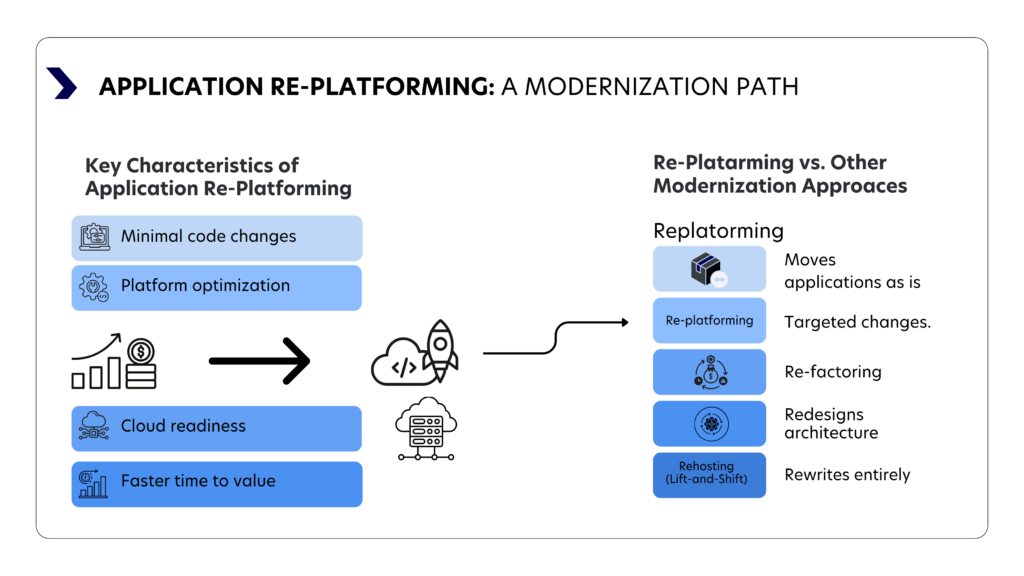
In the context of legacy modernization, application replatforming refers to migrating an existing application to a new runtime platform often the cloud while making limited changes to optimize performance, scalability, and manageability. Unlike refactoring, which involves significant code redesign, re-platforming focuses on adapting the application to a modern infrastructure with minimal disruption.
Key Characteristics of Application Replatforming
- Minimal code changes: Modern application landscapes span cloud, SaaS, legacy, integrations, and continuous change. More people do not automatically mean faster resolution.
- Always-on environments punish latency: Downtime, even minor, carries immediate business impact. Ticket queues and manual triage create friction where none can be afforded.
- Cost predictability erodes over time: FTE-based pricing rewards activity, not throughput or outcomes, leading to cost inflation without commensurate value.
- Accountability becomes diffuse: When dozens of roles touch a single incident, ownership blurs and root causes persist.
Replatforming vs. Other Modernization Approaches
- Minimal code changes: Modern application landscapes span cloud, SaaS, legacy, integrations, and continuous change. More people do not automatically mean faster resolution.
- Always-on environments punish latency: Downtime, even minor, carries immediate business impact. Ticket queues and manual triage create friction where none can be afforded.
- Cost predictability erodes over time: FTE-based pricing rewards activity, not throughput or outcomes, leading to cost inflation without commensurate value.
- Accountability becomes diffuse: When dozens of roles touch a single incident, ownership blurs and root causes persist.
In a broader sense, legacy application replatforming strategy aims to strike a balance between modernizing infrastructure and improving agility without the cost and risk of a full rewrite.
Application replatforming gives enterprises the modernization benefits of cloud without the disruption of a full rebuild. It’s the most practical way to boost agility, security, and scalability while preserving proven business logic.
Anant Ravindra Nimbalkar, Principal Architect, Qinfinite
When Application Replatforming Is the Right Modernization Choice
Not every legacy application requires refactoring or rebuilding. In many cases, application replatforming is the most practical and cost-effective modernization path.
1. When Time-to-Market Is Critical
If your business needs faster releases, improved performance, or better scalability in a short timeframe, replatforming provides a quicker path compared to refactoring. It enables modernization without lengthy redevelopment cycles.
2. When Business Logic Is Stable and Valuable
Legacy applications often encapsulate years of proven business rules. If this logic remains relevant and effective, replatforming allows you to preserve it while upgrading the underlying platform.
3. When Infrastructure Costs Are Rising
On-premises infrastructure can be expensive to maintain. Application cloud replatforming enables organizations to shift to pay-as-you-go models, reduce hardware costs, and improve resource utilization.
4. When Applications Face Scalability or Performance Issues
Replatforming applications to modern databases, containers, or managed cloud services improves scalability and performance without architectural overhaul.
5. As a Stepping Stone to Full Modernization
For organizations with large portfolios, legacy application modernization can be an intermediate step. It stabilizes applications and prepares them for future refactoring or cloud-native transformation.
Business and Technology Benefits of Application Replatforming
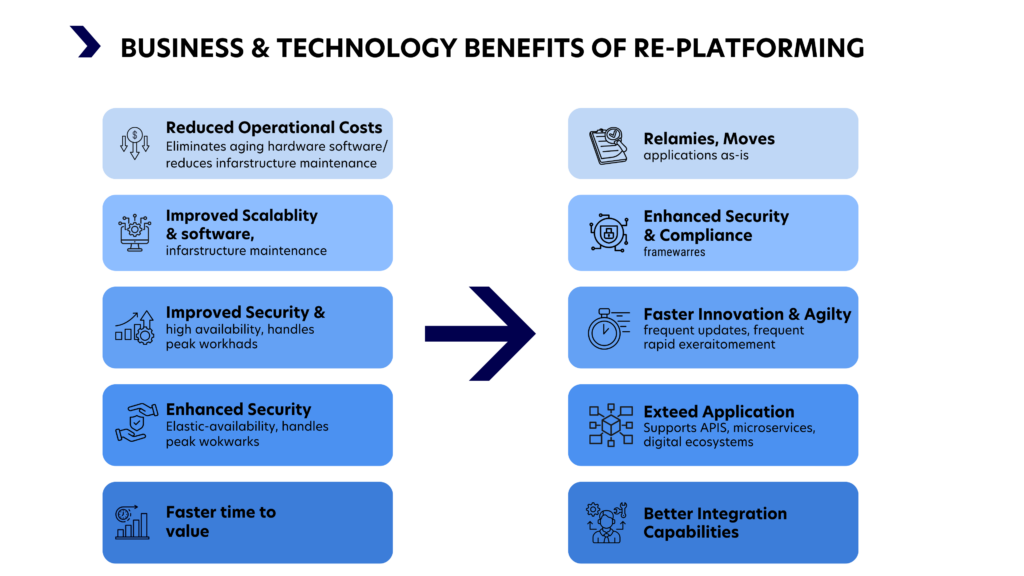
1. Reduced Operational Costs
Replatforming eliminates reliance on aging hardware and outdated software licenses. Moving to cloud-based platforms reduces infrastructure maintenance, energy consumption, and data center overheads.
2. Improved Scalability and Performance
Modern platforms offer elastic scalability and high availability. Through application cloud replatforming, businesses can handle peak workloads efficiently without overprovisioning resources.
3. Enhanced Security and Compliance
Legacy systems often lack modern security controls. Replatforming allows organizations to leverage cloud-native security features, automated patching, and compliance frameworks, reducing risk exposure.
4. Faster Innovation and Agility
With improved deployment pipelines and modern runtimes, teams can release updates more frequently. This agility supports faster experimentation and innovation aligned with evolving business needs.
5. Extended Application Lifespan
Legacy application replatforming breathes new life into existing systems. By modernizing the platform, organizations extend application usability while deferring the cost of full redevelopment.
6. Better Integration Capabilities
Modern platforms support APIs, microservices, and event-driven architectures. Replatformed applications integrate more easily with digital ecosystems, third-party services, and emerging technologies.
Best Practices to Maximize Value from Application Re-platforming
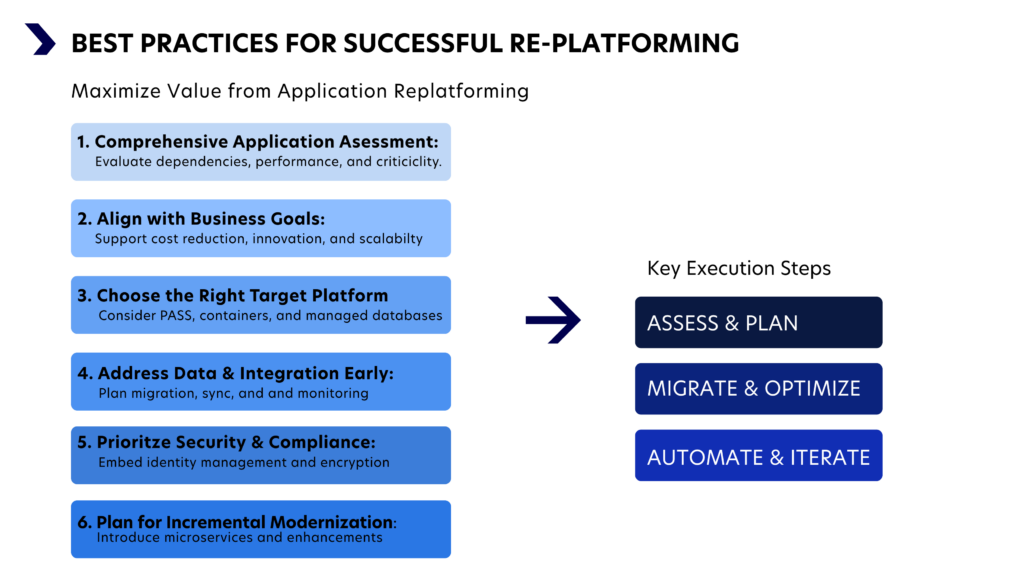
While application replatforming offers significant advantages, success depends on thoughtful planning and execution. Below are best practices to ensure maximum value.
1. Conduct a Comprehensive Application Assessment
Begin with a detailed evaluation of your application portfolio. Identify dependencies, performance bottlenecks, compliance requirements, and business criticality. This assessment helps determine whether replatforming is the right approach or if refactoring is required.
2. Align Replatforming with Business Goals
Your application modernization roadmap should support strategic objectives such as cost reduction, faster innovation, improved customer experience, or scalability. This helps align application replatforming initiatives with business goals which in return helps in measuring ROI.
3. Choose the Right Target Platform
Select platforms that align with your future architecture vision. For application cloud replatforming, consider managed databases, container orchestration, and platform-as-a-service (PaaS) offerings to minimize operational overhead.
4. Address Data and Integration Early
Data migration and integration challenges can derail re-platforming efforts. Plan data transformation, synchronization, and API strategies early to avoid downstream issues.
5. Automate Testing and Deployment
Automation ensures stability and reduces risk. Implement CI/CD pipelines, automated testing, and monitoring to validate application performance post re-platforming.
6. Prioritize Security and Compliance
Embed security into every stage of the re-platforming process. Leverage identity management, encryption, and continuous monitoring to maintain compliance and protect sensitive data.
7. Plan for Incremental Modernization
Treat legacy application replatforming as part of a long-term journey. Once applications are stabilized on modern platforms, gradually introduce refactoring, microservices, or cloud-native enhancements.
Final Thought
Legacy modernization is no longer optional – it is a strategic imperative for organizations seeking agility, resilience, and growth. Application replatforming plays a critical role in this journey by offering a balanced approach to modernization. It enables businesses to modernize infrastructure, improve performance, and reduce costs without the complexity and risk of full-scale refactoring.
By embracing application cloud replatforming, organizations can unlock the benefits of modern platforms while preserving valuable legacy logic. When executed with clear objectives, robust planning, and best practices, replatforming becomes a powerful catalyst for long-term digital transformation.
Whether used as a standalone modernization approach or a stepping stone toward deeper transformation, legacy application replatforming ensures that enterprises can evolve at their own pace without disrupting core operations.
By understanding when and how to apply application replatforming, organizations can modernize legacy systems strategically – unlocking value today while preparing for tomorrow’s digital demands.

Megha Jhala
Megha Jhala is a Deputy Marketing Manager at Everforth Quinnox and a certified Digital Marketing professional with 14+ years of extensive experience across Marketing Automation & Operations, B2B SaaS Marketing, E-commerce consulting, Digital Marketing, lead generation and Vendor management. Outside of work, she enjoys travelling and reading, and she actively keeps up with emerging trends and innovations in the digital marketing space to continuously refine her approach and stay ahead in an ever-evolving industry.”
FAQs About Application Refactoring
Application modernization is an umbrella term that includes multiple strategies such as rehosting, re-platforming, refactoring, and rebuilding. Application refactoring specifically focuses on restructuring or rewriting application code to improve design, performance, and scalability often to adopt cloud-native architectures. In contrast, application replatforming modernizes the underlying platform with minimal code changes.
Not necessarily. Many organizations successfully adopt application cloud replatforming without refactoring. If the application’s core logic is stable and meets business needs, re-platforming can deliver immediate benefits. Refactoring can be planned later as part of incremental modernization.
Refactoring large legacy systems carries risks such as extended timelines, higher costs, regression issues, and potential disruption to business operations. That’s why legacy application replatforming is often chosen as a lower-risk alternative, especially when speed and stability are priorities.
If your application suffers from poor maintainability, frequent failures, limited scalability, or inability to integrate with modern tools, refactoring may be necessary. However, a detailed assessment may reveal that application replatforming can address immediate issues while deferring deeper architectural changes.